
Michigan DLLP Requirements: Hours, Exams & Step-by-Step Guide
Stop guessing if your categories match Michigan requirements. License Trail checks your direct, indirect, and supervision hours against DLLP requirements continuously and flags mismatches before you submit.
No credit card required · Free plan available
Quick Requirements Overview
- Eligibility (education): Doctoral degree in psychology/closely related field from a regionally accredited institution; program meets APA/CPA/PCSAS or ASPPB/National Register criteria
- Eligibility (internship): Completed qualifying doctoral internship (integrated in program or board-approved equivalent); submit Psychology Supervision Evaluation Form documenting internship hours
- Apply via MiPLUS + fee: Online application for “Psychologist – Doctoral Educational Limited”; $99.15
- Required docs/checks: Official doctoral transcripts sent directly to LARA; criminal background check; SSN/affidavit; English proficiency if required (foreign grads: NACES eval + TOEFL iBT ≥80 if non-English instruction)
- Training requirements: One-time human trafficking training; 2 hours implicit bias training within 5 years prior to issuance; good moral character documentation if applicable
- Practice purpose: Hold DLLP after doctorate/internship to accrue required postdoc supervision toward full LP licensure
- Postdoc experience rules (while DLLP): ≥2,000 clock hours supervised by a licensed psychologist, completed in ≤2 consecutive years, in an organized healthcare setting
- Supervision minimum: Individual supervision weekly, totaling ≥4 hours/month (in-person or real-time audiovisual) reviewing active work/records
License Details
Procedures
Michigan’s Doctoral Educational Limited Psychologist License (DLLP)
Michigan treats the Doctoral Educational Limited license (often abbreviated DLLP by training programs) as the bridge between completion of a doctoral degree and full, independent psychologist licensure. It is the credential you hold while you accrue your post‑doctoral supervised hours.
The Michigan Board of Psychology calls this license type a “psychologist – doctoral educational limited” license.(michigan.gov)
1. Where the DLLP fits in the Michigan licensing ladder
For a typical Michigan doctoral‑level psychologist, the progression is:
-
Doctoral Temporary Educational Limited License (TLLP)
- Held during the doctoral internship (the first large block of supervised experience).
-
Doctoral Educational Limited License (DLLP)
- Held after the doctorate is awarded and internship is completed.
- Used to complete required post‑doctoral supervised experience for full licensure.(psychologydegree411.com)
-
Full Psychologist License (LP)
- Granted after:
- Required doctoral education,
- Completed internship, and
- 1 year (2,000 clock hours) of postdoctoral experience under the educational limited license, plus
- Passing the EPPP.(law.cornell.edu)
- Granted after:
In practice, this path yields about 4,000 total supervised hours: roughly 2,000 internship hours + 2,000 postdoctoral hours. Michigan law and rules state those pieces separately (internship + “1 year of postdoctoral degree experience”), but multiple licensure guides summarize the total as 4,000 hours.(psychologydegree411.com)
2. Prerequisite education and internship hours before you can hold a DLLP
Before the Board will issue a Doctoral Educational Limited license, you must have:
-
A qualifying doctoral degree in psychology or a closely related field
Michigan Administrative Rule R 338.2543(b) requires a doctoral degree that:(law.cornell.edu)
- Comes from a regionally accredited college, university, or institution; and
- Is from a program that meets one of the recognized accreditation/designation standards (APA, CPA, PCSAS, or ASPPB/National Register criteria).
-
A qualifying internship integrated into the doctoral program (or a board‑approved post‑degree internship)
The Board requires proof of completion of an internship that was:
- “An integrated part of a doctoral degree program” that meets the educational standards above; or
- A “substantially equivalent postdoctoral internship” approved in advance by the Board, following standards “substantially equivalent to those required by the Association of Psychology Postdoctoral and Internship Centers (APPIC).”(law.cornell.edu)
The Board does not itself fix a specific internship‑hour number in rule, but by adopting APA/CPA/APPIC standards, it effectively requires a full‑time, formal doctoral internship. APPIC criteria, which the Board uses as the reference point for equivalency, require a structured internship of at least 1,500 hours, and most programs used for Michigan licensure provide approximately 2,000 hours of internship experience.(appic.org)
-
Documented internship hours
The official Doctoral Educational Limited Licensing Guide from LARA requires you to:
“Submit the Supervision Evaluation Form to show proof of supervised hours completed for the Internship.” (michigan.gov)
That Supervision Evaluation Form, completed by your internship supervisor(s), is how the Board verifies you have the doctoral‑level internship experience needed before it will issue the DLLP.
3. Official Board requirements to obtain the DLLP
The Michigan Department of Licensing and Regulatory Affairs (LARA) summarizes the requirements in its “Psychologist – Doctoral Educational Limited Licensing Guide” (Revision 10/1/2023). Key items:
3.1. Application and fee
- Online application for “Psychologist – Doctoral Educational Limited License” via the MiPLUS system.(michigan.gov)
- Fee: “Doctoral Educational Limited – $99.15” (application + one‑year license fee).(michigan.gov)
3.2. General requirements for all applicants (except simple renewals)
The guide specifies:(michigan.gov)
- Criminal Background Check – instructions sent after the application is received.
- Good Moral Character – if you answer “yes” to any character questions, you must submit documentation showing that you can now serve the public “in a fair, honest and open manner,” or that you are rehabilitated, or that the prior offense is not reasonably related to the profession.
- Human Trafficking Training – one‑time training “in identifying victims of human trafficking that meets the standards in Administrative Rule 338.2525” completed before issuance.
- Social Security Number – or an SSN affidavit if you are legally exempt.
- English Language Proficiency – demonstrated either by English‑language education, 60+ college credits from an English‑speaking institution, or a passing score on a Board‑approved English proficiency exam.
- Implicit Bias Training – “completion of 2 hours of implicit bias training within the 5 years immediately preceding issuance of the license.”
3.3. Professional education and verification
To be licensed by examination as a psychologist – doctoral educational limited, you must:(michigan.gov)
- Provide the name of the school and program;
- Have final, official doctoral transcripts sent directly from the institution to the Bureau of Professional Licensing; and
- If your degree is from outside the U.S. or Canada, submit a NACES‑member credential evaluation, and, if the instruction was not in English, achieve an overall TOEFL iBT score of at least 80.
3.4. Proof of internship hours
As noted earlier, the LARA guide requires you to:(michigan.gov)
- Submit the Psychology Supervision Evaluation Form showing your supervised internship hours, sent directly to the Bureau.
Although the rules do not break internship time into categories such as “X hours direct service vs. Y hours assessment vs. Z hours supervision,” the internship must comply with APA/CPA/PCSAS/ASPPB–National Register/APPIC standards. That means, in practice, a mix of:
- Direct client contact (e.g., therapy, assessment, consultation),
- Regular didactic activities, and
- Scheduled individual supervision with licensed doctoral‑level psychologists.(appic.org)
4. The supervised hours you accrue while holding a DLLP
Once you hold the Doctoral Educational Limited license, you use it to complete the postdoctoral supervised experience that is required for full psychologist licensure.
4.1. Statutory and rule framework
For full licensure, Administrative Rule R 338.2543(d) requires:(law.cornell.edu)
- “1 year of postdoctoral degree experience in the practice of psychology” that meets the requirements of R 338.2553(3).
Rule R 338.2553 is the dedicated rule on educational limited licenses and postdoctoral experience. It states:(law.cornell.edu)
-
You must hold an educational limited license before starting the postdoctoral experience
“An individual shall obtain an educational limited license before engaging in the postdoctoral experience required under section 18223(1)(b) … and R 338.2543(d).”
-
Application prerequisites for the educational limited license (DLLP)
The rule requires an applicant to:
- “Provide the required fee and a completed application on a form provided by the department,” and
- “Provide proof … verifying the applicant satisfies the educational requirements under R 338.2543(b)” (i.e., the qualifying doctoral degree requirements discussed above).
-
Quantitative requirement for postdoctoral hours
The heart of the rule is subsection (3)(a):
- The postdoctoral experience “must consist of not less than 2,000 clock hours completed under the supervision of a licensed psychologist during a period of not more than 2 consecutive years.”
These are clock hours of actual work time in a qualifying setting (see below), all of which are supervised hours. The rule does not subdivide them into “direct service vs. indirect” categories; the key requirement is that you are practicing psychology under supervision, in a qualifying setting, for at least 2,000 clock hours.
-
Supervision structure during the 2,000 postdoctoral hours
Under R 338.2553(3)(b)–(c):(council.legislature.mi.gov)
- The supervisee (DLLP holder) “shall meet individually and in‑person or via 2‑way real‑time audiovisual technology … weekly for a minimum of 4 hours a month,” during which “all active work functions and records of the supervisee are reviewed.”
- The supervisee must “function as a psychologist using generally accepted applications of psychological knowledge and techniques acquired during the supervisee’s education and training.”
Although the rule does not give a numeric breakdown of clinical vs. administrative hours, this language makes clear that the substance of the 2,000 hours must be authentic psychological practice (assessment, intervention, consultation, etc.), not primarily clerical or non‑clinical tasks.
-
Setting requirement for the 2,000 postdoctoral hours
R 338.2553(3)(d) requires that the experience:(council.legislature.mi.gov)
- “Be acquired in an organized healthcare setting,” as that term is defined in R 338.2521(1)(j).
The definition of an “organized healthcare setting” in R 338.2521(1)(j) is:
“A clinic, hospital, institution, organization, organized governmental entity, nonprofit organization, or private agency engaged in the delivery of healthcare services that provides an opportunity for professional interaction and collaboration with other disciplines, an opportunity to utilize a variety of theories, and an opportunity to work with a broad range of populations and techniques.”
-
Flexibility in cases of hardship
In earlier and current rule texts, the Board allows alternative supervision arrangements in cases of “extreme hardship,” but any alternative must be approved by the Board before implementation. The rule specifies the information that must be submitted (hours completed, hours remaining, nature of hardship, attempts to secure standard supervision, qualifications of proposed supervisor, etc.).(ars.apps.lara.state.mi.us)
4.2. How those hours fit into the full licensure total
Putting these pieces together:
-
Internship:
- Completed during the doctoral program (or as a Board‑approved post‑degree internship).
- Must meet APA/CPA/PCSAS/ASPPB/APPIC‑aligned standards.
- In practice, ~2,000 supervised internship hours are expected for Michigan licensure, though the Board references accreditation and APPIC criteria rather than setting an explicit number in rule.(regulations.justia.com)
-
Postdoctoral experience under DLLP:
- Exactly specified by rule:
- “Not less than 2,000 clock hours”
- Under the supervision of a licensed psychologist
- Completed in no more than 2 consecutive years
- In an organized healthcare setting
- With at least 4 hours/month of individual supervision (in‑person or real‑time audiovisual).(law.cornell.edu)
- Exactly specified by rule:
-
Total experience for full psychologist license (LP):
- The internship plus the 1‑year postdoctoral experience yields about 4,000 supervised hours used toward full licensure, even though the Board describes them as two separate blocks rather than as a single 4,000‑hour number.(psychologydegree411.com)
Michigan law does not break those 2,000 postdoctoral hours down into “direct client contact vs. indirect service” with specific numeric minimums (for example, it does not say “1,500 direct hours and 500 indirect hours”). Instead, it focuses on:
- Total clock hours (≥ 2,000),
- The nature of the work (functioning as a psychologist using accepted techniques),
- The setting (organized healthcare setting), and
- The structure of supervision (licensed psychologist supervisor, minimum 4 hours/month).
5. Practical step‑by‑step summary to become licensed as a DLLP in Michigan
-
Complete an approved doctoral program in psychology (or closely related field)
- From a regionally accredited institution, and
- From a program that meets APA/CPA/PCSAS or ASPPB/National Register designation standards.(regulations.justia.com)
-
Complete a qualifying doctoral internship
- Integrated into your doctoral program or approved post‑degree internship.
- Must meet APA/CPA/PCSAS/APPIC‑equivalent standards.
- Document your hours and supervision so your internship director/supervisor can complete the Psychology Supervision Evaluation Form.(law.cornell.edu)
-
Apply for the Doctoral Educational Limited license (DLLP)
- File the online application in MiPLUS and pay the $99.15 fee.
- Arrange for official doctoral transcripts to be sent directly to LARA.
- Ensure your Supervision Evaluation Form documenting internship hours is sent to the Bureau.(michigan.gov)
-
Complete all general licensure prerequisites
- Criminal background check,
- Good moral character documentation (if applicable),
- One‑time human trafficking training,
- Social Security number or SSN affidavit,
- English proficiency (if required), and
- 2 hours of implicit bias training within 5 years prior to license issuance.(michigan.gov)
-
Hold the DLLP and begin accruing postdoctoral experience
- Work in an organized healthcare setting that meets the Board’s definition.(law.cornell.edu)
- Accumulate ≥ 2,000 clock hours of supervised psychological practice over no more than 2 consecutive years.
- Meet with your licensed psychologist supervisor weekly, totaling at least 4 hours of individual supervision per month, reviewing your active cases and work.(law.cornell.edu)
-
Renew the DLLP annually as needed
- The license is valid for 12 months and may be renewed up to 5 times; renewals require a fee (currently $38.55/year) and updated implicit‑bias and trafficking compliance, but do not add new hour requirements.(michigan.gov)
-
When postdoctoral hours are complete, apply for full psychologist licensure (LP)
- Submit proof of:
- Doctoral degree (already on file),
- Completed internship,
- 2,000 postdoctoral clock hours meeting R 338.2553,
- Passing EPPP score (≥ 500 for full licensure in Michigan).(law.cornell.edu)
- Submit proof of:
Key hour numbers, in plain language
-
Internship (pre‑doctoral)
- Governed by accreditation/APPIC standards; in practice, ~1,500–2,000 supervised internship hours, conducted under close supervision as part of your doctoral program.
-
Postdoctoral experience under DLLP
- Exactly specified in Michigan rule:
- 2,000 clock hours minimum,
- All under supervision of a licensed psychologist,
- Completed in ≤ 2 consecutive years,
- In an organized healthcare setting,
- With at least 4 hours per month of individual supervision reviewing your active work.
- Exactly specified in Michigan rule:
Michigan’s Board of Psychology does not slice these into separate minimums for “direct client” vs. “supervised” hours the way some other states do; instead, it requires that all 2,000 postdoctoral hours be supervised psychologist practice in an appropriate healthcare setting that reflects your doctoral training.
Track your DLLP hours with confidence
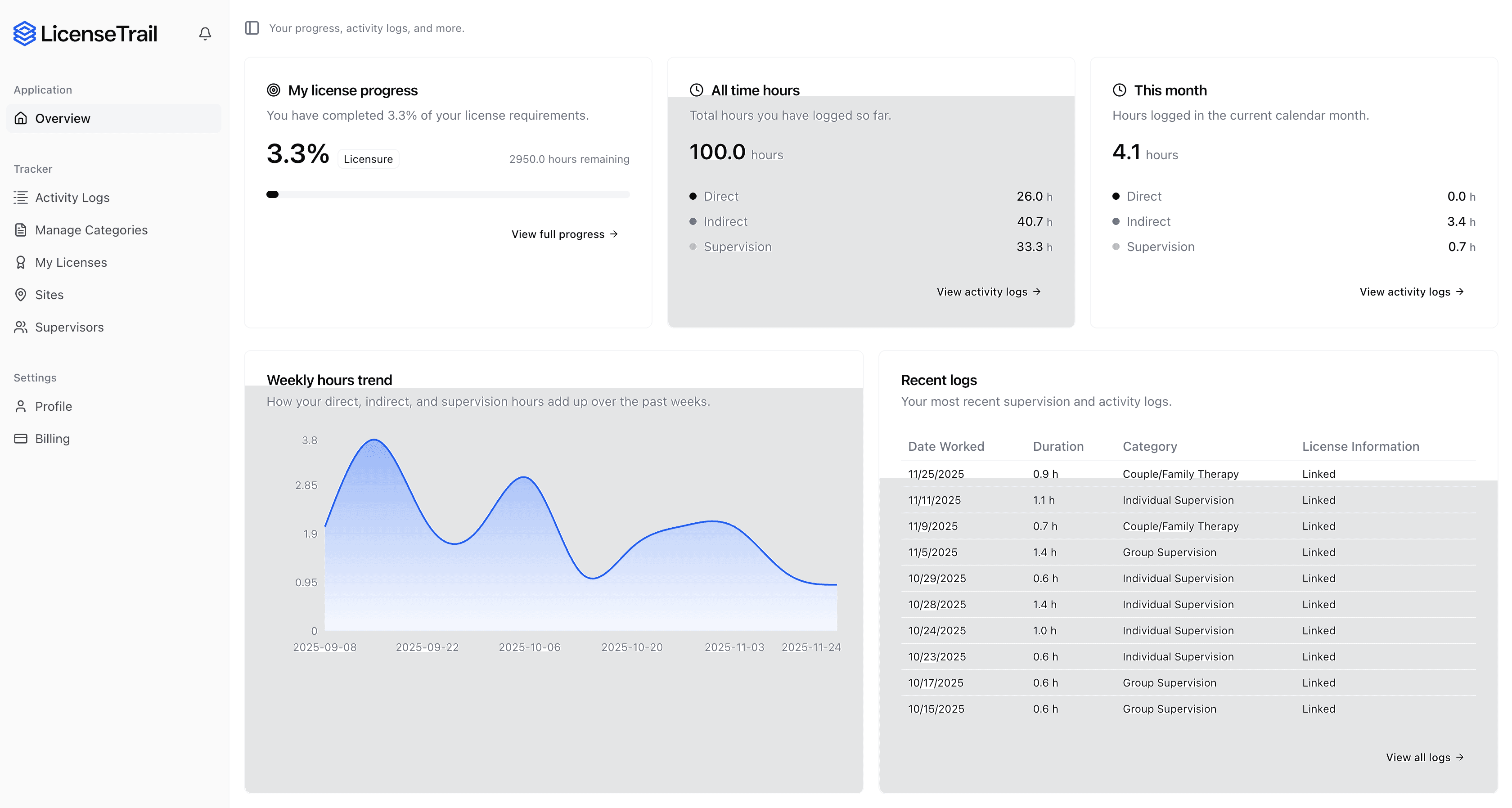
License Trail checks your direct, indirect, and supervision hours against Michigan DLLP requirements continuously and flags mismatches before you submit.
 Start Tracking for Free
No credit card required · Free plan available
Related Licenses
Is your spreadsheet hiding Michigan DLLP risks?
Stop guessing if your categories match Michigan Board of Psychology requirements. License Trail checks your direct, indirect, and supervision hours continuously and flags mismatches before you submit.
Import or log
Bring your spreadsheet or start fresh
Upload your existing tracking spreadsheet and we'll map every hour into the right Michigan Board of Psychology categories automatically.
Verify against Michigan
Catch mismatches before the board does
License Trail checks your direct, indirect, and supervision hours against Michigan DLLP requirements continuously.
Export board-ready
One-click clean reports
Generate professional, board-ready reports for supervision meetings and Michigan Board of Psychology submissions in seconds.
No credit card required · Free plan available