
Michigan D-TLLP Requirements: Hours, Exams & Step-by-Step Guide
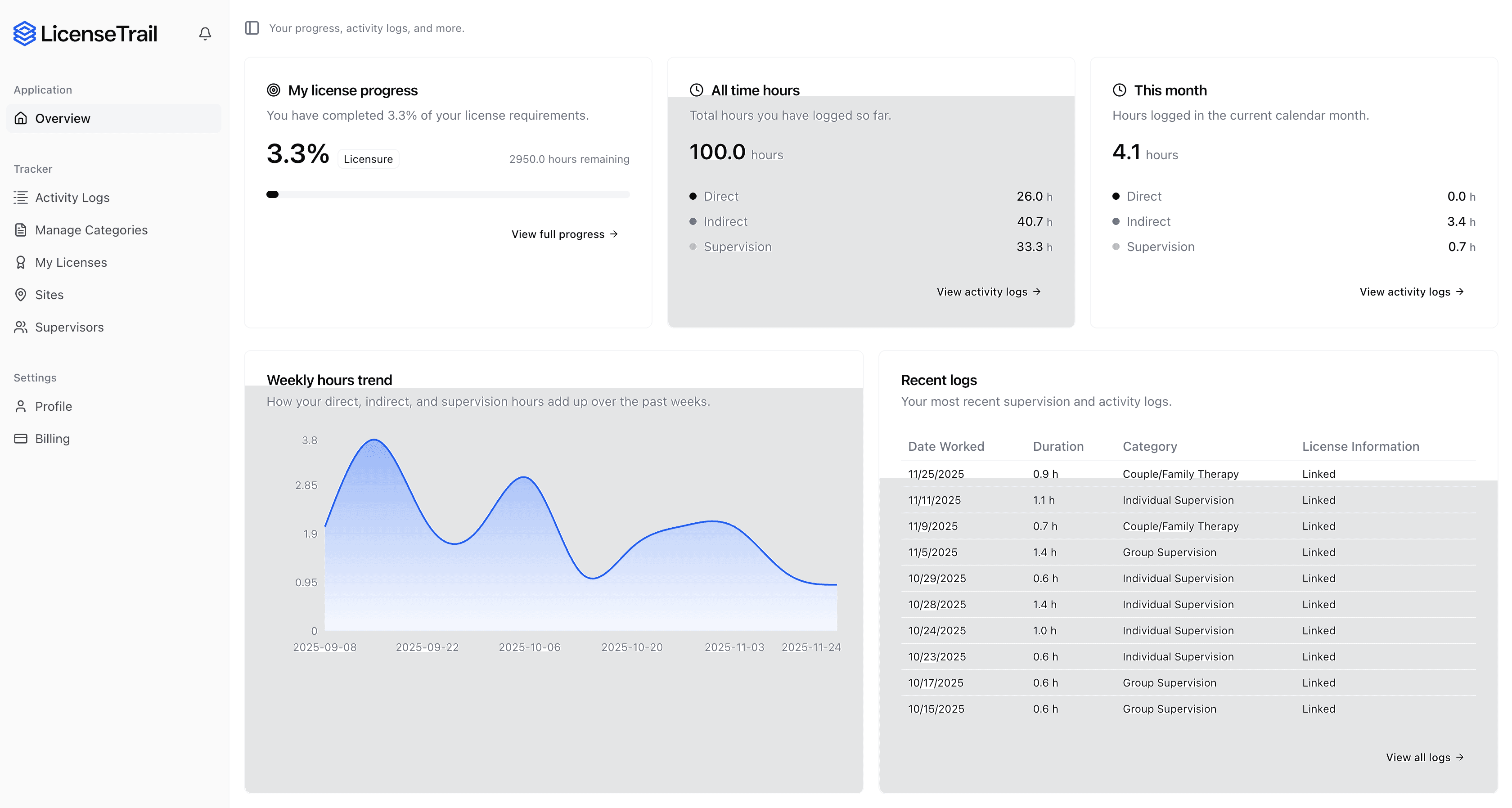
Stop guessing if your categories match Michigan requirements. License Trail checks your direct, indirect, and supervision hours against D-TLLP requirements continuously and flags mismatches before you submit.
No credit card required · Free plan available
Quick Requirements Overview
- Regulator: MI Board of Psychology (LARA); apply via MiPLUS
- Purpose/Scope: Allows practice under supervision to complete pre‑doctoral internship hours; not independent practice
- Eligibility: Must be enrolled in a qualifying doctoral psychology program at a regionally accredited institution meeting MI program standards (e.g., APA/CPA/PCSAS/ASPPB-NR designated/equivalent)
- Application basics: Application + fee; school verification of doctoral enrollment; standard MI health-profession items (background check/good moral character, SSN/docs, required trainings such as human trafficking & implicit bias)
- Supervised training expectations: Internship typically ~2,000 hours in an organized healthcare setting under a licensed psychologist
- Supervision structure (rule-based): Weekly individual supervision, in-person or live 2‑way video; ≥4 hours/month; supervisor reviews active work/records
- Term/Renewals: 24‑month license; renewable up to 3 additional terms; max 8 years
- Exam note: D‑TLLP does not confer EPPP eligibility (EPPP tied to DLLP/full licensure pathway)
License Details
Procedures
Michigan regulates psychologist licensure through the Board of Psychology within the Department of Licensing and Regulatory Affairs (LARA). The Psychologist – Doctoral Temporary Educational Limited license (commonly called the “D‑TLLP” or “Doctoral TLLP”) is the credential doctoral students use to complete their pre‑doctoral internship hours in Michigan.
This article walks through:
- What the D‑TLLP is and where it fits in the licensure ladder
- Who qualifies for a D‑TLLP
- How to apply
- How supervised hours actually work (pre‑doctoral internship and postdoctoral experience), using the Board’s own terminology
1. Where the D‑TLLP fits in Michigan’s licensure ladder
Michigan has several psychology license types; at the doctoral level the key sequence is:
-
Psychologist – Doctoral Temporary Educational Limited License (D‑TLLP)
- Held while you are still enrolled in a qualifying doctoral program.
- Used to complete the doctoral internship hours that will later be credited toward licensure. (michigan.gov)
-
Psychologist – Doctoral Educational Limited License (DLLP)
- Held after the doctorate is completed to accrue the postdoctoral supervised experience hours. (law.cornell.edu)
-
Psychologist (full, independent license)
- Granted after the doctoral degree, internship, 2,000 postdoctoral hours, and passing the EPPP at the doctoral cut score. (law.cornell.edu)
The Board is explicit that the doctoral temporary educational limited license is “specifically for obtaining internship hours required for the doctoral educational limited license” and does not make you eligible to take the EPPP. (michigan.gov)
2. What the D‑TLLP allows you to do
With a D‑TLLP you may:
- Engage in the practice of psychology under supervision while you complete your pre‑doctoral internship in Michigan. (law.cornell.edu)
- Work only within the scope of your training and under the authority of your supervisors; you are not independently licensed.
The credential is treated in law as a form of “temporary limited license” issued under the Board of Psychology’s General Rules (Rule 69; Mich. Admin. Code R 338.2569). (law.cornell.edu)
3. License duration and renewal limits
State materials summarizing the D‑TLLP describe its duration this way:
- Initial term: 24 months (2 years)
- Renewals: May be renewed three additional 24‑month terms
- Maximum time under a D‑TLLP: 8 years total
The Board’s fee schedule lists “Psychologist‑Doctoral Temporary Limited” as a 2‑year license with an 8‑year maximum, consistent with that description. (michigan.gov)
4. Eligibility requirements for a D‑TLLP
Under Rule 69 of the General Rules, a temporary limited license (which includes the D‑TLLP) must be granted to an applicant who meets either:
- Post‑master’s criteria (for the master’s‑level TLLP), or
- Is “enrolled in a doctoral degree program” that meets specific standards. (law.cornell.edu)
For the doctoral track (the D‑TLLP pathway), the program must:
- Be offered by a regionally accredited college, university, or institution that meets the Board’s standards in Rule 29 (R 338.2529). (law.cornell.edu)
- Be a designated or accredited psychology program that meets one of the standards in Rule 41 (R 338.2541), which refers to APA, CPA, PCSAS, or ASPPB/National Register‑designated programs. (law.cornell.edu)
In practice, this means:
- Your doctoral program in psychology (PhD or PsyD) must be in an institution and program recognized under the Board’s rules (e.g., APA‑accredited or equivalent). (law.cornell.edu)
5. Application components
While the full D‑TLLP licensing guide PDF isn’t directly viewable here, Board rules and state‑level summaries make clear that you must provide at least:
-
Application and fee
- A completed application on a form provided by the Department, plus the required fee, under Rule 69(2)(a). (law.cornell.edu)
-
Proof of qualifying doctoral enrollment
- Verification that your doctoral program meets the Rule 29 and Rule 41 standards, typically via the “Certification of Enrollment in a Doctoral Degree Program for Psychology” sent directly by your institution. (michigan.gov)
-
General health‑profession prerequisites used for all Michigan psychology licenses, as summarized by LARA‑based resources:
- Criminal background check
- “Good moral character” attestation
- Social Security number (or equivalent documentation)
- Training in human trafficking and implicit bias recognized by the state
- English language proficiency, where applicable (psychology.org)
You apply online through the Michigan MiPLUS system via the Board of Psychology’s licensing page. (michigan.gov)
6. How supervised hours work with a D‑TLLP
6.1. Total hours needed for eventual licensure
For full psychologist licensure in Michigan, the Board expects:
- 4,000 total hours of psychology‑related training, generally divided as:
- 2,000 hours of pre‑doctoral internship, completed while enrolled in your doctoral program (this is the D‑TLLP phase), and
- 2,000 hours of postdoctoral supervised experience, completed under the Doctoral Educational Limited License (DLLP). (psychologydegree411.com)
The postdoctoral 2,000 hours are explicitly codified in Rule 53: the postdoctoral experience “must consist of not less than 2,000 clock hours” under the supervision of a licensed psychologist in no more than two consecutive years. (law.cornell.edu)
The pre‑doctoral 2,000‑hour internship is not listed as a specific number in the rules, but:
- Rule 43 requires completion of an internship that is an “integrated part” of the doctoral program or a board‑approved postdoctoral internship that follows Association of Psychology Postdoctoral and Internship Centers (APPIC) criteria. (law.cornell.edu)
- Multiple Board‑focused licensure resources, including summaries keyed to the Michigan rules and out‑of‑state program equivalency checks, state plainly that Michigan requires 2,000 hours of pre‑doctoral internship plus 2,000 postdoctoral hours for psychologist licensure. (psychologydegree411.com)
So, in the Board’s framework, your hours break down as:
- 2,000 supervised “clock hours” of pre‑doctoral internship (D‑TLLP period)
- 2,000 supervised “clock hours” of postdoctoral experience (DLLP period)
Michigan does not divide these into categories like “1,500 direct client hours + 1,500 supervised hours.” All hours that count toward these totals are supervised professional practice hours; the direct‑versus‑indirect distribution is governed primarily by your doctoral program and internship site (often following APA/APPIC norms), not by a Michigan‑specific numeric split.
6.2. What counts as acceptable hours (Board terminology)
Although the internship details are largely set by your program, the Board uses the same foundational concepts for supervised experience—whether post‑master’s or postdoctoral—that inform what internship hours look like.
Key defined terms and requirements include:
- “Clock hours” and supervision requirement
For both post‑master’s TLLP experience and postdoctoral experience, the rules require “not less than 2,000 clock hours completed under the supervision of a licensed psychologist.” (law.cornell.edu)
Supervision must meet all of the following:
- The supervisee meets individually with the supervisor
- Meetings are in‑person or via 2‑way real‑time audiovisual that allows direct interaction by sight and sound
- Meetings occur weekly, for a minimum of 4 hours per month
- During these meetings, the supervisor reviews all active work functions and records of the supervisee (law.cornell.edu)
Internship sites that prepare you for Michigan licensure typically mimic or exceed this structure even during the pre‑doctoral (D‑TLLP) phase.
- “Organized healthcare setting”
Supervised experience must be acquired in what the rules call an “organized healthcare setting.” The Board defines this as a:
Clinic, hospital, institution, organization, organized governmental entity, nonprofit organization, or private agency engaged in the delivery of healthcare services that provides opportunities for professional interaction with other disciplines, use of a variety of theories, and work with a broad range of populations and techniques. (law.cornell.edu)
Doctoral internships under a D‑TLLP are normally located in such settings (e.g., hospital‑based programs, community mental health centers, university counseling centers, etc.).
- Nature of the work
In both post‑master’s and postdoctoral supervised experience, the rules specify that the supervisee must:
- **“Function as a psychologist” using generally accepted applications of psychological knowledge and techniques acquired during education and training. (law.cornell.edu)
Applied to internship, that means:
- Hours should involve bona fide psychological services—assessment, psychotherapy, consultation, treatment planning, etc.—not purely clerical or non‑clinical duties.
- The Board later verifies this through Psychology Supervision Evaluation forms that document your internship hours and activities. (michigan.gov)
- Minimum weekly engagement (practical expectations)
While the administrative rules themselves do not spell out an exact weekly minimum for pre‑doctoral internships, licensing resources keyed to Michigan law describe the Board’s expectations as:
-
Internship (pre‑doctoral / D‑TLLP phase):
- Typically 2,000 hours over one year,
- With at least 20 hours per week at a qualifying site to receive credit. (psychologydegree411.com)
-
Postdoctoral experience (DLLP phase):
- 2,000 hours completed in an organized healthcare setting within 24 months,
- At a rate of roughly 16–40 hours per week,
- With at least four hours of in‑person (or equivalent live audiovisual) supervision per month from a licensed psychologist, as required by Rule 53. (law.cornell.edu)
Again, the Board’s rules emphasize total clock hours, appropriate setting, and supervision structure rather than a formal “direct vs indirect” hour split.
7. EPPP eligibility and the D‑TLLP
The Board is explicit that holding a D‑TLLP alone does not qualify you to sit for the Examination for Professional Practice in Psychology (EPPP). To be eligible you must either:
- Hold (or have held) a doctoral educational limited license (DLLP), or
- Have applied for and met the requirements for full psychologist licensure. (michigan.gov)
The D‑TLLP is therefore strictly an internship‑phase credential, not an exam‑eligible license.
8. Key numbers and Board terms at a glance
- License name: Psychologist – Doctoral Temporary Educational Limited License (D‑TLLP / Doctoral TLLP) (michigan.gov)
- Purpose: To lawfully practice psychology under supervision in Michigan while completing your doctoral internship hours. (michigan.gov)
- Degree status: Must be enrolled in a qualifying doctoral program in psychology or closely related field meeting Board standards in R 338.2529 and R 338.2541. (law.cornell.edu)
- Total supervised experience for full licensure:
- ~2,000 pre‑doctoral internship hours (under D‑TLLP)
- 2,000 postdoctoral supervised hours (under DLLP), as codified in Rule 53(3)(a)
- All hours are supervised “clock hours” in acceptable settings; there is no Michigan requirement of “1,500 direct + 1,500 supervised” hours or similar split. (law.cornell.edu)
- Supervision structure (for Board‑defined supervised experience):
- At least 2,000 clock hours
- Under a licensed psychologist
- In an organized healthcare setting
- With weekly individual supervision, minimum 4 hours/month, reviewing all active work and records. (law.cornell.edu)
- License duration: 24 months; renewable up to three times; maximum 8 years. (michigan.gov)
- EPPP: D‑TLLP holders are not EPPP‑eligible. (michigan.gov)
In practical terms, becoming a D‑TLLP Psychologist in Michigan means: enrolling in a Board‑recognized doctoral program, obtaining the D‑TLLP so you can legally complete a roughly 2,000‑hour supervised internship in an organized healthcare setting, then moving on to the DLLP and your 2,000‑hour postdoctoral experience before applying for full licensure and the EPPP.
Track your D-TLLP hours with confidence
License Trail checks your direct, indirect, and supervision hours against Michigan D-TLLP requirements continuously and flags mismatches before you submit.
 Start Tracking for Free
No credit card required · Free plan available
Related Licenses
Is your spreadsheet hiding Michigan D-TLLP risks?
Stop guessing if your categories match Michigan Board of Psychology requirements. License Trail checks your direct, indirect, and supervision hours continuously and flags mismatches before you submit.
Import or log
Bring your spreadsheet or start fresh
Upload your existing tracking spreadsheet and we'll map every hour into the right Michigan Board of Psychology categories automatically.
Verify against Michigan
Catch mismatches before the board does
License Trail checks your direct, indirect, and supervision hours against Michigan D-TLLP requirements continuously.
Export board-ready
One-click clean reports
Generate professional, board-ready reports for supervision meetings and Michigan Board of Psychology submissions in seconds.
No credit card required · Free plan available