
Minnesota LAMFT Requirements: Hours, Exams & Step-by-Step Guide
Stop guessing if your categories match Minnesota requirements. License Trail checks your direct, indirect, and supervision hours against LAMFT requirements continuously and flags mismatches before you submit.
No credit card required · Free plan available
Quick Requirements Overview
- Age/ethics: Must be 18+ and agree to follow the Board Code of Ethics.
- Education: Master’s/doctoral in MFT (or equivalent related degree) meeting MN Rule 5300.0140 coursework requirements.
- Practicum (within degree): 300 hrs clinical client contact minimum, incl. 150 hrs with couples/families/relational groups; supervised by LMFT or AAMFT-approved supervisor.
- Exam: Must pass the AMFTRB National MFT Exam (Board authorizes exam after credential review).
- Application/fees: Submit LAMFT application + fee (currently $75 initial, $100 annual renewal, $50 late).
- Supervision: Practice only under a Board-approved MN LMFT supervisor while LAMFT.
- Term/renewal: License is 1 year, renewable annually up to 6 more years (max 7 years as LAMFT); no CE required for LAMFT renewal.
- Postdegree hours toward LMFT (typically while LAMFT): 4,000 hrs in 2–7 years, incl. 1,000 clinical client contact (500 relational) + 200 supervision (avg 1:5; 100 individual; up to 25% via live secure video; ≤ 2,800 hrs may be supervised by other qualifying professionals).
License Details
Procedures
In Minnesota, the Licensed Associate Marriage and Family Therapist (LAMFT) credential is the provisional license under which new graduates begin practicing and accrue the supervised hours needed for full LMFT licensure. The Minnesota Board of Marriage and Family Therapy governs this process through Minnesota Statutes chapter 148B and Minnesota Rules chapter 5300.
Below is a step‑by‑step guide focused on what the Board actually requires, including specific hour counts and the key terms it uses.
1. Understand what an LAMFT is in Minnesota
Minnesota rules define “LAMFT” as the initials designating a licensed associate marriage and family therapist who is licensed by the Board to practice in Minnesota.(revisor.mn.gov)
Rule 5300.0175 adds that a licensed associate marriage and family therapist:
- Has completed the Board’s educational requirements (Rule 5300.0140).
- Has passed the national MFT examination.
- Must practice under the supervision of a Board‑approved LMFT supervisor.
- Receives a license that is granted for one year, renewable annually for up to six additional years (maximum of seven years total in LAMFT status).(revisor.mn.gov)
The LAMFT license is therefore the status under which you complete your post‑graduate supervised experience toward LMFT.
2. Meet the education and practicum requirements
2.1. Qualifying degree
By statute and rule, an LAMFT applicant must:
- Complete a master’s or doctoral degree in marriage and family therapy from a regionally accredited institution or COAMFTE‑accredited program, or
- Complete a related master’s or doctoral degree with coursework the Board deems equivalent.(revisor.mn.gov)
This degree must meet the detailed coursework distribution in Rule 5300.0140, including specified semester hours in human development, marital and family studies, marital and family therapy, research, and ethical/professional studies.(revisor.mn.gov)
2.2. Practicum / internship hour requirements
The Board’s rule sets a specific practicum requirement that must be included in your qualifying degree or equivalent post‑degree coursework:
- At least 300 hours of “clinical client contact” in marriage and family therapy, including assessment, diagnosis, and treatment of individuals, couples, and families.
- At least 150 of those 300 hours must be with couples, families, or similar relational groups.
- The clinical experience must be supervised on‑site or at the academic institution by a licensed marriage and family therapist or an AAMFT‑approved supervisor.(revisor.mn.gov)
The Board’s term clinical client contact here refers to direct therapeutic work with clients, not classroom or administrative time.
3. Satisfy the basic eligibility criteria for LAMFT
Under Rule 5300.0135, to be eligible for licensure as an LAMFT you must:(regulations.justia.com)
- Complete the education requirements described above (Minn. Stat. 148B.33, subd. 1(5) and Rule 5300.0140).
- Be at least 18 years of age.
- Agree to conduct all professional activities as an LAMFT in accordance with the Board’s Code of Ethics for marriage and family therapists (Rule 5300.0350).
- Pass the national examination specified in Rule 5300.0240 (the AMFTRB National MFT Exam).
An applicant who fails to meet all of these requirements is denied a license under Subpart 2 of the same rule.
4. Pass the national MFT examination
The Board’s process for new applicants is summarized on its “New Applicants” page:(mn.gov)
- After your educational and practicum credentials are approved, the Board authorizes you to register for the AMFTRB National Examination in MFT.
- You must sit for and pass this national examination.
Only after passing the national exam can you apply for the LAMFT license itself.
5. Apply for the LAMFT license
Once you receive notice that you have passed the national exam:
- You must submit the Application for LAMFT Licensure to the Board; LAMFT licensure is not automatic upon exam passage.(mn.gov)
- Rule 5300.0175 states that LAMFT status is granted for one year upon completion of the Board’s application form and payment of the required fee, and can be renewed yearly for up to six additional years.(revisor.mn.gov)
Fees
According to the Board’s current fee schedule:
- Initial LAMFT license fee: $75
- Annual LAMFT renewal fee: $100
- Late LAMFT renewal fee: $50(mn.gov)
(Statute 148B.392 also codifies LAMFT fees; amounts there may differ slightly from the currently posted Board fees if recently adjusted.(law.justia.com))
6. Practice under supervision as an LAMFT
6.1. Supervision requirement while associate‑licensed
By rule, an LAMFT must practice under the supervision of a Board‑approved LMFT supervisor as defined in Rules 5300.0160 and 5300.0170.(revisor.mn.gov)
The Board’s licensee information page reinforces that “all applicants for licensure and LAMFTs must practice under the supervision of a Board‑approved LMFT supervisor until independently licensed.”(mn.gov)
The Board’s rules and statutes use these key terms:
- Board‑approved LMFT supervisor – a Minnesota LMFT who meets specific experience and training criteria and has been approved as a supervisor by the Board (Rule 5300.0160).(revisor.mn.gov)
- Postgraduate supervised experience – supervised experience occurring after the graduate degree is granted and all educational requirements are completed (Rule 5300.0100, Subp. 11).(revisor.mn.gov)
LAMFT is the license category under which you usually accrue this “postgraduate supervised experience.”
7. Hours you must complete while LAMFT to qualify later for LMFT
Although these hours are formally requirements for LMFT licensure, they are normally completed while you hold the LAMFT license. Minnesota Rule 5300.0155 governs applicants who started supervised experience on or after August 1, 2016.(revisor.mn.gov)
7.1. Total postgraduate supervised experience hours
The rule requires:
- At least 4,000 hours of postgraduate supervised experience in the practice of marriage and family therapy.
- These 4,000 hours must be completed in no less than 2 and no more than 7 years from the date you file your application to take the national exam.(revisor.mn.gov)
7.2. Breakdown of the 4,000 hours
Within those 4,000 hours, you must document the following:
-
Clinical client contact hours
- Minimum 1,000 hours of “clinical client contact” supervised by a Board‑approved, Minnesota‑licensed LMFT supervisor.
- Of these 1,000 hours, at least 500 hours must be face‑to‑face therapy with couples, families, or similar relational groups.(revisor.mn.gov)
Clinical client contact is defined in the rule as therapy time spent in assessment, diagnosis, and treatment with clients; it does not include supervision or non‑clinical administrative duties.
-
Supervision hours
- Minimum 200 hours of supervision are required.(revisor.mn.gov)
- Supervision must be obtained at an average rate of one hour of supervision for every five hours of clinical client contact, which practically ties your supervision hours to your 1,000 clinical contact hours.(revisor.mn.gov)
- At least 100 of the 200 supervision hours must be individual supervision (supervisor with no more than two supervisees).
- The remaining supervision hours (up to 100) may be in group supervision (supervisor with no more than six supervisees).(revisor.mn.gov)
- Up to 25% of required supervision may be conducted via secure, synchronous electronic means (e.g., live video).(revisor.mn.gov)
-
Other supervised professional hours
- No more than 2,800 hours of the 4,000 may be supervised by certain other licensed mental health professionals defined in Minnesota mental health statutes, and these hours must still involve assessment, diagnosis, treatment of mental illness, and other professional responsibilities.(revisor.mn.gov)
-
Record‑keeping requirement
- You must maintain a detailed, permanent log of all professional activity during the supervised experience, including clinical client contact hours, supervision hours, settings, and dates.(revisor.mn.gov)
In short, Minnesota’s Board does not use a “1,500 hours of direct + 1,500 hours of supervision” model. Instead, for LMFT licensure you need:
- 4,000 total hours of post‑degree supervised experience, including:
- 1,000 hours of clinical client contact, of which 500 are relational (couples/families);
- 200 hours of supervision, linked to your clinical hours at about a 1:5 supervision‑to‑practice ratio.
These are the hours you are expected to accumulate while holding LAMFT status (unless you already meet them when you pass the exam and apply directly for LMFT).
8. Renewal, continuing education, and timing issues for LAMFT
8.1. LAMFT renewal timing
- LAMFT licenses are valid for one year and must be renewed annually by the expiration date shown on the license card (commonly January 31 or June 30).(mn.gov)
- Renewal is handled through the Board’s online services system, and late renewals incur a late fee.(mn.gov)
- LAMFT status may only be renewed for up to six additional years, for a total of seven years in associate status (initial year + six renewals).(revisor.mn.gov)
Because your 4,000 hours must be completed within a 2–7‑year window, and LAMFT status is limited to seven years, the timeframes align but require careful planning.
8.2. Continuing education for LAMFTs
The Board’s continuing education rule explicitly states that:
- Continuing education is required only for licensed marriage and family therapists (LMFTs).
- Licensed associate marriage and family therapists are not required to complete continuing education for license renewal.(revisor.mn.gov)
So, while you must renew your LAMFT annually, you do not need CE hours for renewal until you become an LMFT.
9. Summary of key quantitative requirements and Board terminology
For Minnesota’s LAMFT pathway (with the language the Board itself uses):
- Education: Master’s or doctoral degree meeting Rule 5300.0140, including a clinical practicum of at least 300 hours of clinical client contact, with 150 hours with couples/families/relational groups, supervised by an LMFT or AAMFT‑approved supervisor.(revisor.mn.gov)
- Base eligibility for LAMFT:
- Education requirements met
- Age 18 or older
- Agreement to follow the Board’s Code of Ethics as an LAMFT
- Passage of the national MFT examination(regulations.justia.com)
- LAMFT license characteristics:
- Must practice under “the supervision of a board‑approved LMFT supervisor”
- License granted for one year, renewable up to six additional years
- Requires Board application and fee (currently $75 initial, $100 annual renewal)(revisor.mn.gov)
- Postgraduate supervised experience (for LMFT, typically accrued as LAMFT):
- 4,000 total hours of postgraduate supervised experience
- 1,000 hours of clinical client contact, including 500 relational hours (couples/families)
- 200 hours of supervision, at roughly 1 hour supervision per 5 hours of clinical contact, with at least 100 hours individual supervision
- All clinical client contact supervised by a board‑approved Minnesota LMFT supervisor
- Up to 25% of supervision may be via secure, synchronous electronic means
- No more than 2,800 hours supervised by other qualifying licensed mental health professionals(revisor.mn.gov)
These statutory and rule‑based requirements form the Board’s official framework for becoming a Licensed Associate Marriage and Family Therapist in Minnesota and progressing from LAMFT to full LMFT licensure.
Track your LAMFT hours with confidence
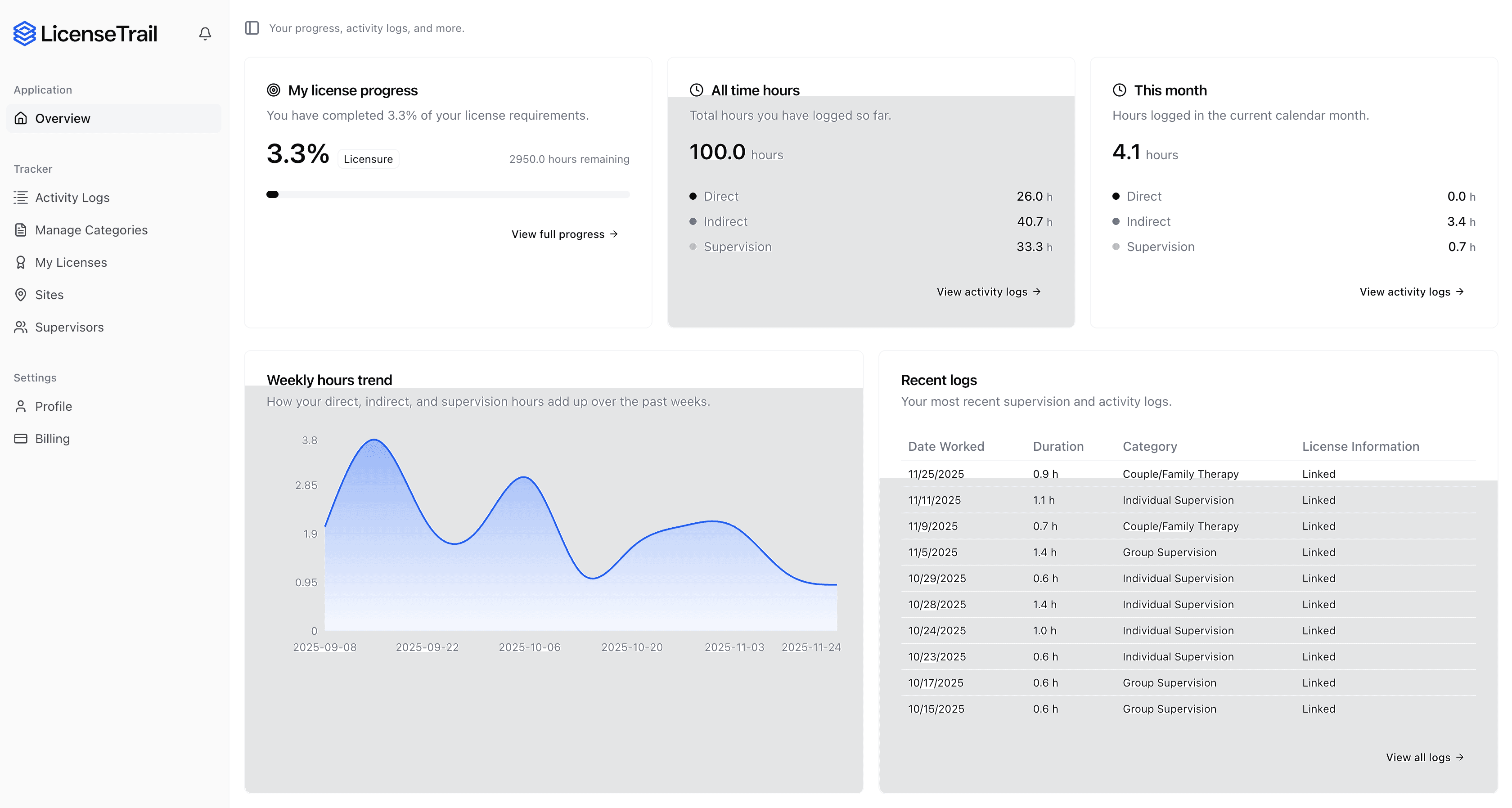
License Trail checks your direct, indirect, and supervision hours against Minnesota LAMFT requirements continuously and flags mismatches before you submit.
 Start Tracking for Free
No credit card required · Free plan available
Related Licenses
Is your spreadsheet hiding Minnesota LAMFT risks?
Stop guessing if your categories match Minnesota Board of Marriage and Family Therapy requirements. License Trail checks your direct, indirect, and supervision hours continuously and flags mismatches before you submit.
Import or log
Bring your spreadsheet or start fresh
Upload your existing tracking spreadsheet and we'll map every hour into the right Minnesota Board of Marriage and Family Therapy categories automatically.
Verify against Minnesota
Catch mismatches before the board does
License Trail checks your direct, indirect, and supervision hours against Minnesota LAMFT requirements continuously.
Export board-ready
One-click clean reports
Generate professional, board-ready reports for supervision meetings and Minnesota Board of Marriage and Family Therapy submissions in seconds.
No credit card required · Free plan available