
Mississippi LCSW Requirements: Hours, Exams & Step-by-Step Guide
Stop guessing if your categories match Mississippi requirements. License Trail checks your direct, indirect, and supervision hours against LCSW requirements continuously and flags mismatches before you submit.
No credit card required · Free plan available
Quick Requirements Overview
- Hold LMSW in good standing (requires CSWE-accredited MSW/DSW); cannot go directly to LCSW
- Meet general MS licensure eligibility (age 21+, background checks, legal status, good moral character, etc.)
- Board approval required before supervision starts (contract + Plan of Supervision); no retroactive credit
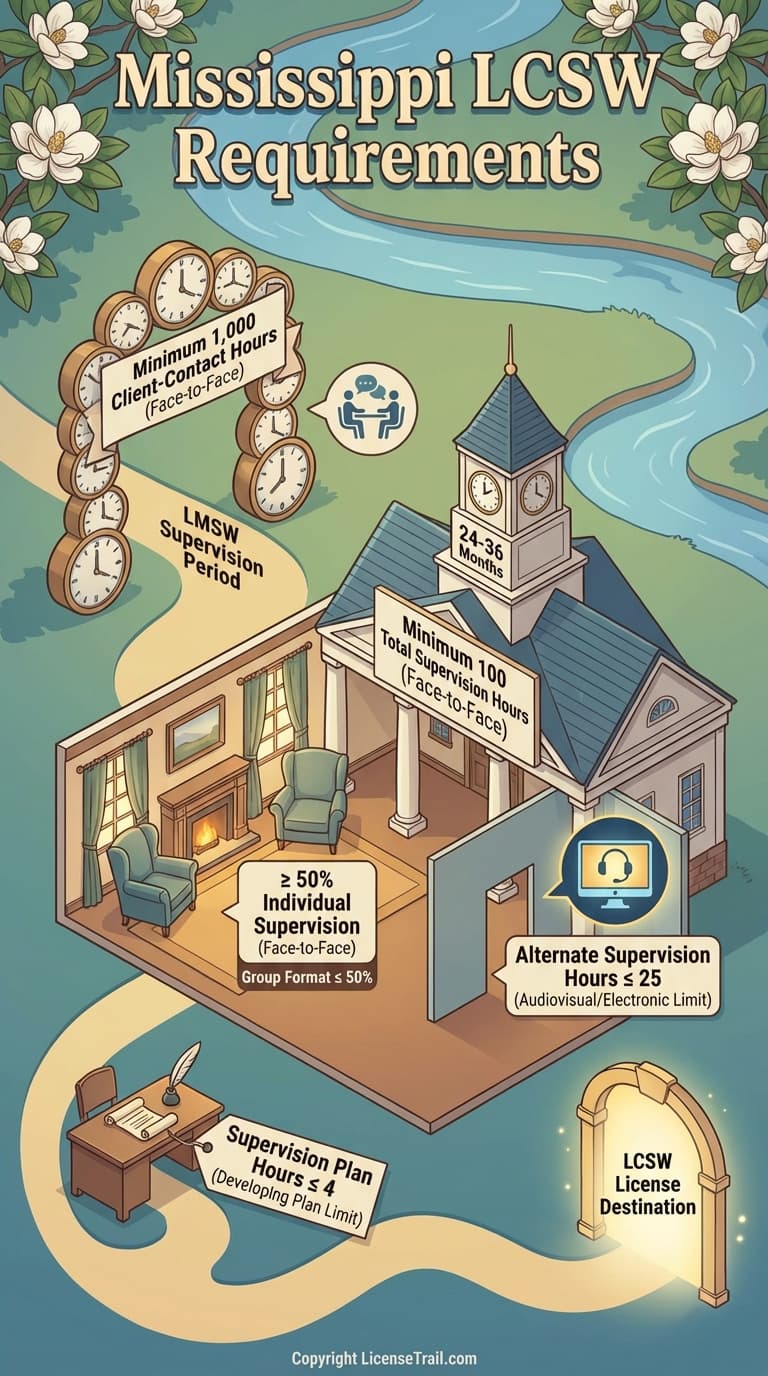
- Complete 24–36 consecutive months of supervision: 100 hours minimum, ≥1 hr/week, ≥50% individual face-to-face; ≤25 hours via approved live electronic means; extension up to 6 months if approved before deadline
- Earn 1,000 hours of face-to-face client contact during the supervision period (documented on Board form)
- Supervision must occur in an agency/institution/group practice; no independent practice as an LMSW candidate
- Supervisor must be Board-approved LCSW supervisor (LCSW + 2 years practice; supervisor training/CE); max 7 supervisees and group limits apply
- Submit required documentation for LCSW: 4 evaluations (q6 months), termination form, 3 references (incl. 1 LCSW not your supervisor), current background checks, and pass ASWB Clinical (attempt within 6 months of exam authorization)
License Details
Procedures
In Mississippi, the Licensed Certified Social Worker (LCSW) is the highest level of social work credential and is regulated by the Mississippi Board of Examiners for Social Workers and Marriage & Family Therapists. The Board’s rules spell out exactly how many hours of supervision and client contact you must complete, the time frame for those hours, and the documentation that has to be submitted.
Below is a step‑by‑step explanation, using the Board’s own language and structure where it matters.
1. Licensure ladder and scope of LCSW
Mississippi recognizes three social work licenses:
- LSW – Licensed Social Worker
- LMSW – Licensed Master Social Worker
- LCSW – Licensed Certified Social Worker (clinical or macro)
You cannot go directly to LCSW. You must first become an LMSW and then complete a formal, Board‑approved supervision process toward LCSW status. (law.cornell.edu)
Clinical social work practice at the LCSW level is defined as the application of social work methods in the “diagnosis and treatment and prevention of psychosocial dysfunction” and emotional, mental, and behavioral disorders. (law.cornell.edu)
2. General eligibility requirements for any Mississippi social work license
Before you can be licensed at any level (including LCSW), you must meet the Board’s general requirements. An applicant must, among other things: (law.cornell.edu)
- Be at least 21 years of age.
- Be of “good moral character” as defined in the Rules and Regulations.
- Have an acceptable fingerprint criminal history record check.
- Have an acceptable Mississippi Sex Offender Registry check.
- Be a U.S. citizen or legal resident alien.
- Have no felony conviction related to the practice of social work within the last 10 years.
- Be mentally competent and free from current substance dependence.
- Hold an acceptable social work degree for the level requested.
These general requirements must still be satisfied at the time you upgrade to LCSW.
3. Educational pathway: from degree to LMSW
3.1 Education
To ultimately qualify for LCSW, you must first qualify for LMSW. The Board requires for LMSW: (law.cornell.edu)
- A master’s degree in social work from a school accredited by the Council on Social Work Education (CSWE), or
- A doctorate in social work (D.S.W. or Ph.D.).
This same graduate degree is the educational foundation underlying the later LCSW.
3.2 LMSW licensure
To become an LMSW, you must: (law.cornell.edu)
- Submit an initial LMSW application.
- Have official verification of your qualifying MSW/DSW degree sent to the Board.
- Complete fingerprint and sex‑offender checks (results sent directly to the Board).
- Pass the ASWB Intermediate (Masters‑level) exam.
- Pay applicable fees.
Only after you hold an active LMSW license in good standing can you enter LCSW supervision.
4. Entering the LCSW supervision process
4.1 Requirement to be an LMSW “in good standing”
For LCSW level, the regulation states that an applicant: (law.cornell.edu)
“must be a current LMSW in good standing who has completed the Supervision process as outlined in Part 1902, Chapter 2, Rule 2.3 as verified by Board records”
That supervision process is what creates the post‑master’s supervised clinical experience required for LCSW.
4.2 Approval must come before supervision begins
The Board is explicit that “all plans for professional post‑Master’s supervision must be approved by the Board prior to the beginning of said supervision,” and no retroactive approval will be granted. (law.cornell.edu)
In practice this means:
- You and your prospective LCSW supervisor complete an Application to Enter into Contract for Supervision toward LCSW status and pay the supervision‑processing fee. (swmft.ms.gov)
- You and the supervisor jointly develop a Plan of Supervision using the Board’s mandated outline and forms. (law.cornell.edu)
- You submit the plan to the Board’s Social Work Discipline Specific Committee (SWDSC) and wait for written approval before counting any supervision or hours toward LCSW.
5. Supervisor qualifications and limits
The regulations require that LCSW supervision be provided only by a Board‑approved LCSW Supervisor. Key points: (law.cornell.edu)
-
The supervisor must:
- Hold an LCSW license in good standing.
- Have a minimum of two years of verifiable practice at the LCSW level.
- Complete a Board‑approved supervision course (initially at least 16 hours; then 2 hours of supervision CE each renewal).
- Obtain and maintain “approved supervisor” status through an application and fee.
-
It is considered unethical for an LCSW without clinical expertise to supervise an LMSW who is seeking to become a clinician.
-
A supervisor may not supervise more than seven (7) LMSWs who are in candidacy for LCSW at any one time. If supervising up to 7 supervisees, no more than 50% of supervision may be in a group format; at least 50% must be individual, face‑to‑face supervision.
-
“Individual supervision” is defined as a maximum of two supervisees with one supervisor; “group supervision” is three to seven supervisees with one supervisor.
6. The supervised experience: required hours and structure
This is where the Board is very specific about hours and the types of experience that count.
6.1 Setting in which supervision must occur
Supervision “must occur within an agency, institution, or group practice setting.” An LMSW who is practicing independently outside such a setting “will not be considered a candidate for LCSW supervision” and may face disciplinary action. (law.cornell.edu)
In other words, your supervised practice must be tied to a formal organizational context, not solo private practice as an LMSW.
6.2 Supervision hours (time spent with your supervisor)
Both the regulation and the Board’s supervision guide describe the supervision hours in identical terms: (law.cornell.edu)
- You must receive a minimum of one (1) hour per week of face‑to‑face supervision with your LCSW supervisor.
- The supervision period must cover at least twenty‑four (24) months and may not exceed thirty‑six (36) consecutive months (2 to 3 years).
- Over this period you must accumulate a minimum of one hundred (100) hours of supervision.
Additional details:
- At least 50% of supervisory interactions must be individual face‑to‑face (not group). (law.cornell.edu)
- You can receive up to 4 hours of supervision credit for collaboratively developing your Plan of Supervision. (law.cornell.edu)
- Supervision may include limited use of audio or audiovisual electronic means (e.g., live video), but no more than one‑fourth (¼) of the required 100 hours—that is, no more than 25 hours—may be obtained this way; at least 75 hours must still be direct, in‑person face‑to‑face supervision. (law.cornell.edu)
If you need more than 36 months, you or your supervisor must request an extension (up to six additional months) before the 36‑month limit expires, and provide documentation of extenuating circumstances. (law.cornell.edu)
Summary of supervision hours requirement
- 100 hours minimum of LCSW supervision
- Delivered at at least 1 hour/week
- Over 24–36 months
- ≥ 50 hours must be individual face‑to‑face
- ≤ 25 hours may be via approved live electronic means
6.3 Client contact hours (“face‑to‑face client contact”)
Separate from supervision hours, the Board requires a defined amount of clinical (or direct practice) work with clients. During your supervision period as an LMSW, you must complete: (law.cornell.edu)
- A minimum of one thousand (1,000) hours of face‑to‑face client contact.
“Face‑to‑face client contact” refers to direct client interaction—typically psychotherapy, counseling, or other direct service—where you are the practitioner providing social work services to individuals, families, or groups. These hours are documented on the Board’s Verification of Face to Face Client Contact Form, which must be submitted with your termination‑of‑supervision materials. (swmft.ms.gov)
Important distinction:
- Mississippi does not currently state a required “3,000 total hours” of supervised experience in the regulations.
- The Board’s controlling requirements instead are:
- 100 hours of LCSW supervision, and
- 1,000 hours of face‑to‑face client contact,
completed under an approved supervision plan over 24–36 months.
Third‑party websites sometimes mention 3,000 or other totals, but those numbers are not what appears in the current Mississippi Administrative Code sections governing LCSW supervision.
Summary of practice‑hour requirement
- 1,000 hours of face‑to‑face client contact during the supervision period.
7. Ongoing evaluation and documentation during supervision
The Board requires structured, periodic evaluation throughout the supervision process: (law.cornell.edu)
- Four (4) written evaluations from the supervisor, typically at:
- 6 months
- 12 months
- 18 months
- 24 months
These evaluations are submitted to the Board every six months and must show growth in competence. The Board’s Social Work Discipline Specific Committee must approve each evaluation period before the next six‑month segment can begin.
At the end of supervision, the supervisor completes a Termination of Supervision Form documenting the total supervised hours and period of supervision.
8. Final LCSW application requirements
Once you have:
- Maintained an LMSW in good standing,
- Completed 100 hours of supervision over 24–36 months,
- Completed 1,000 hours of face‑to‑face client contact, and
- Submitted the required evaluations and termination form,
you formally apply for LCSW licensure.
The regulations specify that an applicant for LCSW designation must submit: (law.cornell.edu)
- Initial application for LCSW license.
- Supervision Plan and Contract for Supervision (already on file as part of supervision).
- Four evaluations covering the 24‑month minimum supervision period (not to exceed 36 months).
- Termination of Supervision Contract.
- A current fingerprint criminal history check (conducted within 365 days of the completed application, sent directly to the Board).
- An acceptable Sex Offender Registry check (conducted by the Board).
- Three professional reference letters:
- From licensed mental health professionals who have known you for at least one year during the supervision period.
- These cannot be from the people who documented your supervision/clinical experience.
- At least one must be from an LCSW other than your supervisor.
- Passing scores on the ASWB Clinical examination (the regulations call this the ASWB LCSW Clinical exam).
The regulations also state that an application for LCSW is considered abandoned if you have not attempted the ASWB Clinical exam within six (6) months from the date the Board approved termination of supervision and authorized you to take the exam. Any later attempt would require a new application and fees. (law.cornell.edu)
9. Snapshot of the key hour requirements for Mississippi LCSW
Based on the Mississippi Board’s rules and official supervision guide, the core experiential requirements for LCSW licensure are:
-
Supervision hours (with LCSW Supervisor)
- 100 hours minimum of post‑master’s face‑to‑face professional supervision
- At least 1 hour per week for 24–36 consecutive months
- At least 50% of supervision must be individual face‑to‑face
- No more than 25 of these 100 hours may be via approved live electronic means
-
Practice (client) hours
- 1,000 hours minimum of face‑to‑face client contact during the supervision period
-
Time frame
- Supervision must span at least 24 months, and may not exceed 36 months without a Board‑approved extension (maximum extra 6 months).
These are the controlling quantitative requirements as defined by the Mississippi Board of Examiners for Social Workers and Marriage & Family Therapists in Part 1902 of the Mississippi Administrative Code and in the Board’s official LMSW Guide to Supervision. (law.cornell.edu)
Track your LCSW hours with confidence
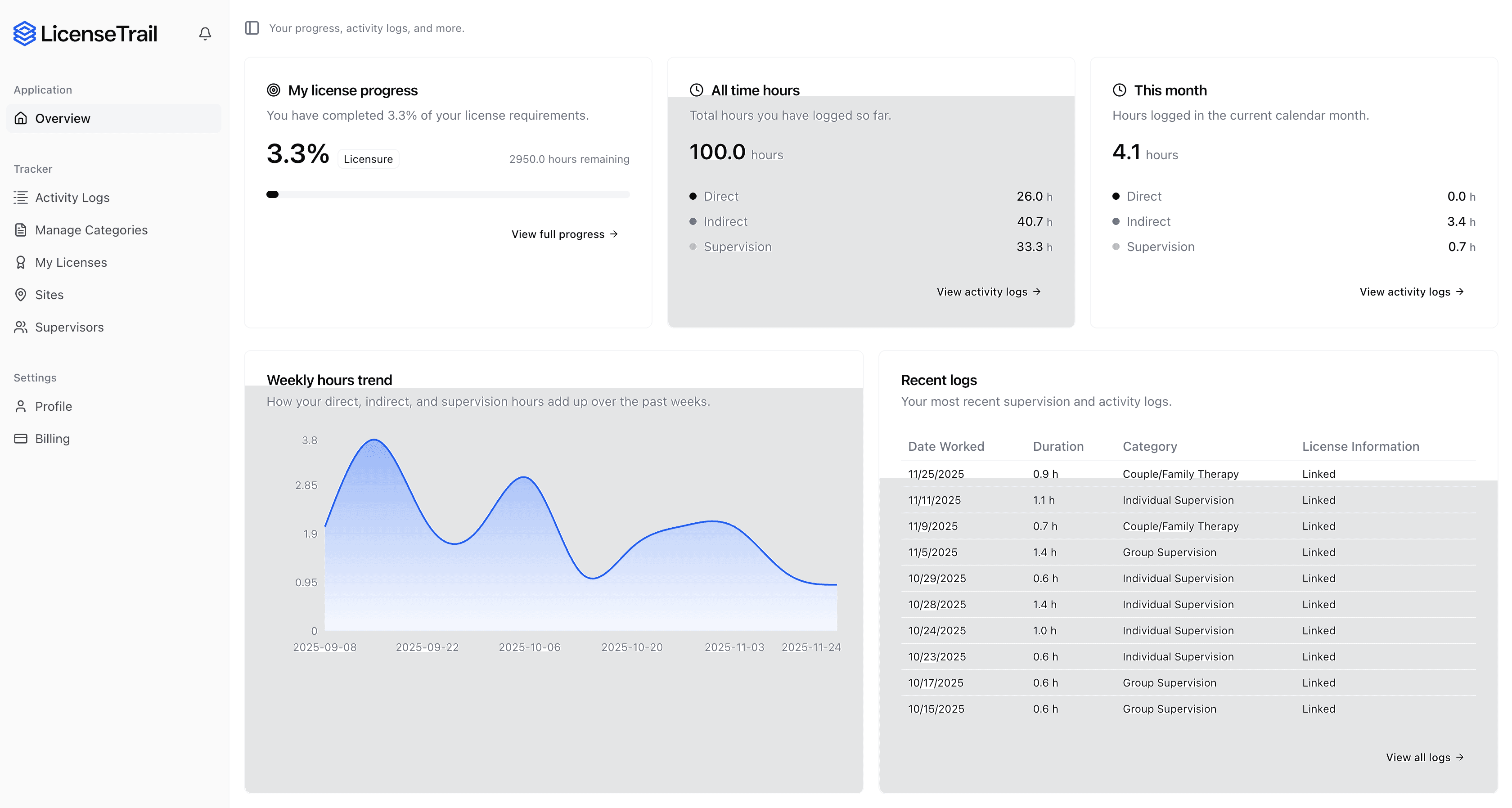
License Trail checks your direct, indirect, and supervision hours against Mississippi LCSW requirements continuously and flags mismatches before you submit.
 Start Tracking for Free
No credit card required · Free plan available
Related Licenses
Is your spreadsheet hiding Mississippi LCSW risks?
Stop guessing if your categories match Mississippi Board of Examiners for Social Workers and Marriage & Family Therapists requirements. License Trail checks your direct, indirect, and supervision hours continuously and flags mismatches before you submit.
Import or log
Bring your spreadsheet or start fresh
Upload your existing tracking spreadsheet and we'll map every hour into the right Mississippi Board of Examiners for Social Workers and Marriage & Family Therapists categories automatically.
Verify against Mississippi
Catch mismatches before the board does
License Trail checks your direct, indirect, and supervision hours against Mississippi LCSW requirements continuously.
Export board-ready
One-click clean reports
Generate professional, board-ready reports for supervision meetings and Mississippi Board of Examiners for Social Workers and Marriage & Family Therapists submissions in seconds.
No credit card required · Free plan available