
Mississippi LMFT Requirements: Hours, Exams & Step-by-Step Guide
Stop guessing if your categories match Mississippi requirements. License Trail checks your direct, indirect, and supervision hours against LMFT requirements continuously and flags mismatches before you submit.
No credit card required · Free plan available
Quick Requirements Overview
- Age/fitness: 21+; “good moral character”; fingerprint-based criminal/sex-offender background check; no unresolved discipline
- Education: Master’s/Doctorate in MFT from COAMFTE-accredited program (or COAMFTE-candidacy at graduation that later became accredited); official transcript required
- Graduate practicum (12 consecutive months): 500 client contact hrs (≥ 300 direct; ≥ 100 relational direct w/ couples/families) + 100 supervision hrs (AAMFT Approved Supervisor/Supervisor Candidate; groups max 8)
- Exam: Pass the AMFTRB national exam (typically eligible last semester or after graduation)
- Supervision contract: Board-approved Plan of Supervision required before hours count (no retroactive approval except up to 4 hrs to develop plan); practice typically as LMFTA in an agency setting
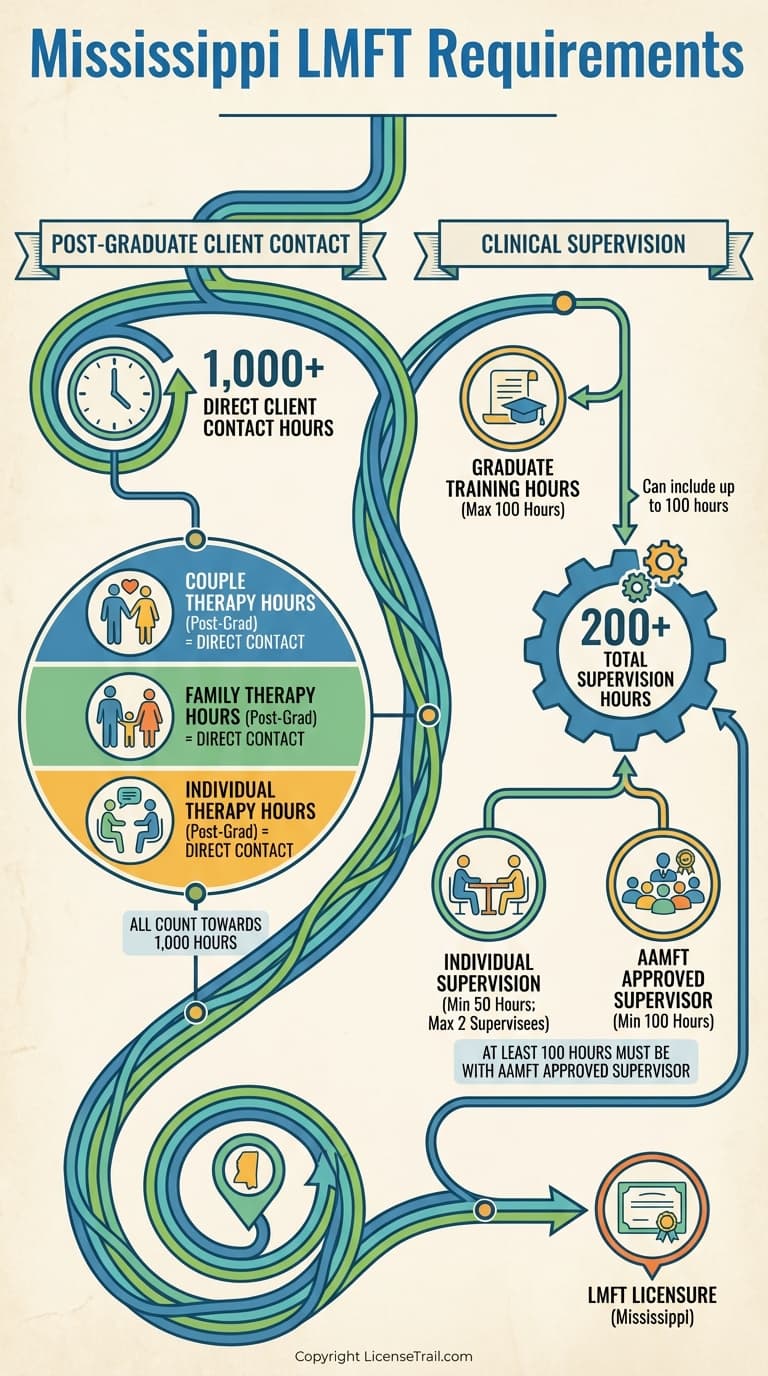
- Post-grad clinical experience: 2 years in agency/institution/group practice with 1,000 direct client contact hrs (face-to-face in-person or secure video)
- Post-grad supervision: 200 supervision hrs total (≥ 50 individual; group 3–8; 50-min “hour”); ≥ 100 hrs with AAMFT Approved Supervisor; up to 100 grad supervision hrs may count
- Timing: Supervision averages 1 hr/week (or 2 biweekly) over 24 consecutive months, must be completed within 36 months (extensions limited); apply for LMFT within 2 years of completing post-grad experience
License Details
Procedures
Mississippi’s pathway to becoming a Licensed Marriage and Family Therapist (LMFT) is structured around three pillars: (1) a COAMFTE‑aligned graduate education and practicum, (2) a defined period of post‑graduate clinical experience with specified direct client contact hours, and (3) a substantial block of clinical supervision hours under Board‑approved supervisors, plus the national exam.
All of this is governed by Title 30, Part 1903 of the Mississippi Rules and Regulations for Marriage and Family Therapists and the Board’s LMFT “Quickstep Guide.” (sos.ms.gov)
Below is a step‑by‑step outline, followed by a focused breakdown of the hours and key definitions.
1. Meet the baseline eligibility and education requirements
Age, character, and background
To be eligible to apply for licensure (LMFT or LMFTA), an individual must, among other things: (sos.ms.gov)
- Be at least 21 years of age.
- Be of “good moral character” as defined in the Board’s general rules (Part 1901).
- Have acceptable criminal history and sex‑offender background checks using fingerprint identification, as prescribed by the Board.
- Have no unresolved professional complaints or disciplinary actions that the Board finds unsatisfactory.
Degree and graduate program
For LMFT, Mississippi requires a graduate degree squarely in marriage and family therapy from a program aligned with COAMFTE standards. Specifically, the applicant must: (sos.ms.gov)
- Hold a master’s or doctoral degree in Marriage and Family Therapy from:
- A COAMFTE‑accredited MFT program, or
- A program that held COAMFTE candidacy status when the applicant graduated and that later achieved full COAMFTE accreditation.
The Board will require an official transcript sent directly from the institution.
Required graduate practicum and its hours
The degree must include a structured clinical practicum in marriage and family therapy of no less than twelve (12) consecutive months, providing face‑to‑face clinical practice (in‑person or secure video) with individuals, couples, and families. (sos.ms.gov)
The practicum must include all of the following minimums:
- 500 total client contact hours, of which:
- At least 300 must be “direct client contact” hours; and
- At least 100 must be “relational direct client contact” hours with couples and/or families.
- 100 hours of supervision during the practicum.
- Practicum supervision must be provided by an AAMFT Approved Supervisor or an AAMFT Supervisor Candidate under the supervision of an AAMFT Approved Supervisor, with practicum groups capped at eight supervisees per supervisor.
These practicum hours are pre‑licensure and distinct from the post‑graduate hours described below, although up to 100 supervision hours from graduate training can later be counted toward the 200‑hour supervision requirement for LMFT (see Section 4). (sos.ms.gov)
2. Take and pass the national AMFTRB examination
Mississippi uses the national exam endorsed by the Association of Marital and Family Therapy Regulatory Boards (AMFTRB) as its “Examination” for MFT licensure. (sos.ms.gov)
The Board’s Quickstep Guide states that during the last semester of a COAMFTE‑accredited MFT program (or after graduation), candidates may apply to sit for the AMFTRB exam. (swmft.ms.gov)
You must obtain a passing score on the AMFTRB exam as part of the requirements to ultimately be licensed as an LMFT.
3. Enter a Board‑approved supervision contract and typically obtain LMFTA
LMFTA status and supervised setting
Mississippi defines two levels of MFT licensure: (sos.ms.gov)
- LMFTA – Licensed Marriage and Family Therapy Associate
- Must practice in an agency setting under a “Board Approved” supervision contract.
- LMFT – Licensed Marriage and Family Therapist
- May practice independently once all requirements are met and license is granted.
In practice, most new graduates who have passed the exam and had their supervision plan approved apply for LMFTA while they accrue their post‑graduate clinical and supervision hours.
Plan of Supervision
Before accruing post‑graduate supervision hours, the candidate and a Board Approved Supervisor must: (sos.ms.gov)
- Complete and sign a Plan of Supervision and a Supervisor’s Statement.
- Submit:
- Application to enter into contract for supervision toward LMFT licensure.
- The Plan of Supervision.
- Required processing fee.
- Obtain Board approval of the plan before supervision begins. The rules specify that:
- The Board will not grant retroactive approval of professional supervision, except for up to four (4) hours of supervision, which may be credited and should be used to develop the plan with the supervisor.
Supervision must be face‑to‑face (in‑person or secure video) and conducted by a Board Approved Supervisor; at least half of the total supervision hours must be with an AAMFT Approved Supervisor (details below). (sos.ms.gov)
4. Complete the required post‑graduate clinical experience and supervision
This is where the core “hours” requirements come in. Mississippi distinguishes between:
- Post Graduate Clinical Experience (client work); and
- Supervision (clinical review of that work).
4.1. Post‑graduate clinical experience hours
Under an approved supervision plan, the candidate must complete two (2) years of documented clinical experience in marriage and family therapy after the first qualifying graduate degree. This experience must: (sos.ms.gov)
- Be carried out in an agency, institution, or group practice setting.
- Include a minimum of 1,000 documented direct client contact hours that are:
- Face‑to‑face (either in‑person or through a secure video conferencing platform); and
- Direct client contact hours as defined by the Board (see definitions below).
The rules explicitly state that an applicant who is not obtaining this clinical experience in an agency, institution, or group practice is “practicing outside of the Board’s Rules and Regulations,” and the Plan of Supervision will not be approved.
Timing requirement: Application for LMFT licensure must occur within two (2) years of completing this post‑graduate clinical experience. (sos.ms.gov)
4.2. Required supervision hours
Separate from the 1,000 client contact hours, Mississippi requires 200 total hours of marriage and family therapy clinical supervision associated with that post‑graduate clinical experience. The rules specify that an individual seeking LMFT must: (sos.ms.gov)
-
Complete 200 hours of clinical supervision, of which:
- At least 50 hours must be “individual supervision.”
- Individual supervision is defined as no more than two supervisees in the session; a supervision hour is 50 minutes.
- The remaining hours may be individual or group, but group supervision sessions must have at least three (3) and no more than eight (8) supervisees, with a supervision hour defined as 50 minutes. (sos.ms.gov)
- At least 50 hours must be “individual supervision.”
-
At least 100 of the 200 supervision hours must be with an AAMFT Approved Supervisor.
-
Up to 100 hours of acceptable clinical supervision from graduate training (e.g., practicum supervision) may be counted toward the 200‑hour requirement. In that case:
- The remaining 100 post‑graduate supervision hours must be completed with a Board Approved Supervisor; and
- At least 100 of the total 200 hours must still be with an AAMFT Approved Supervisor.
-
Structure and time frame of supervision:
- The supervisory process must average one (1) hour per week or two (2) hours every other week of face‑to‑face supervision throughout a minimum of 24 consecutive months.
- The supervision period may not exceed 36 months, unless the supervisee is granted an extension under unusual circumstances (e.g., documented illness, natural disaster). (sos.ms.gov)
In addition, the Board emphasizes that all post‑graduate supervision hours (i.e., those beyond what is credited from graduate practicum) must be completed under a Board Approved Supervisor.
5. Apply for LMFT after completing supervision and hours
Once the candidate has: (swmft.ms.gov)
- Completed the two years of qualifying post‑graduate clinical experience (with at least 1,000 direct client contact hours);
- Accrued the required 200 hours of clinical MFT supervision under a Board Approved Supervisor (with the specified mix of individual vs. group and AAMFT Approved Supervisor involvement);
- Achieved a passing score on the AMFTRB examination; and
- Met all general requirements (age, background check, good moral character, etc.),
they may submit the LMFT Application for Licensure (with its checklist and supporting documentation) to the Board.
The application packet will require:
- Documentation of post‑graduate clinical hours (1,000 direct client contact hours minimum) sent directly from the agency or supervisor. (sos.ms.gov)
- Documentation and evaluation forms from the supervisor, confirming completion of the 200 hours of required supervision and the overall time frame.
- Official transcripts and evidence of having met the practicum requirements.
- Proof of passing the national AMFTRB exam.
- Required fees and forms as specified in the current LMFT application packet on the Board’s site. (swmft.ms.gov)
6. Key Board definitions about hours and supervision
Because Mississippi’s requirements hinge on very specific terminology, it is important to use the Board’s defined concepts.
Direct client contact hours
The Rules define “Direct Client Contact” as face‑to‑face interaction (in‑person or secure video) between the therapist and an individual, couple, or family. (sos.ms.gov)
This is the category into which the 1,000 post‑graduate hours must fall, and it is the core of the 300+100 relational hours required in the graduate practicum.
Client contact vs. direct client contact
The term “client contact hours” is broader and includes both: (sos.ms.gov)
- Direct client contact (as above); and
- Certain administrative or supportive client‑associated hours, as defined by the individual accredited institution during practicum.
For licensure purposes:
- The 500 practicum hours are total client contact hours, of which at least 300 must be direct client contact, and at least 100 must be relational direct client contact (couples/families).
- The 1,000 post‑graduate hours must be direct client contact hours.
Face‑to‑face supervision, individual supervision, and group supervision
The Board defines: (sos.ms.gov)
- “Face‑to‑Face Supervision” as supervision conducted in‑person or via secure video conferencing, for the purpose of carrying out the functions described in the supervision rules (case review, feedback, etc.).
- “Individual Supervision” as supervision with no more than two supervisees in a clinical setting during the supervision hour (a supervision hour is 50 minutes).
- “Group Supervision” as supervision with at least three and no more than eight supervisees during the supervision hour (also 50 minutes).
These definitions govern how you structure the required 200 supervision hours (minimum 50 individual; remainder may be group or individual).
Clinical supervision
“Clinical Supervision” is defined as direct clinical review by a supervisor of the supervisee’s interaction with clients, for the purpose of training and teaching. It must involve case‑related, interactive review (not just administrative oversight), and is distinct from personal therapy or purely didactic instruction. (swmft.ms.gov)
7. Putting the Mississippi hour requirements into numbers
Summarizing the critical “hours” for LMFT licensure in Mississippi:
During graduate training (practicum): (sos.ms.gov)
- 500 client contact hours minimum, including:
- 300 direct client contact hours (face‑to‑face).
- 100 relational direct client contact hours (couples/families).
- 100 hours of supervision (may later contribute up to 100 hours toward the 200‑hour supervision requirement).
Post‑graduate, under Board‑approved supervision:
-
Clinical experience (client work):
- At least two (2) years of documented clinical experience in an agency, institution, or group practice.
- At least 1,000 documented direct client contact hours (face‑to‑face, in‑person or secure video). (sos.ms.gov)
-
Supervision:
- 200 total hours of marriage and family therapy clinical supervision, of which:
- At least 50 hours are individual supervision (no more than two supervisees).
- At least 100 hours are with an AAMFT Approved Supervisor.
- Up to 100 supervision hours from graduate training may count toward this 200, but all remaining post‑graduate supervision hours must be with a Board Approved Supervisor, and the AAMFT‑Approved‑Supervisor minimum still applies. (sos.ms.gov)
- 200 total hours of marriage and family therapy clinical supervision, of which:
All of this must be completed within the specified timeframes (24–36 months of supervision; LMFT application within two years of finishing the post‑graduate clinical experience) and under a Board‑approved Plan of Supervision.
Because the Board periodically amends Part 1903, it is wise to confirm any details against the most recent version of Title 30, Part 1903 and the current LMFT application materials on the Mississippi Board’s website before you submit an application or finalize a supervision plan. (swmft.ms.gov)
Track your LMFT hours with confidence
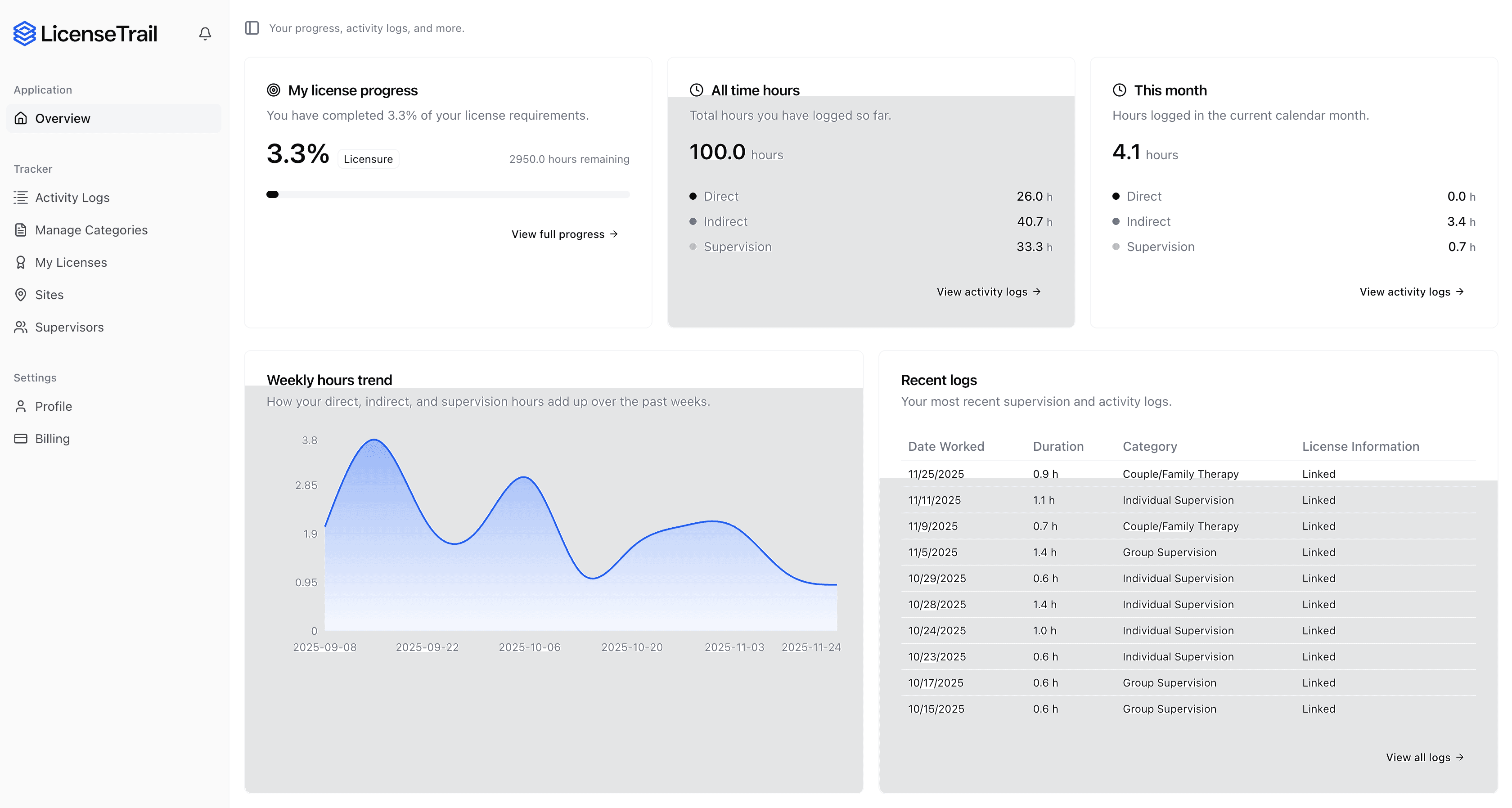
License Trail checks your direct, indirect, and supervision hours against Mississippi LMFT requirements continuously and flags mismatches before you submit.
 Start Tracking for Free
No credit card required · Free plan available
Related Licenses
Is your spreadsheet hiding Mississippi LMFT risks?
Stop guessing if your categories match Mississippi Board of Examiners for Social Workers and Marriage & Family Therapists requirements. License Trail checks your direct, indirect, and supervision hours continuously and flags mismatches before you submit.
Import or log
Bring your spreadsheet or start fresh
Upload your existing tracking spreadsheet and we'll map every hour into the right Mississippi Board of Examiners for Social Workers and Marriage & Family Therapists categories automatically.
Verify against Mississippi
Catch mismatches before the board does
License Trail checks your direct, indirect, and supervision hours against Mississippi LMFT requirements continuously.
Export board-ready
One-click clean reports
Generate professional, board-ready reports for supervision meetings and Mississippi Board of Examiners for Social Workers and Marriage & Family Therapists submissions in seconds.
No credit card required · Free plan available