
Mississippi P-LPC Requirements: Hours, Exams & Step-by-Step Guide
Stop guessing if your categories match Mississippi requirements. License Trail checks your direct, indirect, and supervision hours against P-LPC requirements continuously and flags mismatches before you submit.
No credit card required · Free plan available
Quick Requirements Overview
- Age/eligibility: 21+; U.S. citizen or work-authorized; good moral character
- Education: Master’s (or higher) meeting MS standards; 60 graduate semester hours (or 90 quarter hours) with required core content incl. supervised internship
- Exams (for P-LPC): Pass NCE + Mississippi Jurisprudence Exam
- Application materials: Official graduate transcripts + Board-required background check
- Supervision required to be issued: Board-approved LPC‑S with online supervision agreement, written supervision contract, and Declaration of Practice (hours start only after P‑LPC issued)
- Practice limits: Must practice only under supervision; no independent practice/title misuse
- P‑LPC term/renewal: Renewable up to 4 total years; annual LPC‑S evaluation required
- Toward full LPC: 3,000 supervised hours post‑master’s over ≥18 months, incl. 1,200 direct client hours + 100 supervision hours (up to 50 group; group counts half); weekly caps 40 total/25 direct; hours must be within 7 years of LPC application
License Details
Procedures
Mississippi’s pathway into professional counseling runs through the Provisional Licensed Professional Counselor (P‑LPC) credential. This provisional license is the status under which you complete your supervised post‑master’s hours toward full Licensed Professional Counselor (LPC) licensure.
Below is a concise, regulation‑based guide to becoming a P‑LPC in Mississippi as of rules current through mid‑2025, with a clear breakdown of the supervised‑hour requirements you will eventually need for full LPC licensure.
1. What a P‑LPC Is in Mississippi
State law defines a “provisional licensed professional counselor” as a person who holds themself out to the public using the provisional title and who offers professional counseling or psychotherapy under the supervision of a board‑qualified supervisor for a fee. (codes.findlaw.com)
In practical terms:
- P‑LPC = post‑master’s counselor who:
- is licensed by the Mississippi State Board of Examiners for Licensed Professional Counselors (the Board),
- practices only under supervision by a Board‑qualified LPC‑Supervisor (LPC‑S),
- uses this period to complete required supervised hours for later LPC (independent) licensure.
You must hold a Mississippi P‑LPC (or meet its equivalent requirements if applying from out of state) before you can qualify for full LPC licensure. (regulations.justia.com)
2. General Eligibility Requirements (Apply to All License Types)
Mississippi’s general requirements for any counseling license, including P‑LPC, are set out in Rule 30‑2201‑4.1 and in Miss. Code §73‑30‑9. To be eligible you must: (law.cornell.edu)
- Be at least 21 years of age.
- Be a U.S. citizen or hold current, valid authorization to work in the U.S. (Board requires current immigration documentation).
- Be of good moral character (the Board may request endorsements regarding character, professional integrity, and competence).
- Not be in violation of Mississippi’s counseling statute (Miss. Code §73‑30‑1 et seq.) or Board rules.
- Meet the Board’s education and experience requirements.
- Pass a Board‑approved exam (details below).
These general requirements are satisfied within the specific P‑LPC process that follows.
3. Education Requirements for P‑LPC
3.1 Degree level and credit hours
Rule 30‑2201‑4.2(B) sets the graduate education standards for P‑LPC: (law.cornell.edu)
- You must complete either:
- at least 60 semester hours of graduate study, or
- 90 quarter hours (which must convert to at least 60 semester hours using the standard quarter‑to‑semester formula).
- For degrees conferred after January 1, 2017, the Board will only accept 60‑semester‑hour (or 90‑quarter‑hour) master’s programs meeting one of the following:
- A CACREP‑accredited counseling program, or
- A counseling‑titled degree (the word “counseling” in the title) whose structure is equivalent to CACREP with respect to the twelve Board‑specified core courses, or
- An earned doctoral or educational specialist degree primarily in counseling, guidance, or a related field that meets similar standards.
All hours referred to in the rule are counted as graduate‑level semester hours.
3.2 Required coursework and internship
The Board defines a “graduate program related to counselor education” as one that includes specific content areas. Each applicant must complete at least a three‑semester‑hour course (or equivalent) in each of the required core areas (e.g., Human Growth and Development, helping relationships, appraisal, research, ethics, multicultural issues, etc.). (law.cornell.edu)
One of these areas is an Internship, which the rules describe as supervised, planned, practical, advanced clinical experience where you apply counseling principles and techniques in a clinical setting. (law.cornell.edu)
The rules do not assign a specific number of internship hours beyond your graduate program’s requirements, but they do require that such a supervised internship be part of the 60‑hour program.
3.3 Official transcripts
You must arrange for official graduate transcripts documenting the required degree and coursework to be sent directly to the Board (via secure electronic services or sealed paper transcript). Only graduate‑level transcripts are required. (law.cornell.edu)
4. Examination Requirements for P‑LPC
There are two key exams in the P‑LPC process:
4.1 National Counselor Examination (NCE)
The Board’s licensure‑exams page states that you must have a passing score on the National Counselor Exam (NCE) to apply for a P‑LPC credential. Individuals may take the NCE without prior Board approval, and the exam is administered through NBCC/CCE at Pearson VUE testing centers. (lpc.ms.gov)
4.2 Mississippi Jurisprudence Exam
Rule 30‑2201‑4.2(D) adds a state‑specific legal/ethics requirement: (law.cornell.edu)
- You must pass the Mississippi Jurisprudence Exam, a Board‑approved exam covering Mississippi counseling laws and regulations.
- The exam is administered by an entity designated by the Board. You pay associated testing fees.
- A certificate showing a passing score on the Jurisprudence Exam must be included in your P‑LPC application.
The general rule that “Applicants must pass a Board approved examination to be eligible for licensure” is found in Rule 4.1(E); for P‑LPC, this is operationalized as the NCE plus the Mississippi jurisprudence exam. (law.cornell.edu)
5. Supervision Setup Required to Obtain the P‑LPC
At the point you apply for the P‑LPC, you do not yet need accrued post‑master’s practice hours. Those hours come after the P‑LPC is issued. However, you must already have a supervision arrangement and practice plan in place, because:
- Rule 30‑2201‑4.2(A) and (E) require that, for a P‑LPC to be issued, the Board must approve:
- an online supervision agreement between you and an LPC‑S,
- a written supervision contract, and
- a Declaration of Practice describing your practice setting(s) and arrangements. (law.cornell.edu)
Key points from Rule 4.2(E): (law.cornell.edu)
- Post‑master’s supervised experience begins only after the P‑LPC is issued; hours before that don’t count toward LPC licensure.
- You must remain under supervision until you are licensed as an LPC.
- Your supervisor must be a Mississippi Board‑qualified supervisor (LPC‑S).
- Supervised hours can only be accrued in Mississippi (the Board may accept out‑of‑state hours if they were supervised by an LPC‑S or equivalent).
- Practice sites:
- You may practice under an LPC‑S in clinical settings governed by federal, state, county, or municipal authorities (e.g., community mental health centers).
- In other settings, you may practice as long as an LPC or another professional independently licensed to provide psychotherapy in Mississippi is physically available on‑site, and this affiliation is documented in your Declaration of Practice, with proof of that person’s license submitted to the Board.
- P‑LPCs may not practice independently nor present themselves as independent practitioners.
These supervision documents are part of the P‑LPC application, not something you add later.
6. Application Components and Fees for P‑LPC
Rule 30‑2201‑4.2(A), (C), (D), (F), together with Miss. Code §73‑30‑9, outline what must be complete for the Board to issue a P‑LPC: (law.cornell.edu)
Your P‑LPC file must include:
- Completed P‑LPC application on the Board’s form/online system.
- Evidence you meet all general requirements (age, citizenship/immigration, good moral character, not in violation of statute/rules).
- Official graduate transcripts documenting a qualifying 60‑semester‑hour (or equivalent) counseling‑related degree from a regionally or nationally accredited institution.
- Background check (fingerprinting and criminal history) as directed by the Board.
- Verification of passing score on the Mississippi Jurisprudence Exam.
- Online Supervision Agreement with a Mississippi LPC‑S.
- Written Supervision Contract with the LPC‑S.
- Declaration of Practices, detailing your practice settings, client populations, and supervisory/onsite coverage arrangements.
- Application fee: a nonrefundable $50 fee, paid by check, money order, or online. Checks/money orders are made payable to the Mississippi Board of Examiners for Licensed Professional Counselors.
The Board’s “Apply for a License” page also explains that P‑LPC applicants must meet “pre‑application” requirements (education and exams) before applying and describes the P‑LPC as someone approved to provide counseling/psychotherapy while under supervision of an LPC‑S. (msblpc.org)
7. Duration and Renewal of the P‑LPC
Mississippi treats the P‑LPC as a time‑limited provisional license:
- Rule 30‑2201‑4.2(G) states that the P‑LPC is renewable, but for no more than four (4) years in total; licensees may appeal to the Board for an extension in special circumstances. (law.cornell.edu)
- At each annual renewal, your LPC‑S must submit an online evaluation of your performance and progress as a supervisee. (law.cornell.edu)
- You must continue under supervision and may not transition to independent practice until your LPC license is issued. Even after applying for LPC, you must maintain at least one hour of individual supervision per month until the Board grants the full license. (regulations.justia.com)
8. Supervised‑Practice Hours Required on the Path from P‑LPC to LPC
Although no post‑master’s supervised hours are required to obtain the P‑LPC itself, Mississippi does have very specific requirements for the hours you must complete as a P‑LPC to later qualify for LPC (independent) licensure.
These supervised‑experience requirements are contained in Rule 30‑2201‑4.3(B): (regulations.justia.com)
8.1 Total supervised hours and time frame
To become an LPC you must complete:
- 3,000 total supervised hours of counseling in a clinical setting,
- completed in not less than 18 months,
- post‑master’s degree, and
- under the supervision of a Mississippi LPC‑S (or equivalent, if accepted for out‑of‑state applicants).
These 3,000 hours are your post‑degree supervised practice as a P‑LPC.
8.2 Weekly caps
The Board imposes weekly limits to keep the experience realistic and safe:
- You may count a maximum of 40 supervised hours per workweek toward the 3,000‑hour total.
- Of those, you may count a maximum of 25 hours of direct service per 40‑hour workweek.
Anything beyond those caps in a given week doesn’t increase your total toward licensure.
8.3 Required “Direct Services” hours
Within the 3,000 hours, the Board requires at least:
- 1,200 hours of Direct Services with clients and/or psychotherapy services to clients.
“Direct Services” is specifically defined by the Board as face‑to‑face or synchronous counseling (e.g., individual counseling, couples/family counseling, group counseling, testing and assessment when it is part of counseling services). (regulations.justia.com)
So, in terms of the breakdown you asked about:
- It is not “1,500 hours of direct experience and 1,500 of supervised experience.”
- It is 3,000 supervised hours, of which at least 1,200 must be direct client services, and all 3,000 must be completed under supervision and within the specified weekly limits.
The remaining 1,800 hours can be a mix of:
- additional direct service (within weekly caps),
- indirect clinical activities (documentation, case consultation, treatment planning, etc.), and
- the time in which you are receiving supervision, as long as the work falls under your supervised counseling role.
8.4 Required supervision hours
Within those 3,000 supervised hours, you must complete specific supervision hours with an LPC‑S:
- 100 hours of individual face‑to‑face supervision minimum.
- The Board allows supervision to follow either of these maximum ratios:
- 1 hour of supervision per 40 total service hours, or
- 1 hour of supervision per 25 hours of Direct Services.
- If you work part‑time, supervision must occur at least every other week.
The Board also defines how group supervision can count:
- Up to 50 of the 100 required supervision hours may be group supervision.
- Two hours of group supervision count as one hour of individual supervision for licensure‑credit purposes. (You report total group hours, and the Board halves that number when reviewing.)
The supervision must be clearly documented via:
- the Board’s online supervision reporting log, and
- Supervision Verification forms submitted through the online portal. (regulations.justia.com)
8.5 Time window for supervised experience
The supervised experience you use to qualify for LPC must be completed within the seven years immediately preceding the date you apply for LPC licensure. (regulations.justia.com)
9. Restrictions on Use of the P‑LPC Title and Independent Practice
Mississippi strictly controls who may call themselves a P‑LPC or practice independently:
- No one may represent themselves as a “Provisional Licensed Professional Counselor” or “Licensed Professional Counselor” without having been licensed by the Board; doing so is a misdemeanor, with fines per offense. (law.cornell.edu)
- P‑LPCs must not practice independently nor advertise or present themselves as independent practitioners; they must always be under supervision and work within the approved Declaration of Practice. (law.cornell.edu)
10. Summary of Key Numerical Requirements
For quick reference, under current Mississippi Board rules:
To qualify for P‑LPC (no post‑degree hours required yet):
- Graduate education:
- Minimum 60 graduate semester hours (or 90 quarter hours) in counseling or a closely related counseling program meeting Board standards.
- Exams:
- Pass the NCE (required to apply for P‑LPC). (lpc.ms.gov)
- Pass the Mississippi Jurisprudence Exam. (law.cornell.edu)
- Supervision documentation:
- Online supervision agreement, written supervision contract, and Declaration of Practice with a Mississippi LPC‑S.
- Fee:
- $50 nonrefundable application fee. (law.cornell.edu)
To progress from P‑LPC to LPC (independent license):
- 3,000 supervised hours post‑master’s, over at least 18 months, in a clinical setting.
- Weekly caps:
- Max 40 supervised hours/week, with max 25 direct‑service hours/week.
- Within the 3,000 hours:
- At least 1,200 hours of Direct Services (face‑to‑face or synchronous counseling/psychotherapy with clients).
- At least 100 hours of individual face‑to‑face supervision with an LPC‑S, with up to 50 hours allowed as group supervision (group hours count at half credit).
- All hours must be:
- Under an approved LPC‑S,
- Documented in the Board’s online supervision log, and
- Completed within 7 years of your LPC application date. (regulations.justia.com)
Together, these rules describe the full supervised‑practice framework that begins when you are granted the P‑LPC and culminates in eligibility for independent LPC licensure in Mississippi.
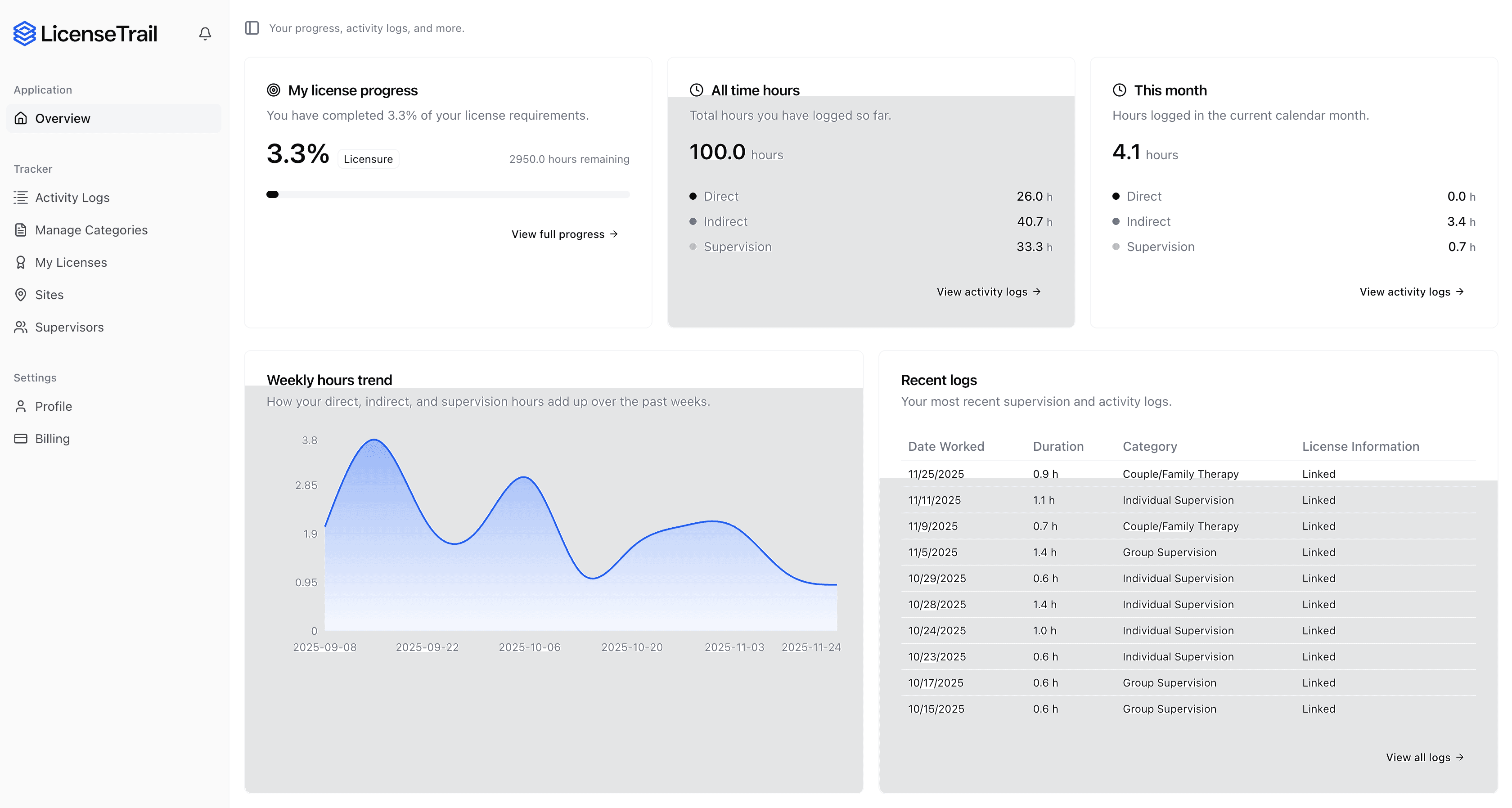
Track your P-LPC hours with confidence
License Trail checks your direct, indirect, and supervision hours against Mississippi P-LPC requirements continuously and flags mismatches before you submit.
 Start Tracking for Free
No credit card required · Free plan available
Related Licenses
Is your spreadsheet hiding Mississippi P-LPC risks?
Stop guessing if your categories match Mississippi State Board of Examiners for Licensed Professional Counselors requirements. License Trail checks your direct, indirect, and supervision hours continuously and flags mismatches before you submit.
Import or log
Bring your spreadsheet or start fresh
Upload your existing tracking spreadsheet and we'll map every hour into the right Mississippi State Board of Examiners for Licensed Professional Counselors categories automatically.
Verify against Mississippi
Catch mismatches before the board does
License Trail checks your direct, indirect, and supervision hours against Mississippi P-LPC requirements continuously.
Export board-ready
One-click clean reports
Generate professional, board-ready reports for supervision meetings and Mississippi State Board of Examiners for Licensed Professional Counselors submissions in seconds.
No credit card required · Free plan available