
Mississippi Temporary Practice Certificate Requirements: Hours, Exams & Step-by-Step Guide
Stop guessing if your categories match Mississippi requirements. License Trail checks your direct, indirect, and supervision hours against Temporary Practice Certificate requirements continuously and flags mismatches before you submit.
No credit card required · Free plan available
Quick Requirements Overview
- Must hold a current, in-good-standing psychologist license in another jurisdiction (doctoral-degree–based; subdoctoral licenses ineligible)
- Must be a nonresident of MS and not maintain an office in Mississippi
- Intended MS work must be brief/limited; not full-time or a major portion of professional time; not for ongoing/extended part-time or contractual roles
- Practice cap: max 30 days of psychological work in any consecutive 12-month period; any part of a day counts as 1 day
- Ineligible if previously denied MS licensure (and not for those seeking MS licensure or with revoked/denied MS license status)
- Application: submit online + provide license verification in good standing + statement describing nature/scope of MS services
- May be required to pass a Mississippi jurisprudence exam
- Fee: $100; certificate may be issued no more than 3 times (then must pursue full licensure)
License Details
Procedures
A Temporary Practice Certificate from the Mississippi Board of Psychology is a short‑term authorization that lets an already‑licensed psychologist from another jurisdiction practice in Mississippi for a limited time without obtaining a full Mississippi license. It is aimed at situations such as a forensic evaluation in a Mississippi court case or brief specialty consultation, rather than ongoing practice in the state. (psychologyboard.ms.gov)
Below is a structured explanation of what the Board requires, including how the state talks about hours and supervised experience.
1. What the Temporary Practice Certificate Is (and Is Not)
Mississippi distinguishes between:
- Permanent Mississippi psychologist license – full licensure in the state (with formal training and supervised‑experience hour requirements).
- Temporary License – for applicants already licensed elsewhere who are in the process of obtaining Mississippi licensure and need authority to practice while awaiting the oral exam. (psychologyboard.ms.gov)
- Temporary Practice Certificate – for psychologists who stay licensed in another jurisdiction and only need to practice in Mississippi briefly, without becoming Mississippi licensees. (psychologyboard.ms.gov)
Your question is about the Temporary Practice Certificate.
The Board describes this certificate as designed for “psychologists already licensed in another jurisdiction who have a limited or temporary need to provide services in Mississippi,” and specifically states that it is not intended for those in the process of seeking a Mississippi license or for anyone whose Mississippi license has been denied or revoked. (psychologyboard.ms.gov)
2. Core Eligibility Requirements
Under the Board’s Rules and Regulations (Rule 4.7(B)) and Mississippi Code § 73‑31‑14(2), you must meet all of the following to be granted a Temporary Practice Certificate: (psychologyboard.ms.gov)
-
Licensed as a psychologist in another jurisdiction
- You must already be “duly licensed” as a psychologist by another state, territory, the District of Columbia, Puerto Rico, or a Canadian province.
- Your license must be current and in good standing.
-
Doctoral‑degree‑based license
- You are ineligible if your home jurisdiction issued your psychology license “based on a level of education below a doctoral degree.” (psychologyboard.ms.gov)
- In practice, this means your underlying license must rest on a doctoral degree in psychology (or a closely regulated equivalent consistent with that jurisdiction’s law).
-
Non‑resident with no office in Mississippi
- You must not be a resident of Mississippi and must not maintain an office in Mississippi. (psychologyboard.ms.gov)
-
Intended practice is brief and not a regular presence
- You cannot intend to practice full‑time or for “a major portion” of your professional time in Mississippi. (psychologyboard.ms.gov)
- Extended part‑time, routine contractual roles, or arrangements that effectively create an ongoing Mississippi practice are explicitly disallowed even if they technically fit under the day limit (see practice‑limits section below). (psychologyboard.ms.gov)
-
No prior denial of Mississippi licensure
- The rules state that any applicant who has been denied licensure by the Mississippi Board of Psychology is not eligible for a Temporary Practice Certificate. (psychologyboard.ms.gov)
-
Limit on how many certificates you can receive
- The Board’s rules specify that an individual may be issued a Temporary Practice Certificate no more than three times. After that, the individual “will be required to apply for licensure.” (psychologyboard.ms.gov)
3. Practice Limits: Days, Scope, and What Counts as a “Day”
Unlike some states that strictly limit hours of practice, Mississippi limits days and the nature of the engagement.
3.1 Duration Limit – 30 Days per 12‑Month Period
Mississippi law and Board rules both state that practice under a Temporary Practice Certificate:
- “shall be limited in duration” and
- “shall not exceed thirty (30) days during a consecutive twelve‑month period.” (psychologyboard.ms.gov)
The Board goes further in its regulations and defines what they mean by a “day”:
- A day is defined as any part of a day in which psychological work is performed under the Temporary Practice Certificate. (psychologyboard.ms.gov)
This means:
- If you perform psychological services for even a short portion of a calendar day while physically (or legally) practicing in Mississippi, that entire day counts against your 30‑day limit.
3.2 Scope Limit – Preventing “Back‑Door” Full‑Time Practice
The Board is clear that a Temporary Practice Certificate:
- “shall be limited in scope” and
- “shall not be used to circumvent or avoid obtaining a license to practice psychology.” (psychologyboard.ms.gov)
The rules explicitly state that you are not eligible for a Temporary Practice Certificate if you intend to practice full‑time or devote a major portion of your professional time to Mississippi. (psychologyboard.ms.gov)
They then list examples of disallowed use, even if you remain under the 30‑day cap:
- Extended part‑time employment in Mississippi
- Extended contractual employment or engagement in Mississippi
These are treated as evidence that you are creating an ongoing practice and should instead seek a permanent license. (psychologyboard.ms.gov)
4. Application Requirements and Process
4.1 Application and Documentation
To obtain a Temporary Practice Certificate, you must: (psychologyboard.ms.gov)
-
Submit the Board’s online application
- The Board directs applicants to apply through its online system via the Temporary Practice Certificate page. (psychologyboard.ms.gov)
-
Provide verification of licensure in good standing
- The rules require “verification of licensure in good standing with another board in a jurisdiction whose licensure requirement requires obtaining a doctoral degree.” (psychologyboard.ms.gov)
- This can be via direct license verification or equivalent documentation acceptable to the Mississippi Board.
-
Submit a statement of the nature and scope of practice
- You must describe what services you will provide, to whom, where, and under what circumstances (e.g., expert witness evaluation for a specific case, short‑term inpatient consultation, etc.). (psychologyboard.ms.gov)
-
Take a Mississippi jurisprudence examination if required
- The rules specify that an applicant may be required to take a jurisprudence examination covering Mississippi licensure law and the Board’s rules. (psychologyboard.ms.gov)
-
Pay the required fee
- The Board’s published fee schedule lists a “Temporary Practice Certificate Fee” of $100. (psychologyboard.ms.gov)
-
Await Board approval
- The Board reviews your application, verifies your out‑of‑state license and the proposed scope of practice, and decides whether to approve the certificate.
5. Hours and Supervised Experience: How Mississippi Talks About Them
Your example mentioned requirements such as “1,500 hours of direct experience and 1,500 hours of supervised experience.” Mississippi’s rules and statutes use a different structure and terminology.
5.1 For the Temporary Practice Certificate Itself
For the Temporary Practice Certificate, Mississippi does not require you to document a specific number of:
- direct service hours,
- supervised hours, or
- total professional experience hours.
Instead, for the temporary certificate, the Board focuses on:
- your existing license, which must be doctoral‑degree‑based and in good standing, and
- strict limits on days and scope of practice in Mississippi. (psychologyboard.ms.gov)
The only explicit “time” metric applied to the certificate itself is:
- a cap of 30 days of practice in any consecutive 12‑month period, and
- the definition of a day as any part of a day in which psychological work is performed. (psychologyboard.ms.gov)
There is no numeric hour cap per day in the rules. Practically, you could provide services for one hour or ten hours in a day; both count as one “day” for purposes of the 30‑day limit.
5.2 Hours and Supervised Experience in Mississippi’s Licensure Law (Context)
While not directly required for the Temporary Practice Certificate, the Mississippi psychologist licensure law does define supervised training hours for permanent licensure, and this is the main place where specific hour counts appear.
Historically, Mississippi required: (law.justia.com)
- Two (2) years of supervised experience in the same area as the academic degree.
- This included:
- a pre‑doctoral internship and
- one (1) year of supervised post‑doctoral experience.
- This included:
- Each year (or equivalent) had to consist of at least 2,000 hours of actual work, including direct service, training, and supervisory time.
- A pre‑doctoral internship could be counted as one of the two years.
This amounted to a minimum of 4,000 hours of supervised, doctoral‑level experience (2,000 hours internship + 2,000 hours post‑doc) under earlier versions of § 73‑31‑13.
More recently, the licensing statute has been amended. As reflected in the current text of Mississippi Code § 73‑31‑13 (as of 2024) and proposed amendments, the focus is now on a doctoral‑level supervised internship: (law.justia.com)
- Applicants must have completed a supervised internship from an APA‑ or CPA‑accredited program (or equivalent, as determined by the Board).
- This internship must consist of at least 1,800 hours of actual work, which explicitly includes:
- direct service,
- training, and
- supervisory time.
Key point for your original question:
- These 1,800+ supervised internship hours (and, under older versions, 4,000 supervised hours including a postdoc year) are licensure requirements for a full Mississippi psychologist license, not criteria that the Board asks you to document separately when applying for a Temporary Practice Certificate.
- For the Temporary Practice Certificate, Mississippi relies on the fact that you already hold a doctoral‑based psychology license in another jurisdiction; they do not restate or re‑verify your pre‑licensure hour totals.
6. Step‑by‑Step Checklist for the Temporary Practice Certificate
If you are an out‑of‑state psychologist planning limited services in Mississippi, your process would look like this:
-
Confirm you are eligible
- Doctoral‑degree‑based psychology license in another jurisdiction.
- License in good standing.
- You are not a Mississippi resident, do not maintain a Mississippi office, have never been denied Mississippi licensure, and do not intend to practice full‑time or for a major part of your time in Mississippi. (psychologyboard.ms.gov)
-
Check your planned practice
- Make sure total days of psychological work in Mississippi will not exceed 30 days in any consecutive 12‑month period, remembering that any part of a day of work counts as a full day. (psychologyboard.ms.gov)
- Ensure your work is short‑term and case‑specific, not ongoing employment or a long‑term contractual arrangement.
-
Gather documentation
- Official verification of your license in good standing from your home jurisdiction.
- A concise written description of the nature and scope of the services you will provide in Mississippi. (psychologyboard.ms.gov)
-
Apply online and pay the fee
- Use the Mississippi Board of Psychology’s online portal from the Temporary Practice Certificate page.
- Pay the $100 Temporary Practice Certificate fee (amount per current fee schedule). (psychologyboard.ms.gov)
-
Complete jurisprudence requirements (if assigned)
- Be prepared to take a Mississippi jurisprudence examination if the Board requires it. (psychologyboard.ms.gov)
-
Track your certificates
- You may be issued a Temporary Practice Certificate no more than three times; beyond that, you must seek regular licensure if you wish to continue practicing in the state. (psychologyboard.ms.gov)
Bottom line on “hours”
For the Temporary Practice Certificate:
- Mississippi measures your activity in days, not hours, and places a 30‑day‑per‑year cap with a broad definition of what counts as a “day.”
- There is no stated requirement such as “1,500 hours of direct experience and 1,500 hours of supervised experience” attached specifically to the Temporary Practice Certificate.
For permanent licensure, Mississippi’s law uses supervised‑experience hour counts (historically 4,000 total supervised hours; currently an internship of at least 1,800 supervised hours), but these are part of the full licensure pathway rather than the Temporary Practice Certificate requirements. (law.justia.com)
Track your Temporary Practice Certificate hours with confidence
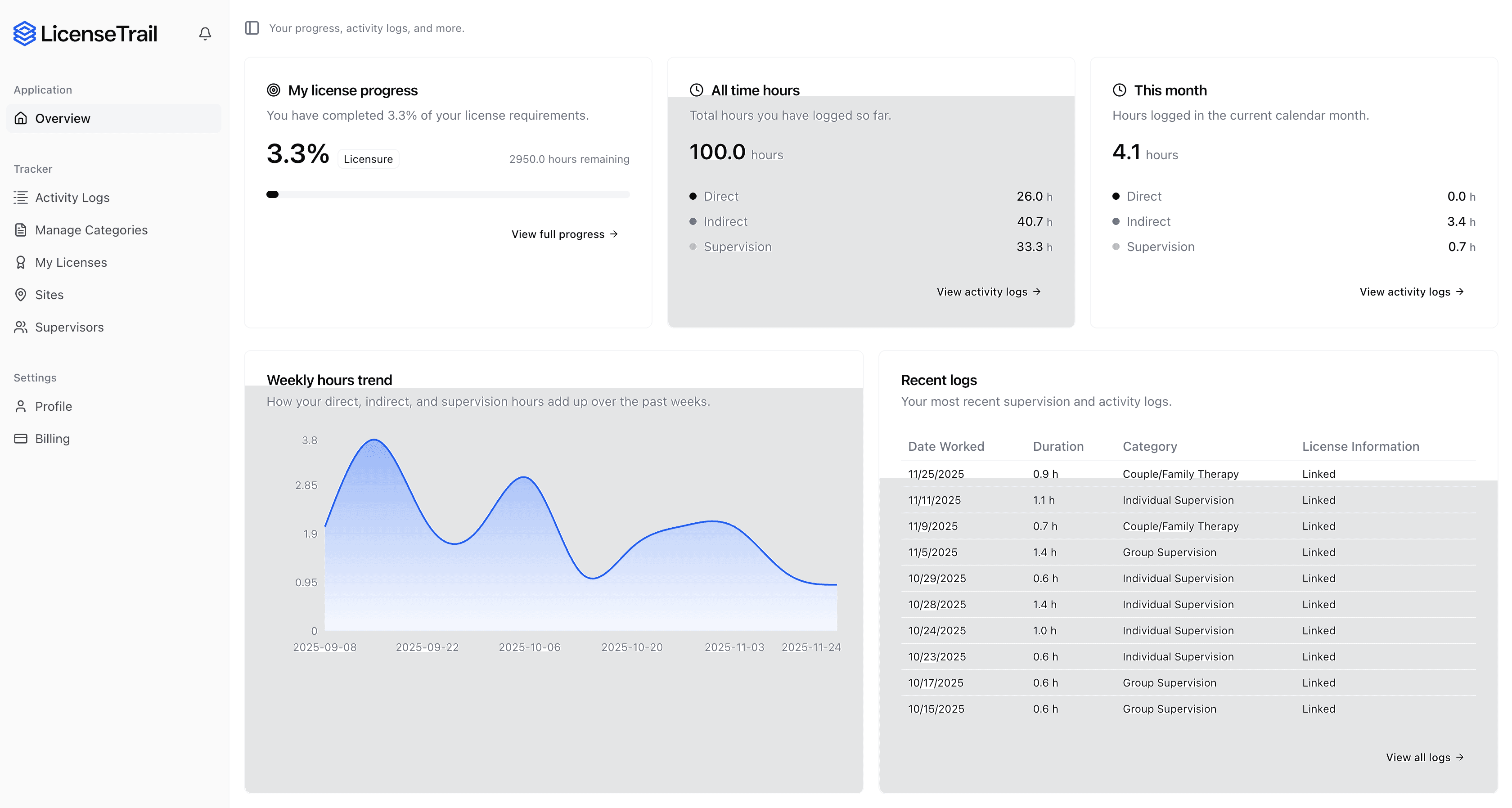
License Trail checks your direct, indirect, and supervision hours against Mississippi Temporary Practice Certificate requirements continuously and flags mismatches before you submit.
 Start Tracking for Free
No credit card required · Free plan available
Related Licenses
Is your spreadsheet hiding Mississippi Temporary Practice Certificate risks?
Stop guessing if your categories match Mississippi Board of Psychology requirements. License Trail checks your direct, indirect, and supervision hours continuously and flags mismatches before you submit.
Import or log
Bring your spreadsheet or start fresh
Upload your existing tracking spreadsheet and we'll map every hour into the right Mississippi Board of Psychology categories automatically.
Verify against Mississippi
Catch mismatches before the board does
License Trail checks your direct, indirect, and supervision hours against Mississippi Temporary Practice Certificate requirements continuously.
Export board-ready
One-click clean reports
Generate professional, board-ready reports for supervision meetings and Mississippi Board of Psychology submissions in seconds.
No credit card required · Free plan available