
Missouri LMSW Requirements: Hours, Exams & Step-by-Step Guide
Stop guessing if your categories match Missouri requirements. License Trail checks your direct, indirect, and supervision hours against LMSW requirements continuously and flags mismatches before you submit.
No credit card required · Free plan available
Quick Requirements Overview
- CSWE-accredited MSW/DSW required (master’s-level, non-independent license)
- Must be 18+ and a U.S. citizen or legal resident; criminal history reviewed (affidavit/documents if issues)
- Pass ASWB Masters exam (cannot test before final semester; program letter required if testing in final semester pre-grad)
- Complete 2 hours suicide assessment/referral/treatment/management training within 2 years of application
- Fingerprint-based MO State Highway Patrol vendor background check (state + FBI) required
- Submit application (MOPRO / LMSW-LBSW form) with official transcripts + ASWB score sent directly; $70 fee
- No post-degree supervised hours required for LMSW issuance
- LMSW limits: cannot diagnose or provide psychotherapy/treat mental/emotional disorders without direct LCSW supervision; higher licensure (LCSW/LAMSW) requires registered supervision and 3,000 hours in 24–48 months
License Details
Procedures
Licensure as a Licensed Master Social Worker (LMSW) in Missouri is governed by the State Committee for Social Workers (Division of Professional Registration) under Chapter 337, RSMo, and Title 20 CSR 2263. This credential is the master’s‑level, non‑independent license and is the gateway to supervised clinical (LCSW) or advanced macro licensure.
Below is a Missouri‑specific guide, with emphasis on hours, supervision, and the board’s own wording.
1. What the LMSW License Is (and Is Not) in Missouri
Missouri law defines a “licensed master social worker” as someone licensed to practice master social work who offers services for a fee and holds a current LMSW license. An LMSW:
- “may not treat mental or emotional disorders, provide psychotherapy without the direct supervision of a licensed clinical social worker, or diagnose a mental disorder.” (law.justia.com)
“Master social work” covers advanced, non‑independent practice such as assessment, treatment planning, case management, counseling, client education, supervision, consultation, research, advocacy, and community organization. Under supervision and for a limited period, it can also include activities reserved to clinical or advanced macro social workers while you work toward those higher licenses. (law.justia.com)
2. Core Eligibility Requirements for LMSW
2.1 Education
Missouri statute requires that an LMSW applicant:
- “has a master's or doctorate degree in social work from an accredited social work degree program approved by the Council on Social Work Education.” (law.justia.com)
In practice: your MSW/DSW must be from a CSWE‑accredited program (or equivalent accepted by the committee).
2.2 Age, citizenship, and character
The same statute requires that an applicant: (law.justia.com)
- Be at least 18 years of age.
- Be a U.S. citizen or legal resident alien.
- Have no disqualifying criminal history as described in section 324.012 RSMo (offenses “directly related to the duties and responsibilities of the occupation”).
If you disclose anything that might be grounds for denial, you must file a sworn affidavit with detailed facts and documentation. (law.justia.com)
2.3 Examination
You must achieve “a passing score, as defined by the committee, on an examination approved by the committee.” (law.justia.com)
By rule, that exam is the ASWB Masters exam. The application rule specifies: (law.cornell.edu)
- The required test is the “licensed master social worker – masters examination” administered by ASWB.
- An exam “taken prior to the final semester of the degree program is not acceptable”; the committee must receive a letter from your CSWE‑accredited program confirming you are on track to graduate if you test during the final semester.
3. Application Components and Process
3.1 Forms and portal
The State Committee’s forms page lists an “Application for Licensure – LMSW/LBSW,” used for initial LMSW or LBSW licensure. (pr.mo.gov)
As of 2025, Missouri is moving all applications into the MOPRO online licensing portal, where you can “apply for a license” and manage your file. (pr.mo.gov)
3.2 Required documentation (20 CSR 2263‑2.050)
The application rule applies broadly to social work licensure and requires the following for a complete file: (law.cornell.edu)
- Completed application form, specifying LMSW as the license type.
- Official transcripts sent directly from your school.
- Verification of passing ASWB score sent directly from ASWB.
- Proof of suicide‑prevention training:
- “Proof of completing two (2) hours of suicide assessment, referral, treatment, and management training taken within the prior two (2) years of application submission.” (law.cornell.edu)
- Fingerprint‑based background check:
- Proof that you submitted fingerprints to the Missouri State Highway Patrol’s approved vendor for both state and FBI checks; fees are paid directly to the Patrol/vendor. (law.cornell.edu)
- Application/initial license fee (currently $70, payable to the State Committee for Social Workers). (pr.mo.gov)
The same rule notes that any required Attestation of Supervision forms must be sent directly by the supervisor “if applicable,” but—for LMSW licensure—no supervised post‑degree hours are required, so most new‑graduate applicants will not submit supervision attestations. (law.cornell.edu)
4. Hours and Supervised Experience: What Missouri Actually Requires
4.1 Post‑degree hours required to obtain an LMSW: none
Missouri’s LMSW statute (§337.644) lists education, exam, age/legal status, application, and fee requirements—but does not list any number of supervised practice hours as a precondition for the LMSW license. (law.justia.com)
The state’s supervision rule, 20 CSR 2263‑2.030, explicitly states its purpose is to “set out the supervised experience requirements for licensed clinical social workers and licensed baccalaureate social workers,” not for LMSWs. (regulations.justia.com)
Independent summaries of Missouri licensure (based on these rules) are consistent: “LBSW and LMSW licenses don’t need supervised experience. Higher-level credentials have stricter requirements.” (msweducation.org)
So:
- Number of supervised post‑MSW hours required to obtain LMSW in Missouri:
- 0 hours.
- The only “hours” before LMSW are your graduate field/practicum hours, which are part of your CSWE‑accredited MSW program, not a separate state‑mandated hour requirement.
4.2 Hours after LMSW, if you pursue LCSW or advanced macro licensure
Once you hold an LMSW, you may register supervision with the committee to work toward:
- Licensed Clinical Social Worker (LCSW), or
- Licensed Advanced Macro Social Worker (LAMSW).
Key supervision rules and hour requirements:
-
Supervision can begin only after LMSW (or LBSW) is issued
- “Supervision of the applicant for licensure shall not begin, and will only be acceptable to the committee, after the issuance of the license as a master social worker or licensed baccalaureate social worker.” (regulations.justia.com)
-
Registration of supervision is mandatory
- Before beginning, “supervised social work experience shall be registered for approval by the committee.” (regulations.justia.com)
- To register, you must hold either:
- a Licensed Master Social Worker (LMSW) license (for clinical or advanced macro paths), or
- a Licensed Baccalaureate Social Worker (LBSW) license (if seeking independent baccalaureate‑level practice). (regulations.justia.com)
- If you change supervisors or settings, you must file a change‑of‑status form within 14 days. Failure to do so means “supervision hours [are] not calculated towards the three thousand (3,000) hours of supervised licensed social work experience.” (regulations.justia.com)
-
Total supervised experience required for higher licenses
For clinical and advanced macro licensure, Missouri requires a minimum acceptable supervised experience of:
- “three thousand (3,000) hours obtained in no less than twenty‑four (24) and no more than forty‑eight (48) consecutive calendar months.” (regulations.justia.com)
This 3,000‑hour requirement is repeated in:
- 20 CSR 2263‑2.030 (Supervised Licensed Social Work Experience) for clinical/baccalaureate paths; (regulations.justia.com)
- §337.615 RSMo (LCSW); (codes.findlaw.com)
- §337.645 RSMo (advanced macro). (house.mo.gov)
Missouri does not break those 3,000 hours into something like “1,500 direct client hours + 1,500 other hours” in statute or rule. The formal wording is simply “three thousand (3,000) hours of supervised” social work experience over a 24–48 month consecutive period, with detailed supervision structure (below). (regulations.justia.com)
- Supervision session requirements (part of those hours)
The supervision rule outlines how the 3,000 hours must be supervised: (regulations.justia.com)
- Frequency and format:
- At least two (2) hours every two (2) weeks of individual face‑to‑face supervision.
- These individual hours may be consolidated to four (4) hours per four‑week period.
- Up to 50% of supervision per month may be group supervision.
- Group supervision size:
- Group supervision may include “at least two (2) and no more than six (6) supervisees.”
- Use of technology:
- Electronic communication (audio‑visual) is acceptable if confidentiality and interactive verbal/visual contact are maintained.
These supervision sessions occur within the broader 3,000 hours of supervised licensed social work experience.
5. Scope of Practice and Supervision Limits for LMSWs
Missouri’s definition and practice provisions together establish the LMSW’s scope: (law.justia.com)
- You are authorized to practice “master social work,” including advanced case management, counseling, supervision (of certain staff roles), program planning and administration, research, and advocacy.
- You cannot independently perform services reserved for clinical or advanced macro social workers (psychotherapy, diagnosis, clinical treatment) without proper supervision and higher licensure.
- Any practices “reserved to clinical social workers or advanced macro social workers” that you perform as an LMSW must:
- be done under registered supervision, and
- be “for the purpose of obtaining licensure” as LCSW or LAMSW, and
- occur within an employment setting where a licensed clinical or licensed advanced macro social worker is your approved supervisor. (law.justia.com)
6. License Term and Continuing Education
All social work licenses issued under §§337.600–337.689, including the LMSW, have: (house.mo.gov)
- A term of 24 months, and
- A requirement of “a minimum number of thirty clock hours of continuing education” for each renewal cycle.
Recent board and CE guidance clarifies that: (elevatece.com)
- LMSWs must complete 30 hours of CE every two years, which must include at least:
- 3 hours in ethics,
- 2 hours in suicide assessment, referral, treatment and management, and
- 3 hours related to diversity, inclusion, cultural awareness/competence/humility.
- For the 2024–2025 renewal cycles, the committee has temporarily waived the usual 15‑hour limit on correspondence courses; CE can be any mix of live, webinar, or correspondence, subject to other rules.
7. Step‑by‑Step Path to LMSW in Missouri
- Complete a CSWE‑accredited MSW (or DSW/PhD in social work) that meets §337.644(2)(1). (law.justia.com)
- During your final MSW semester, arrange to sit for the ASWB Masters exam:
- If testing before graduation, obtain the program letter confirming you are “on track to graduate,” as required by 20 CSR 2263‑2.050. (law.cornell.edu)
- Pass the ASWB Masters exam.
- Complete mandatory 2‑hour suicide‑prevention training (assessment, referral, treatment, management) within two years before application. (law.cornell.edu)
- Submit fingerprints through the Missouri State Highway Patrol vendor for state and FBI background checks. (law.cornell.edu)
- File your LMSW application via MOPRO or the “Application for Licensure – LMSW/LBSW,” including:
- Application form;
- Official transcripts (sent directly);
- ASWB exam score verification (sent directly);
- Proof of suicide training;
- Fingerprint/background documentation as instructed;
- $70 application/initial license fee. (law.cornell.edu)
- Wait for committee review and issuance of your LMSW license. Once issued, you may:
- Practice within the master‑level scope of practice, observing all LMSW limitations; and
- Register supervision to begin accruing the 3,000 supervised hours over 24–48 months if you plan to pursue LCSW or advanced macro licensure. (regulations.justia.com)
Key Takeaway on Hours
- To obtain the LMSW itself in Missouri: there is no state‑mandated number of supervised post‑degree practice hours; eligibility is based on degree, exam, background/character, suicide training, and application/fees. (law.justia.com)
- To move beyond LMSW (LCSW or LAMSW): you must complete 3,000 hours of supervised licensed social work experience in 24–48 consecutive months, with structured, face‑to‑face supervision as detailed in 20 CSR 2263‑2.030 and 20 CSR 2263‑2.032. (regulations.justia.com)
Track your LMSW hours with confidence
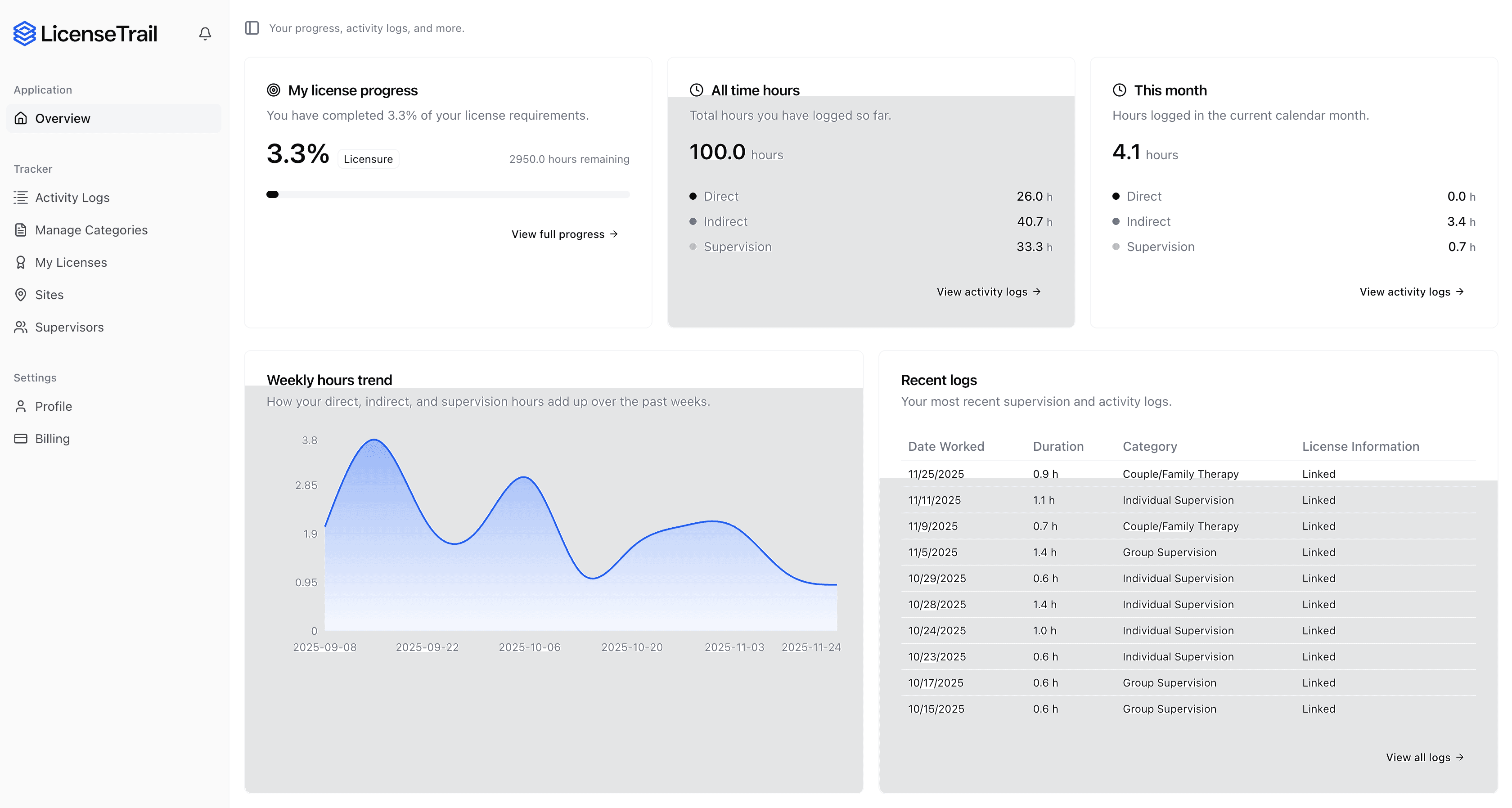
License Trail checks your direct, indirect, and supervision hours against Missouri LMSW requirements continuously and flags mismatches before you submit.
 Start Tracking for Free
No credit card required · Free plan available
Related Licenses
Is your spreadsheet hiding Missouri LMSW risks?
Stop guessing if your categories match Missouri Committee for Social Workers requirements. License Trail checks your direct, indirect, and supervision hours continuously and flags mismatches before you submit.
Import or log
Bring your spreadsheet or start fresh
Upload your existing tracking spreadsheet and we'll map every hour into the right Missouri Committee for Social Workers categories automatically.
Verify against Missouri
Catch mismatches before the board does
License Trail checks your direct, indirect, and supervision hours against Missouri LMSW requirements continuously.
Export board-ready
One-click clean reports
Generate professional, board-ready reports for supervision meetings and Missouri Committee for Social Workers submissions in seconds.
No credit card required · Free plan available