
Missouri PLMFT Requirements: Hours, Exams & Step-by-Step Guide
Stop guessing if your categories match Missouri requirements. License Trail checks your direct, indirect, and supervision hours against PLMFT requirements continuously and flags mismatches before you submit.
No credit card required · Free plan available
Quick Requirements Overview
- Degree: Master’s/specialist/doctorate in MFT (or equivalent mental health discipline) from a regionally accredited school; COAMFTE/CACREP accepted; otherwise ≥45 semester (60 quarter) hours with required core areas incl. diagnostic systems
- Exam: Pass the AMFTRB National MFT Exam
- Background check: MO State Highway Patrol + FBI fingerprinting (via approved vendor; applicant pays)
- Supervision registration: File supervision registration (and fee), official transcripts, and (if needed) setting–supervisor agreement; changes filed within 15 days
- Supervisor: Qualified per rule (proper degree, 5 yrs clinical experience, licensed ≥2 yrs, plus AAMFT-Approved Supervisor or 200 supervision hrs); may supervise max 10 total supervisees
- PLMFT practice limits: Must practice under supervisor’s full oversight; no independent/private practice; ads must list supervisor name & license #; no direct billing (handled by supervisor/setting); supervisor co-signs/reviews documentation
- Post-degree hours toward LMFT (master’s path): 1,500 direct client-contact hrs in 24–60 months (must log ≥15 supervised hrs/month) + 200 supervision hrs (≥100 individual; group allowed; 1 hr weekly or 2 hrs/2 weeks)
- Alternate hours (doctoral/specialist/30 post-grad hrs): 750 direct client-contact hrs in 12–24 months (still ≥15 hrs/month) with same supervision standards; PLMFT validity typically 3 yrs (master’s) or 2 yrs (advanced path), extendable for good cause
License Details
Procedures
In Missouri, the State Committee of Marital and Family Therapists regulates three statuses related to marital and family therapy:
- Provisional Licensed Marital and Family Therapist (PLMFT)
- Licensed Marital and Family Therapist (LMFT)
- Supervised Marital and Family Therapist (S‑MFT)
A PLMFT is someone who has met all requirements for licensure except the post‑degree supervised clinical experience, and who is practicing under a qualified supervisor while completing that experience. (house.mo.gov)
Below is a step‑by‑step overview of how to qualify for PLMFT in Missouri, followed by a detailed breakdown of the supervised hours and how the board defines them.
1. Understand the Roles: PLMFT vs LMFT vs S‑MFT
Statutory definition of PLMFT
Missouri law defines a “provisional licensed marital and family therapist” as a person who:
- Has at least a master’s degree in marital and family therapy (or equivalent, as defined by regulation) from an acceptable institution, and
- “Meets all requirements of a licensed marital and family therapist other than the supervised clinical experience” required for full licensure, and
- Is supervised by a person who meets the board’s standards to be a supervisor. (house.mo.gov)
S‑MFT (Supervised Marital and Family Therapist)
Missouri also recognizes a supervised status (S‑MFT) for people completing supervised experience without holding a provisional license. These individuals must still register supervision with the committee and work under an approved supervisor, but cannot use the PLMFT title. (law.cornell.edu)
In practice, your options while accruing hours toward LMFT are:
- Hold a PLMFT license, or
- Work under the title S‑MFT (registered supervision, but not provisionally licensed).
The supervised hour requirements discussed below apply to both PLMFT and S‑MFT.
2. Educational Requirements (Pre‑PLMFT)
To apply for licensure or supervision (which includes PLMFT status), you must have a graduate degree that meets the board’s education rule. (regulations.justia.com)
Degree level and type
Missouri requires:
- A master’s, specialist, or doctoral degree with:
- A major in marriage and family therapy, or
- An equivalent graduate course of study in a mental health discipline, from a regionally accredited institution recognized by the U.S. Department of Education. (regulations.justia.com)
Degrees from COAMFTE‑accredited MFT programs or CACREP‑accredited marriage, couple, and family counseling programs automatically meet the educational standard. (regulations.justia.com)
If your program is not COAMFTE/CACREP‑accredited, it must include at least 45 semester hours (or 60 quarter hours) of graduate study in marital and family therapy or equivalent mental health coursework. (regulations.justia.com)
Required content areas
Your graduate or post‑graduate coursework must cover the following core areas (each with minimum credit hours): (regulations.justia.com)
-
Theoretical foundations of marriage and family therapy
- 3 semester hours (or 5 quarter hours)
-
Practice of marriage and family therapy
- 12 semester hours (or 20 quarter hours)
-
Human development and family studies
- 6 semester hours (or 10 quarter hours)
-
Ethics and professional studies
- 3 semester hours (or 5 quarter hours)
-
Research methodology
- 3 semester hours (or 5 quarter hours)
-
Practicum in marital and family therapy
- 6 semester hours (or 10 quarter hours)
- Must include at least the minimum client contact hours required by COAMFTE standards.
-
Diagnostic systems
- 3 semester hours (or 5 quarter hours) of graduate‑level study in diagnostic systems, either within the degree program or as post‑master’s coursework, completed prior to issuance of a license. (regulations.justia.com)
You must complete these educational requirements before you can be fully licensed. Supervision for licensure may begin while you are finishing some core courses, but deficiencies must be completed as specified by the committee. (law.cornell.edu)
3. Criminal Background Check and Fingerprinting
Before your supervision registration / PLMFT application is considered complete, the committee requires: (law.cornell.edu)
- A criminal background check using:
- Missouri State Highway Patrol, and
- FBI fingerprint check,
- Submitted through the Patrol’s approved vendor(s), with fees paid by you directly.
Statute also requires that an applicant be at least 18, a U.S. citizen or legal resident, and have no disqualifying criminal history as defined in §324.012 RSMo. (law.justia.com)
4. Register Supervision and Secure an Approved Supervisor
To begin accruing licensure supervision as a PLMFT or S‑MFT, you must file a registration of supervision with the State Committee. The supervision rule requires the following be on file for your supervision application to be considered complete: (law.cornell.edu)
- A registration of supervision (or change of supervision) application form, legible and completed in black or blue ink.
- The supervision application fee.
- Official graduate transcripts sent directly from your institution(s).
- When applicable, a written agreement connecting the supervisor to the setting where you will obtain licensure supervision.
- Results of the background and fingerprint checks described above.
If you change supervisors or settings, you must file a change of supervision form and pay the associated fee within 15 days. (law.cornell.edu)
Supervisor qualifications
Your supervisor must meet the requirements in 20 CSR 2233‑2.021, including: (law.cornell.edu)
- Graduate degree with a major in marital and family therapy or a mental health discipline from a regionally accredited institution;
- At least five years of clinical experience providing marital and family therapy (excluding practicum/internship hours);
- A current license (for at least 2 years) in Missouri or another state as:
- Marital and family therapist, professional counselor, psychologist, clinical social worker, or psychiatrist;
- AND either:
- Designation as an AAMFT‑Approved Supervisor, or
- At least 200 hours of providing clinical supervision to individuals seeking licensure in specified mental health professions (including MFT).
A supervisor may oversee no more than 10 supervisees at one time (including PLMFTs, S‑MFTs, and supervisees from other mental health disciplines). (law.cornell.edu)
5. Pass the National MFT Examination
Missouri uses the National Examination in Marital and Family Therapy (AMFTRB exam). Statute requires that, “upon examination,” the applicant show requisite knowledge of the profession, including techniques and applications, research and its interpretation, and professional affairs and ethics. (law.justia.com)
Current practice information summarized for Missouri indicates that to obtain a PLMFT license you must: (counselingschools.com)
- Have the required MFT master’s (or higher) degree,
- Pass the AMFTRB national exam,
- Complete the background check and fingerprinting,
- File a completed licensure/supervision application with appropriate fees and supervision documentation.
You should confirm exact exam timing and fee details with the committee’s current forms, as the administrative rules outline the authority to require and designate the licensing examination but do not duplicate the step‑by‑step checklist.
6. Apply for the PLMFT License
In practical terms, becoming a PLMFT means:
- Education completed (or very nearly completed if the committee allows supervision to start while you finish some core areas). (law.cornell.edu)
- Supervision registration approved with a qualified supervisor and setting. (law.cornell.edu)
- Background check and fingerprints processed. (law.cornell.edu)
- National MFT exam passed (per committee practice and external summaries). (counselingschools.com)
- PLMFT application and fee submitted to the committee via its licensing portal or paper forms.
Duration of the PLMFT license
For a PLMFT whose qualifying degree is a master’s degree:
- The provisional license is valid for at least three years from issuance and remains valid until the expiration date of the license or the termination of supervision, whichever occurs first, unless it is disciplined.
- The committee may extend a provisional license for good cause upon written request made before expiration. (law.cornell.edu)
For a PLMFT obtained based on 30 post‑degree graduate hours, a specialist, or a doctoral degree (under the advanced‑training path in 20 CSR 2233‑2.020(12)):
- The provisional license is valid for at least two years from issuance, through its expiration date or termination of supervision, with possible extension for good cause. (law.cornell.edu)
7. Supervised Experience Requirements While You Are a PLMFT
The supervised work experience is what ultimately qualifies you for full LMFT licensure. These hours are earned while you hold PLMFT or S‑MFT status, not before.
The board’s supervision rule defines “supervised clinical experience” and sets out specific numeric requirements for:
- Direct client contact hours, and
- Supervision hours.
7.1. Direct client contact hours (master’s‑level path)
For applicants whose path is based on a master’s degree, 20 CSR 2233‑2.020 requires: (law.cornell.edu)
- A minimum of 1,500 hours of supervised experience in marital and family therapy direct client contact,
- Completed in no fewer than 24 months and no more than 60 months.
The rule further specifies:
- The PLMFT or S‑MFT must obtain at least 15 hours of supervised experience in a calendar month for the hours in that month to count toward licensure. (law.cornell.edu)
- “Direct client contact” is defined as face‑to‑face interaction between the client and PLMFT or S‑MFT (which can include couples, families, and individuals, consistent with the statutory definition of marital and family therapy). (law.cornell.edu)
In other words:
1,500 hours must be direct, face‑to‑face client contact in marital and family therapy, accrued at a pace of at least 15 supervised hours per month, over 2–5 years.
Many secondary sources still describe Missouri as requiring 3,000 total supervised hours, including 1,500 direct client hours, but the current supervision rule itself explicitly sets a minimum of 1,500 direct client contact hours and 200 supervision hours (see below). (law.cornell.edu)
7.2. Supervision hours
Within the same 24‑ to 60‑month period, the board requires a significant amount of structured supervision with your registered supervisor: (law.cornell.edu)
-
Frequency of supervision
- At least 2 hours every 2 weeks, or
- At least 1 hour every week
of face‑to‑face supervision with the registered supervisor.
-
Definition of an hour
- An hour of individual face‑to‑face supervision is not less than 50 continuous minutes.
- Two hours is not less than 100 continuous minutes.
-
Minimum total supervision hours
- The PLMFT or S‑MFT must complete at least 200 hours of supervision.
- At least 100 of those hours must be individual face‑to‑face supervision; the remainder may be group supervision.
-
Individual vs. group
- Individual supervision may include no more than two PLMFTs or S‑MFTs in session with the supervisor.
- Group supervision may include at least three and no more than six PLMFTs and/or S‑MFTs.
-
Modality
- Supervision may be conducted via secure real‑time electronic methods (e.g., secure video) if:
- There is visual and audio interaction, and
- Data storage and communications are kept private and legally compliant.
- Supervision may be conducted via secure real‑time electronic methods (e.g., secure video) if:
These supervision hours are in addition to your 1,500 direct client contact hours (they are spent with your supervisor reviewing cases, not in therapy with clients).
7.3. Alternative path: Doctoral / Specialist / 30‑hour post‑master’s route
For applicants applying for supervised experience on the basis of: (law.cornell.edu)
- A doctoral or specialist degree in marriage and family therapy or an approved mental health discipline, or
- At least 30 graduate hours of post‑master’s coursework in MFT or an approved mental health discipline,
the rule provides an alternative supervised experience option:
- At least 750 hours of supervised experience in marital and family therapy direct client contact,
- Completed in no fewer than 12 months and no more than 24 months,
- With at least 15 hours of supervised experience per calendar month, and compliance with the same supervision requirements in subsections (10)–(12) (including ongoing supervision and provisional license validity). (law.cornell.edu)
The same principles regarding supervisor qualifications, supervisory frequency, and the requirement for a minimum number of supervision hours apply.
8. Practice Conditions and Restrictions While You Are a PLMFT
The board’s supervision rule sets tight guardrails on what PLMFTs and S‑MFTs can do in practice: (law.cornell.edu)
- All services you provide must be under the supervisor’s “full order, control, oversight, and guidance.”
- You must remain under licensure supervision until you are licensed as an LMFT.
- You may not:
- Engage in independent or private practice, or
- Offer therapy that is not affiliated with the supervisor approved by the committee.
Advertising and billing rules
While provisionally licensed or supervised:
- You cannot advertise or market your services without including the name and license number of your registered supervisor.
- You may not bill clients directly; billing and payment for services you provide must be handled by your supervisor or the approved supervision setting. (law.cornell.edu)
Use of title
- While under licensure supervision and representing yourself as provisionally licensed, you must use one of the following titles:
- “PLMFT” or
- “provisional licensed marital and family therapist.”
- If you are under supervision but not provisionally licensed, you must instead use:
- “S‑MFT” or
- “supervised marital and family therapist.” (law.cornell.edu)
Documentation requirements
- Your registered supervisor must read and co‑sign all written reports you prepare—including treatment plans and progress notes—and include their license number.
- If a setting prohibits co‑signatures on reports, you must document that your supervisor has reviewed those records. (law.cornell.edu)
9. Summary of Key Hour Requirements for Missouri PLMFTs
While no pre‑licensure hours are required to obtain the PLMFT itself (beyond degree practicum), the PLMFT is the license under which you complete the supervised experience needed for LMFT. Under current Missouri rules, the core experience requirements are:
For master’s‑based applicants (law.cornell.edu)
- 1,500 hours of supervised experience in marital and family therapy direct client contact
- Direct client contact = face‑to‑face interaction with clients.
- Must be completed in 24–60 months, with at least 15 supervised hours per month.
- 200 hours of supervision, of which:
- At least 100 hours must be individual face‑to‑face supervision,
- Remaining hours may be in group supervision (3–6 supervisees),
- Supervisory sessions must be at least 1 hour weekly or 2 hours every 2 weeks.
For doctoral / specialist / 30‑hour post‑master’s applicants (law.cornell.edu)
- 750 hours of supervised experience in direct client contact,
- Completed in 12–24 months, with at least 15 supervised hours per month,
- Supervision frequency and standards otherwise mirror those for master’s‑level applicants.
These supervised hours, along with continued good standing and adherence to ethical standards, are then documented and submitted when you apply to upgrade from PLMFT to LMFT under 20 CSR 2233‑2.020 and 20 CSR 2233‑2.030. (regulations.justia.com)
Track your PLMFT hours with confidence
License Trail checks your direct, indirect, and supervision hours against Missouri PLMFT requirements continuously and flags mismatches before you submit.
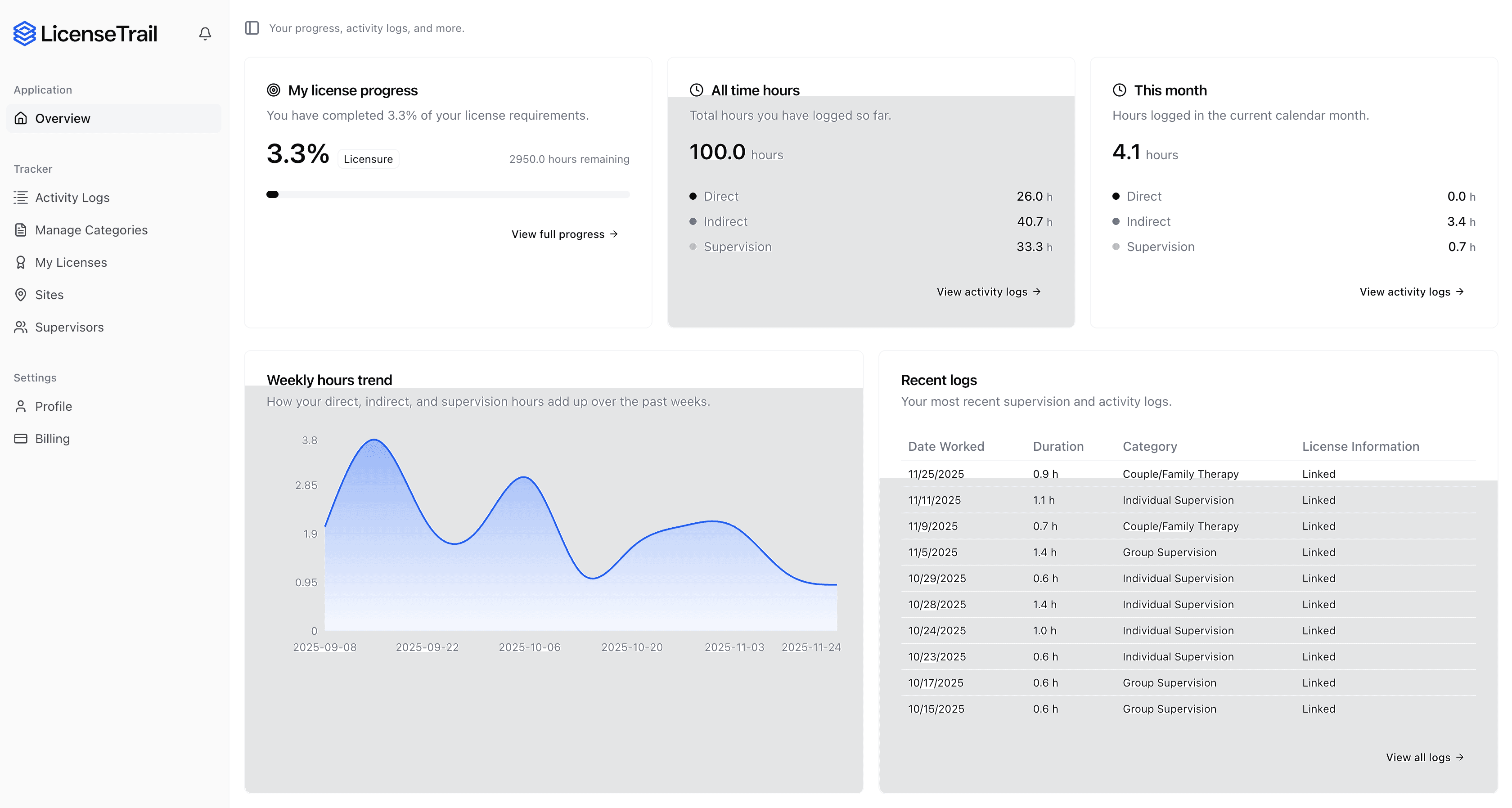 Start Tracking for Free
No credit card required · Free plan available
Related Licenses
Is your spreadsheet hiding Missouri PLMFT risks?
Stop guessing if your categories match Missouri State Committee of Marital and Family Therapists requirements. License Trail checks your direct, indirect, and supervision hours continuously and flags mismatches before you submit.
Import or log
Bring your spreadsheet or start fresh
Upload your existing tracking spreadsheet and we'll map every hour into the right Missouri State Committee of Marital and Family Therapists categories automatically.
Verify against Missouri
Catch mismatches before the board does
License Trail checks your direct, indirect, and supervision hours against Missouri PLMFT requirements continuously.
Export board-ready
One-click clean reports
Generate professional, board-ready reports for supervision meetings and Missouri State Committee of Marital and Family Therapists submissions in seconds.
No credit card required · Free plan available