
Missouri PLPC Requirements: Hours, Exams & Step-by-Step Guide
Stop guessing if your categories match Missouri requirements. License Trail checks your direct, indirect, and supervision hours against PLPC requirements continuously and flags mismatches before you submit.
No credit card required · Free plan available
Quick Requirements Overview
- Education: Graduate degree with a major in counseling from a regionally accredited institution; 48 sem hrs if enrolled/degree before 8/28/2023, otherwise 60 sem hrs; includes 10 core areas + 600-hour practicum/internship (min 240 face-to-face; telehealth allowed if HIPAA-compliant)
- Exam: Pass the NCE (NBCC/CCE; MO uses NBCC minimum passing score)
- Apply/Setup: Submit MO application for Registration of Supervision + PLPC with a registered supervisor (LPC/psychologist/psychiatrist); typically includes fingerprint-based state/FBI background check
- Supervised experience (Master’s track): 3,000 total hours within 60 months, including 24 continuous months, avg ≥15 hrs/week; 1,200 must be direct client contact (in-person, same room)
- Supervised experience (Advanced track): If specialist/doctorate or 30 post-master’s credits: 1,500 hours within 36 months, min 12 months, avg ≥15 hrs/week; 600 direct client contact (in-person)
- Supervision cadence: ≥1 hour/week face-to-face supervision; at least 2 weeks/month individual; up to 2 weeks/month group (max 3 supervisees for the hour to count as required weekly supervision); live interactive video may qualify
- Practice limits: Must be in the same setting/contracted setting as supervisor; no independent private practice; client payments go to supervisor/employer, not PLPC
- Titles/records/marketing: Use only “PLPC” (or “CIT” if applicable); records and advertising must include supervisor name + license number; apply for LPC within 30 days of completing supervision (or stop practicing unless extension granted)
License Details
Procedures
In Missouri, the Provisional Licensed Professional Counselor (PLPC) credential is the status you hold while completing the supervised counseling experience required for full Licensed Professional Counselor (LPC) licensure. The credential and its requirements are defined in Missouri statutes (Chapter 337, RSMo) and in the Committee for Professional Counselors’ regulations in 20 CSR 2095, which were current through June 16, 2025. (regulations.justia.com)
Below is a step‑by‑step, regulation‑based guide focusing on exactly what Missouri requires to become a PLPC and what you must complete while you hold that provisional license.
1. How Missouri Law Defines a PLPC
Missouri statute defines a “provisional licensed professional counselor” as a person who:
- Has at least a master’s degree “with a major in counseling, or its equivalent” from an acceptable institution,
- “Meets all requirements of a licensed professional counselor, other than the supervised counseling experience,” and
- Is supervised by someone “qualified for the practice of professional counseling.” (documents.house.mo.gov)
In other words, a PLPC has already met the education and exam requirements for LPC, but has not yet completed the required post‑degree supervised counseling hours.
2. Educational Requirements Before You Can Be a PLPC
Educational requirements are spelled out in 20 CSR 2095‑2.010 (“Educational Requirements”). To qualify for supervision, provisional licensure, or licensure as a professional counselor, you must: (law.cornell.edu)
-
Hold a graduate counseling degree
- A master’s, specialist, or doctoral degree “with a major in counseling” from a regionally accredited institution (an “acceptable educational institution”). (law.cornell.edu)
-
Meet the minimum credit‑hour requirements (depending on when you enrolled)
- If you obtained your master’s degree or were enrolled before August 28, 2023: at least 48 semester hours (72 quarter hours). (law.cornell.edu)
- If you enrolled on or after August 28, 2023: at least 60 semester hours (90 quarter hours). (law.cornell.edu)
-
Complete required core counseling coursework, including:
- Courses in 10 core areas (e.g., counseling theory, assessment, diagnosis, human growth and development, group counseling, social and cultural diversity, research methods, professional orientation and ethics, etc.). (law.cornell.edu)
-
Complete a qualifying practicum/internship
- At least 600 clock hours of practicum/internship spanning at least two academic semesters or three quarters, including a minimum of 240 clock hours of face‑to‑face counseling (which may include HIPAA‑compliant telehealth). (law.cornell.edu)
You must have this degree (and specified core courses) before supervised post‑degree counseling experience can begin. (law.cornell.edu)
3. National Exam Requirement (NCE) for PLPC
Missouri rules make the National Counselor Examination (NCE) a requirement for both provisional licensure and full licensure:
“An applicant for provisional licensure or licensure as a professional counselor shall pass the National Counselor Examination (NCE)…” (20 CSR 2095‑2.030(1)). (law.cornell.edu)
Key points:
- You must pass the NCE as administered by NBCC/CCE.
- The Committee adopts NBCC’s minimum passing score. (law.cornell.edu)
- Practically, passing the NCE is expected before you apply for PLPC and register supervision. (counselingdegreeguide.org)
4. Background Check and General Application Requirements
When you later apply for full LPC licensure, the Committee expressly requires a background check. In practice, the same fingerprint‑based check is expected at the provisional stage as part of your licensing file: (law.cornell.edu)
- You must submit proof of fingerprinting to the Missouri State Highway Patrol’s approved vendor (IdentoGO) for both state and FBI background checks.
- The Committee’s website lists the current fingerprint registration number (e.g., “Registration Number: 5409”) and notes that the fingerprint fee (recently around $43.05) is paid directly to the vendor, not to the Committee. (pr.mo.gov)
Under 20 CSR 2095‑2.065, any licensure application (including for those moving from PLPC to LPC) must:
- Be on the Committee’s form,
- Be signed, notarized,
- Include all required supporting documents and fees,
- Include proof of background check. (law.cornell.edu)
5. Applying for PLPC and Registering Supervision
You do not simply “get a PLPC” automatically; you apply for:
- Registration of Supervision, and
- Provisional Licensure
using the Committee’s “Application: Supervision & CIT/Provisional Licensure” packet. (pr.mo.gov)
Core procedural requirements:
-
Find a qualified supervisor and site
- Supervisor must be a currently licensed professional counselor, psychologist, or psychiatrist (“registered supervisor”). (law.cornell.edu)
- You and the supervisor must both be employed at, or contractually affiliated with, the same counseling setting. (law.cornell.edu)
-
Submit the supervision/provisional licensure application
- The completed application for supervision or change of supervision must arrive at least 30 days before the Committee’s meeting to be placed on the agenda. (pr.mo.gov)
- The Committee reviews and either approves or denies supervision; you are notified in writing. (law.cornell.edu)
-
PLPC license validity periods (20 CSR 2095‑2.005):
- With a qualifying master’s degree: the provisional license must be valid for at least 2 years from issuance, and it becomes void upon expiration or termination of supervision, whichever comes first. (regulations.justia.com)
- With 30 post‑master’s credits, a specialist degree, or a doctoral degree in counseling/other qualifying mental health discipline: the provisional license must be valid for at least 1 year from issuance and is void upon expiration or termination of supervision. (regulations.justia.com)
-
Extension of a provisional license
- The Committee may extend a provisional license “for good cause” at its discretion. An extension request must be submitted before the provisional license expires. (regulations.justia.com)
6. Supervised Experience Requirements While You Are a PLPC
This is the core of what you asked for: the exact hours, types of hours, and board language. These requirements are in 20 CSR 2095‑2.020 (“Supervised Counseling Experience”). (law.cornell.edu)
6.1 Two Different Hour Tracks
Missouri sets different supervised‑experience requirements based on your degree level:
A. If you qualify based on a master’s degree (most PLPCs)
Under 20 CSR 2095‑2.020(4), you must obtain, in no more than 60 calendar months:
-
Total supervised counseling hours
- “A minimum of three thousand (3,000) total hours of supervised counseling experience.” (law.cornell.edu)
-
Time frame / continuity requirement
- “A minimum of twenty‑four (24) calendar months of continuous supervised counseling experience.” (law.cornell.edu)
- You must average at least 15 hours of supervised counseling experience per week for the experience to be accepted. If you cannot, you must notify the Committee in writing and the Committee decides whether those hours can count. (law.cornell.edu)
-
Direct client contact requirement
- At least 1,200 of the 3,000 hours must be “direct client contact.” (law.cornell.edu)
- The regulation defines direct client contact as “face‑to‑face interaction between the client/patient or group and the counselor‑in‑training or provisional licensed professional counselor in the same room.” (law.cornell.edu)
So, functionally:
- 1,200 hours = direct, in‑person client work (individual/group counseling, etc.).
- Up to 1,800 hours = other supervised counseling activities (documentation, consultation, case management, professional development, etc.), still under supervision and within the statutory scope of “professional counseling.” (law.cornell.edu)
B. If you qualify based on a specialist/doctoral degree or 30 post‑master’s hours
Under 20 CSR 2095‑2.020(5), if your supervised experience is approved based on:
- A specialist or doctoral degree in counseling or another qualifying mental health discipline, or
- 30 hours of post‑master’s counseling coursework in a qualifying mental health discipline,
you must complete, in no more than 36 calendar months: (law.cornell.edu)
-
Total supervised counseling hours
- “A minimum of fifteen hundred (1,500) hours of supervised counseling experience.” (law.cornell.edu)
-
Time frame / weekly minimum
- “A minimum of twelve (12) calendar months of supervised counseling experience.” (law.cornell.edu)
- You must average at least 15 hours per week; if not, you must explain in writing and the Committee decides whether those hours are acceptable. (law.cornell.edu)
-
Direct client contact requirement
- At least 600 hours of the 1,500 must be direct client contact (same regulatory definition as above). (law.cornell.edu)
6.2 Required Weekly Supervision
While accruing these hours, PLPCs must receive regular, documented supervision that counts toward the total supervised hours:
- At least 1 hour of face‑to‑face supervision per week with the registered supervisor. (law.cornell.edu)
Missouri splits that supervision as follows:
- At least two weeks per month must include one hour per week of individual face‑to‑face supervision with the registered supervisor. (law.cornell.edu)
- Up to two weeks per month may substitute a one‑hour group face‑to‑face supervision session, facilitated by the registered supervisor. (law.cornell.edu)
- Group supervision is limited to no more than three (3) counselors‑in‑training or PLPCs for that hour to “count” as the required weekly face‑to‑face supervision. If more than three people are present, the hour still counts toward your 3,000 (or 1,500) total, but not toward the mandatory weekly supervision hour. (law.cornell.edu)
Supervision must be visually and verbally interactive in real time if done electronically (e.g., live video). Audio‑only or non‑interactive methods alone do not satisfy the face‑to‑face requirement. (law.cornell.edu)
6.3 Where and How You May Practice as a PLPC
Missouri places strict limits on PLPC practice settings and how you represent yourself:
-
Employment/affiliation with supervisor’s setting
- “The counselor‑in‑training, provisional licensed professional counselor, and registered supervisor shall either be employed at the same counseling setting or affiliated to the setting by contract.” (law.cornell.edu)
-
No independent private practice
- “A counselor‑in‑training or provisional licensed professional counselor shall not operate a private practice.” (law.cornell.edu)
You may be employed in a licensee’s private practice, but must provide services under the “full order, control, oversight, and guidance” of the registered supervisor. (law.cornell.edu)
-
Payment for services
- Payment for counseling services provided by a PLPC/CIT must be made to the registered supervisor or employing organization, not directly to the PLPC. (law.cornell.edu)
-
Scope of activities
- Your supervised experience must encompass activities defined within the statutory scope of “professional counseling” in §337.500(6)–(7) RSMo (e.g., assessment, counseling interventions, consultation, etc.). (law.cornell.edu)
7. Required Titles, Documentation, and Advertising as a PLPC
Missouri is very specific about how PLPCs identify themselves and document services.
7.1 Allowed acronyms and credentials
- A counselor‑in‑training may use “CIT.”
- A provisional licensed professional counselor may use “PLPC.”
- “No other acronyms shall be acceptable” for these roles. (law.cornell.edu)
7.2 How to sign treatment records
For every treatment record or report, you must list: (law.cornell.edu)
- Your name and credentials (e.g., “Jane Doe, PLPC”), and
- The name and license number of the registered supervisor.
The regulation even gives an example format such as:
“Counselor Name, CIT, PLPC, under the supervision of Supervisor Name, license number 000000.” (law.cornell.edu)
If the supervisor does not sign the records, they must provide a brief signed note to the file indicating that the case information has been discussed with you. (law.cornell.edu)
7.3 Advertising / marketing
A PLPC “shall not engage in marketing or advertising” without including the name and license number of the registered supervisor. (law.cornell.edu)
8. When and How You Move from PLPC to Full LPC
Once you have completed the required supervised experience as a PLPC/CIT (3,000 or 1,500 hours plus the month and direct‑contact requirements), you must transition to full LPC.
Key regulatory requirements:
-
Application timing
- You must apply for licensure within 30 days of completing the supervised experience. If you do not, you are prohibited from practicing counseling until licensed, unless the Committee grants more time upon written request. (regulations.justia.com)
- You may submit an LPC application up to 30 days before you expect to finish hours/months of supervision; applications more than 60 days early will be rejected as untimely. (regulations.justia.com)
-
Missouri Legal and Ethical Responsibilities (“jurisprudence”) examination
While not codified in detail in the regulations, the Committee and state‑level guidance require a Missouri jurisprudence exam (often called the “Missouri Legal and Ethical Responsibilities Examination”) before full LPC licensure. (mentalhealthcounselorlicense.com)
- It is an open‑book, internet‑based exam covering Missouri counseling statutes (Chapter 337, RSMo), Committee rules, scope of practice, confidentiality, and related legal/ethical standards. (mentalhealthcounselorlicense.com)
- You must submit the certificate of completion with your application for LPC licensure. (mentalhealthcounselorlicense.com)
-
Suicide prevention training
Missouri statute (HB 1719; §337.718.1 RSMo) requires at least two hours of training in suicide assessment, referral, treatment, and management as a condition of initial LPC licensure. This may be completed as part of your graduate coursework or via self‑study. (pr.mo.gov)
-
Background check and final application
- Submit the LPC application form, required fees, proof of completion of supervised hours (via supervisor verification form), NCE score, jurisprudence exam certificate, and background check documentation. (law.cornell.edu)
9. Summary of Hour Requirements in Plain Numbers
Putting it all together, for Missouri PLPCs supervised under the Committee for Professional Counselors:
If your qualifying degree is a master’s in counseling (most PLPCs):
- 3,000 hours total supervised counseling experience, all post‑degree, accrued as a PLPC/CIT.
- At least 1,200 hours must be direct client contact (face‑to‑face in the same room).
- Remaining 1,800 hours may be other supervised counseling activities within the professional counseling scope of practice. (law.cornell.edu)
- At least 24 months of continuous supervised experience, completed within 60 months.
- Average of at least 15 hours per week of supervised counseling activities.
- At least 1 hour per week of face‑to‑face supervision, with at least two weeks per month being individual supervision.
If you qualify based on a specialist/doctoral degree or 30 post‑master’s counseling credits:
- 1,500 hours total supervised counseling experience.
- At least 600 hours must be direct client contact.
- At least 12 months of supervised experience, completed within 36 months.
- Same minimum 15 hours per week and weekly supervision structure as above. (law.cornell.edu)
These hour requirements—together with the education, NCE, background check, and later jurisprudence exam—constitute the pathway laid out by the Missouri Committee for Professional Counselors for becoming a PLPC and progressing to full LPC licensure.
Track your PLPC hours with confidence
License Trail checks your direct, indirect, and supervision hours against Missouri PLPC requirements continuously and flags mismatches before you submit.
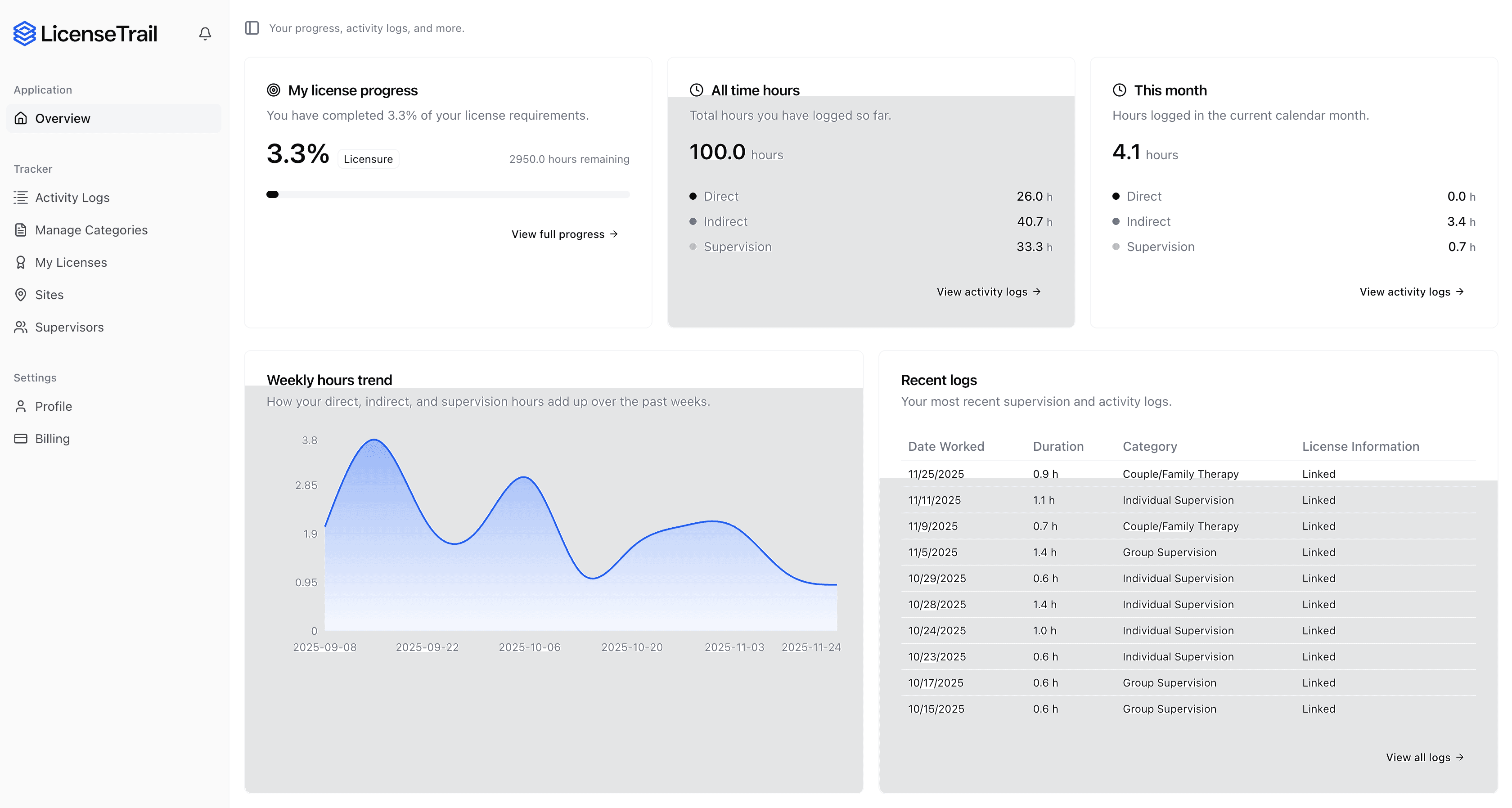 Start Tracking for Free
No credit card required · Free plan available
Related Licenses
Is your spreadsheet hiding Missouri PLPC risks?
Stop guessing if your categories match Missouri Committee for Professional Counselors requirements. License Trail checks your direct, indirect, and supervision hours continuously and flags mismatches before you submit.
Import or log
Bring your spreadsheet or start fresh
Upload your existing tracking spreadsheet and we'll map every hour into the right Missouri Committee for Professional Counselors categories automatically.
Verify against Missouri
Catch mismatches before the board does
License Trail checks your direct, indirect, and supervision hours against Missouri PLPC requirements continuously.
Export board-ready
One-click clean reports
Generate professional, board-ready reports for supervision meetings and Missouri Committee for Professional Counselors submissions in seconds.
No credit card required · Free plan available