
Missouri PLP Requirements: Hours, Exams & Step-by-Step Guide
Stop guessing if your categories match Missouri requirements. License Trail checks your direct, indirect, and supervision hours against PLP requirements continuously and flags mismatches before you submit.
No credit card required · Free plan available
Quick Requirements Overview
- Eligibility: Age 21+; doctoral degree in psychology from a recognized/qualifying program; complete 2 hours suicide assessment/referral/treatment/management training
- PLP status: Doctorate completed; not yet passed EPPP + MO jurisprudence/oral; postdegree supervised experience still pending
- Internship requirement (predoc): 1,500 hours completed in 12–24 months
- Total supervised experience framework for full licensure: 3,500 hours minimum = 1,500 internship + 2,000 additional (mix of preinternship, predoctoral postinternship, up to 750 extra internship, and/or postdoc)
- Postdegree hours typically completed under PLP: ≥1,500 postdoc hours in psychological (health-service or nonhealth) services over 12–24 consecutive months, 20–50 hrs/week
- Supervision/practice limits: Must practice only under a licensed psychologist supervisor who assumes full responsibility/control; no independent practice
- Supervision minimums: Primary supervisor ≥1 hr/month face-to-face; if clinical/secondary supervisors used ≥1 hr/week face-to-face (or ≥1 hr/week with primary if also clinical); group supervision doesn’t count
- License term/renewal: Expires 1 year from issuance; may renew, but generally capped at 2 years total (extensions/changes possible by committee rule/forms)
License Details
Procedures
In Missouri, the Provisional Licensed Psychologist (PLP) credential is a transitional license that allows new psychology doctorates to practice under supervision while they complete their postdegree supervised experience and licensing exams. It is created and governed jointly by statute (Chapter 337, RSMo) and the State Committee of Psychologists’ administrative rules (20 CSR 2235‑2).
Below is a structured summary of what the state actually requires, with an emphasis on hours and how they are defined.
1. What a “Provisional Licensed Psychologist” Is in Missouri
Missouri law defines a “provisional licensed psychologist” as someone who:
- Has a doctoral degree in psychology from a recognized educational institution as defined in section 337.025, and
- Otherwise meets all requirements to become a licensed psychologist except:
- Passing the national licensing exam (EPPP) and state exams (jurisprudence/oral), and
- Completing the required period of postdegree supervised experience specified in section 337.025.2. (revisor.mo.gov)
In other words, you must already be a doctorate‑level psychologist who has finished the degree, but you have not yet completed the required postdoctoral supervised hours or passed all exams.
2. Baseline Eligibility Before You Can Hold a PLP
2.1 Age, education, and suicide‑training requirement
For any license (temporary, provisional, or permanent), Missouri requires that an applicant: (revisor.mo.gov)
- Be at least 21 years old.
- Meet the appropriate educational requirements under either section 337.021 or 337.025 (PLPs use the doctoral pathway in 337.025).
- Have completed two hours of training in suicide assessment, referral, treatment, and management that meets guidelines developed by the committee.
2.2 Doctoral degree requirements (section 337.025 and 20 CSR 2235‑2.005)
For the PLP route (doctoral level), you must hold a doctoral degree in psychology that satisfies section 337.025.3. In practice, this generally means: (revisor.mo.gov)
- A program accredited/provisionally accredited by APA, CPA, or PCSAS or
- A program designated/approved by ASPPB or the National Register or
- A graduate psychology program meeting detailed criteria in law and rule, including:
- Being clearly identified as a psychology program.
- At least three academic years of full‑time graduate study.
- At least one year of residency at the degree‑granting institution (defined in rule as at least nine hours a week of face‑to‑face psychological instruction, supervision, and/or consultation with multiple faculty and students for a minimum of one year). (sos.mo.gov)
Your program must also include appropriate supervised practicum / internship / field training.
3. Predoctoral and Internship Hours Required for Licensure
Even though the PLP license itself is about the postdegree period, you cannot be a PLP unless your overall path lines up with the supervised‑experience framework in section 337.025.2–4.
3.1 Total supervised professional experience required by statute
Section 337.025.4 states that acceptable supervised professional experience for initial licensure may be accrued through preinternship, internship, predoctoral postinternship, or postdoctoral experiences. Those hours must include: (revisor.mo.gov)
-
Internship:
- At least 1,500 hours of experience in a successfully completed internship.
- Internship must be completed in no less than 12 and no more than 24 months.
-
Additional 2,000 hours of experience, consisting of any combination of:
- Preinternship and predoctoral postinternship hours (after the first year of the doctoral program or after completion of a psychology master’s equivalent),
- Up to 750 extra internship hours beyond the base 1,500, and/or
- Postdoctoral professional experience obtained within 24 consecutive months, not more than 50 hours per week.
So, from statute alone, the full supervised‑experience picture for a doctoral‑level Missouri psychologist is:
- 1,500 hours – doctoral internship (12–24 months).
- 2,000 hours – a mix of preinternship, predoctoral postinternship, extra internship, and postdoctoral hours.
That is a minimum total of 3,500 supervised hours (1,500 + 2,000) across your training trajectory.
3.2 What must be finished before you can be a PLP?
By definition, a PLP has already: (revisor.mo.gov)
- Completed the doctoral degree in psychology (with the required internship), and
- Met all other requirements for licensure except:
- Passing the licensing exams; and
- Completing the postdegree supervised experience portion.
In practical terms, when you apply for PLP you should have:
- Doctorate conferred (or all doctoral requirements satisfied), including the 1,500‑hour internship.
- Any predoctoral supervised hours (preinternship and predoctoral postinternship) you plan to count toward the 2,000‑hour statutory total already documented.
- Remaining hours to be completed postdegree under PLP supervision (see next section).
4. Postdegree Supervised Experience You Complete as a PLP
The “required period of postdegree supervised experience” referenced in the PLP definition is governed by both statute (337.025.4–6) and the committee’s rules for supervised professional experience under section 337.025 (20 CSR 2235‑2.040 and ‑2.050). (revisor.mo.gov)
4.1 Minimum postdoctoral hours
The key rules are:
-
Health service provider track (clinical, counseling, or school‑type health services):
- Postdoctoral supervised professional experience must include at least 1,500 hours of professional experience in the delivery of psychological health services, completed in:
- No fewer than 12 months and no more than 24 consecutive months, and
- At a rate of 20–50 hours per week. (sos.mo.gov)
- Postdoctoral supervised professional experience must include at least 1,500 hours of professional experience in the delivery of psychological health services, completed in:
-
Non‑health psychological services track (e.g., industrial‑organizational, certain consultation roles):
- Postdoctoral supervised professional experience must also consist of at least 1,500 hours of professional experience in the delivery of psychological services, over 12–24 months at 20–50 hours per week. (sos.mo.gov)
These 1,500 postdoctoral hours are part of the 2,000 additional supervised hours required by statute; the remaining (up to 500) can be earned predoctorally or as extra internship, depending on how your training was structured. This allocation is an inference from reading the statute (2,000 flexible hours) together with the committee’s rules mandating 1,500 postdoctoral hours.
4.2 What counts within those 1,500 postdoctoral hours
For both health‑service and nonhealth tracks, the regulations describe the supervised professional experience broadly. Examples of qualifying activities (depending on the rule section and your intended area of practice) include: (sos.mo.gov)
- Direct psychological services:
- Individual, group, or family psychotherapy or interventions.
- Psychological assessment, testing, and report writing.
- Consultation and collaboration with other professionals.
- Other professional activities tied to your area of practice:
- Case conferences and interdisciplinary team meetings.
- In‑service training, seminars, and workshops.
- Research and its application, when directly relevant to psychological practice.
- Teaching graduate or undergraduate psychology courses in certain contexts.
The committee’s rules emphasize that the experience must be organized, structured, and clearly oriented to the intended area of practice (for example, health‑service delivery vs. nonhealth organizational consulting).
5. Supervision Requirements While You Are a PLP
5.1 Legal limits on a PLP’s practice
Under section 337.020.5, a PLP: (revisor.mo.gov)
- May only render psychological services under the supervision, and the full professional responsibility and control, of a postdoctoral‑degree licensed supervisor.
- Cannot practice independently.
- Holds a license that:
- Automatically terminates when you receive a permanent license,
- Can be terminated for cause after due process,
- Otherwise expires one year from issuance (with renewals and exceptions described below), or
- Ends if your supervision relationship terminates.
5.2 Structure and intensity of supervision
For postinternship and postdoctoral hours under section 337.025 (which is typically when you are a PLP), the statutory and rule‑based supervision requirements include: (revisor.mo.gov)
-
Order, control, and responsibility:
- Your psychological activities must be performed under your primary supervisor’s order and full professional responsibility.
-
Minimum face‑to‑face supervision:
- Primary supervisor must maintain a continuing relationship and meet with you at least one hour per month in individual face‑to‑face supervision.
- Clinical/secondary supervisors (if used) must meet with you at least one hour per week in face‑to‑face individual supervision.
- If the primary supervisor also serves as your clinical supervisor, you must meet at least one hour per week face‑to‑face.
- Group supervision does not count toward the required supervised professional experience.
-
Supervisor qualifications and limits:
- Supervisors must be licensed (and, for health‑service experience, must be health‑service providers or meet HSP requirements). (sos.mo.gov)
- Supervisors cannot be relatives.
- Supervisors cannot be under discipline by any licensing board during the supervision period.
- No supervisor may have more than four individuals under postdegree supervision for licensure at the same time, unless the committee approves an exception. (sos.mo.gov)
-
Setting and documentation:
- Supervision is only acceptable when the supervisor and supervisee are employed by or affiliated with the same professional setting (for certain rule sections). (sos.mo.gov)
- Supervisors must attest to your hours and competence on committee forms (attestation forms, postdegree supervision forms) at the end of the supervised experience.
6. Time Limits and Renewal for the PLP License
The statute sets explicit time constraints on the PLP: (revisor.mo.gov)
-
Initial term:
- A PLP license expires one year from the date of issuance unless:
- You obtain a permanent license earlier,
- The license is terminated for cause, or
- Supervision ends.
- A PLP license expires one year from the date of issuance unless:
-
Renewal:
- The PLP may be renewed after one year, but the statute caps the total issuance at two years per provisional licensee (i.e., typically one renewal).
- The committee may create exceptions or variances by rule (for example, for vacations, illness, pregnancy, or other “good causes”).
-
Board processes and forms:
- The State Committee of Psychologists provides:
- A Request for Extension of Provisional License (Form 375‑1135), and
- A Change in Supervisor or Setting of Supervised Licensee form (Form 375‑1147),
to handle situations where more time or a different supervisor/setting is needed. (pr.mo.gov)
- The State Committee of Psychologists provides:
7. Step‑by‑Step Outline to Becoming a PLP in Missouri
Step 1 – Complete an approved doctoral program in psychology
- Enroll in a doctoral program that meets section 337.025.3 and the committee’s educational rules (20 CSR 2235‑2.005).
- Complete all core coursework and your doctoral internship of at least 1,500 hours over 12–24 months. (revisor.mo.gov)
Step 2 – Accrue and document your predoctoral supervised hours
- During graduate training, earn supervised experience that can count toward the 2,000 additional hours allowed under statute:
- Preinternship practicum hours,
- Predoctoral postinternship hours, and
- Extra internship hours (up to 750 beyond the base 1,500). (revisor.mo.gov)
- Work with your training director and supervisors to document these hours using the board’s Supervised Pre‑Doc Hours Summary Form (Form 375‑1076) and any required attestation forms. (pr.mo.gov)
Step 3 – Graduate and become eligible for PLP
- Have the doctoral degree conferred (or have your institution certify that all degree requirements are complete). (sos.mo.gov)
- Complete the required two hours of suicide‑related training. (revisor.mo.gov)
- Arrange a postdoctoral supervision plan with a licensed psychologist who meets the supervisor requirements and is willing to serve as your postdoctoral supervisor.
Step 4 – Apply for Provisional Licensed Psychologist status
Submit an application to the State Committee of Psychologists using the Application for Licensure/Temporary Licensure/Provisional Licensure (Form 375‑0332). The board’s forms page also lists: (pr.mo.gov)
- Educational data form (375‑1019).
- Supervision agreement (375‑0590).
- Postdegree supervised professional experience forms (375‑0333, 375‑0334).
The committee reviews:
- Age (≥21).
- Doctoral degree and program acceptability.
- Documentation of predoctoral supervised hours and internship.
- Suicide‑training compliance.
- Your proposed postdoctoral supervision arrangement.
If approved, the committee issues a Provisional Licensed Psychologist license.
Step 5 – Complete postdoctoral supervised experience as a PLP
- Over 12–24 consecutive months, accumulate at least 1,500 hours of postdoctoral supervised professional experience, at 20–50 hours/week, in either:
- Psychological health services (if you intend to be a health service provider), or
- Nonhealth psychological services (for non‑HSP practice areas). (sos.mo.gov)
- Comply with supervision requirements:
- At least one hour/month with the primary supervisor.
- At least one hour/week with clinical/secondary supervisors (or the primary if they are also your clinical supervisor).
- No group supervision counted.
- Supervisors maintain full professional responsibility and must attest to your competence and hours.
Step 6 – Transition from PLP to full licensure
Once you have:
- Completed the required supervised experience (predoctoral + postdoctoral) in compliance with statute and rules, and
- Passed:
- The Examination for Professional Practice in Psychology (EPPP), and
- Missouri’s jurisprudence and oral examinations, (revisor.mo.gov)
you may apply to have your status changed from PLP to fully licensed psychologist. At that point, the provisional license terminates, and you may practice independently within the scope of a licensed psychologist in Missouri.
Summary of Key Hour Requirements for the PLP Path in Missouri
-
Internship (predoctoral):
- 1,500 supervised hours over 12–24 months (part of doctoral program). (revisor.mo.gov)
-
Additional supervised professional experience (total):
- 2,000 hours from a combination of:
- Preinternship and predoctoral postinternship hours,
- Up to 750 extra internship hours, and/or
- Postdoctoral supervised professional experience (completed while a PLP or equivalent). (revisor.mo.gov)
- 2,000 hours from a combination of:
-
Postdoctoral supervised experience (typically under PLP):
- At least 1,500 hours in 12–24 months at 20–50 hours/week, in either health‑service or nonhealth psychological practice, under tightly defined supervision requirements. (sos.mo.gov)
All of this is layered on top of the educational, age, and training prerequisites and the exam requirements that must ultimately be satisfied for permanent licensure.
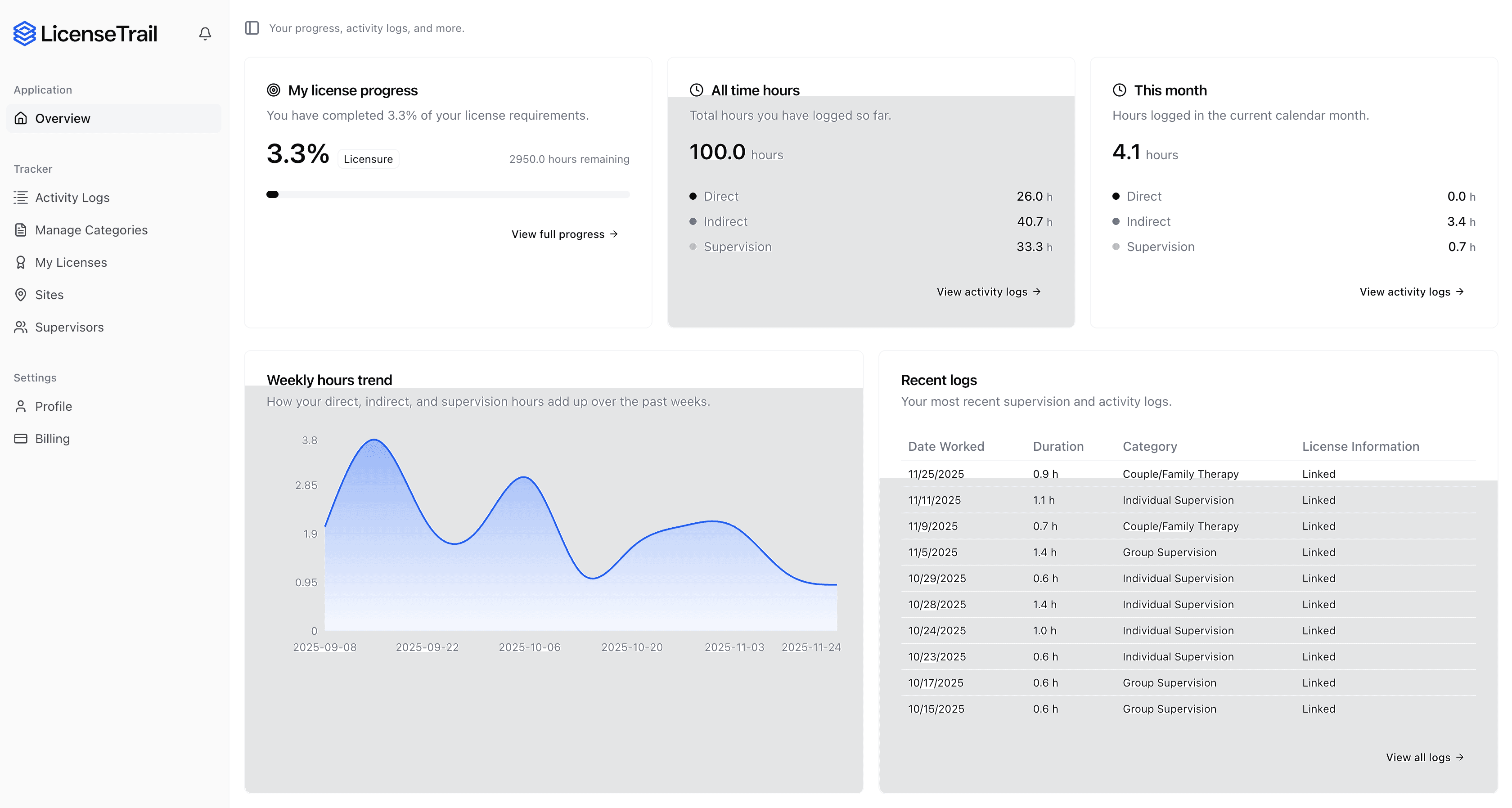
Track your PLP hours with confidence
License Trail checks your direct, indirect, and supervision hours against Missouri PLP requirements continuously and flags mismatches before you submit.
 Start Tracking for Free
No credit card required · Free plan available
Related Licenses
Is your spreadsheet hiding Missouri PLP risks?
Stop guessing if your categories match Missouri State Committee of Psychologists requirements. License Trail checks your direct, indirect, and supervision hours continuously and flags mismatches before you submit.
Import or log
Bring your spreadsheet or start fresh
Upload your existing tracking spreadsheet and we'll map every hour into the right Missouri State Committee of Psychologists categories automatically.
Verify against Missouri
Catch mismatches before the board does
License Trail checks your direct, indirect, and supervision hours against Missouri PLP requirements continuously.
Export board-ready
One-click clean reports
Generate professional, board-ready reports for supervision meetings and Missouri State Committee of Psychologists submissions in seconds.
No credit card required · Free plan available