
Missouri S-MFT Requirements: Hours, Exams & Step-by-Step Guide
Stop guessing if your categories match Missouri requirements. License Trail checks your direct, indirect, and supervision hours against S-MFT requirements continuously and flags mismatches before you submit.
No credit card required · Free plan available
Quick Requirements Overview
- Status/Title: S‑MFT is a supervised status (not full license); use “S‑MFT / supervised marital and family therapist” if not PLMFT
- Prereqs: Master’s/doctorate (or equivalent) with required MFT core content; 3 graduate credits in diagnosis (DSM) if required
- Must register supervision: Committee approval + effective date required before hours count; submit form+fee, official transcripts, fingerprints/background (MSHP+FBI), setting agreement if applicable
- Supervisor + setting: Qualified licensed supervisor (held license ≥2 years, meets MFT supervision quals; not a relative; ≤10 supervisees); you and supervisor must share the same approved setting; no private practice you own/manage
- Experience hours/time (typical master’s route): 24–60 months, commonly 3,000 total hours with ≥1,500 direct client contact (face‑to‑face); ≥15 hours/month to count
- Supervision requirements: ≥200 hours supervision total, ≥100 individual; frequency 1 hr weekly or 2 hrs/2 weeks; individual can be 1–2 supervisees; group 3–6; secure real‑time video allowed if compliant
- Practice limits: Under supervisor’s full oversight; no independent practice, no direct billing; ads must include supervisor name/license #; clients must be told you’re supervised + provide supervisor contact; supervisor reviews/cosigns documentation; report supervisor/setting changes within 15 days
License Details
Procedures
In Missouri, “Supervised Marital and Family Therapist” (S‑MFT) is not a full license but a supervised status you use while completing the post‑degree experience required for Licensed Marital and Family Therapist (LMFT) licensure. You can accrue your hours either as:
- a Provisional Licensed Marital and Family Therapist (PLMFT), or
- an S‑MFT (Supervised Marital and Family Therapist) if you do not hold a provisional license.
Both paths use the same supervision rules and hour requirements set by the State Committee of Marital and Family Therapists.
Below is a step‑by‑step guide based on Missouri regulations and the committee’s rules.
1. Understand what S‑MFT status is in Missouri
Missouri regulations explicitly recognize “supervised‑marital and family therapist (S‑MFT)” alongside the PLMFT when describing supervised experience.(law.cornell.edu)
- While you are under board‑approved licensure supervision and do not hold a provisional license, you must use one of these titles:
“S‑MFT” or “supervised marital and family therapist.” (law.cornell.edu) - The American Association for Marriage and Family Therapy’s Missouri summary notes that you are not required to have a provisional license to obtain supervision hours and may complete them under the title Supervised Marital and Family Therapist (SMFT), provided you register your supervision with the State Committee.(aamft.org)
So “becoming S‑MFT” in Missouri really means: getting your supervision registration approved so you can legally practice as a supervised marital and family therapist and accrue licensure hours.
2. Education prerequisites before you can register as S‑MFT
Before your supervised clinical experience (and S‑MFT status) can begin, you must meet the committee’s education requirements in 20 CSR 2233‑2.010 and §337.715 RSMo:(law.cornell.edu)
At a high level:
-
Degree level
- A master’s or doctoral degree in marital and family therapy, or equivalent mental‑health discipline, from an acceptable, regionally accredited institution.(law.justia.com)
-
Required coursework
- Coursework must meet the committee’s specified “core areas” in MFT (defined in 20 CSR 2233‑2.010). If you are missing some core courses, the committee may still approve supervision to begin while you complete the remaining coursework.(law.cornell.edu)
-
Diagnostic coursework
- After August 28, 2008, you must complete at least three semester hours of graduate‑level coursework in diagnostic systems (e.g., DSM) either in the degree or as post‑master’s coursework. (law.justia.com)
You should not assume any supervised hours will count until the State Committee has formally approved your supervision registration.
3. Secure a qualified supervisor and practice setting
Before applying for S‑MFT supervision, you must line up both:
3.1. A qualifying supervisor
Regulations require that a supervisor for PLMFTs or S‑MFTs must:(law.cornell.edu)
- Hold a current license in Missouri or another state as:
- Marital and family therapist, or
- Professional counselor, or
- Psychologist, or
- Clinical social worker, or
- Psychiatrist
and that license must have been held for at least two years (inactive, provisional, expired, temporary, or retired does not qualify).
- Have a qualifying graduate degree and at least 5 years of clinical experience in marital and family therapy (excluding practicum/internship hours).(regulations.justia.com)
- Meet additional supervision‑training criteria (for example, AAMFT Approved Supervisor designation or substantial prior supervision experience), as detailed in 20 CSR 2233‑2.021.(regulations.justia.com)
- Not be your relative (parent, spouse, child, sibling, grandparent, grandchild, aunt, uncle, cousin, or someone related by marriage).(law.cornell.edu)
A supervisor is limited to no more than 10 total supervisees at a time (across S‑MFTs, PLMFTs and other mental‑health licensure candidates).(law.cornell.edu)
3.2. An acceptable supervision setting
- You and your supervisor must be employed by or contractually affiliated with the same supervision setting.(law.cornell.edu)
- The supervision setting cannot be a private practice that you operate, manage, or own in whole or in part.(law.cornell.edu)
4. Register supervision with the State Committee (S‑MFT status)
To legally function as an S‑MFT and start counting supervised experience hours, you must file a registration of supervision with the State Committee. The supervision does not begin until the committee approves your application and sets an effective date.(law.cornell.edu)
The supervision registration file must include:(law.cornell.edu)
- Registration of supervision (or change of supervision) application form
- Must be the committee’s form, legible and printed in black or blue ink.
- Application fee for supervision or change of supervision.
- Official graduate transcripts, sent directly from your institution(s).
- When applicable, a written agreement affiliating the licensure supervisor with the setting where you will obtain licensure supervision.
- Background check with fingerprints submitted to the Missouri State Highway Patrol’s approved vendor for both:
- Missouri State Highway Patrol background check, and
- FBI criminal background check.
You pay any fees directly to the Highway Patrol or vendor.
The committee will notify you in writing of the effective date of supervision. Only hours accrued on or after that effective date in the approved setting with the registered supervisor count.
If you later change supervisors or settings, you must notify the committee within 15 days by filing a change of supervision form and paying the applicable fee.(law.cornell.edu)
5. Hour requirements while you are S‑MFT
Once supervision is approved, you work under S‑MFT status (if you are not PLMFT) and begin accruing the supervised clinical experience for LMFT licensure.
5.1. Time frame for supervised experience
For most master’s‑level applicants, Missouri regulations require that your supervised experience occur over:
- At least 24 months, and
- No more than 60 months
of supervised clinical practice.(law.cornell.edu)
For those qualifying via certain doctoral/specialist or 30 post‑master’s credit routes, an additional supervised‑experience segment must be completed in no less than 12 months and no more than 24 months, as described in section 12 of 20 CSR 2233‑2.020.(law.cornell.edu)
5.2. Total hours and “direct client contact” requirements
Missouri’s rules define detailed minimums (and AAMFT provides the total hour numbers commonly used in practice):
Master’s‑level route
- Total supervised experience:
The State Committee’s requirements are commonly summarized (by AAMFT) as 3,000 hours of supervised experience as an MFT.(aamft.org) - Direct client contact requirement:
Within that supervised experience, at least 1,500 hours must be “direct client contact” in marital and family therapy.(law.cornell.edu) - Board definition of direct client contact:
The rule states that “direct client contact” is face‑to‑face interaction between the client and PLMFT or S‑MFT.(law.cornell.edu)
Practically, this means:
- You must accumulate 1,500+ hours of face‑to‑face sessions (individuals, couples, families) where you, as S‑MFT, are directly providing therapy.
- The remaining supervised hours (to reach 3,000) may consist of other supervised clinical activities within marital and family therapy (e.g., additional clinical contact that is not counted as direct, case‑related work, etc.), so long as they fall under the committee’s definition of supervised clinical experience.
Doctoral / specialist / 30‑post‑master’s hours route
For applicants qualifying via a doctoral or specialist degree in MFT or a mental‑health discipline, or 30 graduate post‑master’s MFT hours, the regulations specify additional supervised experience:(law.cornell.edu)
- At least 750 hours of supervised experience in marital and family therapy direct client contact (face‑to‑face therapy), to be completed in no less than 12 and no more than 24 months, with at least 15 supervised hours per calendar month.
- AAMFT’s Missouri summary translates this to 1,500 total supervised hours, of which 750 must be direct client contact.(aamft.org)
5.3. Minimum monthly hours
In all supervised‑experience tracks, the PLMFT or S‑MFT:(law.cornell.edu)
- Must obtain at least 15 hours of supervised experience within each calendar month for that month to count.
If you drop below 15 supervised hours in a month, the committee may not accept that month toward your required supervised‑experience period.
6. Required supervision hours and structure
Missouri distinguishes between clinical hours and the supervision you receive about those hours. Both are required.
6.1. Supervision hour minimums
For PLMFTs and S‑MFTs, 20 CSR 2233‑2.020 requires that acceptable supervision include:(law.cornell.edu)
- Frequency of supervision sessions:
- At least 2 hours every 2 weeks, or
- 1 hour every week
of face‑to‑face supervision with the registered supervisor.
- Definition of a supervision hour:
- One hour of individual face‑to‑face supervision is no less than 50 continuous minutes.
- Two hours is no less than 100 continuous minutes.
- Total supervision hours:
- You must complete at least 200 hours of supervision,
- At least 100 of those hours must be individual face‑to‑face supervision.
AAMFT echoes this, stating that master’s‑level applicants must complete 200 hours of face‑to‑face supervision, at least 100 individual.(aamft.org)
6.2. Individual vs. group supervision
Missouri rules further specify:(law.cornell.edu)
- At least half of all supervision must be individual face‑to‑face supervision.
- “Individual” may include up to two PLMFTs or S‑MFTs with the supervisor at once.
- The remaining supervision may be group supervision, defined as:
- 3–6 PLMFTs or S‑MFTs (or a combination of both) with the supervisor.
6.3. Supervision can be electronic if it meets rules
You may request to use electronic methods to meet the face‑to‑face supervision requirement, provided that:(law.cornell.edu)
- The system is secure and real‑time,
- Allows both audio and visual interaction, and
- Data storage and communication comply with all applicable privacy laws and rules.
7. What you can and cannot do as an S‑MFT
While under supervision, your practice is tightly regulated. The regulations state that services you provide as a PLMFT or S‑MFT must be performed under your registered supervisor’s “full order, control, oversight, and guidance”, and you must remain under such supervision until fully licensed as a marital and family therapist.(law.cornell.edu)
Key practice limits:
-
No independent private practice
- You may not engage in independent, private practice or provide therapy that is not affiliated with your approved supervision setting and supervisor.(law.cornell.edu)
-
No independent marketing without supervisor identification
- You may not market or advertise services without including your supervisor’s name and license number.(law.cornell.edu)
-
You do not bill clients directly
- As an S‑MFT, you must not bill clients for therapeutic services yourself.
- Billing and payment must be facilitated by the supervisor approved by the committee for licensure supervision.(law.cornell.edu)
-
Required disclosure to clients
- While you are accumulating supervised experience, you must inform clients that you are under supervision for licensure, and provide the name, address, and license number of your registered supervisor.(law.cornell.edu)
-
Use of title
- If you hold a provisional license, your title must be PLMFT or “provisional licensed marital and family therapist.”
- If you are not provisionally licensed but are under supervision, you must use “S‑MFT” or “supervised marital and family therapist.”(law.cornell.edu)
-
Documentation oversight
- Your registered supervisor must read and cosign (including their license number) all written reports, including treatment plans and progress notes, that you prepare.
- If the setting prohibits cosigning, you must document that your supervisor has reviewed those reports.(law.cornell.edu)
If you do not apply for full licensure within the timeframe allowed for your supervised experience, you may not continue providing marital and family therapy services unless you continue under committee‑approved supervision.(law.cornell.edu)
8. Moving from S‑MFT status to full LMFT licensure
Once you, as an S‑MFT (or PLMFT), have:
- Completed the required supervised experience period (time and hours),
- Met the direct client contact and supervision‑hour minimums, and
- Met all educational and diagnostic coursework requirements,
you apply for licensure as a Licensed Marital and Family Therapist.
The application for licensure must include:(law.cornell.edu)
- The LMFT application form and fee,
- Official graduate transcripts, and
- Documentation of your post‑degree supervised experience in compliance with 20 CSR 2233‑2.020,
- Plus successful completion of the required licensing examination.
Only at that point do you move out of S‑MFT/PLMFT status and into independent LMFT practice, no longer subject to the S‑MFT restrictions on independent practice and billing.
Summary of key hour requirements (board language and structure)
For master’s‑level applicants working as S‑MFT (or PLMFT):
- Time frame: 24–60 months of supervised experience
- Total supervised experience: about 3,000 hours (per AAMFT summary), subject to committee approval(aamft.org)
- Direct client contact: ≥ 1,500 hours of “direct client contact,” defined by the committee as face‑to‑face interaction between the client and PLMFT or S‑MFT(law.cornell.edu)
- Minimum monthly experience: at least 15 hours of supervised experience per calendar month(law.cornell.edu)
- Supervision: at least 200 hours of face‑to‑face supervision, with ≥ 100 hours individual; supervision frequency of 1 hour weekly or 2 hours every 2 weeks(law.cornell.edu)
For doctoral/specialist/30‑post‑master’s routes, Missouri requires at least 750 direct client‑contact hours in MFT over 12–24 months, with the same 15‑hours‑per‑month minimum; AAMFT summarizes this as 1,500 total supervised hours, 750 direct.(law.cornell.edu)
All of these hours may be accrued as an S‑MFT so long as your supervision is registered with the State Committee and you comply with the supervision, practice, and title rules described above.
Track your S-MFT hours with confidence
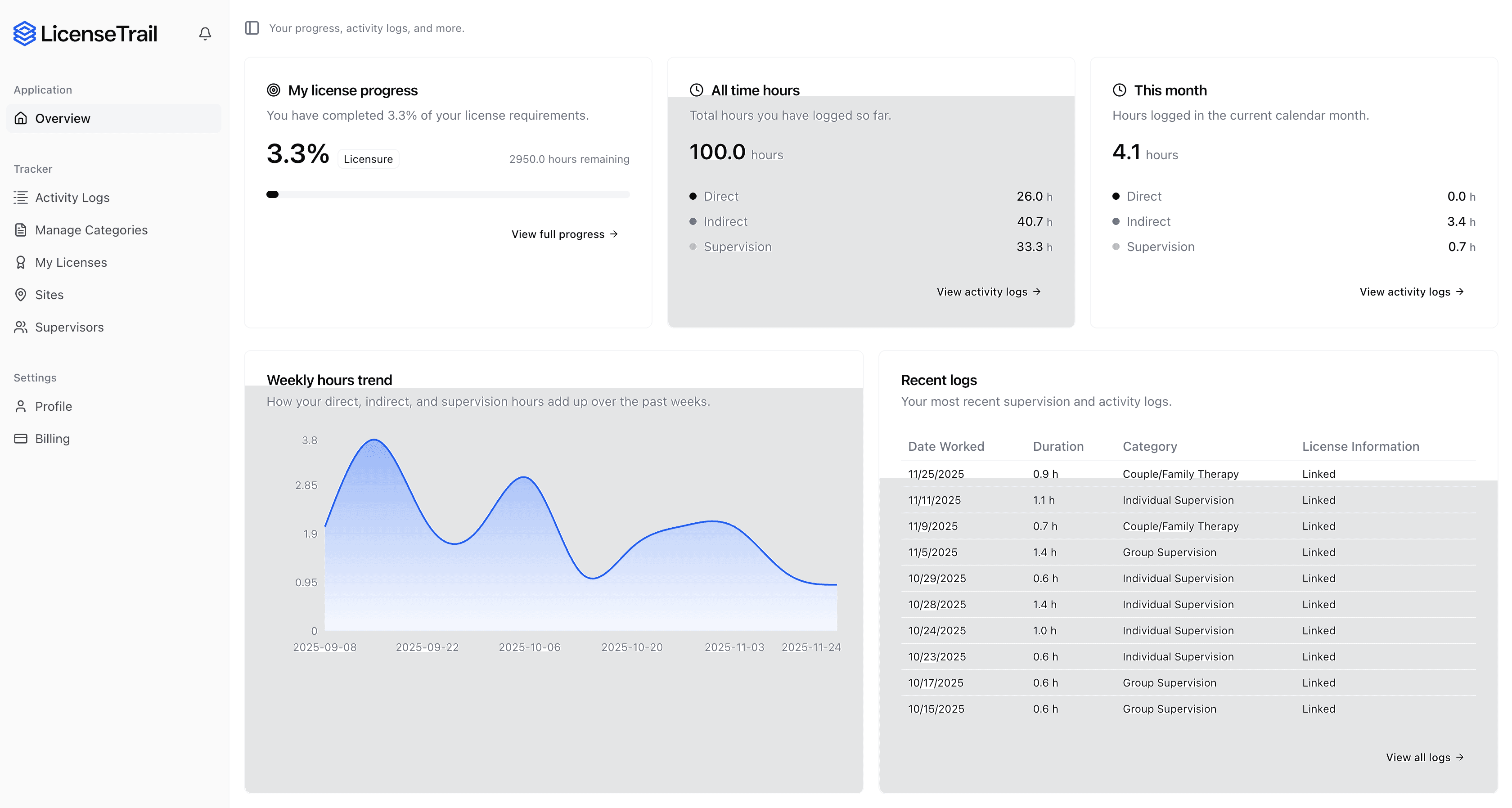
License Trail checks your direct, indirect, and supervision hours against Missouri S-MFT requirements continuously and flags mismatches before you submit.
 Start Tracking for Free
No credit card required · Free plan available
Related Licenses
Is your spreadsheet hiding Missouri S-MFT risks?
Stop guessing if your categories match Missouri State Committee of Marital and Family Therapists requirements. License Trail checks your direct, indirect, and supervision hours continuously and flags mismatches before you submit.
Import or log
Bring your spreadsheet or start fresh
Upload your existing tracking spreadsheet and we'll map every hour into the right Missouri State Committee of Marital and Family Therapists categories automatically.
Verify against Missouri
Catch mismatches before the board does
License Trail checks your direct, indirect, and supervision hours against Missouri S-MFT requirements continuously.
Export board-ready
One-click clean reports
Generate professional, board-ready reports for supervision meetings and Missouri State Committee of Marital and Family Therapists submissions in seconds.
No credit card required · Free plan available