
Nevada LISW Requirements: Hours, Exams & Step-by-Step Guide
Stop guessing if your categories match Nevada requirements. License Trail checks your direct, indirect, and supervision hours against LISW requirements continuously and flags mismatches before you submit.
No credit card required · Free plan available
Quick Requirements Overview
- Eligibility: Age 21+; U.S. citizen or lawfully authorized to live/work in U.S.; fingerprint-based criminal history check required
- Education: MSW/DSW in social work from CSWE-accredited/candidate program (or foreign equivalent with required documentation)
- Internship required (pre-approved): Must enroll in a Board-approved LISW internship before hours accrue; must use the title “intern” in practice communications
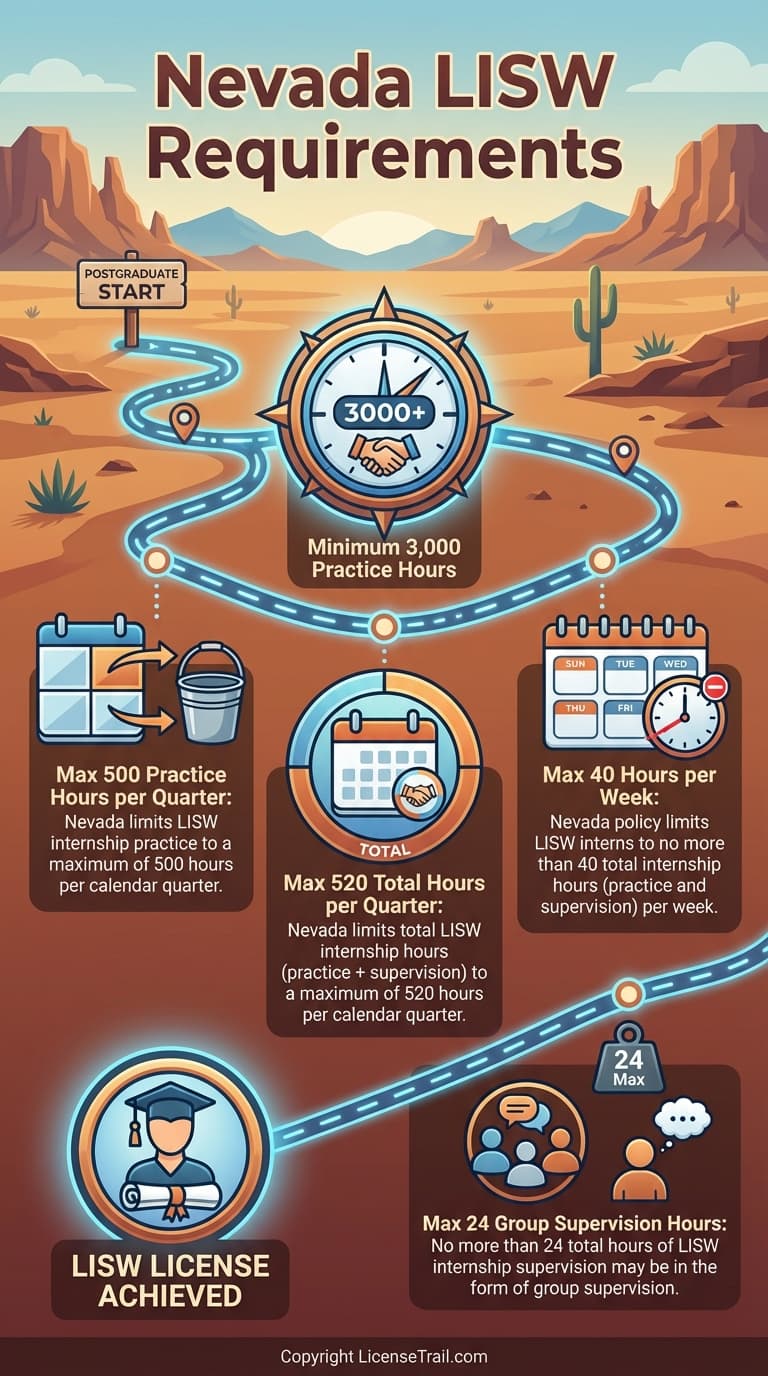
- Experience: 3,000 hours of supervised, postgraduate social work in the approved internship; completed no sooner than 2 years and no later than 3 years after program approval (extensions possible; hours may be disallowed if licensure not issued timely)
- What doesn’t count: Classes/workshops/seminars/orientations; work not under a Board-approved agency, Board-approved supervisor, and Board-approved supervision agreement/plan
- Supervision rules: Supervisor must be Board-approved LISW/LCSW with required experience/training; 1 hour/week individual supervision (in-person or telecom); ≤24 total hours group supervision; monthly site visit if supervisor is off-site; 6‑month progress reports required
- Location limits: No concurrent out-of-state postgraduate internship or practice outside Nevada; internship may be at up to 3 agencies simultaneously (Board-authorized)
- Exam: Pass ASWB Advanced Generalist exam (retests generally every 90 days)
License Details
Procedures
Nevada’s Licensed Independent Social Worker (LISW) credential is the state’s non‑clinical independent practice license for MSW‑level social workers. Requirements are set in the Nevada Revised Statutes (NRS) Chapter 641B and the Nevada Administrative Code (NAC) Chapter 641B, administered by the Nevada Board of Examiners for Social Workers.
Below is a step‑by‑step guide, with the key legal language highlighted and explained.
1. Understand what the LISW license allows
Under NRS 641B.230, a person licensed as an independent social worker may:
- Engage in social work independently or within an agency, and
- Supervise other persons engaging in the practice of social work. (leg.state.nv.us)
Nevada also permits an LISW to engage in clinical social work as part of an approved internship toward eventual LCSW licensure. (leg.state.nv.us)
2. Meet the preliminary qualifications
All applicants for any Nevada social work license must meet the “preliminary qualifications” in NRS 641B.200:
- Be at least 21 years of age; and
- Be a U.S. citizen or lawfully entitled to remain and work in the United States. (nevada.public.law)
Additionally, all applicants must submit fingerprints for a criminal history check under NRS 641B.202. (leg.state.nv.us)
3. Earn the required social work degree
For the LISW license, Nevada requires a graduate social work degree:
- You must possess a master’s or doctoral degree in social work from:
- A college or university accredited by the Council on Social Work Education (CSWE) or a candidate for such accreditation, or
- A foreign program with the equivalent degree plus documentation required by NRS 641B.204. (leg.state.nv.us)
This degree must be in hand before you begin accruing the LISW internship hours, because the law describes them as “postgraduate” hours.
4. Become an LISW “intern” and get your program approved
Nevada does not allow you to simply accumulate experience and then ask the Board to count it. You must be in a Board‑approved internship program.
4.1. “Intern” status and title
NAC 641B.035 defines “intern” as:
- An applicant for licensure as a LISW or LCSW who has not yet completed 3,000 hours of supervised postgraduate training, but is in the process of doing so under a Board‑approved internship. (law.cornell.edu)
NAC 641B.240 requires that while you are in this internship:
- You must use the title “intern” in all communications within the scope of your practice, including with the Board and with clients. (law.cornell.edu)
In practice, this means you are typically designated something like “Licensed Independent Social Worker – Intern” (LISW‑Intern).
4.2. Internship program approval
For LISW applicants, NAC 641B.140 requires that you complete:
- “An internship consisting of not less than 3,000 hours of supervised, postgraduate social work.” (law.cornell.edu)
Those 3,000 hours must be:
-
Undertaken in a program approved by the Board before you begin. The program must include, at minimum:
- An examination if the Board deems it necessary,
- An appropriate setting (as the Board determines),
- Supervision by a Board‑approved supervisor, and
- A Board‑approved plan of supervision. (law.cornell.edu)
-
Completed in a specific time window:
- Not earlier than 2 years and not later than 3 years after the Board approves the program.
- The Board can grant a specific extension for good cause.
- If the required work does not lead to issuance of an LISW license within 3 years after the end of the program, the Board may disallow credit for all internship hours. (law.cornell.edu)
-
Conducted under Board standards:
- The Board may withdraw approval of a program if it cannot sustain enough hours, or if investigations reveal unethical or unsafe practices at the site or by the supervisor. (law.cornell.edu)
-
Limited to Nevada and one internship at a time:
- While in a Nevada LISW internship, you may not:
- Hold a postgraduate internship in another jurisdiction, or
- Engage in the practice of social work outside Nevada. (law.cornell.edu)
- While in a Nevada LISW internship, you may not:
-
Possibly across multiple agencies:
- The Board will authorize an internship program to be conducted at no more than three agencies simultaneously. (law.cornell.edu)
5. Understand exactly what counts (and does NOT count) toward the 3,000 hours
5.1. “Type” of hours in Nevada law
For LISW, Nevada law and regulations use a single category:
- “3,000 hours of supervised, postgraduate social work” approved by the Board. (leg.state.nv.us)
They do not break this into a specified number of:
- Direct client hours vs indirect hours, or
- Assessment vs administration hours, etc.
That kind of numeric split (e.g., “1,500 direct / 1,500 supervision”) simply does not appear in Nevada’s LISW statutes or regulations. The Board defines “what counts” primarily by describing what does not qualify and by specifying the supervision structure.
5.2. Activities that do not qualify as “supervised, postgraduate social work”
NAC 641B.140(4) lists specific activities that do not count toward the 3,000 LISW hours:
- Instruction through classes, workshops, or seminars.
- Orientational programs.
- Any practice not under the supervision of a Board‑approved agency. An agency counts as supervising the intern only if:
- Each client is clearly identified as a client of the agency on contracts, releases, billing, etc.
- All client records belong to the agency, with confidentiality and safekeeping provided by the agency.
- The agency appoints a specific employee as the Board‑approved supervisor (or approves a non‑employee if no such employee is available).
- That supervisor reviews the intern’s work according to Board supervision standards.
- The supervisor has full access to agency records related to the intern’s practice.
- Any compensation for the intern’s services is paid directly by the agency. (law.cornell.edu)
The Board may also declare other activities not to be within the scope of “the practice of social work”; such activities will not count as supervised postgraduate hours. (law.cornell.edu)
In addition, NAC 641B.155 makes clear that the Board will not recognize time spent:
- Under a supervisor whom the Board has not approved to supervise interns, or
- Under a supervision agreement that the Board has not approved. (nvrules.elaws.us)
6. Meet the supervision requirements during those 3,000 hours
6.1. Who may supervise a LISW intern
NAC 641B.155(1) sets the baseline:
- To supervise a LISW intern, a person must:
- Be approved by the Board as a supervisor, and
- Be a licensed independent social worker (LISW) or licensed clinical social worker (LCSW), and
- Have at least 3 years of post‑licensure experience as an LISW, LCSW, licensed clinical psychologist, or qualified psychiatrist, and
- Demonstrate that their current practice includes at least 15 hours per month of independent practice when supervising an LISW intern, and
- Complete Board‑specified supervisor training, repeated every 5 years. (regulations.justia.com)
Supervisors cannot be related to the intern, have had them as a client, or supervise more than a Board‑limited number of interns concurrently, and they must keep detailed supervision records for at least 5 years. (nvrules.elaws.us)
6.2. Structure and frequency of supervision
NAC 641B.160 describes how the supervision itself must occur. Key requirements:
-
Weekly individual supervision
The supervisor must meet at least 1 hour per week, individually and in person with the intern, unless the Board specifically approves a different schedule. These meetings are to discuss and evaluate the intern’s performance. (law.cornell.edu) -
Remote supervision allowed
Telecommunication technologies can be used to supervise remotely, but weekly meetings (in person or via telecommunication) are still required. (law.cornell.edu) -
On‑site visits for off‑site supervision
If the intern practices at a site where the supervisor does not practice, the supervisor must (unless waived for good cause) visit that site at least once a month and coordinate with the on‑site supervisor. (law.cornell.edu) -
Group supervision limits
No more than 24 hours of the total supervision may be in the form of group supervision; the rest must be individual supervision. (law.cornell.edu) -
Progress reports
The supervisor must submit progress reports to the Board every 6 months, plus a final report, using Board forms. The Board can refuse to accept inadequate or late reports and may then disallow all hours reported on those forms. (law.cornell.edu) -
Supervisor’s responsibilities
The supervisor is responsible for the intern’s practice and must ensure that the intern:- Works in an appropriate professional setting,
- Follows professional standards,
- Develops a professional identity,
- Gains practice‑management and continuing‑competence skills,
- Learns the applicable laws and regulations,
- Stays current with the literature in relevant areas of practice, and
- Provides culturally and linguistically appropriate services. (law.cornell.edu)
7. Pass the LISW licensing examination
Nevada regulations require LISW applicants to pass the ASWB Advanced Generalist examination.
NAC 641B.105 provides that:
- All social work applicants must pass an examination given by the Association of Social Work Boards (ASWB) or another Board‑approved test administrator.
- For a licensed independent social worker, the required examination is the Advanced Generalist Examination of the ASWB. (regulations.justia.com)
You must also satisfy the Board that you meet requirements for age, character, education, and (where relevant) supervisory experience before taking the exam. (regulations.justia.com)
Failed exams may generally be retaken every 90 days, and LISW interns may continue to retest beyond initial attempts. (regulations.justia.com)
8. Apply for your LISW license
Once you have:
- Met the preliminary qualifications (age/citizenship, fingerprints),
- Obtained the required MSW/DSW degree,
- Completed 3,000 hours of supervised, postgraduate social work in a Board‑approved internship within the required timeframe, and
- Passed the ASWB Advanced Generalist exam,
the Board is required by NRS 641B.230(1) to grant you a license to engage in social work as an independent social worker, assuming all documentation and fees are properly submitted. (leg.state.nv.us)
From that point, you may independently practice social work (non‑clinical) and supervise other social workers as permitted by statute. (leg.state.nv.us)
9. Hour‑requirement summary for LISW in Nevada
Based strictly on Nevada statutes and regulations:
-
Total experience hours required:
- 3,000 hours of supervised, postgraduate social work, completed within 2–3 years in a Board‑approved internship program. (law.cornell.edu)
-
Type of hours:
- The law uses one category—“supervised, postgraduate social work.”
- It does not specify separate minimums for direct client contact vs indirect hours, or any similar subdivisions, for LISW.
-
What does not count:
- Classes, workshops, seminars, orientations.
- Any practice not under a Board‑approved agency and supervisor, or under an unapproved supervision agreement. (law.cornell.edu)
-
Supervision structure (during those 3,000 hours):
- Weekly, 1‑hour individual supervision (in person or via telecommunication).
- Monthly site visits if the supervisor is off‑site.
- No more than 24 hours of group supervision in total. (law.cornell.edu)
-
Exam:
- ASWB Advanced Generalist exam, as specified for licensed independent social workers. (regulations.justia.com)
All of these requirements come from the Nevada Board’s governing statutes (NRS 641B.200, 641B.230, etc.) and regulations (NAC 641B.035, 641B.105, 641B.140, 641B.155, 641B.160, 641B.240). Always confirm directly with the Nevada Board’s website or staff before you apply, as laws and regulations can be amended.
Track your LISW hours with confidence
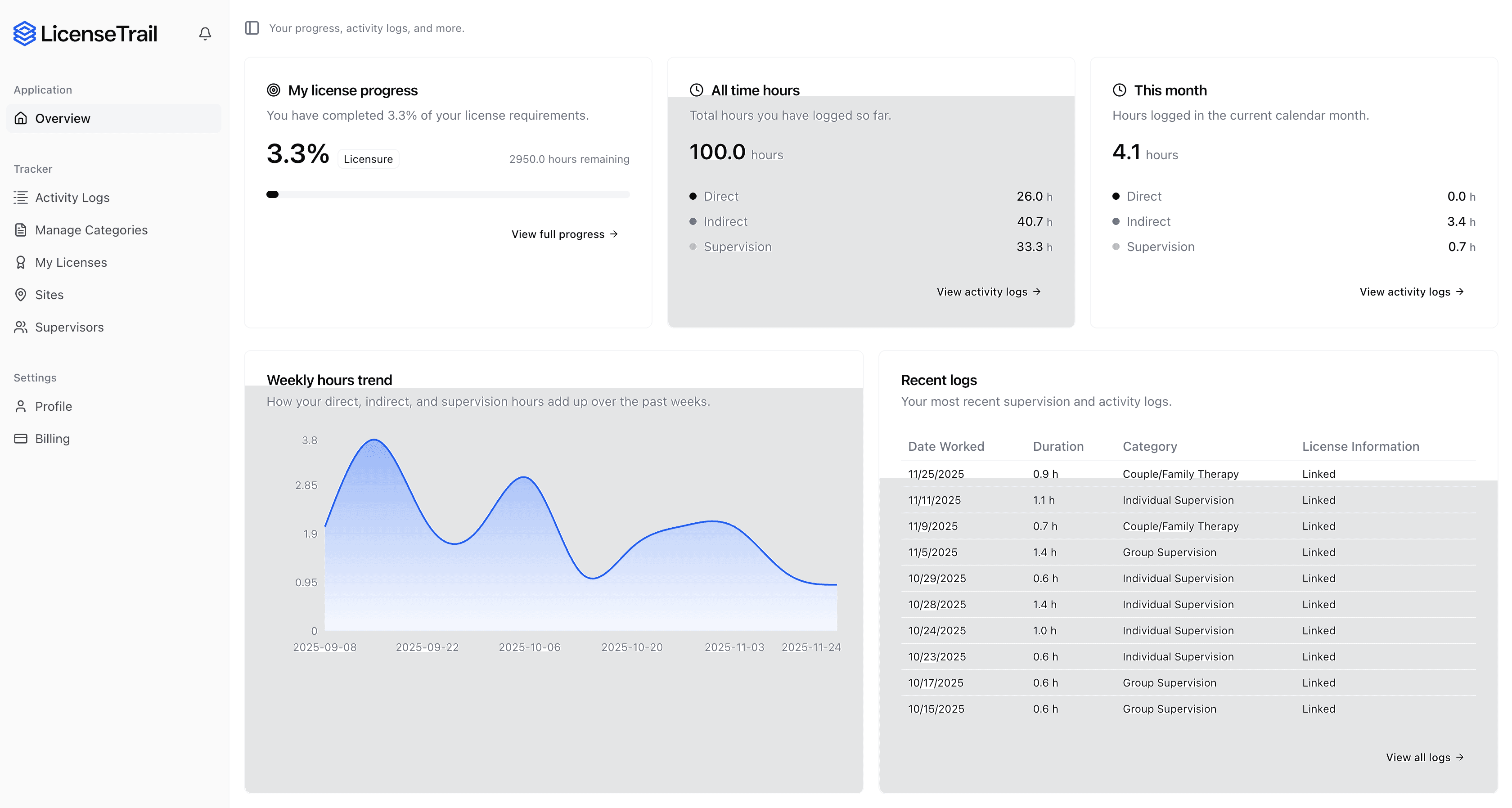
License Trail checks your direct, indirect, and supervision hours against Nevada LISW requirements continuously and flags mismatches before you submit.
 Start Tracking for Free
No credit card required · Free plan available
Related Licenses
Is your spreadsheet hiding Nevada LISW risks?
Stop guessing if your categories match Nevada Board of Examiners for Social Workers requirements. License Trail checks your direct, indirect, and supervision hours continuously and flags mismatches before you submit.
Import or log
Bring your spreadsheet or start fresh
Upload your existing tracking spreadsheet and we'll map every hour into the right Nevada Board of Examiners for Social Workers categories automatically.
Verify against Nevada
Catch mismatches before the board does
License Trail checks your direct, indirect, and supervision hours against Nevada LISW requirements continuously.
Export board-ready
One-click clean reports
Generate professional, board-ready reports for supervision meetings and Nevada Board of Examiners for Social Workers submissions in seconds.
No credit card required · Free plan available