
Nevada MFT-Intern Requirements: Hours, Exams & Step-by-Step Guide
Stop guessing if your categories match Nevada requirements. License Trail checks your direct, indirect, and supervision hours against MFT-Intern requirements continuously and flags mismatches before you submit.
No credit card required · Free plan available
Quick Requirements Overview
- Must be licensed as an MFT‑Intern before beginning any supervised experience; no independent practice (only to accrue hours toward licensure).
- Eligibility: 21+, good moral character, qualifying graduate degree (MFT/psychology/social work or Board‑equivalent) from an approved accredited school, and a supervision agreement in place.
- Education must include Board‑required MFT content and ≥60 semester / 72 quarter graduate credits (graduate-level only).
- Application: Board form + official transcripts, government ID, fingerprints/background check, internship plan naming primary + secondary Board‑approved supervisors; interview if requested; pass Board MFT exam.
- Supervision structure: ≥2 Board‑approved supervisors; primary supervision ≥160 hrs (typically ≥1 hr/week), secondary supervision ≥40 hrs (combined); supervision must be qualifying (e.g., case review/observation—not seminars).
- Internship completion window: 3 years from approval, with one 3‑year renewal possible (max ~6 years); otherwise must reapply under current rules.
- Experience required for full licensure: 3,000 hrs over ≥2 postgraduate years, including 1,500 direct client contact, 300 supervision (meets 160/40 minimums), and 1,200 related‑practice hours (category caps apply).
- Reporting: semiannual supervisor reports due Mar 15 and Sep 15; missing reports can trigger revocation and reapplication.
License Details
Procedures
In Nevada, “marriage and family therapist intern” (often written MFT‑Intern) is a formal license category regulated by the State of Nevada Board of Examiners for Marriage and Family Therapists and Clinical Professional Counselors. It is the mandatory bridge between your graduate degree and full licensure.
Below is a step‑by‑step outline of what Nevada law and regulation actually require, including the precise hour breakdown and the Board’s own terminology.
1. What the MFT‑Intern license is
Nevada defines:
- “Marriage and family therapist intern” as a person licensed as such under NRS 641A.287. (law.cornell.edu)
- “Internship” as the period of supervised experience required of a marriage and family therapist intern under NRS 641A.287. (law.cornell.edu)
By statute, anyone who wants to obtain the supervised experience required for MFT licensure must first obtain a license as a marriage and family therapist intern before beginning the supervised experience. (leg.state.nv.us)
The holder of an MFT‑Intern license:
- May engage in the practice of marriage and family therapy only for the purpose of obtaining the supervised experience needed for full licensure, and
- “Shall not engage in the practice of marriage and family therapy independently.” (law.justia.com)
It is also unlawful to use the title “marriage and family therapist intern” (or similar) unless you are licensed under Chapter 641A. (leg.state.nv.us)
2. Baseline eligibility for the MFT‑Intern license
Statutory qualifications (NRS 641A.287)
To apply for a marriage and family therapist intern license, you must provide evidence to the Board that you: (leg.state.nv.us)
- Are at least 21 years of age.
- Are of good moral character.
- Possess a graduate degree in:
- marriage and family therapy, or
- psychology, or
- social work,
from an accredited institution approved by the Board, or have other education/training the Board deems equivalent.
- Have entered into a supervision agreement with an approved supervisor.
Graduate coursework and credit‑hour requirements (NAC 641A.085)
On top of simply having a qualifying degree, Nevada’s regulations specify the content of that degree for anyone seeking licensure as an MFT or MFT‑Intern. For marriage and family therapy, your graduate program must include specific courses such as: (leg.state.nv.us)
- Human development
- Marital and family systems
- Marital and family therapy
- Ethical and legal issues in MFT
- Supervised practice of MFT
- Diagnosis and assessment (including use of the DSM)
- Social and cultural foundations
- Research
- Substance abuse
- Crisis/trauma, grief/loss, group counseling, and individual counseling theories
The Board further requires that, to count for MFT/MFT‑Intern licensure, the graduate degree must include at least 60 semester hours or 72 quarter hours and that only graduate‑level courses will be considered. (law.cornell.edu)
3. Application requirements for the MFT‑Intern license
Nevada’s licensing regulations for interns consolidate several expectations.
Application package (NAC 641A.065 & 641A.156)
An applicant for licensure as an intern must: (law.cornell.edu)
- Satisfy general licensing requirements in NAC 641A.065, 641A.075, and 641A.085, including:
- Completed Board application form.
- Official graduate transcripts.
- Government‑issued ID.
- Fingerprints and criminal background check authorization.
- Submit a proposed plan for internship, including:
- A supervision agreement;
- The names of the proposed primary and secondary supervisors (who must be Board‑approved).
- Complete a personal interview if requested by the Board.
- Pass the examination required by NRS 641A.230 (for MFT) – a written exam on marriage and family therapy administered under Board authority. (law.cornell.edu)
The same application file used for your intern license is later used by the Board for your full MFT license once the internship is completed. (regulations.justia.com)
Time frame for the internship license (NAC 641A.146)
Once your internship plan is approved, your internship must be:
- Approved by the Board before you begin, and
- Completed within 3 years after Board approval,
- With the possibility of one 3‑year renewal of your intern license (for a maximum of roughly 6 years). (law.cornell.edu)
If you do not complete within that extended period, you must explain to the Board and re‑apply for a new license under whatever laws are in effect at that time. (law.cornell.edu)
4. Supervision structure for Nevada MFT‑Interns
Nevada requires a specific supervisory arrangement.
Supervisors (NAC 641A.178 & 641A.182)
Before beginning your internship, you must have at least two Board‑approved supervisors: one primary and at least one secondary. (law.cornell.edu)
During your internship:
- The primary approved supervisor must:
- Meet with you for at least 160 hours total;
- Meet at least 1 hour per week to discuss and evaluate your performance;
- Document any deviation from weekly meetings. (law.cornell.edu)
- The secondary supervisor(s) must:
- Meet with you for a combined total of at least 40 hours. (law.cornell.edu)
Supervision time may include reviewing audio/video recordings, live observation, co‑therapy, and case discussions, but does not include simply attending seminars or classes. (law.cornell.edu)
Supervisors themselves must meet Board requirements (licensed at least 3 years, not related to you, not someone who has been your therapist, must carry liability insurance, etc.). (leg.state.nv.us)
Ongoing reporting (NAC 641A.146 & 641A.178)
Twice a year (by September 15 and March 15), your primary supervisor must submit written reports to the Board that include: (law.cornell.edu)
- Evaluation of your progress (“sufficient” or “insufficient”),
- Total hours accumulated to date, and
- Hours accumulated in the preceding 6‑month period.
Failure to file these reports can result in revocation of your intern license, requiring re‑application. (law.cornell.edu)
5. The required internship hours – precise Nevada breakdown
To move from MFT‑Intern to fully licensed MFT, Nevada requires at least 3,000 hours of supervised experience in marriage and family therapy, including at least 2 years of postgraduate experience. (nevada.public.law)
The detailed hour breakdown for interns appears in NAC 641A.146(5). This is the key section for hours:
Total supervised experience: 3,000 hours
Nevada’s regulations require an intern to complete 3,000 hours of supervised experience, divided as follows (note the Board’s own terms): (law.cornell.edu)
-
1,500 hours of “direct contact with clients”
- This must be direct client contact in the practice of marriage and family therapy (e.g., providing therapy services to individuals, couples, and families).
- These are the classic “face‑to‑face clinical hours,” whether in person or (if permitted by Board policy) via approved telehealth.
-
300 hours of supervised marriage and family therapy
- The regulation requires “at least 300 hours of marriage and family therapy…that is supervised by the primary approved supervisor or secondary approved supervisor or supervisors of the intern,” including: (law.cornell.edu)
- At least 160 hours with the primary supervisor, and
- At least 40 hours with the secondary supervisor(s).
- These 300 hours are supervision hours – the scheduled supervisory meetings, live observation, case consultations, and similar activities that meet the NAC 641A.178 definition of supervision time. (law.cornell.edu)
- The regulation requires “at least 300 hours of marriage and family therapy…that is supervised by the primary approved supervisor or secondary approved supervisor or supervisors of the intern,” including: (law.cornell.edu)
-
1,200 hours of “work related to the practice of marriage and family therapy”
- In addition to the 1,500 direct hours and the 300 supervision hours, Nevada requires 1,200 hours of related professional work. The regulation states these hours must be “work related to the practice of marriage and family therapy” and gives examples that may count, with caps, such as: (law.cornell.edu)
- Up to 500 hours of additional direct client contact performed in conjunction with a graduate program of study.
- Up to 600 hours of leading group psychotherapy or process groups.
- Up to 200 hours of teaching activities (e.g., family education groups, workshops, psychoeducation groups) that are approved by your primary supervisor and documented.
- Up to 150 hours of individual counseling or therapy that you personally receive from a licensed mental health professional (not your supervisor).
- Up to 200 hours of qualifying training (e.g., graduate coursework, workshops) that are approved by your primary supervisor.
- In addition to the 1,500 direct hours and the 300 supervision hours, Nevada requires 1,200 hours of related professional work. The regulation states these hours must be “work related to the practice of marriage and family therapy” and gives examples that may count, with caps, such as: (law.cornell.edu)
Those three components add up to 3,000 hours:
- 1,500 direct client hours
- 300 supervision hours
- 1,200 related‑practice hours
So, Nevada is not a simple “1,500 direct + 1,500 supervised” state. Instead, it uses the specific categories above and the “direct contact,” “supervised,” and “work related to the practice” language from NAC 641A.146.
Credit for prior experience (NAC 641A.146(6)–(7))
Nevada may allow some pre‑internship experience to count toward these totals, within strict limits: (law.cornell.edu)
- Up to 750 hours of prior direct client contact,
- Up to 150 hours of prior supervised therapy/counseling, and
- Any number of hours for qualifying “work related to the practice” activities.
A larger amount of prior credit may be available for active members of the U.S. Armed Forces or their spouses. (law.cornell.edu)
Approval of prior experience is not automatic; you must request it and document it when you apply as an intern.
6. From MFT‑Intern to fully licensed Marriage and Family Therapist
After you complete your internship:
-
You must demonstrate to the Board that you have:
- Completed at least 2 years of postgraduate experience in marriage and family therapy, and
- Completed 3,000 hours of supervised experience, with at least 1,500 hours of direct contact with clients, as set out in NRS 641A.220 and NAC 641A.146. (nevada.public.law)
-
You must have passed the Board‑required MFT examination under NRS 641A.230. (nevada.public.law)
-
You then move forward in the same application stream that began with your intern license (the Board uses the same base application). (regulations.justia.com)
7. Quick summary of Nevada’s hour requirements in plain language
To be licensed as a Marriage and Family Therapist Intern in Nevada and then qualify for full MFT licensure, you must:
- Meet age, character, and degree requirements (21+, good moral character, qualifying graduate degree). (leg.state.nv.us)
- Complete Board‑specified graduate coursework and sufficient credit hours (generally 60 semester or 72 quarter hours). (leg.state.nv.us)
- Secure Board‑approved primary and secondary supervisors, submit a detailed internship/supervision plan, and pass the Board‑required MFT exam. (law.cornell.edu)
- Complete an internship of at least 3,000 supervised hours, consisting of:
- 1,500 hours of direct contact with clients in the practice of marriage and family therapy,
- 300 hours of supervised marriage and family therapy (160 with your primary supervisor, 40 with a secondary supervisor, minimum), and
- 1,200 hours of work related to the practice of marriage and family therapy (with specific caps on sub‑activities such as group therapy, teaching, training, and personal therapy). (law.cornell.edu)
All of this must be done under the MFT‑Intern license, within the time frames and supervision structures laid out by the Nevada Board and Chapter 641A of the Nevada Administrative Code and Revised Statutes.
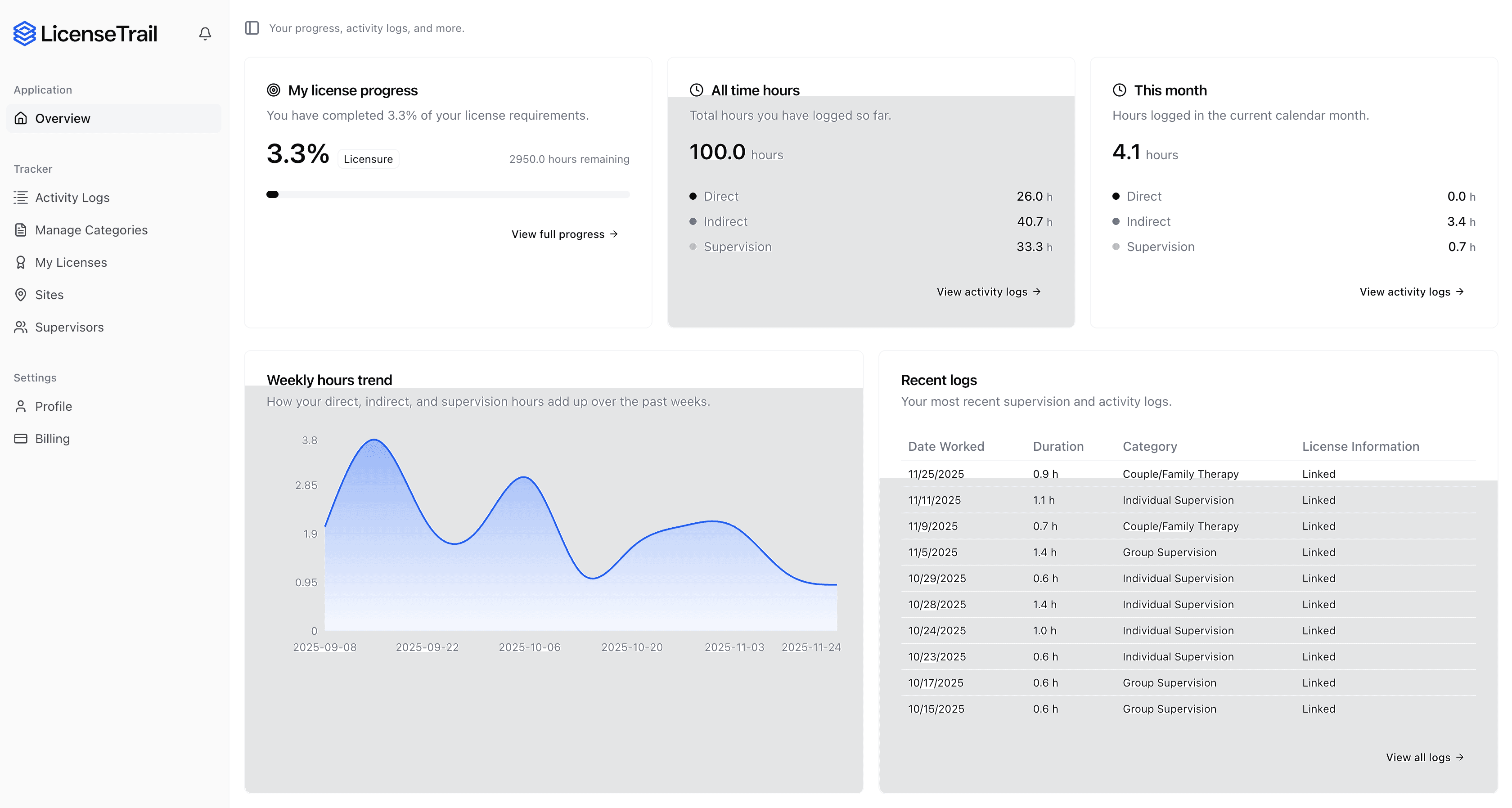
Track your MFT-Intern hours with confidence
License Trail checks your direct, indirect, and supervision hours against Nevada MFT-Intern requirements continuously and flags mismatches before you submit.
 Start Tracking for Free
No credit card required · Free plan available
Is your spreadsheet hiding Nevada MFT-Intern risks?
Stop guessing if your categories match Nevada Board of Examiners for Marriage and Family Therapists and Clinical Professional Counselors requirements. License Trail checks your direct, indirect, and supervision hours continuously and flags mismatches before you submit.
Import or log
Bring your spreadsheet or start fresh
Upload your existing tracking spreadsheet and we'll map every hour into the right Nevada Board of Examiners for Marriage and Family Therapists and Clinical Professional Counselors categories automatically.
Verify against Nevada
Catch mismatches before the board does
License Trail checks your direct, indirect, and supervision hours against Nevada MFT-Intern requirements continuously.
Export board-ready
One-click clean reports
Generate professional, board-ready reports for supervision meetings and Nevada Board of Examiners for Marriage and Family Therapists and Clinical Professional Counselors submissions in seconds.
No credit card required · Free plan available