
Nevada PI Requirements: Hours, Exams & Step-by-Step Guide
Stop guessing if your categories match Nevada requirements. License Trail checks your direct, indirect, and supervision hours against PI requirements continuously and flags mismatches before you submit.
No credit card required · Free plan available
Quick Requirements Overview
- Board registration (not independent practice); must be in a qualifying doctoral psychology program and completing a required predoctoral internship
- Internship must be APA-accredited or equivalent and total ≥ 2,000 training hours over ≥ 12 months full-time or ≥ 24 months part-time
- All services must be supervised by a Nevada-licensed psychologist; minimum 4 supervision hours/week, including ≥ 2 hours/week face-to-face individual supervision
- Employment structure: intern must be employee of supervisor or covered by a 3-party written agreement (intern/agency/supervisor); cannot be an independent contractor
- Apply via Board PI/PA registration application; $150 fee; fingerprints + criminal background check required (application not complete until received)
- Board uses ASPPB PLUS; requires a Supervision Practice Plan submission
- Registration term: expires 2 years from issuance; generally not renewable without Board-approved exception
- Ongoing compliance: log supervised experience, disclose “Psychological Intern” status (include supervisor name; no independent advertising); supervisor caseload caps (max 2 FTE interns; intern max 2 supervisors)
License Details
Procedures
Nevada’s “PI” (Psychological Intern) status is a formal Board registration that allows you to complete your predoctoral internship in psychology and have those hours counted toward full psychologist licensure. It is not an independent practice license, but most people informally call it an “intern license.”
Below is a structured, step‑by‑step description of what the Nevada State Board of Psychological Examiners requires, with a focus on hour requirements and the Board’s own terminology.
1. What a Psychological Intern (PI) Is in Nevada
Under Nevada law, a “psychological intern” is a person who:
- Is in a doctoral training program in psychology (at an accredited institution approved by the Board, or an equivalent doctoral-level program), and
- Wishes to engage in a predoctoral internship that is required by that training program. (nevada.public.law)
Such a person may register with the Board as a Psychological Intern. This registration is what people often refer to as getting a “PI license.”
Any services you perform as a psychological intern must be under the supervision of a licensed psychologist and in compliance with Board regulations. (nevada.public.law)
2. Big‑Picture Hour Requirements on the Path to Licensure
Nevada’s psychologist licensure framework requires two years of supervised, documented experience equivalent to full‑time work. (regulations.justia.com)
Those two years are typically:
-
Year 1 – Predoctoral Internship (as a Psychological Intern)
- Must be a doctoral internship that meets APA accreditation standards or their equivalent.
- Must include at least 2,000 hours of training, completed in:
- ≥ 12 months if full‑time, or
- ≥ 24 months if part‑time. (regulations.justia.com)
-
Year 2 – Postdoctoral Supervised Experience (as a Psychological Assistant)
- Must be postdoctoral and consist of at least 1,750 hours of supervised experience. (regulations.justia.com)
Total: ≈ 3,750 supervised hours (2,000 internship + 1,750 postdoc) before you can receive full psychologist licensure.
So, Nevada does not use a breakdown like “1,500 direct hours + 1,500 supervised hours.” Instead, it requires:
- A 2,000‑hour doctoral internship year (your PI year), and
- A 1,750‑hour postdoctoral year, with both years fitting specific structure and supervision rules.
3. Hour Requirements Specific to the Predoctoral Internship (PI Year)
3.1 Minimum total internship hours
For your internship to count as the first supervised year toward licensure, the Board requires:
- A minimum of 2,000 total training hours,
- Completed over at least 12 months full‑time or 24 months part‑time. (regulations.justia.com)
These 2,000 hours are the internship program’s total training hours — they include direct clinical work, supervision, documentation, didactics, and other educational activities. Nevada does not break those 2,000 hours into fixed sub‑blocks (e.g., “X therapy hours, Y assessment hours”) in regulation; instead, it requires that the internship substantially meet APA Standards of Accreditation.
3.2 Supervision hours during the internship
Nevada spells out minimum weekly supervision requirements for interns:
- At least 4 hours of supervision per week, and
- Within those 4 hours, at least 2 hours per week must be face‑to‑face individual supervision by one or more doctoral‑level licensed psychologists who are in an ongoing supervisory relationship with the intern and have primary responsibility for the cases discussed. (regulations.justia.com)
The remaining supervision each week may be individual or group, and may involve other appropriately credentialed health professionals, as long as it fits the Board’s supervision definition and remains interactive (not just passive observation). Overall responsibility for supervision still rests with doctoral‑level licensed psychologists. (regulations.justia.com)
3.3 Nature of internship activities
For internships that are not APA‑accredited, Nevada requires the program to show it substantially meets APA internship standards. Among other things, the program must: (regulations.justia.com)
- Be structured as a training program, not just a job.
- Provide education and training that prepares interns for practice in health service psychology.
- Be primarily experiential, involving direct service delivery to actual clients/patients.
- Provide enough observation and supervision by doctoral‑level psychologists so that interns are ready to enter general practice upon completion.
The Board does not impose a specific percentage like “X% of your 2,000 hours must be direct therapy,” but in practice, APA‑consistent internships typically provide:
- Substantial direct clinical services (therapy, assessment),
- Ongoing supervision,
- Didactics, case conferences, documentation, and other professional activities.
Many Nevada internships describe sample schedules around 20 hours/week of direct service plus several hours of supervision and documentation, but that distribution is set by the program, not by the Board. (psychinstitutelv.com)
4. How the Board Defines “Supervised Experience” and Hour Types
Although the detailed percentage breakdown appears in the rule for postdoctoral supervised experience, it’s useful to understand the Board’s terminology, because it reflects how they view all supervised hours (including the internship year).
For supervised experience that counts toward licensure, Nevada requires that: (regulations.justia.com)
-
At least 50% of the hours per week are spent providing clinical services, which include:
- Psychological services rendered directly to individuals, couples, families, or groups,
- Psychological testing, and
- Individual or group supervision related to those clinical services.
-
At least 15% of the hours per week are spent in face‑to‑face client care.
-
Remaining hours may be spent in other psychology‑related activities, such as:
- Teaching psychology,
- Conducting psychological research (in ways permitted by the rule),
- Administrative tasks related to psychology, or
- Other activities clearly related to the discipline.
-
Across your supervised experience (primarily highlighted for the postdoc year), you must receive at least 40 hours of training focused on cultural, ethnic, and group processes as social bases of behavior, and at least 3 hours of individual face‑to‑face supervision that specifically focuses on this area.
While this 50% / 15% / 40‑hour framework is written explicitly for the postdoctoral year, it shows how Nevada thinks about legitimate supervised experience and is commonly mirrored in well‑designed internship programs.
5. Eligibility Criteria to Register as a PI (Psychological Intern)
To register as a Psychological Intern with the Nevada Board, you must: (nevada.public.law)
-
Be in a qualifying doctoral program
- You must be currently enrolled in a doctoral training program in psychology at:
- An accredited educational institution approved by the Board, or
- A doctoral‑level program deemed equivalent in subject matter and extent of training by the Board.
- You must be currently enrolled in a doctoral training program in psychology at:
-
Be engaging in a predoctoral internship
- You must be entering or engaged in a predoctoral internship that meets the requirements of your training program and is intended to satisfy Nevada’s internship criteria (APA‑accredited or equivalent 2,000‑hour internship).
-
Be supervised by a Nevada‑licensed psychologist
- All activities or services performed as a psychological intern must be under the supervision of a licensed psychologist in line with the Board’s supervision regulations. (nevada.public.law)
-
Be eligible for a criminal background check
- You must submit fingerprints and give written authorization so the Board can obtain criminal history reports from the Nevada Central Repository and the FBI. An application is not “complete and received” until the Board has your fingerprints (or verification of electronic submission) and the required fees. (nevada.public.law)
6. Application and Registration Process
6.1 Submit the Board’s PI application and fee
The Board handles Psychological Intern and Psychological Assistant registration through a combined application process:
- Use the “Application to Register as a Psychological Intern or Psychological Assistant”:
- Online application via the Board’s website, or
- Paper application mailed with a check.
- Pay the $150 application fee for registration. (psyexam.nv.gov)
6.2 Complete fingerprinting and background check
As part of the same application, you must: (nevada.public.law)
- Arrange for a complete set of fingerprints to be taken by law enforcement or another approved entity.
- Have those fingerprints submitted to the Nevada Central Repository for forwarding to the FBI and any other agencies the Board deems necessary.
- Provide written authorization for the Board (or the fingerprinting entity) to obtain your background reports.
The Board will not treat your PI application as complete until it has both:
- The fingerprints (or verification they were sent) and
- The initial registration fee.
6.3 PLUS (ASPPB Psychology Licensure Universal System)
Once the Board receives your application, it will: (psyexam.nv.gov)
- Email you next‑step instructions, and
- Send you an invitation to the ASPPB PLUS system.
Through PLUS, you and your supervisor submit:
- Detailed educational and training information, and
- A Supervision Practice Plan that describes your internship setting, supervisor(s), and the nature of your work.
6.4 Supervision and employment arrangements
Under Nevada regulations, a Psychological Intern must either: (law.cornell.edu)
- Be an employee of the supervising psychologist, or
- Be covered by a three‑party written agreement among:
- The supervisor,
- The agency where you are based, and
- You (the intern).
That agreement must:
- Specify payment terms,
- Give the supervisor or training committee full oversight of your work and training plan, including access to all patient records, and
- Explicitly state that you cannot be an independent contractor during the term of the contract.
6.5 Registration duration and renewal
Once approved:
- Your Psychological Intern registration expires 2 years after the date of registration.
- It may not be renewed unless the Board specifically approves an exception. (nevada.public.law)
If you do need an extension (for example, an internship disruption or part‑time structure), you must petition the Board and, if allowed, apply for renewal and pay the renewal fee.
7. Ongoing Requirements While You Are a PI
7.1 Weekly supervision
Your supervising psychologist must ensure you receive, at minimum: (regulations.justia.com)
- 4 hours of supervision each week, including
- 2 hours of face‑to‑face individual supervision by a licensed psychologist with primary responsibility for the cases discussed.
Supervision must be documented and commensurate with your level of professional development.
7.2 Limits on caseload and supervisors
Nevada caps how many supervisees a psychologist can oversee at once: (leg.state.nv.us)
- A single psychologist may supervise no more than two full‑time equivalent psychological interns at the same time.
- A psychological intern may not be employed by more than two supervisors simultaneously.
7.3 Logging your supervised experience
You and your supervisor must keep a regular log of supervised professional experience intended to meet licensure requirements. The log must show: (regulations.justia.com)
- The nature of your professional activities and services,
- The population/clients served, and
- Supervisory contacts (dates, type, duration).
Both you and the supervisor must verify entries. The Board provides a supervised experience log form on its website.
7.4 Status disclosure and advertising restrictions
You must be clear about your trainee status:
- You and your supervisor are responsible for informing clients that you are a psychological intern.
- Your supervisor is ethically and legally responsible for your professional activities and for the welfare of your clients.
- You may not advertise independently or represent yourself as independently licensed. In any roster, directory, or professional material, you must:
- Use the title “Psychological Intern” (or equivalent), and
- Include the name of your supervising psychologist. (leg.state.nv.us)
7.5 Conflict‑of‑interest in supervision
Nevada prohibits supervision arrangements that pose certain conflicts of interest (e.g., supervising family members, current romantic partners, or business partners, except in narrow Board‑approved circumstances). (regulations.justia.com)
8. How Your PI Hours Feed Into Full Licensure
Putting it together:
-
During PI status, you complete a doctoral internship of at least 2,000 hours in 12–24 months, with 4 hours/week of supervision (2 hours individual face‑to‑face) by doctoral‑level psychologists in a program that substantially meets APA internship standards.
-
Those 2,000 internship hours count as the first year of supervised experience required by Nevada’s psychologist licensure law. (regulations.justia.com)
-
After completing your doctoral degree, you typically register as a Psychological Assistant and complete an additional 1,750 postdoctoral supervised hours, meeting the Board’s requirements for:
- Proportion of clinical services vs. other activities,
- Face‑to‑face client care, and
- Cultural/ethnic diversity training. (regulations.justia.com)
-
Along the way, you pass the national EPPP (and Nevada’s state exam), and then apply for full licensure as a psychologist.
9. Summary of Hour‑Related Requirements for a Nevada Psychological Intern (PI)
-
Internship year total:
- Minimum 2,000 training hours, completed over ≥12 months full‑time or ≥24 months part‑time in a doctoral internship that is APA‑accredited or demonstrably equivalent.
-
Supervision during internship:
- ≥ 4 hours of supervision per week.
- ≥ 2 hours per week of face‑to‑face individual supervision by doctoral‑level licensed psychologists.
- Remaining supervision may be individual or group with qualified professionals, but overall supervision responsibility remains with psychologists.
-
Structure of supervised experience (conceptual framework, especially for postdoc):
- Each supervised week:
- ≥ 50% of hours in clinical services (direct psychological services, testing, and supervision directly related to those services).
- ≥ 15% of hours in face‑to‑face client care.
- Across supervised experience: ≥ 40 hours of training focused on cultural/ethnic/group processes and ≥ 3 hours of supervision devoted to that content.
- Each supervised week:
-
Legal/administrative points:
- Must be enrolled in a qualifying doctoral psychology program and engaged in a predoctoral internship.
- Must apply to the Board, pay a $150 registration fee, complete fingerprinting and background checks, and enter the ASPPB PLUS system.
- PI registration is valid for 2 years, and generally not renewable without specific Board approval.
- All activities must be under supervision, logged, and accurately represented to clients and in any professional listings.
These are the Nevada Board–recognized requirements and hour structures that govern your status as a Psychological Intern and determine whether those hours ultimately count toward your psychologist license.
Track your PI hours with confidence
License Trail checks your direct, indirect, and supervision hours against Nevada PI requirements continuously and flags mismatches before you submit.
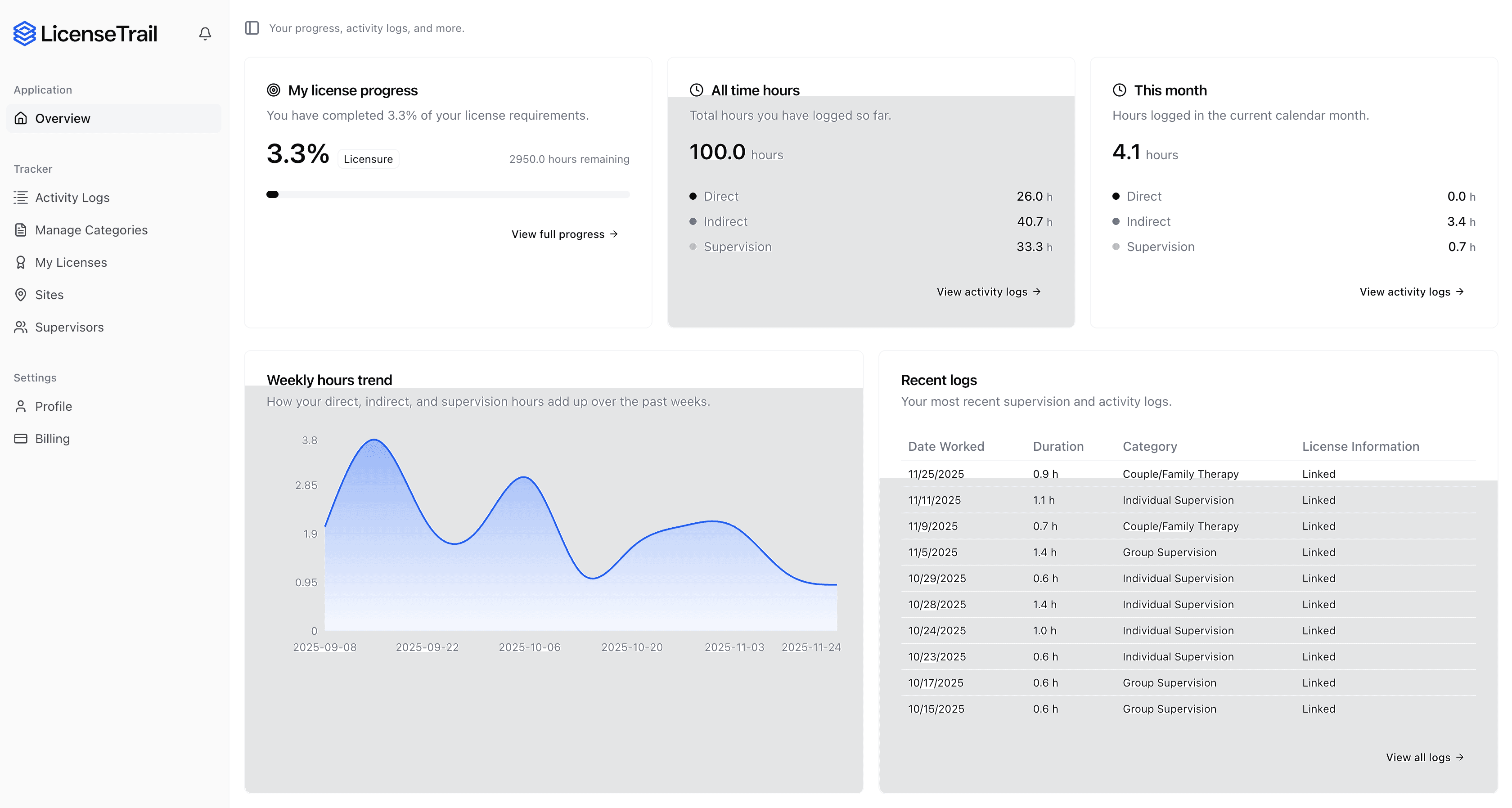 Start Tracking for Free
No credit card required · Free plan available
Related Licenses
Is your spreadsheet hiding Nevada PI risks?
Stop guessing if your categories match Nevada Board of Psychological Examiners requirements. License Trail checks your direct, indirect, and supervision hours continuously and flags mismatches before you submit.
Import or log
Bring your spreadsheet or start fresh
Upload your existing tracking spreadsheet and we'll map every hour into the right Nevada Board of Psychological Examiners categories automatically.
Verify against Nevada
Catch mismatches before the board does
License Trail checks your direct, indirect, and supervision hours against Nevada PI requirements continuously.
Export board-ready
One-click clean reports
Generate professional, board-ready reports for supervision meetings and Nevada Board of Psychological Examiners submissions in seconds.
No credit card required · Free plan available