
New-jersey CSW Requirements: Hours, Exams & Step-by-Step Guide
Stop guessing if your categories match New-jersey requirements. License Trail checks your direct, indirect, and supervision hours against CSW requirements continuously and flags mismatches before you submit.
No credit card required · Free plan available
Quick Requirements Overview
- Regulator: NJ State Board of Social Work Examiners (Division of Consumer Affairs); eligibility per N.J.A.C. 13:44G‑4.3
- Education Path A: BSW in Social Work from CSWE-accredited or candidacy program → eligible
- Education Path B (limited): Bachelor’s earned before 4/6/1995 in specified related fields (or non-CSWE SW) → eligible only with documented experience
- Experience (Path B only): 1,600 hours full-time social work experience in any consecutive 18-month period, completed before 4/6/1995
- Application materials: Board application + fee + criminal history background check consent + official transcript; Path B also needs Board affidavit/employer documentation of hours
- Exam: No ASWB exam required for CSW (exam applies to LSW/LCSW, not CSW)
- Scope limit: CSW may provide non-clinical social work services; cannot perform clinical social work/psychotherapy
- Renewal CE: 20 CE hours per 2-year cycle (min 5 ethics, 3 cultural competence, 1 opioid-related); up to 4 hours carryover
License Details
Procedures
Becoming a Certified Social Worker (CSW) in New Jersey
In New Jersey, the Certified Social Worker (CSW) credential is regulated by the State Board of Social Work Examiners under the Division of Consumer Affairs. The current requirements are set out primarily in N.J.A.C. 13:44G‑4.3 (Eligibility requirements; CSW) and related regulations. (regulations.justia.com)
This guide focuses on:
- Education routes to CSW
- Exactly what “hours” are required (and for whom)
- What the Board’s language means in practice
- Ongoing continuing education hour requirements once certified
1. Core eligibility: two education pathways
Under N.J.A.C. 13:44G‑4.3(a), every CSW applicant must submit materials “on forms provided by the Board”, including an application, fee, consent for a criminal history background check, and specific academic documentation. (regulations.justia.com)
There are two distinct education paths.
Pathway A – Standard BSW route (most current applicants)
You qualify if you have:
- A baccalaureate degree in social work from an educational program accredited, or in candidacy for accreditation, by the Council on Social Work Education (CSWE). (regulations.justia.com)
For this pathway:
- No practice hours are required to qualify as a CSW.
- You do not need the ASWB exam for CSW (that exam is required later for LSW and LCSW, not for CSW). (naswnj.socialworkers.org)
Pathway B – Pre‑April 6, 1995 “related degree + experience hours” route
This is a limited, older pathway for people whose bachelor’s degree was earned prior to April 6, 1995.
You qualify if you have: (regulations.justia.com)
- A baccalaureate degree earned before April 6, 1995 from an accredited institution of higher education in one of these fields:
- Guidance and Counseling
- Human Services
- Marriage and Family Counseling
- Psychology
- Sociology
- Vocational/Disability Rehabilitation
- Social Work (from programs not accredited or not in candidacy with CSWE)
And
- Board‑required documentation (e.g., an affidavit) showing you completed “one year of full‑time social work experience (1,600 hours in any consecutive 18‑month period) prior to April 6, 1995.” (regulations.justia.com)
This is where hours come in for CSW eligibility.
2. Breaking down the required hours (pre‑1995 pathway)
For applicants using the pre‑1995 related‑degree route, the regulation defines the experience requirement as:
- “One year of full‑time social work experience (1,600 hours in any consecutive 18‑month period).” (regulations.justia.com)
Key points:
- 1,600 hours total
- These are practice hours, not classroom or CE hours.
- They must constitute social work experience (see below for how “social work” and “social work services” are defined).
- Time frame: Those 1,600 hours must fall within any single 18‑month consecutive period.
- Timing: All of this experience must have been completed before April 6, 1995.
The regulation does not further subdivide these 1,600 hours into “direct” vs. “supervised” experience the way many states do for clinical licensure. It simply specifies full‑time social work experience, quantified at 1,600 hours in an 18‑month window. (regulations.justia.com)
What counts as “social work” experience?
“Social work” and “social work services” are defined in N.J.A.C. 13:44G‑1.2:
- “Social work” is activity aimed at enhancing, protecting, or restoring a person’s capacity for social functioning. (regulations.justia.com)
- “Social work services” are described as concrete, non‑clinical services, and the rule lists examples such as:
- Social work assessment (identifying problems, gathering information to make referrals and plan social care/action)
- Social work counseling (professional use of social work methods and values to advise, provide guidance, help articulate goals, provide information, and support coping), explicitly excluding psychotherapy. (regulations.justia.com)
In practice, qualifying 1,600 hours might include:
- Case management, service coordination, or client advocacy
- Intake, assessment, and non‑clinical counseling
- Resource linkage, benefits navigation, discharge planning
- Community organizing or program planning where you are functioning as a social worker
The Board doesn’t require those hours to be under formal “clinical supervision” for CSW purposes; the regulation is framed around full‑time social work experience, not clinical supervision standards (those appear later for LCSW). (regulations.justia.com)
3. What CSWs can and cannot do under Board rules
The Board draws a sharp line between “social work services” (CSW scope) and “clinical social work services” (LCSW, or LSW under LCSW supervision).
Relevant regulatory language: (regulations.justia.com)
- Clinical social work services (assessment and psychotherapeutic counseling of individuals, families, or psychotherapy groups) may only be performed:
- By an LCSW, or
- By an LSW under supervision per N.J.A.C. 13:44G‑8.
- CSWs are expressly prohibited from rendering clinical social work services.
So, once certified as a CSW you may provide non‑clinical social work services (assessment, non‑clinical counseling, casework, planning, advocacy, etc.), but not psychotherapy or independent clinical practice.
4. Step‑by‑step: how to obtain CSW certification
Step 1 – Confirm which pathway you’re using
-
If you have a BSW from a CSWE‑accredited (or candidate) program
- You fall under Pathway A.
- No experience hours are required. (regulations.justia.com)
-
If your bachelor’s degree is from before April 6, 1995, in one of the listed related fields (or non‑CSWE social work)
- You fall under Pathway B.
- You must document one year of full‑time social work experience, defined as 1,600 hours in any consecutive 18‑month period, before 4/6/1995. (regulations.justia.com)
Step 2 – Assemble your academic documentation
Under N.J.A.C. 13:44G‑4.3(a)(4), you must provide: (regulations.justia.com)
- Official transcript showing:
- Path A: Baccalaureate degree in social work from a CSWE‑accredited (or candidate) program; or
- Path B: Baccalaureate degree obtained before April 6, 1995 in one of the specified fields from an accredited institution.
If you are using the pre‑1995 route, be sure your transcript clearly shows the conferral date is prior to April 6, 1995.
Step 3 – Document your 1,600 hours (pre‑1995 route only)
If Pathway B applies:
- Prepare the affidavit or Board‑specified form attesting to your one year of full‑time social work experience, quantified as 1,600 hours in any 18 consecutive months before April 6, 1995. (regulations.justia.com)
- Support it with:
- Employer letters (titles, dates, duties, full‑time status)
- Job descriptions showing duties consistent with “social work services” as defined in N.J.A.C. 13:44G‑1.2. (regulations.justia.com)
Step 4 – Complete the Board’s application
Per N.J.A.C. 13:44G‑4.3(a), the Board requires: (regulations.justia.com)
- Completed application form
- This asks for your educational and experiential background.
- Application fee
- The amount is set in the fee schedule at N.J.A.C. 13:44G‑14.1.
- Signed consent for a criminal history background check
- Official transcripts, and if applicable, the experience affidavit for the pre‑1995 route.
Applications are submitted through the New Jersey Board of Social Work Examiners portal on the Division of Consumer Affairs site. (njscsw.us)
Step 5 – Understand that no exam is required for CSW
The Board, via NASW‑NJ and statutory materials, makes clear that the ASWB exam is required for LSW and LCSW, not for CSW. (naswnj.socialworkers.org)
So:
- CSW = no ASWB exam requirement.
- LSW, LCSW = ASWB exams required (Masters for LSW, Clinical for LCSW).
5. After certification: continuing education hour requirements
Once you’re a CSW, you must meet biennial continuing education (CE) requirements to renew.
According to NASW‑NJ and the Board’s CE rules (N.J.A.C. 13:44G‑6): (naswnj.socialworkers.org)
- Total CE hours per 2‑year cycle (CSW): 20 hours
- At least 5 hours in ethics
- At least 3 hours in social and cultural competence
- At least 1 hour related to prescription opioid drugs
- Carryover: You may carry over up to 4 surplus hours into the next renewal cycle (if you exceed 20).
These are educational hours, not practice hours, and are separate from the pre‑1995 1,600‑hour experience requirement.
6. Summary of “hour” requirements specifically for CSW in New Jersey
Putting it all together:
-
Standard modern BSW pathway (CSWE‑accredited BSW)
- Practice hours required to obtain CSW: 0
- No ASWB exam required. (regulations.justia.com)
-
Pre‑April 6, 1995 related‑degree pathway
- Must document one year of full‑time social work experience, precisely defined as:
- 1,600 hours of full‑time social work experience in any consecutive 18‑month period, completed before April 6, 1995. (regulations.justia.com)
- Those hours are not subdivided into “direct” vs. “supervised” by regulation; they must qualify broadly as social work experience consistent with Board definitions.
- Must document one year of full‑time social work experience, precisely defined as:
-
Post‑licensure continuing education
- 20 CE hours every 2 years for CSWs, including specified ethics, cultural competence, and opioid‑related content, with a small number of hours allowed to carry over. (naswnj.socialworkers.org)
No additional supervised practice‑hour categories (such as separate “direct client” vs. “supervision” hours) are imposed for the CSW credential itself in New Jersey; those more complex hour structures apply at the LCSW level, not CSW.
Track your CSW hours with confidence
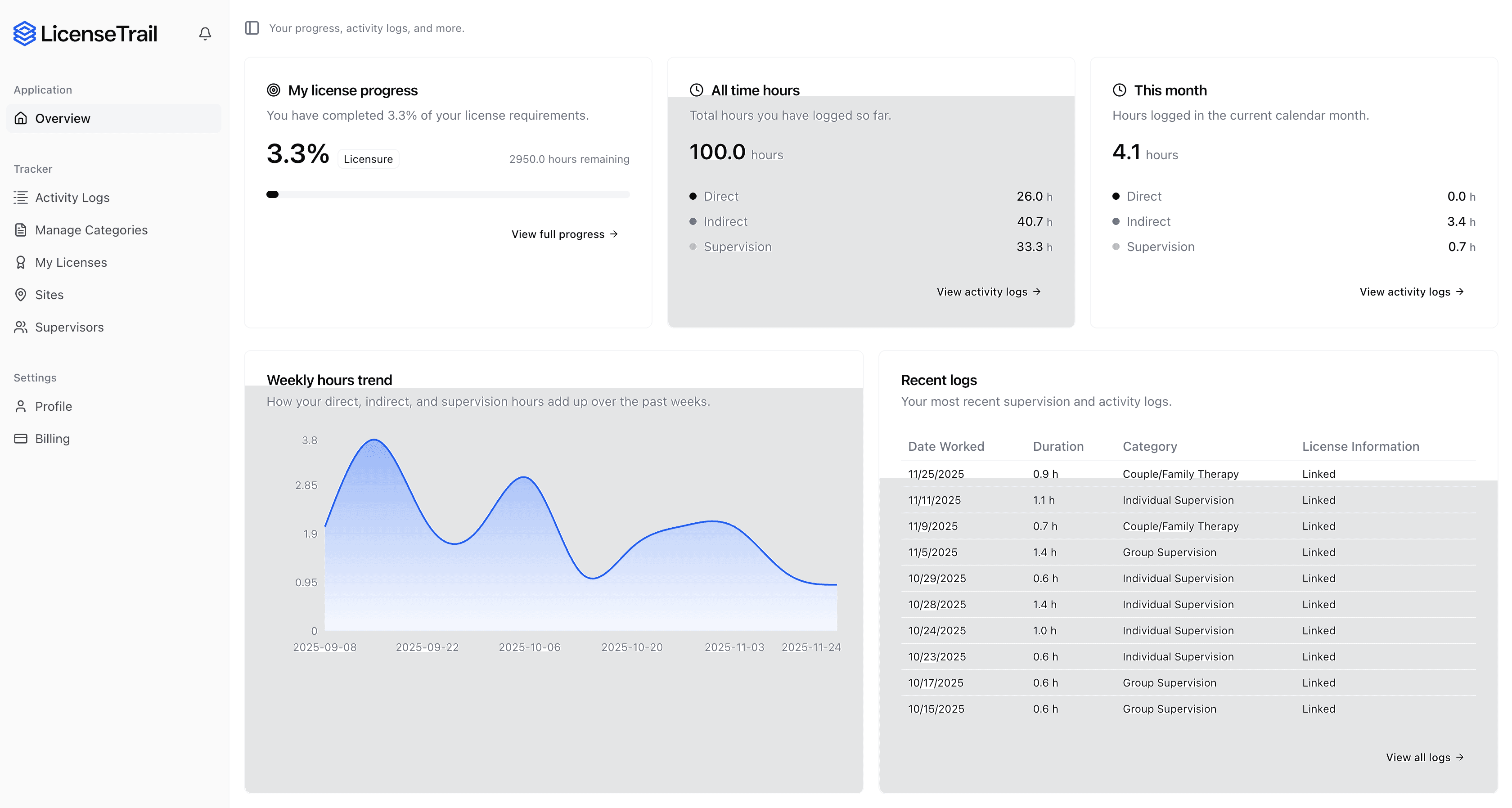
License Trail checks your direct, indirect, and supervision hours against New-jersey CSW requirements continuously and flags mismatches before you submit.
 Start Tracking for Free
No credit card required · Free plan available
Related Licenses
Is your spreadsheet hiding New-jersey CSW risks?
Stop guessing if your categories match New Jersey Board of Social Work Examiners requirements. License Trail checks your direct, indirect, and supervision hours continuously and flags mismatches before you submit.
Import or log
Bring your spreadsheet or start fresh
Upload your existing tracking spreadsheet and we'll map every hour into the right New Jersey Board of Social Work Examiners categories automatically.
Verify against New-jersey
Catch mismatches before the board does
License Trail checks your direct, indirect, and supervision hours against New-jersey CSW requirements continuously.
Export board-ready
One-click clean reports
Generate professional, board-ready reports for supervision meetings and New Jersey Board of Social Work Examiners submissions in seconds.
No credit card required · Free plan available