
New-jersey LP Requirements: Hours, Exams & Step-by-Step Guide
Stop guessing if your categories match New-jersey requirements. License Trail checks your direct, indirect, and supervision hours against LP requirements continuously and flags mismatches before you submit.
No credit card required · Free plan available
Quick Requirements Overview
- Regulator: NJ State Board of Psychological Examiners (Practicing Psychology Licensing Act; N.J.A.C. 13:42)
- Doctorate in psychology/allied field (Board-recognized; regionally accredited) + required application docs (transcripts, dissertation abstract, 2 moral character certificates)
- Education credits: 40 doctoral psych credits (36 across 6 specified content areas) + 20 additional graduate psych credits
- Supervised experience: 2 years FTE = 3,500 hours total (1,750/year)
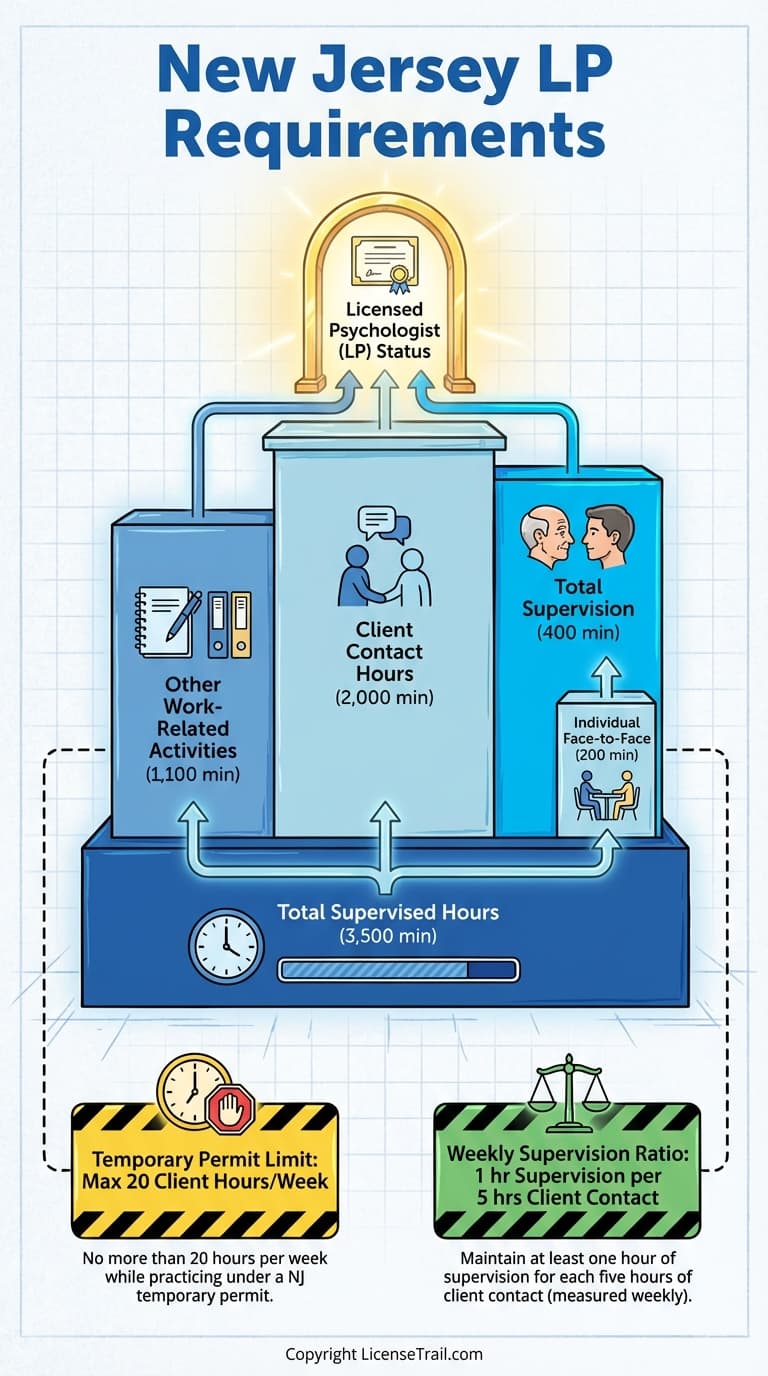
- Per 1,750-hour year: 1,000 client contact + 200 supervision (≥100 individual face-to-face; rest individual/group; 1:5 weekly supervision-to-client-contact ratio) + 550 other professional activities
- Temporary permit: supervised practice permit up to 3 years; no independent practice/billing; cannot practice until issued
- Client contact cap while on temporary permit: ≤20 client/group contact hours per week
- Exams: EPPP + NJ jurisprudence online exam (within 90 days after EPPP pass)
License Details
Procedures
Licensure as a Licensed Psychologist (LP) in New Jersey is governed by the New Jersey State Board of Psychological Examiners, under the Practicing Psychology Licensing Act and Title 13:42 of the New Jersey Administrative Code. The process combines specific doctoral education, a tightly defined package of supervised experience hours, and national and state examinations.
Below is a structured guide focusing on the exact hour types and board language.
1. Governing body and license type
- Regulator: New Jersey State Board of Psychological Examiners, within the Division of Consumer Affairs.(nj.gov)
- Credential: License to practice as a licensed psychologist (often abbreviated LP in other contexts, but in NJ regulations it is simply “licensed psychologist”).
2. Doctoral education requirements
To qualify to sit for the exam, the Board requires:
- An earned doctorate in psychology or an allied field, or equivalent training, from an institution recognized by the Board and regionally accredited.(law.cornell.edu)
- Application materials that include:
- Official transcripts
- An abstract of your doctoral dissertation (as published in Dissertation Abstracts International)
- Two “certificates of good moral character”
- Documentation of supervised experience once completed(law.cornell.edu)
Minimum psychology credit requirements
For a doctorate in psychology, the Board requires at least 40 doctoral credit hours specifically in psychology, earned within a doctoral program, with 36 credits distributed as follows:(law.cornell.edu)
- Personality Theory and Human Development Theory – 6 credits
- Learning Theory and/or Physiological Psychology – 6 credits
- Psychological Measurement and Psychological Assessment – 6 credits
- Psychopathology – 6 credits
- Psychological therapy/counseling or Industrial/Organizational Psychology – 6 credits
- Research and Statistical Design – 6 credits
In addition, you must show 20 more graduate credits in psychology (pre‑ or post‑doctoral) from a regionally accredited institution.(law.cornell.edu)
Programs typically must be APA/CPA accredited or meet equivalent structural criteria described in N.J.A.C. 13:42‑2.1(f).(law.cornell.edu)
3. Supervised professional experience: total hours and required breakdown
The supervised experience requirement is where New Jersey is very specific in its hour types and terminology.
3.1 Total amount of supervised experience
The Board requires you to document:
“at least two years of full time or full‑time equivalent supervised experience in the practice of psychology.” (regulations.justia.com)
Regulation N.J.A.C. 13:42‑4.1 then defines one year of full‑time supervised experience as:
“a minimum of 1,750 hours.” (regulations.justia.com)
Because the requirement is two years, this equals:
- Total supervised experience: 3,500 hours
All of these hours are supervised; New Jersey does not split them into “supervised vs. unsupervised” categories the way some states do. Instead, it distinguishes how those 3,500 hours must be allocated.
3.2 Required breakdown per year (1,750 hours)
The regulation specifies that each 1,750‑hour year must include:(regulations.justia.com)
-
Client contact hours
- “One thousand client contact hours completed in accordance with the limitations provided in N.J.A.C. 13:42‑3.6(f).”
- These are direct services to clients (e.g., psychotherapy, assessment, clinical interviews) performed as part of the practice of psychology.
-
Supervision hours
- “Two hundred hours of supervision. At least 100 hours shall be individual face‑to‑face supervision; the remaining 100 hours may be individual or group supervision. The ratio shall be one hour of supervision for each five hours of client contact per week.”
-
Other work‑related activities
- “Five hundred fifty hours in other work‑related activities such as recordkeeping, consultations, report writing, etc.”
3.3 Required breakdown for the full two‑year requirement (3,500 hours)
Multiplying the one‑year requirement by two, the Board’s structure effectively requires:
- Client contact (“direct” service):
- 1,000 hours/year × 2 years = 2,000 client contact hours
- Supervision:
- 200 hours/year × 2 years = 400 hours of supervision, of which:
- At least 200 hours must be individual face‑to‑face supervision (≥100 per year)
- Up to 200 hours may be either individual or group, as long as the 1:5 supervision‑to‑client‑contact ratio per week is respected
- 200 hours/year × 2 years = 400 hours of supervision, of which:
- Other work‑related activities:
- 550 hours/year × 2 years = 1,100 hours in “other work‑related activities such as recordkeeping, consultations, report writing, etc.”
So, in New Jersey language, you are aiming for:
3,500 total hours of supervised experience
– 2,000 client contact hours
– 400 hours of supervision
– 1,100 hours in other work‑related activities
This is the current standard reflected in both the Administrative Code and recent professional summaries.(regulations.justia.com)
3.4 Weekly limits on client contact
While working under a temporary permit (supervised or one‑year unsupervised), the Board further limits how concentrated your direct work can be:
A temporary permit holder “shall limit client contact to no more than 20 client or group contact hours in any one week.” (law.cornell.edu)
This is why you cannot accelerate the required experience purely by increasing weekly client hours.
3.5 When the hours can be earned (pre‑ vs post‑doctoral)
Historically, New Jersey required that at least one of the two years be post‑doctoral. More recent law has changed this.
As now codified in N.J.A.C. 13:42‑4.1(c)–(d):(regulations.justia.com)
- An individual applying after October 1, 2020 may complete the two years of full‑time or full‑time‑equivalent supervised experience before receiving the doctoral degree.
- Applicants who had already submitted an application but were not yet licensed by December 14, 2020 may update their application to count qualifying professional experience earned prior to the doctorate toward the two years.
In practice, many candidates still accrue a substantial portion of the 3,500 hours post‑doctorally under a supervised temporary permit, but the code now allows pre‑doctoral supervised experience (that meets all requirements) to count toward the full 3,500 hours.
4. Temporary permits during the experience period
New Jersey uses temporary permits to regulate practice before full licensure.
4.1 Three‑year supervised temporary permit
Under N.J.A.C. 13:42‑3.2, the Board:(law.cornell.edu)
- Issues a “temporary permit for the supervised practice of psychology for a period not to exceed three years” to a qualified individual who otherwise meets New Jersey requirements except for:
- “the requisite number of hours of post‑doctoral supervised experience and/or passing the written examination and completing the jurisprudence online examination,” and
- who has not engaged in conduct that would justify denial.
Key conditions:
- You may not provide psychological services until the permit is issued.(law.cornell.edu)
- You must practice only under supervision and in accordance with Subchapter 4 (supervision standards).(law.cornell.edu)
- You cannot engage in unsupervised or independent practice as a supervised permit holder.(law.cornell.edu)
- You cannot set or receive professional fees directly from clients; payment must go through the supervisor or employing entity.(law.cornell.edu)
- You must obey the 20‑hour weekly limit on client contact.(law.cornell.edu)
- You may not use “psychologist” or “psychology” in advertising or title prior to full licensure.(law.cornell.edu)
There is also a one‑year unsupervised temporary permit used mainly for out‑of‑state psychologists who have already satisfied supervised‑hours requirements but still need to pass the New Jersey jurisprudence examination, but that is not typically the route for in‑state trainees.(psychologydegree411.com)
5. Examination requirements
Once you meet the educational and supervised experience criteria and your application is approved, the Board requires two main examinations.
5.1 National written exam – EPPP
N.J.A.C. 13:42‑5.1(a) states:(regulations.justia.com)
- A candidate who has been admitted to sit for examination “shall take the Examination for Professional Practice in Psychology sponsored by the Association of State and Provincial Psychology Boards (ASPPB).”
- “A passing score shall be that as established by the ASPPB at the time of the examination.”
So:
- Exam name: Examination for Professional Practice in Psychology (EPPP)
- Exam body: ASPPB
- Passing standard: Whatever cut score ASPPB sets at the time you test (currently a scaled score of 500 on the computer‑based exam, per ASPPB guidance, but that figure is determined by ASPPB, not the Board).(psychologydegree411.com)
5.2 New Jersey jurisprudence online examination
After you pass the EPPP, you must complete the Board’s state‑specific exam. The regulation and the Board’s own orientation materials specify:(regulations.justia.com)
- A candidate who passes the EPPP “shall then take the Board's jurisprudence online examination within 90 days of notification” of the EPPP pass.
- The jurisprudence examination tests your knowledge of the New Jersey statutes (N.J.S.A.) and regulations (N.J.A.C.) that govern psychology.
- The Board’s site describes it as a 25‑item true/false online examination covering key laws and rules.(nj.gov)
5.3 Limited waiver of written exam requirement
Certain already‑credentialed psychologists (e.g., ABPP diplomates, ASPPB CPQ holders, or those in the National Register) may obtain a “license without examination” as to the EPPP, but they still must complete the jurisprudence online examination and meet all other requirements.(law.cornell.edu)
6. Step‑by‑step summary focused on hours and Board language
Putting the regulatory pieces together, the New Jersey path to an LP (licensed psychologist) license looks like this:
-
Complete qualifying doctoral education that meets N.J.A.C. 13:42‑2.1 requirements:
- Doctorate in psychology (or allied field with equivalent training) from a regionally accredited institution recognized by the Board
- At least 40 doctoral credits in psychology, with 36 across six specified content areas, plus 20 additional graduate psychology credits(law.cornell.edu)
-
Accrue supervised professional experience in the practice of psychology:
- Document “at least two years of full time or full‑time equivalent supervised experience in the practice of psychology”(regulations.justia.com)
- Each year (1,750 hours) must include:
- 1,000 client contact hours
- 200 hours of supervision (≥100 individual face‑to‑face; rest individual or group; 1:5 weekly supervision‑to‑client‑contact ratio)
- 550 hours in other work‑related activities such as recordkeeping, consultations, report writing, etc.(regulations.justia.com)
- Across two years:
- 3,500 total supervised hours
- 2,000 client contact hours
- 400 supervision hours
- 1,100 other work‑related hours
- Ensure client contact stays within the 20‑hours‑per‑week cap while on temporary permit.(law.cornell.edu)
-
Hold appropriate temporary permit(s) while accruing hours and/or awaiting exams:
- Typically a three‑year supervised temporary permit for supervised practice until hours and exams are complete, subject to strict supervision and billing limitations.(law.cornell.edu)
-
Apply to the Board and submit required documentation:
- Application form, fees, official transcripts, dissertation abstract, two certificates of good moral character, and later documentation of supervised experience.(law.cornell.edu)
-
Pass the required exams:
- EPPP, with passing score as set by ASPPB.(regulations.justia.com)
- New Jersey jurisprudence online examination within 90 days of notification that you passed the EPPP.(regulations.justia.com)
-
Receive your license as a New Jersey licensed psychologist once all education, supervised experience, examinations, and administrative requirements have been met and approved.
In New Jersey’s own wording, then, you are aiming to document:
- “at least two years of full time or full‑time equivalent supervised experience in the practice of psychology,” totaling 3,500 hours, with each year composed of:
- “One thousand client contact hours”
- “Two hundred hours of supervision” (≥100 individual face‑to‑face)
- “Five hundred fifty hours in other work‑related activities such as recordkeeping, consultations, report writing, etc.” (regulations.justia.com)
That structure—rather than a simple “X direct hours / Y supervised hours” split—is the defining feature of New Jersey’s LP licensing requirements.
Track your LP hours with confidence
License Trail checks your direct, indirect, and supervision hours against New-jersey LP requirements continuously and flags mismatches before you submit.
 Start Tracking for Free
No credit card required · Free plan available
Is your spreadsheet hiding New-jersey LP risks?
Stop guessing if your categories match New Jersey Board of Psychological Examiners requirements. License Trail checks your direct, indirect, and supervision hours continuously and flags mismatches before you submit.
Import or log
Bring your spreadsheet or start fresh
Upload your existing tracking spreadsheet and we'll map every hour into the right New Jersey Board of Psychological Examiners categories automatically.
Verify against New-jersey
Catch mismatches before the board does
License Trail checks your direct, indirect, and supervision hours against New-jersey LP requirements continuously.
Export board-ready
One-click clean reports
Generate professional, board-ready reports for supervision meetings and New Jersey Board of Psychological Examiners submissions in seconds.
No credit card required · Free plan available