
New-jersey LSW Requirements: Hours, Exams & Step-by-Step Guide
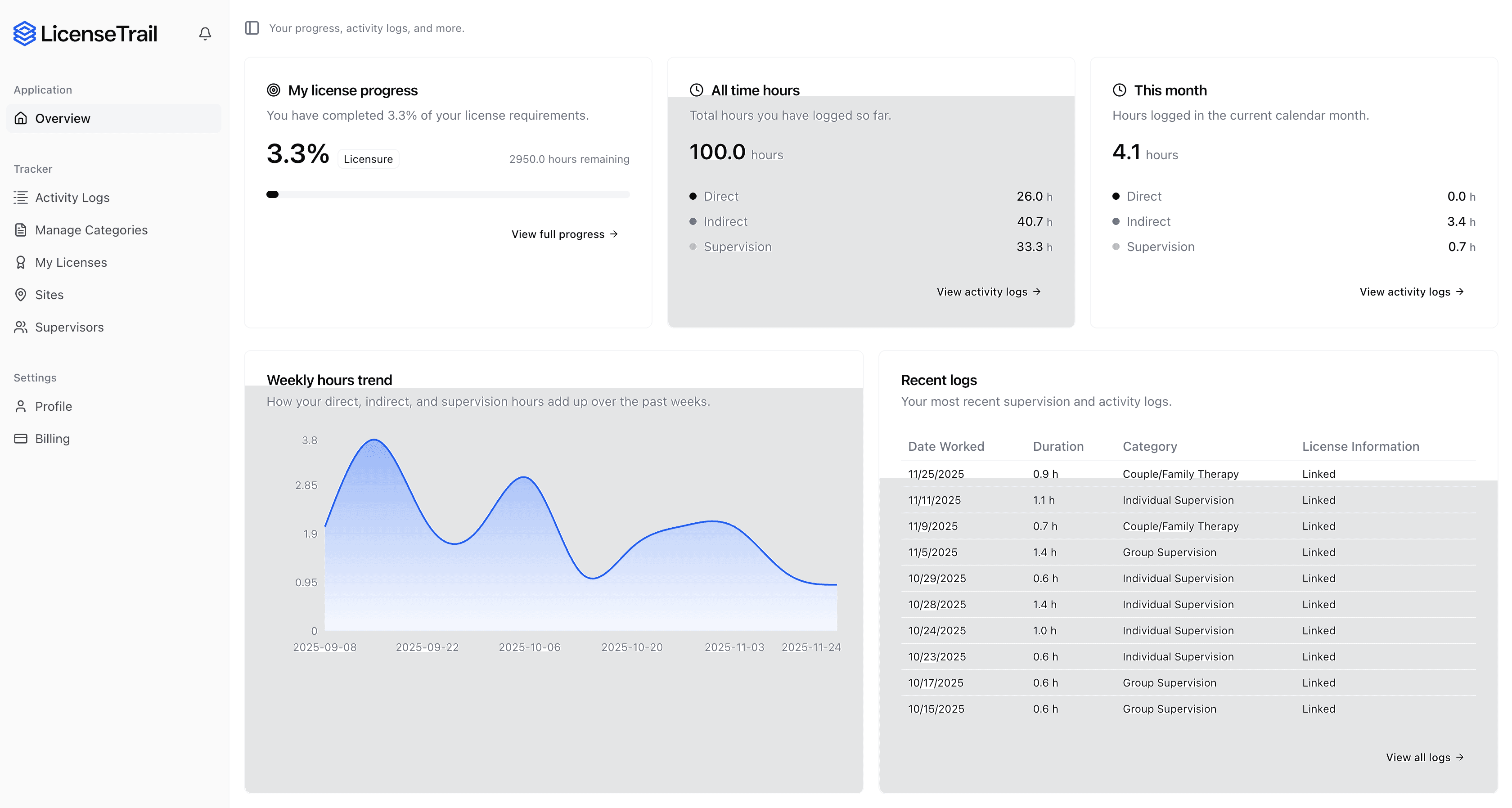
Stop guessing if your categories match New-jersey requirements. License Trail checks your direct, indirect, and supervision hours against LSW requirements continuously and flags mismatches before you submit.
No credit card required · Free plan available
Quick Requirements Overview
- Education: MSW from a CSWE-accredited (or candidacy) program or a doctorate in social work from an accredited institution
- Exam: Pass the ASWB Master’s exam (Board-approved exam)
- Experience hours: No supervised practice/clinical hour requirement for initial NJ LSW licensure
- Early exam eligibility (academic only): Some guides cite 40 graduate credits toward the MSW / final semester to sit for the exam (these are credit-hours, not practice hours)
- Application items: Apply to NJ Board, register with ASWB, submit official transcript, complete criminal background check, pay required fees
- Renewal CE (post-licensure): 30 CE hours every 2 years, including 5 ethics, 3 social/cultural competence, 1 opioid-related hour
License Details
Procedures
Licensing as a Licensed Social Worker (LSW) in New Jersey is primarily an education‑plus‑exam process, not an hours‑of‑experience process. Unlike the Licensed Clinical Social Worker (LCSW) level, the New Jersey State Board of Social Work Examiners does not require a specific number of supervised practice hours (1,500, 3,000, etc.) for initial LSW licensure.
Below is a structured guide, with a focus on the exact types of “hours” that do and do not apply.
1. What the law actually requires for an LSW
The statutory basis for LSW licensure is in N.J. Rev. Stat. § 45:15BB‑6(b). In substance, it directs the Board to issue an LSW license to an applicant who:
- Has received a master’s degree in social work from a Council on Social Work Education (CSWE)–accredited program (or in CSWE “candidacy”) or holds a doctorate in social work from an accredited institution; and
- Has passed an examination provided/approved by the Board. (law.justia.com)
Notice that this statutory language lists no requirement for clinical practice hours or supervised experience for the LSW level. The only prerequisites are education and examination.
2. Educational requirement: the degree and credit-hours piece
2.1 Required degree
For full LSW licensure, the Board – and organizations summarizing its rules – consistently describe the requirement as:
- Master of Social Work (MSW) from a CSWE‑accredited program (or one in CSWE candidacy), or
- Doctorate in Social Work (DSW/PhD) from an accredited institution. (njscsw.us)
The New Jersey Society for Clinical Social Work, summarizing the Board, describes LSW requirements as:
- “A Master’s Degree in Social Work from an educational program accredited by the Council on Social Work Education (CSWE) or in candidacy for accreditation by the CSWE” and
- “Completion of the master’s level examination administered by the Association of Social Work Boards.” (njscsw.us)
That language aligns with the statute and confirms there is no experience‑hour requirement at the LSW level.
2.2 Pre‑degree credit hours (not practice hours)
Some Board‑oriented guides note that you may begin the process while still in your MSW program. One common description of eligibility for the LSW path is: (staging.socialworklicensure.org)
- A bachelor’s degree (usually BSW or related field); and
- Completion of at least 40 graduate credits toward the MSW, or enrollment in the last semester of an advanced‑standing MSW program;
- Registration and passing of the ASWB master’s exam; then
- Submission of the final official MSW transcript to the Board.
Those “40 credits” are academic credit‑hours, not client-contact or supervised‑practice hours. They are part of the academic sequence leading to the MSW; the statute still requires the completed degree for the license itself.
3. Examination requirement
The statute says that an LSW applicant must have “passed an appropriate examination provided by the board” for this purpose. (law.justia.com)
In practice, that “appropriate examination” is the ASWB Master’s‑level exam:
- NASW–NJ explains that the ASWB master’s exam is “a generalist test for social workers with an MSW and limited or no post‑degree experience,” and is required for LSW eligibility. (naswnj.socialworkers.org)
- Guides summarizing Board procedure describe a two‑step exam process:
- Apply to the Board to be approved to sit for the ASWB Master’s exam (often with a $75 application fee). (publichealthonline.org)
- Register directly with ASWB and pay the exam fee (recent guides list about $230, but this is set by ASWB and can change). (staging.socialworklicensure.org)
Again, no practice‑hour requirement attaches to exam eligibility beyond what your MSW program itself has built into its curriculum.
4. Application process for LSW licensure
Third‑party summaries of the New Jersey Board’s process (which quote and link to the Board’s own forms) describe an LSW application sequence that looks like this: (publichealthonline.org)
- Earn at least an MSW (or DSW) in social work from a CSWE‑accredited program (or be in the late stages and then send final transcripts).
- Apply to NJ Board of Social Work Examiners to take the ASWB Master’s exam (approx. $75 Board fee is often cited).
- Register with ASWB for the Master’s exam and pay ASWB’s exam fee (recently around $230).
- Pass the ASWB Master’s exam.
- Submit the LSW license application to the Board:
- Completed online or paper application;
- Official MSW/DSW transcript sent directly to the Board;
- Criminal background check authorization and related forms;
- License issuance fee (recent guides cite about $120).
- Receive Board approval and license number. Only at this point are you legally licensed as an LSW; NASW–NJ emphasizes there is no “grace period” – you are not licensed simply by graduating or by passing the exam. (naswnj.socialworkers.org)
None of these steps adds a requirement such as “1,500 hours of direct experience” for the LSW. The Board’s own statutory standard remains just degree + exam.
5. The “hours” that do not apply to LSW licensure
5.1 No pre‑licensure practice or supervision hours for LSW
- The New Jersey statute setting LSW standards, § 45:15BB‑6(b), does not mention:
- Direct client hours,
- Supervised experience hours, or
- Any numeric practice‑hour totals. (law.justia.com)
- Professional organizations summarizing the Board’s LSW rules likewise list only: MSW/DSW from a CSWE‑accredited program and the ASWB Master’s exam; no hour totals. (njscsw.us)
This is a key point for what you asked:
- New Jersey does not split an LSW requirement into “1,500 hours of direct experience” and “1,500 hours of supervised experience,” or any similar hour‑based breakdown.
- That sort of hour‑by‑hour specification exists only at the LCSW (clinical) level, not for LSW.
5.2 LCSW supervised hours (for context only)
Although it is separate from the LSW license itself, New Jersey does define a supervised‑hours requirement if you later seek an LCSW:
- The Board‑aligned description for LCSW requires two years of full‑time supervised clinical social work experience post‑MSW, and clarifies this as 1,920 hours of face‑to‑face client contact within a three consecutive year period, supervised by an LCSW. (njscsw.us)
- Other Board‑derived guides translate that into a broader requirement of about 3,000 hours of post‑master’s supervised clinical experience, including at least 1,920 hours of direct client contact, completed in no fewer than two and no more than three years while licensed as an LSW. (publichealthonline.org)
Those 3,000/1,920 hours belong to the LCSW process, not to the initial LSW license.
6. The “hours” that do apply to LSWs
While there are no pre‑licensure practice hours for LSW, there are two kinds of hours that matter:
6.1 Academic credit‑hours
As noted above, some Board‑linked resources describe early eligibility in terms of 40 graduate credits toward an MSW before you can be cleared for the exam, especially in advanced‑standing programs. (staging.socialworklicensure.org)
These are course credit‑hours, not client‑contact hours. They are simply part of the degree requirement.
6.2 Continuing Education (CE) hours after you are licensed
Once you hold an LSW, you must complete continuing education hours during each licensing cycle to renew:
- 30 hours of CE every two‑year renewal cycle for an LSW. (naswnj.socialworkers.org)
- Within those 30 hours, the Board’s standards (summarized by NASW‑NJ and licensure guides) break out:
- 5 hours in ethics,
- 3 hours in social and cultural competence, and
- 1 hour related to prescription opioid drugs (coverage of risks, signs of abuse, addiction, and diversion). (naswnj.socialworkers.org)
These CE hours are educational/classroom hours, not supervised clinical‑experience hours. They are completed after you’re already licensed and are tied to renewal, not initial licensure.
7. Concise summary
- Legal standard for LSW (N.J. Rev. Stat. § 45:15BB‑6(b)):
- MSW from a CSWE‑accredited (or candidate) program or a doctorate in social work; and
- Passing an examination approved by the Board (the ASWB Master’s exam). (law.justia.com)
- No experience‑hour requirement is specified anywhere in the statute or in Board‑aligned summaries for LSW. There is no “1,500 direct + 1,500 supervised” style requirement for this license level. (njscsw.us)
- Practice hours and supervision become numerically defined only when you move on to LCSW, where the Board requires approximately 3,000 supervised clinical hours, including 1,920 hours of face‑to‑face client contact over two to three years as an LSW. (njscsw.us)
- Post‑licensure CE hours for LSWs: 30 hours per two‑year cycle, with specified sub‑requirements in ethics, social/cultural competence, and opioid‑related content. (naswnj.socialworkers.org)
In practical terms, becoming an LSW in New Jersey is about finishing a CSWE‑accredited MSW (or DSW), passing the ASWB Master’s exam, and completing the Board’s application and background check, rather than accumulating a particular number of supervised practice hours.
Track your LSW hours with confidence
License Trail checks your direct, indirect, and supervision hours against New-jersey LSW requirements continuously and flags mismatches before you submit.
 Start Tracking for Free
No credit card required · Free plan available
Related Licenses
Is your spreadsheet hiding New-jersey LSW risks?
Stop guessing if your categories match New Jersey Board of Social Work Examiners requirements. License Trail checks your direct, indirect, and supervision hours continuously and flags mismatches before you submit.
Import or log
Bring your spreadsheet or start fresh
Upload your existing tracking spreadsheet and we'll map every hour into the right New Jersey Board of Social Work Examiners categories automatically.
Verify against New-jersey
Catch mismatches before the board does
License Trail checks your direct, indirect, and supervision hours against New-jersey LSW requirements continuously.
Export board-ready
One-click clean reports
Generate professional, board-ready reports for supervision meetings and New Jersey Board of Social Work Examiners submissions in seconds.
No credit card required · Free plan available