
North-carolina CSWM Requirements: Hours, Exams & Step-by-Step Guide
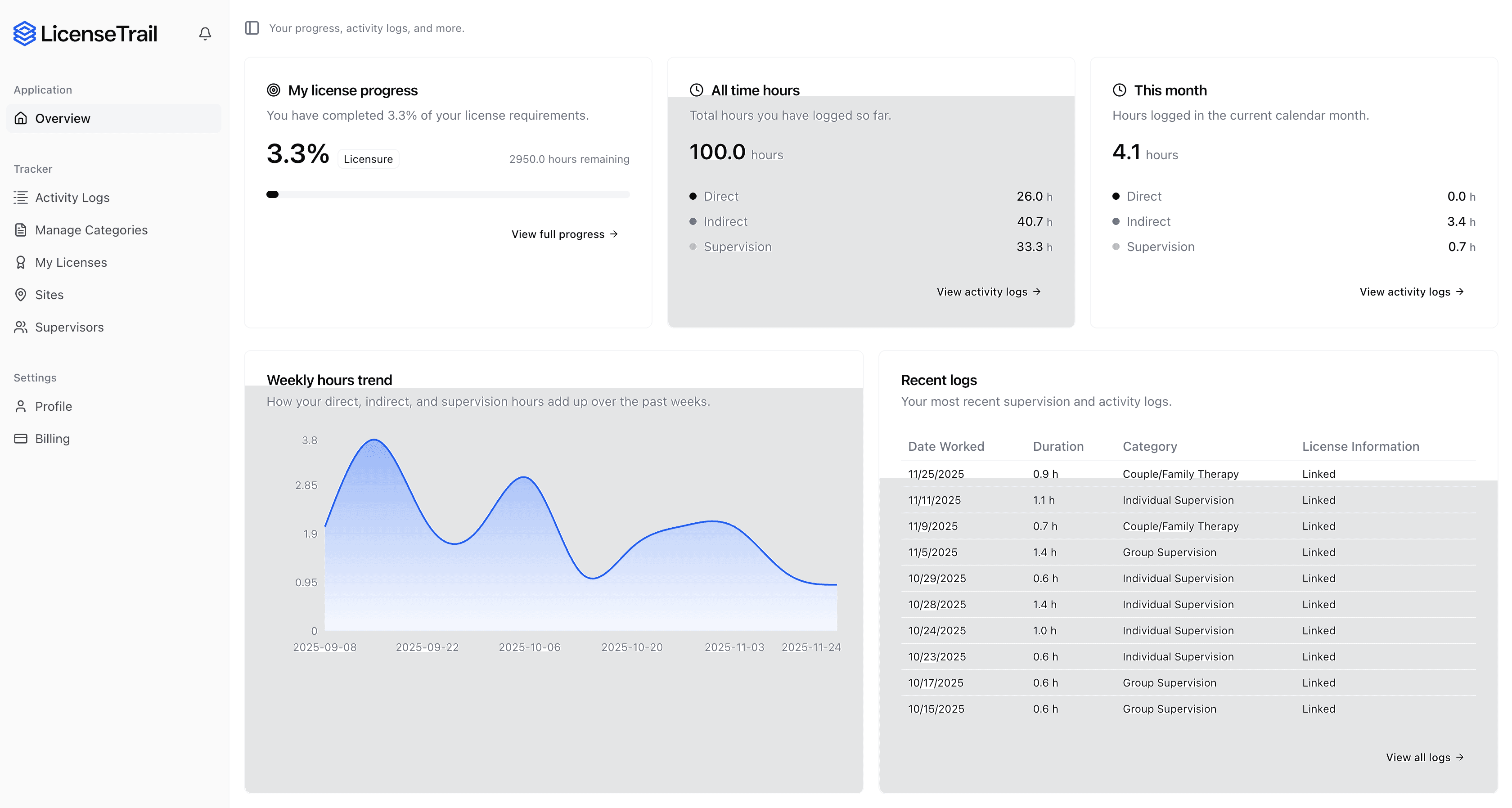
Stop guessing if your categories match North-carolina requirements. License Trail checks your direct, indirect, and supervision hours against CSWM requirements continuously and flags mismatches before you submit.
No credit card required · Free plan available
Quick Requirements Overview
- CSWE-accredited (or candidacy) social work degree required: BSW/MSW/DSW/PhD; experience must be post-degree
- 3,000 clock hours paid administrative social work employment in an administrative setting (policy/budget/management/evaluation/planning/staff development)
- Experience timeframe: must be earned in ≥2 years and within ≤6 consecutive years
- Excludes practicums/internships and other pre-degree training hours
- Supervision: 100 hours minimum, face-to-face at least every 2 weeks, by an NCSWCLB-credentialed social work administrator with ≥2 years admin experience
- Supervision limits: up to 50 hours group; up to 20 hours via synchronous A/V technology with confidentiality safeguards
- Exam: pass ASWB Advanced Generalist
- Fees/renewal: $145 application; renew biennially ($150) with 40 CE hours/2 years incl. 4 ethics
License Details
Procedures
Becoming a Certified Social Work Manager (CSWM) through the North Carolina Social Work Certification and Licensure Board (NCSWCLB) is a structured process defined in statute and administrative rule. The requirements are very specific about both experience hours and supervision.
Below is a step‑by‑step outline using the Board’s own terminology and hour definitions.
1. Credential type and role
In North Carolina, CSWM is a voluntary certification for non‑clinical, administrative social work practice, not a clinical license. The Board lists it as “Level H – Certified Social Work Manager (CSWM)” among its four credentialing levels. (ncswboard.gov)
CSWM is intended for social workers in administrative and management roles in agencies where social work or other mental health services are delivered.
2. Education requirement
The Board states that a CSWM applicant must hold: (ncswboard.gov)
- A BSW, MSW, DSW, or PhD in Social Work
- The degree must be from a social work program accredited (or in candidacy) by the Council on Social Work Education (CSWE).
This is a post–social work degree credential; all qualifying experience must be after the social work degree is awarded. (law.cornell.edu)
3. Administrative experience hours (what “two years” really means)
3.1. Statutory requirement
North Carolina General Statute 90B‑7(e)(2) provides that, to be certified as a CSWM, an applicant must show “two years of experience in an administrative setting with appropriate supervision and training.” (ncswboard.gov)
3.2. Hour definition in the Administrative Code
The Board has turned that “two years” requirement into a specific hour standard in 21 NCAC 63 .0211(b). It defines the work experience for CSWM as:
- 3,000 clock hours of post‑degree employment
- The employment must be paid (“for a salary”)
- The work must be administrative social work duties in an administrative setting where social work or other mental health services are delivered (law.cornell.edu)
The rule further specifies that the qualifying administrative social work duties include (paraphrased): (law.cornell.edu)
- Policy development and implementation
- Budget development and implementation
- Supervision and management
- Program evaluation
- Planning
- Staff development
3.3. Timeframe to complete the 3,000 hours
The same rule is explicit about how quickly or slowly you may accrue those hours: (law.cornell.edu)
- The 3,000 hours must be accumulated in not less than two (2) years
- They must be completed in no more than six (6) consecutive years
In other words:
- You cannot compress the required experience into less than two years, even if you work very full‑time.
- You cannot stretch it over more than six consecutive years; older hours beyond six years from start would not count.
3.4. What does not count toward the 3,000 hours
The Board is explicit that: (law.cornell.edu)
- Practicum or internship experience gained as part of any educational program shall not be included.
- The experience must be post‑degree, paid employment, not student training.
So, for example:
- An MSW internship doing administrative work does not count.
- A paid full‑time job as a program manager in a social service agency after the BSW/MSW can count, if duties are administrative and in a qualifying setting.
4. Supervision requirements (type, hours, and format)
The statute requires that your two years of administrative experience be with “appropriate supervision and training.” (ncswboard.gov)
The Board defines “appropriate supervision” and sets minimum supervision hours for CSWM in 21 NCAC 63 .0211(b).
4.1. Who can be your supervisor
For CSWM purposes, appropriate supervision means supervision by a social work administrator who: (law.cornell.edu)
- Is certified or licensed by the NCSWCLB at least at one level; and
- Has a minimum of two years of administrative experience in a social work or mental health setting.
This person must be clearly identified as your administrative supervisor for CSWM documentation.
4.2. Frequency and nature of supervision
The same rule specifies that appropriate supervision: (law.cornell.edu)
- Must be face‑to‑face (with limited, defined exceptions for technology use – see below)
- Must occur on a regular basis,
- And must be conducted no less than once every two weeks throughout the two years of administrative social work experience.
So your supervision cannot be sporadic “as needed” check‑ins; the Board expects biweekly, ongoing supervision over the full qualifying experience period.
4.3. Minimum supervision hours and allowed formats
The Board has also set specific supervision‑hour requirements for CSWM: (ncswboard.gov)
- Minimum of 100 hours of supervision is required.
- Up to 50 of those 100 hours may be group supervision.
- No more than 20 hours of the supervision may be provided through the use of technology.
When technology is used (for up to 20 hours), the rule requires that all technology‑based supervision: (ncswboard.gov)
- Be synchronous,
- Involve both audio and visual interaction throughout the entire session, and
- Be conducted in a way that maintains confidentiality of the communication.
4.4. How experience and supervision hours fit together
Unlike some states that separate “direct experience hours” and “separately counted supervised hours” (for example, 1,500 + 1,500), North Carolina’s CSWM requirements are structured as:
- 3,000 clock hours of qualifying, paid administrative social work employment, plus
- At least 100 hours of qualifying supervision that occurs regularly (at least every two weeks) over the same general experience period.
The 3,000 hours are your employment hours; the 100 supervision hours are additional, dedicated supervision time, not a separate block of “supervised practice hours” in place of employment.
5. Examination requirement
To be certified as a CSWM, the Board requires that you pass the ASWB Advanced Generalist level examination. (ncswboard.gov)
You must meet the Board’s education and (for full certification) experience/supervision requirements, and then obtain a passing score on this exam as part of your application.
6. Application, fees, and renewal
From the Board’s “Levels and Eligibility Requirements” page for Level H – CSWM: (ncswboard.gov)
- Application fee: $145
- Credential period: Up to two years per certification period
- Biennial renewal fee: $150
- Continuing education for renewal: 40 clock hours of CE every two years, including 4 hours in ethics
The Social Worker Certification and Licensure Act is both a title‑protection and practice‑protection act, and use of any Board credential title (including CSWM) without being properly credentialed is a violation of the Act. (ncswboard.gov)
7. Practical step‑by‑step summary
-
Earn a qualifying social work degree
- BSW, MSW, DSW, or PhD in Social Work from a CSWE‑accredited (or candidate) program.
-
Obtain post‑degree, paid administrative employment
- Work in an administrative setting where social work or mental health services are delivered.
- Perform administrative social work duties (policy, budget, supervision/management, evaluation, planning, staff development).
-
Accrue the required experience hours
- Complete 3,000 clock hours of post‑degree, paid administrative employment.
- Accumulate these hours over no less than 2 years and no more than 6 consecutive years.
- Do not count practicums or internships from your degree program.
-
Secure appropriate supervision
- Supervisor is a social work administrator certified or licensed by the NCSWCLB, with at least 2 years of administrative experience in a social work or mental health setting.
- Receive face‑to‑face supervision at least every two weeks throughout your qualifying experience.
- Accumulate at least 100 hours of supervision, with these limits:
- Maximum 50 hours may be group supervision.
- Maximum 20 hours may be via synchronous, audio‑visual technology, with confidentiality preserved.
-
Pass the required exam
- Take and pass the ASWB Advanced Generalist exam approved by the Board.
-
Apply to the Board for CSWM certification
- Submit the Board’s application form, fees, and documentation of:
- CSWE‑accredited social work degree
- 3,000 administrative experience hours (2–6 year window)
- At least 100 hours of qualifying supervision
- Passing ASWB Advanced Generalist exam score
- Submit the Board’s application form, fees, and documentation of:
-
Maintain your certification
- Renew every two years with required CE hours (40 total, including 4 ethics) and the CSWM renewal fee.
Key hour requirements in one place
-
Experience:
- “Two years of post social work degree experience shall mean 3,000 clock hours of employment for a salary” in administrative social work duties, over 2–6 consecutive years, excluding practicums/internships. (law.cornell.edu)
-
Supervision:
- Minimum 100 hours of appropriate supervision, at least biweekly, by a Board‑credentialed social work administrator with at least two years of administrative experience; up to 50 hours may be group and 20 hours may be via compliant technology. (ncswboard.gov)
These are the controlling definitions used by the North Carolina Social Work Certification and Licensure Board for the CSWM credential as of November 23, 2025.
Track your CSWM hours with confidence
License Trail checks your direct, indirect, and supervision hours against North-carolina CSWM requirements continuously and flags mismatches before you submit.
 Start Tracking for Free
No credit card required · Free plan available
Related Licenses
Is your spreadsheet hiding North-carolina CSWM risks?
Stop guessing if your categories match North Carolina Social Work Certification and Licensure Board requirements. License Trail checks your direct, indirect, and supervision hours continuously and flags mismatches before you submit.
Import or log
Bring your spreadsheet or start fresh
Upload your existing tracking spreadsheet and we'll map every hour into the right North Carolina Social Work Certification and Licensure Board categories automatically.
Verify against North-carolina
Catch mismatches before the board does
License Trail checks your direct, indirect, and supervision hours against North-carolina CSWM requirements continuously.
Export board-ready
One-click clean reports
Generate professional, board-ready reports for supervision meetings and North Carolina Social Work Certification and Licensure Board submissions in seconds.
No credit card required · Free plan available