
North-carolina CSW Requirements: Hours, Exams & Step-by-Step Guide
Stop guessing if your categories match North-carolina requirements. License Trail checks your direct, indirect, and supervision hours against CSW requirements continuously and flags mismatches before you submit.
No credit card required · Free plan available
Quick Requirements Overview
- Scope: Entry-level non-clinical credential; does not authorize psychotherapy/diagnosis (clinical practice requires LCSWA/LCSW)
- Regulator: North Carolina Social Work Certification & Licensure Board (NCSWCLB) under NCGS Chapter 90B
- Education: BSW from a CSWE-accredited (or candidacy) program
- Exam: Pass ASWB Bachelor exam (after Board approval to test)
- Experience/Supervision (pre-credential): None required (no practice or supervised hours)
- Application items: Application + disclosures, 3 professional references, official transcript, background/criminal history consent
- Fees: $145 application (nonrefundable); $70 biennial renewal
- Renewal/CE: Every 2 years; 40 CE clock hours including 4 ethics
License Details
Procedures
Becoming a Certified Social Worker (CSW) in North Carolina
The Certified Social Worker (CSW) credential is North Carolina’s entry‑level, non‑clinical state credential for social workers who hold a Bachelor of Social Work (BSW). It is issued and regulated by the North Carolina Social Work Certification and Licensure Board (NCSWCLB) under Chapter 90B of the North Carolina General Statutes. (law.justia.com)
A key point at the outset: North Carolina does not require any pre‑credential practice hours or supervised hours to obtain the CSW. The only hour‑based requirement related to CSW is for continuing education after you are certified. (ncswboard.gov)
1. What the CSW credential is (and is not)
According to the Board’s levels and eligibility overview, the CSW is a voluntary certification for non‑clinical social work practice. It sits alongside: (ncswboard.gov)
- CSW – Certified Social Worker (bachelor’s level, non‑clinical)
- CMSW – Certified Master Social Worker (master’s/doctoral, non‑clinical)
- CSWM – Certified Social Work Manager (administrative/management, requires experience and supervision)
- LCSWA / LCSW – Licensed Clinical Social Worker Associate / Licensed Clinical Social Worker (clinical practice, requires extensive hours and supervision)
Only the LCSW (and LCSWA while you are working toward it) authorizes clinical practice such as psychotherapy and diagnosis. The CSW does not authorize independent clinical practice.
2. Core eligibility requirements for CSW
The legal qualifications for the “Certified Social Worker” title are set in N.C. Gen. Stat. § 90B‑7(b), and the Board’s “Levels and Eligibility Requirements” page restates them in practical terms. (law.justia.com)
2.1 Education
The Board lists for LEVEL A – CERTIFIED SOCIAL WORKER (CSW):
- Education: “BSW from CSWE accredited undergraduate school.” (ncswboard.gov)
Statute § 90B‑7(b) similarly requires a bachelor’s degree in social work from a program approved, accredited, or in candidacy for accreditation by the Council on Social Work Education (CSWE). (law.justia.com)
In practice this means:
- Your degree must be a Bachelor of Social Work (BSW).
- The program must be CSWE‑accredited (or in candidacy) at the time you graduated.
2.2 Examination
The statute requires that a CSW applicant must have “passed the Board‑approved qualifying examination.” (law.justia.com)
The Board’s administrative rules specify what that exam is:
- “The Board examination required by G.S. 90B‑7(b)(2) for the Certified Social Worker credential is the Association of Social Work Board (‘ASWB’) Bachelor level examination.” (ncswboard.gov)
So you must:
- Obtain Board approval for exam eligibility, and
- Pass the ASWB Bachelor’s Level Exam.
2.3 Experience hours (pre‑credential)
For CSW, the Board states plainly:
- Experience: “No prior experience required.” (ncswboard.gov)
This is crucial for your planning:
- There is no requirement for a specific number of direct practice hours, supervised hours, or post‑degree employment hours to obtain a CSW in North Carolina.
- Requirements such as “1,500 hours of direct experience and 1,500 hours of supervised experience” do not apply to the CSW credential here; those kinds of hour requirements exist only for higher‑level clinical or management credentials (e.g., 3,000 hours of post‑MSW clinical practice plus 100 hours of supervision for LCSW; 3,000 hours plus 100 hours of administrative supervision for CSWM). (ncswboard.gov)
3. The only hour requirement tied to CSW: Continuing education
Although there are no pre‑credential practice or supervision hours, the Board does impose an ongoing continuing education (CE) hour requirement to renew the CSW.
On its Levels and Eligibility page, the Board lists for CSW:
- Biennial renewal: “$70 and documentation of 40 clock hours of CE (4 in ethics) every 2 years.” (ncswboard.gov)
The N.C. Social Work site, summarizing Board rules, restates this for CSW:
- Renewal every two years,
- 40 continuing education hours, including 4 hours in ethics,
- Plus the renewal fee (currently $70). (northcarolinasocialwork.org)
In other words:
- The only explicit “hours” associated with the CSW credential itself are 40 clock hours of continuing education every two years, of which 4 must be ethics‑focused.
- These are post‑certification educational hours, not practice or supervision hours.
4. Step‑by‑step guide to obtaining the CSW in North Carolina
This section combines the statute, Board rules, and Board‑aligned guidance into a practical sequence. (law.justia.com)
Step 1 – Complete a qualifying BSW program
- Earn a Bachelor of Social Work (BSW) from a CSWE‑accredited undergraduate program.
- If your degree is from outside the United States or its territories, the Board directs applicants to CSWE to determine educational equivalency. (ncswboard.gov)
Step 2 – Review the law, rules, and Board requirements
Before applying, you are expected to review:
- N.C. Gen. Stat. Chapter 90B – Social Worker Certification and Licensure Act, and
- The Board’s rules, ethical guidelines, and disciplinary procedures.
The application rule requires applicants to affirm that they have read Chapter 90B and the Board’s rules and ethics materials, as available on the Board’s website. (ncswboard.gov)
Step 3 – Assemble your CSW application package
Under 21 NCAC 63 .0202, all applications for certification or licensure must include detailed identifying and background information. For CSW applicants, this practically means: (ncswboard.gov)
- Completed application form, indicating you are applying for Certified Social Worker (CSW).
- Contact information and Social Security number.
- Educational history and degree attainment (your BSW).
- Employment history (even though no specific experience hours are required, the Board still collects this history).
- Disclosure of any:
- Previous social work certifications/licenses (in NC or other jurisdictions) and related exam information,
- Denied, limited, suspended, or revoked credentials,
- Criminal convictions or pending charges,
- Findings or pending charges of professional misconduct or incompetence.
- Three professional references, provided on the Board’s reference forms and submitted in sealed envelopes with the reference’s signature over the seal (or as otherwise instructed in the current application packet). (ncswboard.gov)
- Official transcript:
- Sent directly from your school to the Board (including electronic transcript to the Board’s transcript email), or
- Submitted by you in an envelope sealed by the institution. (ncswboard.gov)
- Criminal history consent and affirmation that your application is truthful and complete. (ncswboard.gov)
Step 4 – Pay the CSW application fee
The Board lists for CSW:
- Application fee: $145. (ncswboard.gov)
Key points about payment:
- The Board has formally announced that it no longer accepts personal or business checks or cash; fees must be paid via certified check, cashier’s check, money order, or through the online portal where available. (ncswboard.gov)
- Application fees are non‑refundable. (northcarolinasocialwork.org)
- Military‑trained applicants and military spouses are not charged the initial application fee under current Board policy. (ncswboard.gov)
Step 5 – Wait for Board review of your application
- The Board states that it may take up to 21 days to process applications after they are complete, and it urges applicants to allow this time before following up. (ncswboard.gov)
If your application is approved, the Board will then clear you to sit for the CSW examination.
Step 6 – Obtain Board approval and take the ASWB Bachelor exam
Under the Board’s exam rule:
- The qualifying examination for CSW is the ASWB Bachelor Level Exam. (ncswboard.gov)
In practice:
- Receive exam eligibility from NCSWCLB after they approve your application.
- Register with ASWB for the Bachelor’s level exam and pay the exam fee (currently listed by North Carolina Social Work as $230, paid directly to ASWB). (northcarolinasocialwork.org)
- Take and pass the exam at an authorized testing center.
Step 7 – Board issuance of the CSW certificate
Once the Board receives your official passing exam score from ASWB and confirms that all statutory and rule‑based requirements are met (degree, application, background disclosures, fee), it will issue your Certified Social Worker (CSW) certificate. (ncswboard.gov)
The certificate is typically valid for up to two years before renewal is required. (ncswboard.gov)
5. Maintaining your CSW: renewal and continuing education hours
The CSW is a continuing credential and must be renewed every two years.
5.1 Renewal cycle and fees
For the CSW, the Board specifies:
- Biennial renewal: “$70 and documentation of 40 clock hours of CE (4 in ethics) every 2 years.” (ncswboard.gov)
This is the official description of the hour requirement tied to CSW:
- 40 clock hours of continuing education every two years,
- Including 4 clock hours specifically in ethics, and
- Payment of the $70 renewal fee.
5.2 What “clock hours” and CE involve (at a high level)
Board rules in Section .0400 (Renewal of Certification) govern continuing education. In summary: (ncswboard.gov)
- A “clock hour” is a 60‑minute hour of instruction or participation in an approved educational activity.
- CE activities may include workshops, courses, conferences, and certain structured distance‑learning offerings that meet Board criteria.
- The Board requires you to maintain records of your CE activities (course titles, dates, hours, ethics designation, and whether distance learning) in case of audit.
The Board’s “Continuing Education Information” section on its website provides current, detailed guidance on acceptable activities and limits (such as caps on purely distance learning versus in‑person offerings), which you should review before each renewal cycle. (ncswboard.gov)
6. Summary of “hour” requirements for CSW in North Carolina
To address the question about hours as concretely as possible, using the Board’s own terminology:
-
Pre‑credential experience hours:
- The Board’s CSW description states: “EXPERIENCE: No prior experience required.” (ncswboard.gov)
- There is no requirement for:
- Direct practice hours,
- Supervised practice hours, or
- Post‑degree employment hours
to qualify for the CSW credential.
-
Supervision hours:
- No supervision hours are required for CSW certification.
- Supervision hour minimums (e.g., 100 hours of clinical supervision for LCSW; 100 hours of administrative supervision for CSWM) apply only to other, higher‑level credentials. (ncswboard.gov)
-
Continuing education (clock) hours for renewal:
- To renew the CSW every two years, you must document:
- 40 clock hours of continuing education, and
- At least 4 of those hours in ethics,
along with payment of the $70 renewal fee. (ncswboard.gov)
- To renew the CSW every two years, you must document:
There are no split hour requirements such as “X hours of direct experience” versus “Y hours of supervised experience” for the CSW credential itself in North Carolina. All hour‑based requirements for CSW relate to continuing education after certification, not to practice hours required beforehand.
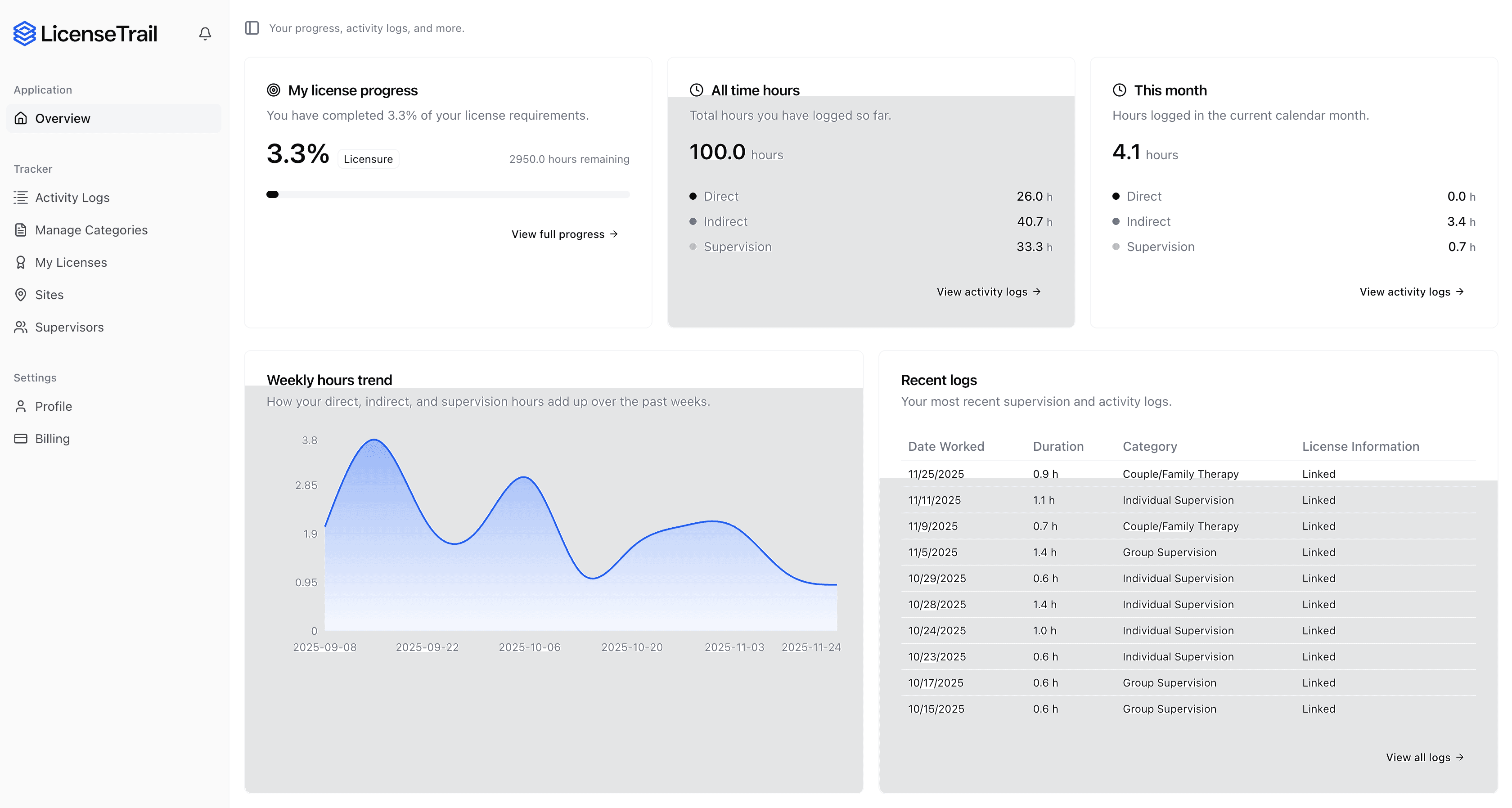
Track your CSW hours with confidence
License Trail checks your direct, indirect, and supervision hours against North-carolina CSW requirements continuously and flags mismatches before you submit.
 Start Tracking for Free
No credit card required · Free plan available
Related Licenses
Is your spreadsheet hiding North-carolina CSW risks?
Stop guessing if your categories match North Carolina Social Work Certification and Licensure Board requirements. License Trail checks your direct, indirect, and supervision hours continuously and flags mismatches before you submit.
Import or log
Bring your spreadsheet or start fresh
Upload your existing tracking spreadsheet and we'll map every hour into the right North Carolina Social Work Certification and Licensure Board categories automatically.
Verify against North-carolina
Catch mismatches before the board does
License Trail checks your direct, indirect, and supervision hours against North-carolina CSW requirements continuously.
Export board-ready
One-click clean reports
Generate professional, board-ready reports for supervision meetings and North Carolina Social Work Certification and Licensure Board submissions in seconds.
No credit card required · Free plan available