
North-carolina LCMHCA Requirements: Hours, Exams & Step-by-Step Guide
Stop guessing if your categories match North-carolina requirements. License Trail checks your direct, indirect, and supervision hours against LCMHCA requirements continuously and flags mismatches before you submit.
No credit card required · Free plan available
Quick Requirements Overview
- Restricted associate license: May practice only under Board-approved supervision; no counseling until at least one supervision contract is approved.
- Education (apps ≥ 7/1/2022): Master’s in counseling/related, 60 semester (90 quarter) hours, CACREP-accredited program + required content areas.
- Graduate practicum/internship: Verified via Board form; pre‑7/1/2022: 300 hrs (≥ 180 direct) + 1 hr supervision/40 hrs; ≥ 7/1/2022: must meet current CACREP practicum/internship standards (report direct/indirect).
- Internship setting change (≥ 7/1/2025): Internship must be in a clinical mental health setting with substantial diagnosis/treatment opportunity; direct counseling as defined by rule.
- Exams: Pass one national exam (NCE/NCMHCE/CRC or equivalent) + NC Jurisprudence Exam (taken within 6 months pre‑application).
- Application items: Online application, transcripts, grad experience verification, 3 references (≥1 LCMHC), exam scores, jurisprudence certificate, PDS, fingerprints/background check, fee.
- Post-degree hours toward LCMHC: 3,000 supervised practice hrs (max 40/wk), with ≥2,000 direct; practicum/internship hours do not count.
- Supervision during 3,000 hrs: ≥100 supervision hrs (≥75 individual/triadic); per 40 practice hrs: 1 hr individual or 2 hrs group; supervision hrs don’t count toward the 3,000.
License Details
Procedures
North Carolina’s Licensed Clinical Mental Health Counselor Associate (LCMHCA) credential is the state’s entry-level counseling license. It allows you to practice counseling only under supervision while you complete the experience required for full licensure as a Licensed Clinical Mental Health Counselor (LCMHC). (ncblcmhc.org)
Below is a structured overview of what the North Carolina Board of Licensed Clinical Mental Health Counselors (NCBLCMHC) currently requires to become licensed as an LCMHCA and what hours you must complete under that license.
1. What the LCMHCA license is
The Board defines an LCMHCA as a person “engaged in the supervised practice of counseling” who holds a license issued under the LCMHC Act. (ncblcmhc.org)
Key points:
- It is a restricted license; you must practice under a qualified clinical supervisor with an approved supervision contract on file.
- You cannot provide counseling until the Board has approved at least one supervision contract.
- LCMHCA status is the required first step for most new graduates on the way to full LCMHC licensure. (ncblcmhc.org)
2. Educational and exam requirements for LCMHCA
2.1 Degree and coursework
For applications filed on or after July 1, 2022, you must: (ncblcmhc.org)
- Hold a master’s degree in counseling or a related field.
- Complete at least 60 semester hours (or 90 quarter hours) of graduate training.
- The program must be from an institution accredited by CACREP (Council for Accreditation of Counseling and Related Educational Programs).
- Coursework must cover specific counseling content areas required by Board rule (e.g., helping relationships, practicum/internship, assessment, professional orientation, etc.). (ncblcmhc.org)
2.2 Graduate counseling experience (practicum/internship)
The Board requires a supervised graduate counseling experience (practicum and internship) that must be documented on the Board’s Verification of Graduate Counseling Experience form. (ncblcmhc.org)
The current rules distinguish by application date:
-
Applicants before July 1, 2022
- Must complete 300 hours of graduate counseling experience.
- At least 180 of those hours must be “direct counseling experience.”
- Supervision must occur at a rate of at least 1 hour of clinical supervision per 40 hours of graduate counseling experience. (law.cornell.edu)
-
Applicants on or after July 1, 2022
- Must complete practicum and internship courses that meet current CACREP standards for practicum and internship (rather than a fixed hour number written into the NC rule). (law.cornell.edu)
- These courses must include graduate counseling supervision as defined by CACREP.
- Your university must report your total direct and indirect hours (as defined by CACREP) and supervisor information on the Board’s verification form. (law.cornell.edu)
-
Additional requirement after July 1, 2025
- All internship experiences must be completed in a clinical mental health setting that provides substantial opportunities to assess, appraise, diagnose, and treat mental health disorders.
- These internship experiences must consist of “direct counseling experience” as defined in Rule .0205(a) (see definition below). (ncblcmhc.org)
Direct counseling experience (Board definition)
In Rule .0205, the Board defines “Direct Counseling Experience” as live contact with individuals, groups, or families through counseling, as that term is defined in the statute. (law.cornell.edu)
2.3 Exams for LCMHCA
You must pass:
-
One approved national counseling exam (any one of the following): (ncblcmhc.org)
- National Counselor Examination (NCE)
- National Clinical Mental Health Counselor Examination (NCMHCE)
- Certified Rehabilitation Counselor Examination (CRC)
(Or another exam the Board deems equivalent.)
-
The North Carolina Jurisprudence Exam, which covers state law and ethics for LCMHCs. It must be taken within six months before your application. (ncblcmhc.org)
3. Application components for LCMHCA
The Board’s LCMHCA application is fully online and typically includes: (ncblcmhc.org)
- Application sections: general information, credentials, legal & ethics history, education.
- Official graduate transcripts from each institution (sent directly or provided sealed).
- Verification of Graduate Counseling Experience form completed by a university faculty/supervisor.
- Three professional references, at least one from a licensed clinical mental health counselor.
- National exam scores (NCE, NCMHCE, or CRC).
- Jurisprudence exam certificate.
- Professional Disclosure Statement (PDS) that meets Rule .0204 requirements and discloses supervision arrangements.
- Criminal background check (state and FBI) using fingerprints.
- Application fee (currently $238 including a $38 background check fee).
4. What happens once you are licensed as an LCMHCA
4.1 Supervision contract and limitations on practice
Before providing any counseling services, you must: (ncblcmhc.org)
- Have a supervision contract approved by the Board for each supervisor and each work setting (you may have multiple supervisors, but each requires its own contract).
- Work only under supervision of a qualified clinical supervisor (LCMHCS or another approved mental health professional meeting Board criteria).
- Notify the Board within 2 weeks of any termination or change in supervision.
- File a Final Supervision Report when supervision ends or changes.
You may not engage in independent practice. Your license remains restricted until you qualify for the LCMHC license.
5. Supervised professional practice hours required under LCMHCA
While the LCMHCA license itself does not require you to arrive with thousands of post‑degree hours, the purpose of the LCMHCA is to allow you to complete those hours toward full LCMHC licensure.
5.1 Total supervised professional practice hours
To become a fully licensed LCMHC, the Board requires: (ncblcmhc.org)
- 3,000 hours of supervised professional practice in clinical mental health counseling
- These hours must be accrued after your degree, under a qualified clinical supervisor approved by the Board.
- Hours from your master’s practicum or internship do not count toward the 3,000 hours.
The Board’s statute and rules break this down further:
- At least 2,000 of the 3,000 hours must be direct counseling experience. (ncblcmhc.org)
- You may count no more than 40 hours of supervised professional practice per week. (ncblcmhc.org)
5.2 Direct vs. indirect counseling hours
Under Rule .0205 and the Board’s LCMHCA guidance: (ncblcmhc.org)
-
Direct counseling experience
- Live, face‑to‑face (or synchronous video) counseling contact with individuals, groups, or families, using counseling skills as defined in G.S. 90‑330(a)(3).
- Examples: individual therapy sessions, family sessions, group therapy.
-
Indirect counseling experience
- Counseling‑related tasks such as treatment planning, documentation, phone calls with clients or collaterals, case consultation, and other clinically related activities that are not live counseling sessions.
The 3,000 hours may include both direct and indirect time, but a minimum of 2,000 must be direct counseling.
5.3 Required clinical supervision hours within the 3,000
The Board requires a specific amount and type of supervision during those 3,000 hours: (ncblcmhc.org)
- At least 100 hours of clinical supervision total.
- At least 75 of those 100 hours must be individual supervision (one‑on‑one or triadic). (ncblcmhc.org)
- For every 40 hours of supervised professional practice, you must receive either:
- 1 hour of individual clinical supervision, or
- 2 hours of group clinical supervision (up to 12 supervisees per group). (ncblcmhc.org)
- Supervision hours do not count toward the 3,000 hours of supervised professional practice.
Supervision must be based on observation of your clinical work (e.g., live observation, co‑therapy, audio/video recordings, or live supervision sessions), with written materials and self‑reports allowed only as supplements. (ncblcmhc.org)
6. Summary of hour‑related requirements
Below is a concise overview of the key hour requirements that appear in Board rules and guidance.
6.1 Before LCMHCA licensure (graduate training)
Graduate counseling experience (practicum + internship)
-
For programs finishing before July 1, 2022:
- 300 hours total graduate counseling experience.
- At least 180 hours must be direct counseling experience.
- Supervision at ≥ 1 hour per 40 hours of experience. (law.cornell.edu)
-
For applicants on or after July 1, 2022:
- Practicum and internship must meet current CACREP practicum and internship standards (exact hour minimums are now set by CACREP, not spelled out numerically in the NC rule). (law.cornell.edu)
-
For applicants on or after July 1, 2025:
- All internship hours must be in a clinical mental health setting and consist of direct counseling experience as defined by Rule .0205. (law.cornell.edu)
6.2 After LCMHCA licensure (on the way to LCMHC)
Supervised professional practice (post‑master’s, under LCMHCA):
- 3,000 hours of supervised professional practice.
- At least 2,000 hours must be direct counseling.
- Maximum 40 hours per week may be counted.
- No hours may be counted from your master’s practicum or internship. (ncblcmhc.org)
Clinical supervision within those 3,000 hours:
- At least 100 hours of clinical supervision.
- At least 75 hours must be individual supervision.
- Minimum 1 hour individual or 2 hours group supervision per 40 hours of supervised practice.
- Supervision hours do not count toward the 3,000 hours. (ncblcmhc.org)
7. Transition from LCMHCA to LCMHC
Once you have: (ncblcmhc.org)
- Completed 3,000 supervised professional practice hours (with at least 2,000 direct and at least 100 supervision hours as described above), and
- Met all other requirements (education, national exam, jurisprudence exam, PDS, background check),
you can apply to upgrade from LCMHCA to LCMHC through the Board’s LCMHCA‑to‑LCMHC application process. Supervision must continue until the Board issues your LCMHC license.
All details above reflect the North Carolina Board of Licensed Clinical Mental Health Counselors’ rules, statutes, and guidance as of November 23, 2025. Because licensure rules can change (especially around CACREP standards and clinical settings), it is important to confirm directly with the NCBLCMHC or its website before you apply or make long‑term plans.
Track your LCMHCA hours with confidence
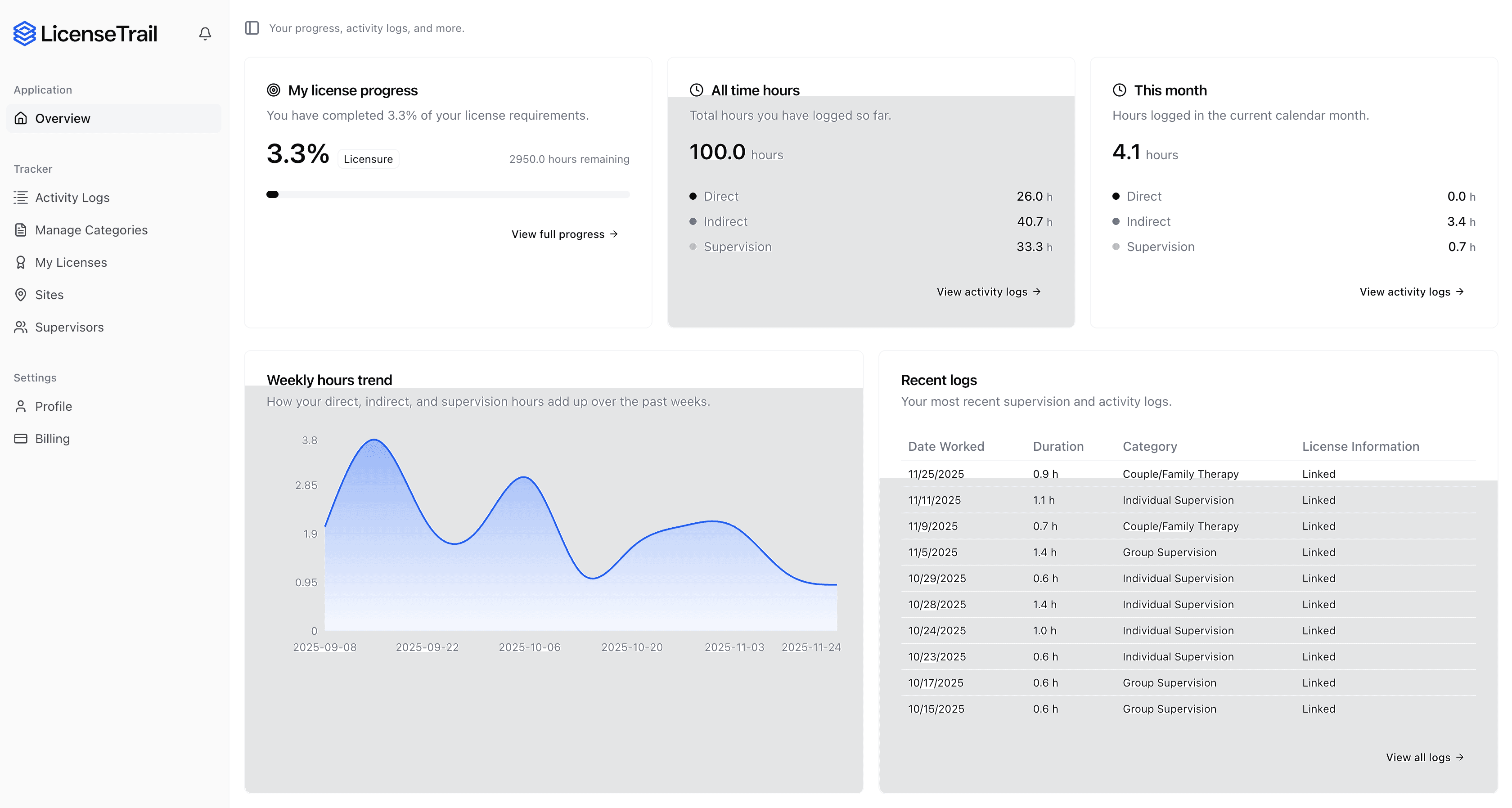
License Trail checks your direct, indirect, and supervision hours against North-carolina LCMHCA requirements continuously and flags mismatches before you submit.
 Start Tracking for Free
No credit card required · Free plan available
Related Licenses
Is your spreadsheet hiding North-carolina LCMHCA risks?
Stop guessing if your categories match North Carolina Board of Licensed Clinical Mental Health Counselors requirements. License Trail checks your direct, indirect, and supervision hours continuously and flags mismatches before you submit.
Import or log
Bring your spreadsheet or start fresh
Upload your existing tracking spreadsheet and we'll map every hour into the right North Carolina Board of Licensed Clinical Mental Health Counselors categories automatically.
Verify against North-carolina
Catch mismatches before the board does
License Trail checks your direct, indirect, and supervision hours against North-carolina LCMHCA requirements continuously.
Export board-ready
One-click clean reports
Generate professional, board-ready reports for supervision meetings and North Carolina Board of Licensed Clinical Mental Health Counselors submissions in seconds.
No credit card required · Free plan available