
North-carolina LMFTA Requirements: Hours, Exams & Step-by-Step Guide
Stop guessing if your categories match North-carolina requirements. License Trail checks your direct, indirect, and supervision hours against LMFTA requirements continuously and flags mismatches before you submit.
No credit card required · Free plan available
Quick Requirements Overview
- Qualifying graduate degree (MFT or related) meeting Board coursework standards (min ~45 semester hours); official transcripts sent directly to Board
- Pass AMFTRB National MFT Exam (only accepted exam)
- Good moral character: 3 Board-form endorsements
- Submit notarized application + fee; include supervision agreement with at least one AAMFT Approved Supervisor/Board-accepted Supervisor Candidate
- Background check required for new applications started on/after 10/1/2025 (SBI fingerprints; $38 fee)
- LMFTA is provisional: practice only under approved supervision; valid up to 3 years (nonrenewable; possible 1-year extension by petition)
- To convert to LMFT: 1,500 clinical hours (≤500 pre-degree; ≥1,000 post-degree; ≥500 relational) + 200 supervision hours (≥25 post-degree), all under approved AAMFT supervision and properly documented
License Details
Procedures
Becoming a Licensed Marriage and Family Therapy Associate (LMFTA) in North Carolina involves two layers of requirements:
- What you need to be issued the LMFTA itself, and
- The specific clinical and supervision hours you must accrue as an LMFTA (or post‑degree) to later qualify for full LMFT licensure.
The North Carolina Marriage and Family Therapy Licensure Board (NCMFTLB) is very explicit about both, and its terminology is important.
1. How North Carolina Defines an LMFTA
Under North Carolina law and board rules, a:
“Licensed marriage and family therapy associate” is an individual licensed under the Marriage and Family Therapy Licensure Act whose license is in force and “permits the individual to engage in the practice of marriage and family therapy under the supervision of an American Association for Marriage and Family Therapy (AAMFT) approved supervisor” in accordance with board rules. (ncbmft.org)
You may not use the titles “Licensed Marriage and Family Therapy Associate” or “LMFTA” in any way unless you hold this license. (law.justia.com)
The LMFTA is explicitly a provisional license meant for those who have not yet met the full clinical and supervision hour requirements for LMFT. (ncbmft.org)
2. Prerequisites Before You Can Apply for LMFTA
2.1 Graduate education
You must have completed at least a master’s degree in marriage and family therapy or a related mental health degree from a recognized/regionally accredited institution, meeting the board’s coursework standards. (ncleg.net)
Key points:
- A direct MFT degree (e.g., COAMFTE‑accredited) is accepted as meeting content requirements. (ncbmft.org)
- A “related degree” may qualify only if your coursework and any post‑degree MFT training collectively are equivalent in content and quality to an MFT master’s/doctorate, as defined in board rules. (ncleg.net)
- Minimum graduate credit is described on the board’s exam/licensure pages as 45 semester hours or the equivalent in quarter hours in MFT or a related mental health field. (ncbmft.org)
Official graduate transcripts must be sent directly from your institution to the Board. (law.cornell.edu)
2.2 National MFT Examination
All MFT applicants in NC must pass the AMFTRB National Marriage and Family Therapy Examination. No other exam is accepted. (ncbmft.org)
- You can apply for exam approval in your last semester if your program confirms expected graduation. (ncbmft.org)
2.3 Good moral character
You must show “evidence of good moral character,” which the Board requires in the form of three endorsements on Board forms from people familiar with your work/character. (law.cornell.edu)
3. Additional Legal Requirements for LMFTA
G.S. 90‑270.54A (the associate‑license statute) requires that, in addition to the general qualifications in G.S. 90‑270.52(a), you must provide evidence that: (ncleg.gov)
- You have completed an MFT or related degree that meets G.S. 90‑270.54(a)(1)a (the educational standard for LMFT).
- You have evidence of intent to accrue the required supervised clinical experience for full licensure.
- Your LMFTA application includes:
- Evidence of appropriate coursework, and
- An agreement by at least one AAMFT‑approved supervisor to provide supervision.
- You have passed the board‑approved exam (the National MFT Exam).
In other words, you do not need the 1,500 clinical hours to get the LMFTA. You must show education, exam passage, and a concrete supervision plan demonstrating your intent to earn those hours.
4. What Must Be Submitted for an LMFTA Application
Board rule 21 NCAC 31 .0801 spells out what an LMFTA applicant must have the Board receive: (law.cornell.edu)
- Notarized application form and fee.
- Official graduate transcripts sent directly from your training institution(s), showing:
- Completion of a master’s or doctoral degree in MFT, or
- Completion of a related degree with a course of study meeting Rule .0501 standards (the Board can request catalogs and syllabi if course content is unclear).
- Evidence of good moral character – three endorsements on Board forms.
- Evidence of a passing score on the National MFT Exam.
- A supervision agreement with a supervisor who meets the Board’s supervisor requirements (Rule .0502), i.e., an AAMFT Approved Supervisor or accepted Supervisor Candidate.
All application materials must be received within two years of the application date or the file is closed. (law.cornell.edu)
4.1 Background check (effective now)
For all new license applications started on or after October 1, 2025, NCMFTLB requires a criminal background check conducted through the State Bureau of Investigation: (ncbmft.org)
- You pay a $38 fee in the application portal.
- Download and complete the Applicant Fingerprinting Guide forms.
- Get fingerprinted at a local law enforcement agency (typically via LiveScan).
- Upload the signed Release of Information form in your application.
- The Board must receive your background check result (1–4 weeks typical) before you can submit the application for final review.
LMFTA licensees who have completed their hours and are simply converting to LMFT are explicitly exempt from this new background check requirement. (ncbmft.org)
5. Nature and Duration of the LMFTA License
5.1 Provisional, time‑limited license
By statute and board policy: (ncleg.gov)
- The LMFTA is a provisional license.
- It is valid for up to three years from the date of issuance.
- It cannot be renewed, but the Board may grant a one‑year extension if you petition in writing and show special circumstances and steady progress toward LMFT licensure.
The Board also explains that LMFTAs have up to three years (with up to a one‑year extension) to acquire the required clinical and supervision hours for conversion to LMFT. (ncbmft.org)
5.2 Practice and supervision while an LMFTA
Key points from the Board’s FAQ and definitions: (ncbmft.org)
- LMFTAs must practice under the supervision of an AAMFT Approved Supervisor or Board‑accepted AAMFT Supervisory Candidate.
- The supervisor does not have to be physically on‑site but must be readily available.
- The Board does not recommend solo private practice for new LMFTAs; if an LMFTA does practice solo, their supervisor must explicitly approve and remains responsible for the practice.
- LMFTAs may work in various settings, including private practice, as long as supervision requirements are met.
You must remain under minimum supervision requirements until LMFT is formally approved, which the Board describes as at least one hour of supervision per month once you have finished your hours but are awaiting LMFT conversion. (ncbmft.org)
5.3 Continuing education as an LMFTA
The LMFTA must be renewed annually while it is active. For each year of LMFTA licensure: (ncbmft.org)
- You must complete 20 hours of continuing education, including
- 3 hours of ethics, and
- Up to 12 of the 20 hours may come from your approved supervision.
6. Hour Requirements to Move from LMFTA to LMFT
This is where the board’s hour language is most specific, and it’s crucial to keep the exact categories straight.
6.1 Total clinical hours required
North Carolina requires, at minimum, for LMFT licensure: (ncbmft.org)
- 1,500 hours of “clinical” experience – defined by the Board as documented clinical experience (face‑to‑face therapy) in the practice of marriage and family therapy.
- Of these 1,500 hours:
- No more than 500 hours may have been obtained while you were a student in your qualifying graduate program.
- At least 1,000 hours must be obtained after the degree is granted (which can include post‑degree, pre‑LMFTA and LMFTA practice, so long as all other conditions are met).
- At least 500 of the 1,500 hours must be “relational hours” – i.e., sessions where more than one member of a relational system (e.g., couples, families) is being treated as part of the same treatment plan.
The Board’s FAQ summarizes this plainly: the minimum requirement is “a total of 1500 clinical hours” with specific supervision and relational‑hour conditions (discussed below). (ncbmft.org)
6.2 Supervision hours required
Separate from clinical hours, the Board requires: (ncbmft.org)
- A minimum of 200 hours of approved supervision with:
- An AAMFT Approved Supervisor or
- An AAMFT Supervisor Candidate accepted by the Board.
The FAQ and licensure pages both emphasize that there are no exceptions: for hours to count toward the 1,500 clinical / 200 supervision minimums, they must be under these approved supervisors. Practicum/internship hours supervised by others may count toward educational requirements but not toward the licensure hour totals. (ncbmft.org)
The Board further specifies:
- You may count up to 500 clinical hours and any amount of approved supervision earned during your qualifying degree if they were under an AAMFT Approved Supervisor or accepted Supervisor Candidate.
- However, at least 25 of the 200 supervision hours must be post‑degree, regardless of how many you had during the degree. (ncbmft.org)
6.3 “Direct clinical” vs “supervised” experience – what North Carolina actually requires
Using your example: North Carolina does not require “1,500 hours of direct experience and 1,500 hours of supervised experience.”
Instead, the Board’s structure is:
- Clinical (therapy) hours:
- 1,500 hours total of face‑to‑face clinical work in MFT, including at least 500 relational hours.
- Supervision hours:
- 200 hours of clinical supervision with an AAMFT Approved Supervisor or accepted Candidate, of which at least 25 hours must be post‑degree.
All clinical hours that will count must be supervised in the required way, but the Board tracks clinical contact hours and supervision hours as two separate numerical requirements, not as two identically sized hour blocks.
7. How and When You Can Earn These Hours
The Board allows flexibility in when you accrue your qualifying hours, with strict conditions on supervision and documentation. (ncbmft.org)
-
During your degree program (pre‑degree)
- Clinical hours can count only if:
- They are part of program practicum/internship listed on your transcript, and
- They were supervised by an AAMFT Approved Supervisor or accepted Supervisor Candidate.
- Up to 500 of your 1,500 clinical hours and any amount of approved supervision may come from this period.
- If practicum supervision was not by an AAMFT Approved Supervisor/Candidate, those hours do not count toward the 1,500/200 licensure totals (though they may count toward coursework requirements).
- Clinical hours can count only if:
-
After your degree but before LMFTA
- You may accrue additional hours under an approved AAMFT supervisor that meet board standards. These count toward your 1,500 clinical / 200 supervision totals if they meet all criteria.
-
As an LMFTA (post‑license hours)
- Once licensed as an LMFTA, your ongoing clinical work and supervision under your filed supervision agreement continues to count toward the 1,500 clinical and 200 supervision hours.
- LMFTAs must stay under supervision at least until LMFT is approved and must keep supervision documentation via the Board’s reporting process (LearningBuilder). (ncbmft.org)
The Board’s FAQ is explicit that, where practicum/internship supervision was not by an AAMFT Approved Supervisor/Candidate, you must earn all 1,500 clinical and 200 supervision hours post‑degree and/or post‑LMFTA under an AAMFT Approved Supervisor or accepted Candidate. (ncbmft.org)
8. Concise Numerical Summary
To put the hour requirements in one place:
To obtain the LMFTA:
- Completed qualifying MFT or related master’s/doctoral degree meeting board coursework standards. (ncleg.net)
- Passed the AMFTRB National MFT Exam. (ncbmft.org)
- Three endorsements as evidence of good moral character. (law.cornell.edu)
- Supervision agreement with an AAMFT Approved Supervisor/accepted Candidate showing your intent to accrue the required supervised clinical experience. (ncleg.gov)
- Completed application with fees, transcripts, and (for applications started on/after Oct 1, 2025) a $38 background check with fingerprints. (ncbmft.org)
You do not have to have the 1,500 clinical hours completed to get LMFTA—LMFTA is the license you use while earning them.
To move from LMFTA to full LMFT:
- 1,500 total clinical hours of face‑to‑face therapy in MFT practice, with:
- No more than 500 hours during the master’s program,
- At least 1,000 hours after the degree is granted,
- At least 500 relational hours within the 1,500. (ncbmft.org)
- 200 total supervision hours by an AAMFT Approved Supervisor or accepted Supervisory Candidate, including:
- At least 25 supervision hours post‑degree, and
- All supervision that is to count must be with these approved supervisors (no exceptions). (ncbmft.org)
- All hours (both clinical and supervision) properly documented and reported through the Board’s system, within:
- 3 years of LMFTA issuance, with a possible one‑year extension upon petition and demonstration of steady progress. (ncleg.gov)
This is the structure the North Carolina Marriage and Family Therapy Licensure Board actually uses: 1,500 clinical hours plus 200 supervision hours, divided across pre‑degree and post‑degree/LMFTA periods under strict supervision standards, rather than matching blocks of “direct” and “supervised” experience.
Track your LMFTA hours with confidence
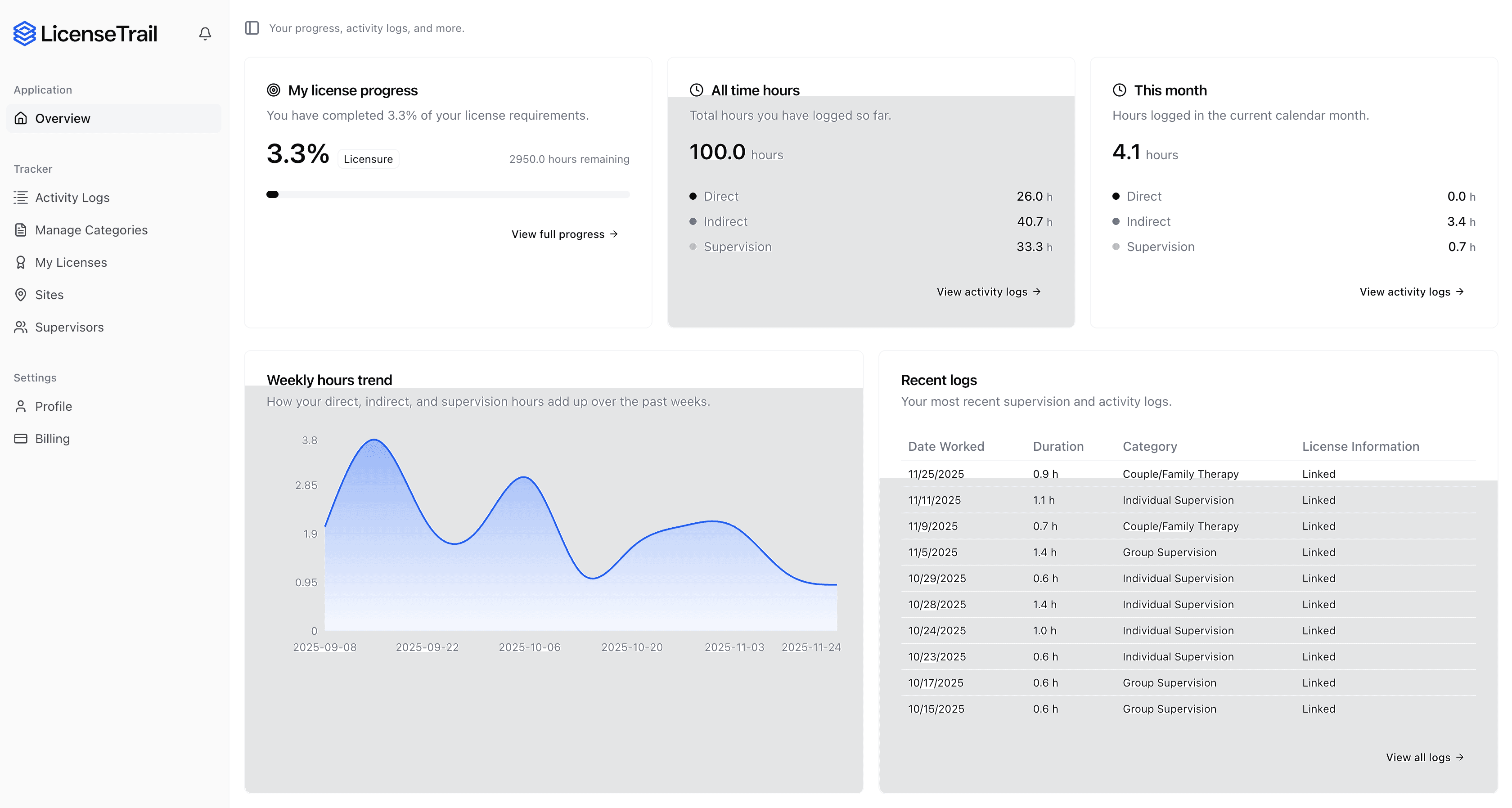
License Trail checks your direct, indirect, and supervision hours against North-carolina LMFTA requirements continuously and flags mismatches before you submit.
 Start Tracking for Free
No credit card required · Free plan available
Related Licenses
Is your spreadsheet hiding North-carolina LMFTA risks?
Stop guessing if your categories match North Carolina Marriage and Family Therapy Licensure Board requirements. License Trail checks your direct, indirect, and supervision hours continuously and flags mismatches before you submit.
Import or log
Bring your spreadsheet or start fresh
Upload your existing tracking spreadsheet and we'll map every hour into the right North Carolina Marriage and Family Therapy Licensure Board categories automatically.
Verify against North-carolina
Catch mismatches before the board does
License Trail checks your direct, indirect, and supervision hours against North-carolina LMFTA requirements continuously.
Export board-ready
One-click clean reports
Generate professional, board-ready reports for supervision meetings and North Carolina Marriage and Family Therapy Licensure Board submissions in seconds.
No credit card required · Free plan available