
North-carolina LPA Requirements: Hours, Exams & Step-by-Step Guide
Stop guessing if your categories match North-carolina requirements. License Trail checks your direct, indirect, and supervision hours against LPA requirements continuously and flags mismatches before you submit.
No credit card required · Free plan available
Quick Requirements Overview
- Must be 18+, good moral character, hold a master’s/specialist degree in psychology from a Board‑qualifying psychology program; pass EPPP + NC law/ethics exam; pay fees
- Degree program must include ≥1 academic year in residence (in‑person 30 semester hours) and ≥45 semester hours of graduate psychology coursework (limits: ≤6 hrs training credit; ≤6 hrs thesis)
- Required in‑degree supervised training experience: ≥500 hours over ≥12 weeks, completed within 12 months, at ≤2 sites
- Of the 500 training hours, ≥400 hours must be in the practice of psychology (direct services)
- Training supervision: individual, face‑to‑face supervision ≥1 hr/week for ≥12 weeks (NC supervisor must be NC licensed/exempt psychologist or psychological associate)
- Post‑licensure, specified clinical activities require supervision; supervision level scales, with key experience threshold 3 years / 4,500 hours for reduced supervision (Board approval required)
- HSP‑PA (health services) adds health‑services education/training; requires a health‑services site training experience meeting ≥500 hours / ≥400 direct health‑services hours with the same 12‑week/12‑month/≤2 sites/1 hr‑per‑week supervision structure
- Independent LPA practice (effective 10/1/2025): Board approval after ≥4,000 post‑licensure supervised hours over 24–60 consecutive months, with average+ performance ratings, plus HSP‑PA (or limited legacy health‑services pathway)
License Details
Procedures
North Carolina licenses master’s‑level practitioners as Licensed Psychological Associates (LPAs) through the North Carolina Psychology Board. The requirements are set by the North Carolina Psychology Practice Act (G.S. 90‑270.145 and related sections) and detailed in Board rules in 21 NCAC 54 and the Board’s own application instructions.
Below is a guide focused on the kinds of hours and supervised experience the Board requires, using the Board’s own terminology.
1. Statutory baseline for LPA licensure
Under G.S. 90‑270.145(b), the Board issues a permanent license as a Licensed Psychological Associate to an applicant who: (ncleg.gov)
- Is at least 18 years of age.
- Is of good moral character.
- Has received a master’s degree in psychology or a specialist degree in psychology from an institution of higher education, where the program is
- publicly identified and clearly labeled as a psychology program, and
- meets Board rules regarding residence in the program, internship and related field experiences, number of course credits, course content, and faculty qualifications. (ncleg.gov)
- Pays the application and examination fees and passes the required examinations in psychology. (ncleg.gov)
The statute itself does not attach a single “3,000 hours” style requirement to the LPA license. Instead, hour requirements are embedded in:
- The graduate program’s supervised training experience, and
- The post‑licensure supervision rules for LPAs.
2. Educational program requirements (what your degree must contain)
Board Rule 21 NCAC 54 .1802 (Psychological Associate) sets detailed standards for the degree program. Key points: (law.cornell.edu)
- The program must be identified and labeled as a psychology program and explicitly state that it trains students to engage in the activities that constitute the practice of psychology (as defined in the Practice Act).
- There must be:
- An identifiable body of psychology students in residence on campus.
- A full‑time psychology faculty in residence.
- A psychologist responsible for each student’s program.
- The program must provide at least one academic year of in‑person graduate study in residence at the granting institution, defined as 30 semester (45 quarter or 40 trimester) hours taken in person at the campus over the course of one year. (law.cornell.edu)
- The curriculum must include at least 45 semester hours (or 68 quarter / 60 trimester hours) of graduate‑level standard psychology courses, with:
- Coursework in academic psychology (e.g., social, experimental, physiological, developmental, history of psychology),
- Statistics and research design,
- Scientific and professional ethics and standards, and
- A specialty area (clinical, counseling, school, etc.).
- Of those 45 semester hours, no more than 6 semester hours may be credited for supervised training experience and no more than 6 semester hours for thesis/dissertation. (law.cornell.edu)
These program rules are crucial because they carry the first explicit hour requirement for LPAs: the supervised training experience embedded in the degree.
3. Required supervised training hours within the degree
Under 21 NCAC 54 .1802(a)(8), every LPA‑qualifying degree must include a “supervised training experience” (internship, externship, practicum, or other supervised field experience) that meets all of the following hour‑based conditions: (law.cornell.edu)
-
Minimum overall hours and duration
- The supervised training experience “shall be a minimum of 12 weeks consisting of at least 500 hours of supervised training.”
- It must be completed within 12 consecutive months.
- It may occur at no more than two training sites.
-
Direct practice hours
- Of those 500 hours, at least 400 hours must be in the practice of psychology (i.e., actually engaging in assessment, intervention, and related professional activities, not just observation or didactic seminars). The rule states that at least 400 of the hours must be in “the practice of psychology,” referencing the statutory definition. (law.cornell.edu)
-
Supervision during the training experience
- The experience must be a planned and directed program of training, integrated with the educational program and planned by faculty and the training site, not by the student. (law.cornell.edu)
- There must be a written description or agreement between the program and the training site, approved by the program before the experience begins. (law.cornell.edu)
- The site must designate a licensed or certified psychologist or psychological associate responsible for the integrity and quality of the supervised training experience. (law.cornell.edu)
- The student must hold a training title such as “intern,” “extern,” or “practicum student.” (law.cornell.edu)
- In North Carolina: supervision must be individual, in‑person, by a North Carolina licensed psychologist or psychological associate (or a psychologist exempt from licensure) at not less than 1 hour per week for at least 12 separate weeks of the training experience. (law.cornell.edu)
- Outside North Carolina: supervision may be by a licensed or certified psychologist or psychological associate, or an individual with a master’s, specialist, or doctoral degree in psychology, again at not less than 1 hour per week for at least 12 weeks. (law.cornell.edu)
In practice: to be LPA‑eligible, your graduate program must document on your transcript that you completed ≥500 supervised hours, of which ≥400 hours were direct practice of psychology, under weekly one‑hour individual supervision for at least 12 weeks, all within a 12‑month period.
4. Examinations and application process
Examinations
Board Rule 21 NCAC 54 .1901 requires two qualifying exams: (law.cornell.edu)
-
National Examination – EPPP
- The exam is the Examination for Professional Practice in Psychology (EPPP).
- Passing score for Licensed Psychological Associate: scaled score of 440.
- If an LPA later wants to practice under the least restrictive supervision category in Rule .2008(h)(3), a higher scaled score of 500 is required, or the LPA must meet the longer supervised‑practice thresholds described below. (law.cornell.edu)
-
State Examination
- Board‑developed, computer‑based exam.
- Tests knowledge of the North Carolina Psychology Practice Act, Board rules (especially on education and supervision), and the APA Ethics Code. (ncpsychologyboard.info)
Application package
The Board’s “Application for Licensure” instructions specify what must be filed. For LPA applicants, this includes: (ncpsychologyboard.org)
- Notarized Application for Licensure Form and fee.
- Supervision Contract Form (filed even if not yet practicing in NC).
- Official graduate transcripts sent directly from the institution.
- The PA DOC series specific to Psychological Associate applicants:
- PA DOC #2 – Psychological Associate Applicant Summary Form
- PA DOC #3 – Psychological Associate Applicant Program Verification Form
- PA DOC #4 – Psychological Associate Applicant Supervised Experience Verification Form (this documents your supervised training hours).
- Supervisor Forms from all supervisors listed for your graduate internship and any post‑degree psychological work you are claiming.
- Three professional reference forms (at least one from a doctoral‑level psychologist).
- Any required legal/criminal documentation and verification of any other licenses.
The application remains active only for three months; if still incomplete at that point, it becomes void and you must re‑apply before practicing in North Carolina. (ncpsychologyboard.org)
5. Supervision and hours after you are licensed as an LPA
Once you hold the LPA license, you do not immediately practice entirely independently. The Practice Act and Board rules require ongoing supervision for defined activities and set hour‑based thresholds for reducing that supervision over time.
5.1. Which activities require supervision?
G.S. 90‑270.139(e) and 21 NCAC 54 .2006 specify that an LPA must be supervised when engaging in: (law.justia.com)
- Assessment of personality functioning (e.g., personality tests, projective tests, personality‑focused clinical interviews).
- Neuropsychological evaluation.
- Psychotherapy, counseling, and other interventions with clinical populations aimed at preventing or eliminating symptomatic, maladaptive, or undesired behavior.
- The use of intrusive, punitive, or experimental procedures (such as seclusion, physical restraint, behavior‑control protective devices, isolation time‑out, aversive stimulation, or other techniques that are physically intrusive, restrict rights or movement, or are not yet clinically established).
- Providing clinical supervision to others who are themselves delivering services that would require supervision if the LPA delivered them directly.
Activities outside those categories may be performed without supervision; for example, certain non‑clinical consultative, educational, or organizational activities that do not involve direct clinical intervention with a “clinical population” as defined by the rules. (studylib.net)
5.2. Baseline supervision rate and definitions
Rule 21 NCAC 54 .2008 (Psychological Associate) provides that: (law.cornell.edu)
- An LPA practicing psychology in North Carolina shall receive supervision for the activities listed above, unless specifically exempted (e.g., a regular salaried employee of the State Department of Public Instruction performing only duties for that agency).
- Supervision must be individual, face‑to‑face (in person or as defined in the rule), lasting 30–120 minutes per session.
- Supervision requirements apply separately to each work setting. The minimum supervision for a setting cannot be split among more than two supervisors.
- The rule defines “post‑licensure” as the time after the LPA license is issued, and “supervised practice” as the activities requiring supervision under the statute and Rule .2006.
5.3. Supervision levels and associated hours
Rule .2008(h) establishes three supervision “levels” tied to the LPA’s accumulated post‑licensure supervised practice hours and years of experience: (law.cornell.edu)
Level 1 – New or less experienced LPAs
Applies to a Psychological Associate with less than 3 calendar years consisting of at least 4,500 hours of post‑licensure supervised practice.
For each work setting, the minimum monthly individual supervision is:
- 1–10 hours per month of supervised practice → 1 hour supervision
- 11–20 hours per month → 2 hours supervision
- 21–30 hours per month → 3 hours supervision
- 31+ hours per month → 4 hours supervision (law.cornell.edu)
In any month with any supervised‑practice activities, at least one hour of individual supervision is required for that setting.
Level 2 – Reduced supervision after ≥3 years / 4,500 hours
Level 2 is available only after an LPA has: (law.cornell.edu)
- Completed at least 3 calendar years and 4,500 hours of post‑licensure supervised practice, and
- Received at least one calendar year of supervision from the current supervisor, and
- Maintained average or above‑average performance ratings for those 3 years / 4,500 hours, and
- Filed a Level 2 application and obtained the current supervisor’s recommendation.
If the LPA did not score 500 or higher on the EPPP (i.e., passed as an LPA at 440 but not at the psychologist‑level cut score of 500), Level 2 provides that:
- The LPA who engages in activities requiring supervision “shall receive one hour of supervision per month, regardless of the number of hours per month” spent in supervised practice.
So Level 2 reduces supervision to a flat 1 hour per month per work setting, rather than scaling with clinical hours.
Level 3 – Further reduced supervision for highly experienced LPAs
Level 3 is available only after one of two experience thresholds: (law.cornell.edu)
- Option A: At least 3 calendar years and 4,500 hours of post‑licensure supervised practice and an EPPP scaled score of 500 or higher; or
- Option B: At least 5 calendar years of post‑licensure supervised practice (with the longer experience required for those who did not meet the 500 cutoff).
With Level 3 approval, the minimum supervision is reduced to one hour every three months of individual supervision for each setting in which the LPA engages in supervised‑practice activities, subject to the same application, performance‑rating, and supervisor‑recommendation requirements noted above. (law.cornell.edu)
Historically, these Level 3 LPAs formed the basis for a distinct “Licensed Psychological Associate‑Independent” category in statute, which required at least 7,500 hours of post‑licensure supervised practice over 5 years. (ncleg.net)
6. Hours and requirements for Health Services Provider – Psychological Associate (HSP‑PA)
If you intend to provide health services (direct preventive, assessment, or therapeutic services to individuals at risk of or experiencing impairment), you generally want to obtain Health Services Provider – Psychological Associate (HSP‑PA) certification.
Educational and training requirements
Rule 21 NCAC 54 .2706 (HSP‑PA Requirements) adds health‑services–specific requirements on top of the LPA education requirements: (law.cornell.edu)
-
Your master’s/specialist/doctoral program in psychology must be one that trains individuals to provide health services in psychology, not just research or administration.
-
You must show coursework in assessment, diagnosis, intervention, psychopathology, evaluation, treatment, remediation, or prevention of mental/emotional disorders, substance abuse, habit/conduct disorders, or psychological aspects of physical illness/injury/disability.
-
The degree must include an internship, externship, practicum, or supervised field experience at a site providing health services, and this experience must:
- Be a planned sequence of training, integrated with your academic program,
- Be based on a written training plan or agreement between the program and the site,
- Be overseen by a designated licensed/certified psychologist or psychological associate, and
- Use an appropriate training title (intern, extern, practicum student, etc.). (law.cornell.edu)
Health‑services training hours
For HSP‑PA, the supervised health‑services training experience must: (law.cornell.edu)
- Last at least 12 weeks,
- Consist of at least 500 hours of supervised training, of which
- At least 400 hours must be in the provision of health services (direct clinical work with clients/patients), and
- Be supervised at not less than 1 hour per week of individual, face‑to‑face supervision for at least 12 separate weeks, within a 12‑month period at no more than two sites.
Statute G.S. 90‑270.153(c) then gives the Board authority to grant HSP‑PA certification to LPAs qualified by education; the Board may issue the LPA license and HSP‑PA certificate simultaneously once it verifies these qualifications. (law.justia.com)
7. Path to independent (unsupervised) LPA practice and the 4,000‑hour requirement
Historically, LPAs always practiced under some supervision when performing the defined clinical activities. Effective October 1, 2025, North Carolina law changed to allow LPAs to practice independently (without supervision) if they meet specific experience and health‑services criteria.
According to the North Carolina Psychology Board’s official notice (Session Law 2025‑37 / House Bill 67 implementation): (ncpsychologyboard.info)
To qualify for LPA – Independent Practice status, an LPA must:
- Accumulate at least 4,000 hours of post‑licensure supervised practice in the delivery of psychological services,
- earned over a period of 24 to 60 consecutive months;
- Have average or above‑average performance ratings for all those 4,000 supervised hours; and
- Either:
- Hold HSP‑PA certification, or
- (If licensed before June 30, 2013) document at least 4,000 hours of supervised practice experience specifically in health services during a 24–60 month period.
LPAs must submit a specific application to the Board and receive approval before beginning independent practice. (ncpsychologyboard.info)
So in concrete hour terms:
- To move from “newly licensed LPA” → “eligible for independent practice,” the Board now requires 4,000 hours of supervised post‑licensure practice over 2–5 consecutive years, subject to performance and health‑services criteria.
8. Numerical hour requirements at a glance
Putting the main hour‑based requirements together:
A. Within the LPA‑qualifying degree (required for initial licensure)
- Supervised training experience (practicum / internship / field placement)
- ≥500 total hours, over ≥12 weeks, completed within 12 months at ≤2 sites.
- ≥400 hours must be in the practice of psychology (direct psychological services).
- 1 hour/week of individual supervision for at least 12 weeks. (law.cornell.edu)
B. Post‑licensure supervision as an LPA (required while you are supervised)
- Activities requiring supervision: personality assessment, neuropsychological evaluation, psychotherapy/counseling with clinical populations, intrusive/punitive/experimental procedures, and clinical supervision of such activities. (studylib.net)
- Level 1 (default):
- Up to 3 years / 4,500 hours post‑licensure.
- Monthly minimum supervision per work setting:
- 1–10 hours practice → 1 hour supervision
- 11–20 hours → 2 hours
- 21–30 hours → 3 hours
- 31+ hours → 4 hours. (law.cornell.edu)
- Level 2 (reduced supervision):
- After ≥3 years and ≥4,500 hours post‑licensure supervised practice with average‑or‑better ratings and Board approval;
- Supervision becomes a flat 1 hour per month for supervised activities in each setting. (law.cornell.edu)
- Level 3 (further reduced):
- After ≥3 years / 4,500 hours (with EPPP ≥500) or ≥5 years post‑licensure supervised practice;
- Supervision can be reduced to 1 hour every 3 months per setting. (law.cornell.edu)
C. For HSP‑PA (health services provider) certification
- Supervised health‑services training within the degree:
- ≥500 hours of supervised training,
- ≥400 hours in direct provision of health services,
- Over ≥12 weeks, completed within 12 months at ≤2 sites,
- With at least 1 hour/week of individual supervision for 12 weeks. (law.cornell.edu)
D. For LPA independent practice (no supervision) – as of October 1, 2025
- ≥4,000 hours of post‑licensure supervised practice in the delivery of psychological services,
- Accumulated within 24–60 consecutive months,
- All performance ratings average or above average, and
- HSP‑PA certification, or (for those licensed before June 30, 2013) 4,000 supervised hours specifically in health services over 24–60 months. (ncpsychologyboard.info)
In sum, North Carolina does not simply require “1,500 hours of direct experience and 1,500 hours of supervised experience” for an LPA. Instead, it:
- Builds a 500‑hour, 400‑direct‑hour supervised training requirement into the graduate degree,
- Defines tiered post‑licensure supervision levels tied to 4,500 and 7,500 hours of post‑licensure supervised practice, and
- Now allows independent LPA practice after 4,000 post‑licensure supervised hours (under specified conditions) rather than mandating permanent supervision for all clinical activities.
Track your LPA hours with confidence
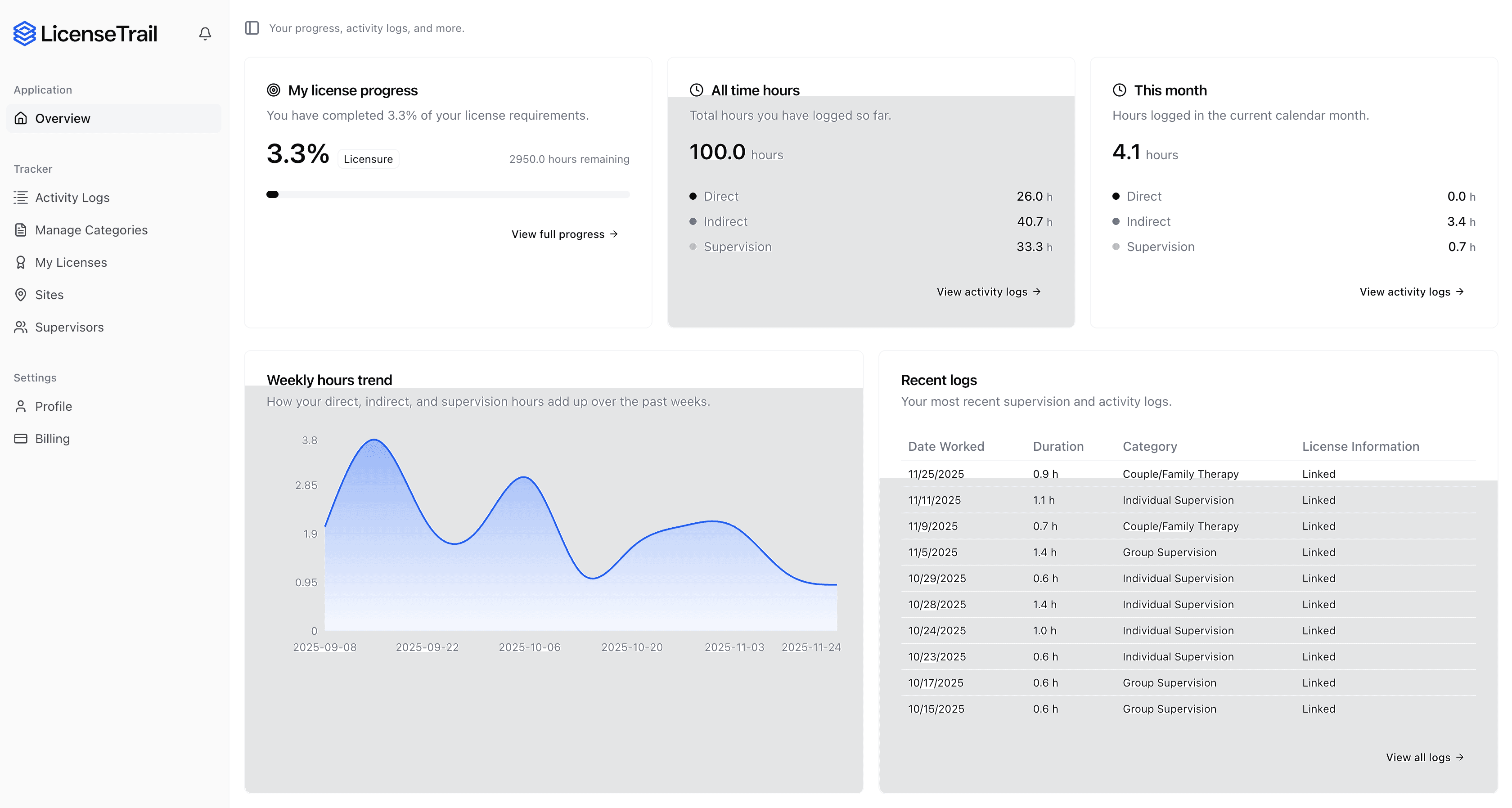
License Trail checks your direct, indirect, and supervision hours against North-carolina LPA requirements continuously and flags mismatches before you submit.
 Start Tracking for Free
No credit card required · Free plan available
Related Licenses
Is your spreadsheet hiding North-carolina LPA risks?
Stop guessing if your categories match North Carolina Psychology Board requirements. License Trail checks your direct, indirect, and supervision hours continuously and flags mismatches before you submit.
Import or log
Bring your spreadsheet or start fresh
Upload your existing tracking spreadsheet and we'll map every hour into the right North Carolina Psychology Board categories automatically.
Verify against North-carolina
Catch mismatches before the board does
License Trail checks your direct, indirect, and supervision hours against North-carolina LPA requirements continuously.
Export board-ready
One-click clean reports
Generate professional, board-ready reports for supervision meetings and North Carolina Psychology Board submissions in seconds.
No credit card required · Free plan available