
North-carolina PLP Requirements: Hours, Exams & Step-by-Step Guide
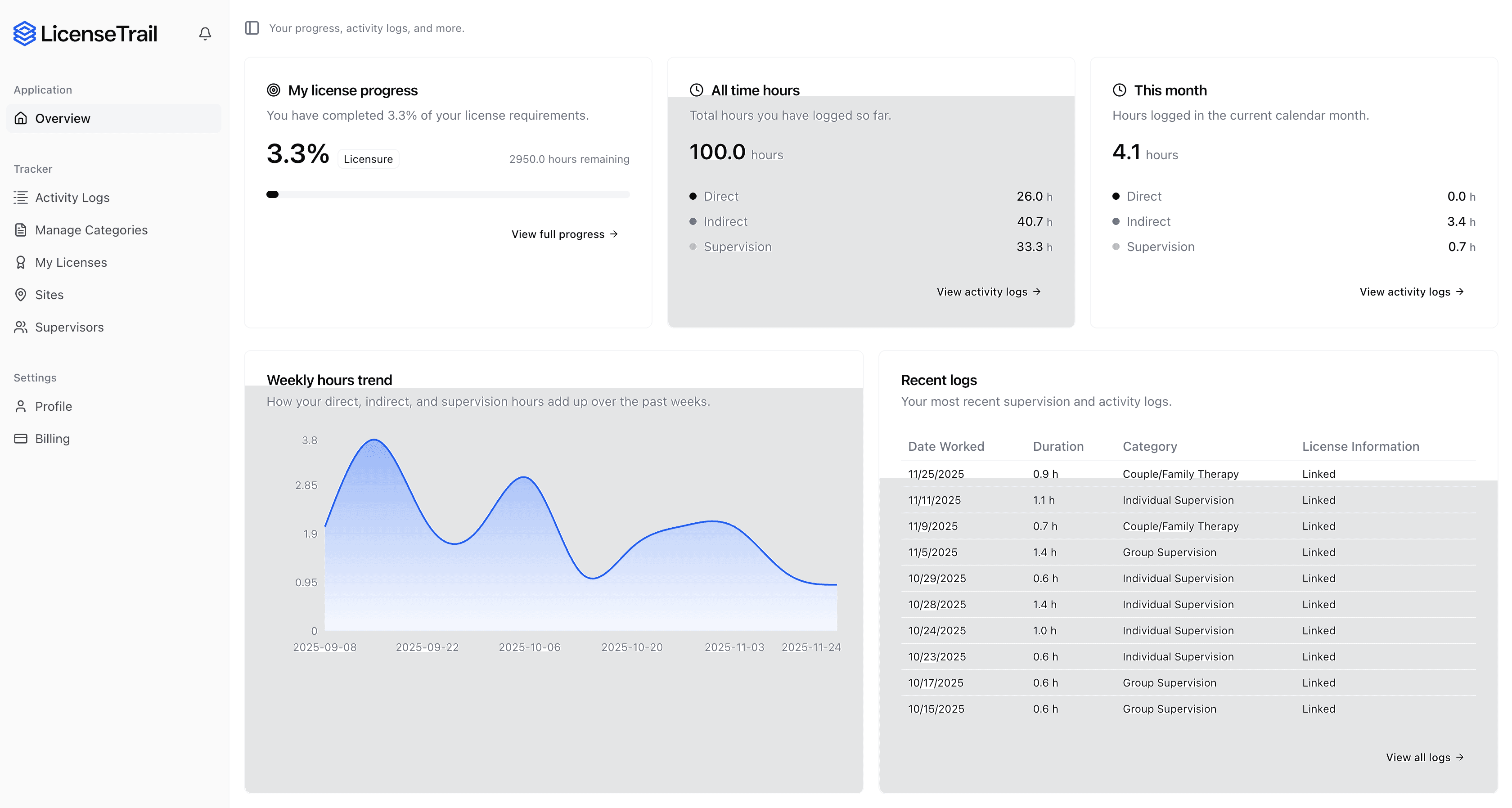
Stop guessing if your categories match North-carolina requirements. License Trail checks your direct, indirect, and supervision hours against PLP requirements continuously and flags mismatches before you submit.
No credit card required · Free plan available
Quick Requirements Overview
- PLP purpose (NC): Provisional license for doctoral psychologists who met all requirements except the full 2 years/3,000 hrs supervised experience for permanent licensure.
- Total experience for full licensure: 3,000 supervised hours over 2 years; ≥1 year/1,500 hrs must be postdoctoral.
- Predoctoral “training program” year: 1,500 hrs in a planned, directed program (typically internship) completed within 24 consecutive months; site has ≥2 doctoral psychologists; includes 2 hrs/week individual face-to-face supervision + 2 hrs/week additional instruction.
- Postdoctoral supervised year (often under PLP): ≥12 months & 1,500 hrs, completed within a 4-year consecutive period; ≥1 hr/week individual face-to-face supervision.
- While practicing as a PLP in NC: ≥1 hr/week individual face-to-face supervision required; if not practicing, supervision not required for that period.
- Supervision administration: Board-required supervision contract on file at all times; updates within 30 days of changes; supervisors submit supervision reports/final report.
- Supervisor qualification: Must meet Board criteria, including a 3-hour supervision training requirement.
- If pursuing HSP designation: Training year must include ≥25% direct health services (≥375 hrs) and ≤25% research; postdoc experience must focus on direct provision of health services.
License Details
Procedures
In North Carolina, a “Provisionally Licensed Psychologist” (often shortened in practice to PLP) is a doctoral‑level psychologist who has met all requirements for licensure except completing the full two years (3,000 hours) of supervised experience required for permanent licensure. The provisional license is the credential you hold while you finish that supervised experience under Board‑approved supervision. (studylib.net)
Below is a step‑by‑step explanation of what the North Carolina Psychology Board actually requires, with attention to how many hours, what kind of hours, and how the Board’s rules describe them.
1. Big‑picture hour requirements
For full licensure as a Licensed Psychologist (permanent status), the North Carolina Administrative Code requires you to document:
- A minimum of 2 years consisting of at least 3,000 hours of supervised practice, and
- At least 1 of those years (minimum 1,500 hours) must be postdoctoral. (studylib.net)
That 3,000‑hour requirement is central: the provisional license exists for people who have met all other criteria but are still completing some portion of those 3,000 supervised hours.
Key point: the Board talks in terms of “supervised practice / supervised experience” and “practice in psychology,” not separate “independent” versus “supervised” hours. For health‑services work, it also distinguishes “direct health services” from other activities (research, seminars, etc.). (studylib.net)
2. How the 3,000 hours are structured
A. One year (1,500 hours) in a planned training program in psychology
One of the two required supervised years must be an organized training program in the practice of psychology (this is typically your doctoral internship). The Board’s Rule 21 NCAC 54 .2009(i) says that one year of supervised experience of this type must: (studylib.net)
- Be a planned and directed program in the practice of psychology (not just “on‑the‑job” learning).
- Be clearly described in a written statement or brochure available to trainees.
- Designate you as an “intern,” “fellow,” “resident,” or another title that clearly indicates training status.
- Be completed within 24 consecutive months.
- Include at least 1,500 hours of practice in psychology (as defined in the Practice Act).
- Occur at a site with at least two doctorally trained, licensed/certified/license‑eligible psychologists who have ongoing contact with you.
- Be under the direction of a doctorally trained psychologist on staff who approves and monitors the training and assumes responsibility for its quality.
- Provide a minimum of two hours per week of individual face‑to‑face supervision focused on your practice.
- Provide at least two additional hours per week of instruction, which may be group supervision, seminars, assigned readings, or other organized training experiences.
This 1,500‑hour year is counted as supervised practice in psychology. The rule itself does not break those 1,500 hours down into “direct vs indirect” for general licensure; all are “practice in psychology” as long as they fit the statutory definition. (studylib.net)
If you are pursuing Health Services Provider certification
For certification as a Health Services Provider Psychologist (HSP‑P), the Board applies additional criteria to that training year under Rule 21 NCAC 54 .2704(d). In that context, the same 1,500‑hour training year must meet health‑services‑specific requirements, including: (law.cornell.edu)
- It is a planned sequence of training in the provision of health services (not generic psychology only).
- It consists of at least 1,500 hours of practice.
- At least 25% of the training time must be in the provision of direct health services to patients or clients who are seeking assessment or treatment.
- Up to 25% of the training may be research.
- It provides two hours per week of individual face‑to‑face supervision, and two hours per week of additional instruction, with at least half of all supervision by doctorally trained psychologists.
So, if you want HSP status, the Board effectively expects:
- 1,500 hours in a health‑services training year, of which
- At least 25% (≥ 375 hours) are direct health‑service hours with clients/patients.
The same structure applies when that health‑services year is completed pre‑doctorally (e.g., as your internship). (law.cornell.edu)
B. One year (1,500 hours) of postdoctoral supervised practice
In addition to the training‑program year above, you must complete at least one calendar year of postdoctoral supervised practice. Rule 21 NCAC 54 .2009(j) describes one year of supervised experience as: (studylib.net)
- At least 1 calendar year,
- Including at least 1,500 hours of practice,
- Completed within a consecutive four‑year period, and
- Involving a minimum of one hour per week of face‑to‑face individual supervision.
In practice, this postdoctoral 1,500‑hour year is normally completed while you hold the provisional license. The Board’s FAQ also reinforces that to move from provisional to permanent status you must complete “1,500 hours AND 12 months of practice” at the postdoctoral level before applying for permanent licensure. (ncpsychologyboard.org)
If you seek HSP‑P designation, the postdoctoral year must additionally meet the health‑services criteria in Rule 21 NCAC 54 .2704(e): it must be at least 1,500 hours over at least one calendar year, focused on direct provision of health services in psychology, with at least one hour/week of individual face‑to‑face supervision by a licensed/certified psychologist. (law.cornell.edu)
3. What kind of hours count
A. “Practice of psychology”
The Practice Act defines “practice of psychology” broadly as applying psychological principles and methods to observe, evaluate, interpret, or modify human behavior, including testing, assessment, psychotherapy, counseling, diagnosis, and treatment of mental and emotional disorders, among other activities. (studylib.net)
Your 1,500‑hour training year and 1,500‑hour postdoc year must consist of hours that fall under this definition to count as “practice” or “supervised experience” for licensure purposes. (studylib.net)
B. “Health services” and “direct health services” (for HSP / HSP‑PP)
The Board distinguishes “health services” as those practice activities involving the direct delivery of preventive, assessment, or therapeutic services to individuals whose functioning is impaired or at substantial risk of impairment. Teaching, research, and organizational consultation do not count as health services unless they involve direct services to identified individuals or groups who are the intended beneficiaries. (ncpsychologyboard.org)
Under Rule 21 NCAC 54 .2704(d)(6), when your 1,500‑hour training year is being used to qualify for health‑services provider status:
- At least 25% of those 1,500 hours must be “direct health services” to clients or patients (assessment or treatment),
- Up to 25% may be research, and
- The remaining time can include other clinical activities and structured training. (law.cornell.edu)
For the 1,500‑hour postdoctoral year used toward HSP‑P (and HSP‑PP), Rule 21 NCAC 54 .2704(e) requires that the supervised experience be specifically for the direct provision of health services in psychology to individuals or groups of clients/patients. (law.cornell.edu)
4. When you actually become a “provisionally licensed psychologist”
The Practice Act and Rule 21 NCAC 54 .2009 frame the provisional license this way:
- A psychologist who meets all other requirements for licensure at the psychologist level—education, exams, and so on—except the two years (3,000 hours) of supervised experience is issued a provisional license at the psychologist level. (studylib.net)
In practical terms, this means:
-
Before you can be a PLP, you must:
- Hold a qualifying doctoral degree in psychology that meets the Board’s educational standards. (studylib.net)
- Have completed the organized 1,500‑hour training program (typically your internship) that satisfies the criteria in Rule .2009(i); if you want HSP‑PP, that internship also must meet the health‑services requirements in Rule .2704(d), including the 25% direct health‑services requirement. (studylib.net)
- Apply for licensure within 30 days of beginning to practice psychology in North Carolina, as required by G.S. 90‑270.153 (formerly 90‑270.5). (studylib.net)
-
Once the Board determines that you meet all eligibility criteria except completing the full 3,000 hours, it issues a provisional license. You then practice as a provisionally licensed psychologist while accruing the remaining supervised hours (most or all of the 1,500‑hour postdoctoral year). (studylib.net)
5. Supervision requirements while you are a PLP
While you hold the provisional license and are practicing in North Carolina, supervision is tightly defined:
- If you are practicing psychology in North Carolina, you must receive at least one hour per week of face‑to‑face individual supervision by an appropriate supervisor (as defined in Rule 21 NCAC 54 .2001). (studylib.net)
- If you are not practicing during a given period, supervision is not required for that time. (studylib.net)
- If you practice psychology in another jurisdiction, supervision for those services is governed by that jurisdiction’s law; North Carolina does not require supervision on those out‑of‑state activities, so long as you comply with the other jurisdiction’s requirements. (studylib.net)
You must also comply with the Board’s supervision paperwork rules:
- Supervision Contract Form: All applicants and provisionally licensed psychologists must have a supervision contract on file with the Board at all times, regardless of setting; a new or updated contract must be filed within 30 days whenever conditions change. (ncpsychologyboard.org)
- Supervision Reports: Supervisors must file reports to confirm that agreed‑upon supervision has occurred and must submit a final report when supervision ends. (studylib.net)
Supervisors themselves must meet the qualifications in Rule 21 NCAC 54 .2001, including completion of a Board‑specified three‑hour supervision training (once, unless ordered to repeat). (law.cornell.edu)
6. Converting from PLP to permanent licensure
You remain under provisional status and weekly supervision until the Board confirms that you have:
- Completed the postdoctoral supervised year — at least 1,500 hours over at least 12 months, in a manner consistent with Rule .2009(j) (and .2704(e) if you’re qualifying as a health‑services provider), and
- Met all other licensure conditions and have been formally approved for permanent licensure. (studylib.net)
Only when the Board notifies you in writing that you are a permanently licensed psychologist does the weekly supervision requirement for North Carolina practice end.
7. Summary of the hour “types” for a North Carolina PLP
Putting the Board’s requirements into a simple numerical summary:
- Total supervised practice required for permanent psychologist licensure:
- 3,000 hours over at least 2 years of supervised practice.
- Minimum training/program year (usually predoctoral internship):
- 1,500 hours of practice in psychology in a structured training program (internship) meeting Rule .2009(i) criteria.
- If used for Health Services Provider (HSP‑P / HSP‑PP): at least 25% (≥ 375 hours) must be direct health services to clients/patients; up to 25% may be research. (studylib.net)
- Postdoctoral year (typically completed as a PLP):
- 1,500 hours of practice in psychology over at least 1 calendar year, with at least 1 hour/week individual face‑to‑face supervision, completed within a 4‑year period. (studylib.net)
All of these hours must be supervised practice, and if you are pursuing Health Services Provider status they must meet the health‑services‑specific criteria regarding direct health‑service time and supervision spelled out in Rule 21 NCAC 54 .2704. (law.cornell.edu)
Track your PLP hours with confidence
License Trail checks your direct, indirect, and supervision hours against North-carolina PLP requirements continuously and flags mismatches before you submit.
 Start Tracking for Free
No credit card required · Free plan available
Related Licenses
Is your spreadsheet hiding North-carolina PLP risks?
Stop guessing if your categories match North Carolina Psychology Board requirements. License Trail checks your direct, indirect, and supervision hours continuously and flags mismatches before you submit.
Import or log
Bring your spreadsheet or start fresh
Upload your existing tracking spreadsheet and we'll map every hour into the right North Carolina Psychology Board categories automatically.
Verify against North-carolina
Catch mismatches before the board does
License Trail checks your direct, indirect, and supervision hours against North-carolina PLP requirements continuously.
Export board-ready
One-click clean reports
Generate professional, board-ready reports for supervision meetings and North Carolina Psychology Board submissions in seconds.
No credit card required · Free plan available