
North-dakota I/O Psychologist Requirements: Hours, Exams & Step-by-Step Guide
Stop guessing if your categories match North-dakota requirements. License Trail checks your direct, indirect, and supervision hours against I/O Psychologist requirements continuously and flags mismatches before you submit.
No credit card required · Free plan available
Quick Requirements Overview
- License required to practice I/O psychology or use I/O titles in ND unless licensed or registered as an I/O psychology resident
- Education: Doctoral degree in an approved I/O program (APA/CPA-recognized, ASPPB/National Register I/O designation, or SIOP-guideline–adherent program as accepted by the Board)
- Supervised experience: 3,000 hours supervised I/O practice required; ≥1,500 hours postdoctoral
- Supervision plan: Individualized supervision plan must be Board-approved; supervisors must be licensed in their jurisdiction and experience must match intended I/O practice
- Postdoc supervision structure: Primary supervisor with ≥3 years post-licensure; weekly supervision; ≥100 hours direct supervision (≥50 with primary)
- Resident registration: Register as I/O psychology resident before practicing/accruing hours (initiate application + fee + supervisor form; complete application within 4 months; residency valid up to 3 years)
- Exams: Pass EPPP (scaled 500+) and ND oral/professional responsibility exam (law/ethics/standards)
- Ethics: Must agree to and comply with the Board’s code of ethical conduct
License Details
Procedures
Licensing requirements for industrial‑organizational (I/O) psychologists in North Dakota are set by statute (North Dakota Century Code, Chapter 43‑32) and by the North Dakota Administrative Code (Title 66, Board of Psychologist Examiners). What follows focuses on becoming licensed specifically as an industrial-organizational psychologist (not a general “psychologist”) through the North Dakota State Board of Psychologist Examiners.
When a North Dakota I/O Psychology License Is Required
North Dakota law makes it clear that you may not practice I/O psychology or use I/O titles without appropriate licensure or residency status:
- A person may not engage in “the practice of industrial-organizational psychology” unless licensed as a psychologist or industrial-organizational psychologist, or registered as a psychology resident or industrial-organizational psychology resident.
- A person may not use the titles “industrial psychologist,” “organizational psychologist,” or “industrial-organizational psychologist” unless licensed as a psychologist or industrial-organizational psychologist. (codes.findlaw.com)
Core Hour Requirements for I/O Licensure
The key workload requirement is contained in North Dakota Administrative Code § 66‑02‑01‑11.1(2):
-
Total hours:
The rule states that “Applicants for licensure as an industrial-organizational psychologist must complete three thousand hours of supervised experience in the practice of industrial-organizational psychology.” (regulations.justia.com) -
Postdoctoral minimum:
The same section continues that “At least one thousand five hundred hours must be completed after the granting of the doctoral degree.” (regulations.justia.com) -
Nature of the hours:
- All 3,000 hours must be supervised experience in the practice of industrial-organizational psychology, not simply any employment. (regulations.justia.com)
- North Dakota rules do not require a formal predoctoral internship for I/O applicants (in contrast to health‑service psychologist applicants, who must complete a 1,500‑hour predoctoral internship). Secondary summaries of board requirements make this explicit: I/O psychologists “must also complete 3,000 hours of supervised experience” and “there is no pre‑doctoral internship requirement,” but at least 1,500 of the 3,000 hours must be postdoctoral and follow an individualized supervision plan approved by the board. (psychologist-license.com)
In other words, for I/O licensure in North Dakota, the breakdown is:
- 3,000 total supervised hours in I/O psychology, of which
- At least 1,500 hours must be completed after the doctoral degree (postdoctoral supervised experience), and
- Up to 1,500 hours may be completed before or after the doctorate, as long as they are supervised I/O practice and fit within the board‑approved supervision plan.
There is no separate category of “direct” vs. “supervised” hours in the rule for I/O applicants; all 3,000 hours are, by definition, supervised professional experience.
Supervision and Supervision Plan Requirements
Individualized supervision plan
For I/O applicants, the board requires an individualized supervision plan:
- Applicants must “submit an individualized supervision plan that is subject to approval by the board.”
- Supervisors of I/O applicants “must be licensed in their jurisdiction of practice.”
- The supervised experience “must be consistent with the applicant's intended area of practice.” (regulations.justia.com)
Practically, this means you should:
- Identify one or more licensed psychologists or industrial‑organizational psychologists who will supervise you (licensed where they practice).
- Draft a detailed supervision plan describing:
- Settings (e.g., corporations, consulting firms, government agencies).
- Types of services (e.g., job analysis, personnel selection, organizational surveys, leadership assessment, training evaluation).
- How supervision will occur (frequency, modality, documentation).
- Submit this plan to the Board for approval before relying on those hours toward the 3,000‑hour requirement.
Postdoctoral supervision standards
For both psychology and industrial‑organizational psychology, North Dakota statute lays out additional supervision parameters for postdoctoral supervised employment:
-
Before starting supervised postdoctoral work, you must have a primary supervisor who:
- Is a psychologist with at least three years of post‑license practice experience, and
- Has competency in supervision in the general area of practice being supervised (here, industrial‑organizational work). (codes.findlaw.com)
-
Supervision must:
- Occur weekly, and
- Include at least 100 hours of direct supervision (face‑to‑face or via distance communications), of which at least 50 hours must be with the primary supervisor. (codes.findlaw.com)
The Board may prorate these supervision requirements for part‑time arrangements, but the weekly, 100‑hour minimum, and 50‑hours‑with‑primary‑supervisor standards are the baseline for postdoctoral supervised employment in psychology and industrial‑organizational psychology under North Dakota law. (codes.findlaw.com)
Industrial‑Organizational Psychology Resident Status
Before you can count supervised postdoctoral hours toward licensure, you function under a resident registration.
Who is an I/O psychology resident?
North Dakota defines an “industrial-organizational psychology resident” as an individual who:
- Has met the doctoral program requirement in § 43‑32‑20(2)(b);
- Is involved in supervised employment in industrial‑organizational psychology; and
- Has registered with the Board. (codes.findlaw.com)
How to register as a resident
Under North Dakota Administrative Code § 66‑02‑01‑13, a person intending to perform services as an industrial-organizational psychology resident, before engaging in practice, must:
- Initiate an application for licensure with the board, using the Board’s application initiation form.
- Pay the application fee.
- Ensure a supervisor has filed a completed supervisor form with the Board. (law.cornell.edu)
You then must:
- Complete the specified online application requirements, and
- Make sure the finished online application is submitted within four months of initiating the application. (law.cornell.edu)
A resident may sit for the required national written examination and, once eligible, the state professional‑responsibility (or oral) exam, while completing supervised experience. The resident and supervisors must update the online application with completed supervised hours, and the Board reviews those hours along with exam results before granting a license. (law.cornell.edu)
Duration of residency:
A person may hold industrial‑organizational psychology resident status for up to three years from the date the residency is issued. (law.cornell.edu)
Supervisors must verify completion of residency by documenting the number and nature of supervised hours and submitting this documentation to the Board. (law.cornell.edu)
Educational Requirements
To be licensed as an industrial-organizational psychologist, the applicant must hold a qualifying doctoral degree:
- Statute requires that the applicant “has received, from a school or college, a doctorate degree in a program of studies accredited by an accrediting body approved by the board by rule.” (codes.findlaw.com)
The Board has specified what counts as an approved I/O doctoral program:
- North Dakota Administrative Code § 66‑02‑01‑06 recognizes the American Psychological Association (APA) and Canadian Psychological Association (CPA) as approved accrediting bodies under § 43‑32‑20 for psychology programs, and allows I/O applicants to qualify if they completed a program that substantively adheres to the Guidelines for Education and Training at the Doctoral Level in Industrial‑Organizational Psychology of the Society for Industrial and Organizational Psychology (SIOP). (law.cornell.edu)
- A later rule, § 66‑02‑01‑12.1, adds that programs designated as doctoral programs in industrial-organizational psychology by the Association of State and Provincial Psychology Boards (ASPPB) and the National Register of Health Service Providers in Psychology are approved for industrial‑organizational licensure purposes. (regulations.justia.com)
In practice, you must earn a doctoral degree in I/O psychology (or equivalent) from a program that is either:
- Accredited by an APA/CPA‑recognized body and meets Board expectations, or
- Designated as a doctoral I/O program by ASPPB and the National Register, or
- Demonstrably built to conform to SIOP’s 1999 doctoral‑level I/O training guidelines (subject to Board review). (law.cornell.edu)
Examination Requirements
North Dakota requires both a national written exam and a state‑level exam.
National written examination (EPPP)
- Under Administrative Code § 66‑02‑01‑09.1, the national written examination for psychologists and industrial‑organizational psychologists is the Examination for Professional Practice of Psychology (EPPP).
- The passing score is a scaled score of 500 (or 70% correct for exams taken before April 18, 1994).
- A passing score is required for applicants for licensure as a psychologist or as an industrial-organizational psychologist. (law.cornell.edu)
North Dakota oral or professional responsibility examination
- The Board currently uses an oral examination, and the rules authorize the Board to replace the oral with a written North Dakota professional responsibility exam once developed. (law.cornell.edu)
- This state‑level exam assesses knowledge of:
- North Dakota law regulating psychology and I/O psychology;
- Professional ethics;
- Professional law and standards of practice. (law.cornell.edu)
You ordinarily complete the EPPP first and then sit for the state exam once the Board determines you are otherwise eligible.
Ethical and Character Requirements
For industrial‑organizational licensure, statute requires that an applicant:
- “Will adhere to the code of ethical conduct adopted by the board by rule.” (codes.findlaw.com)
The Board’s rules incorporate professional ethical standards (e.g., APA ethics code) and North Dakota‑specific provisions. You will typically attest to adherence to those standards in your application and are bound by them as a condition of licensure.
Summary of North Dakota I/O Licensure Requirements (Hours Focused)
For an Industrial‑Organizational Psychologist license issued by the North Dakota State Board of Psychologist Examiners, as of 2025, you must:
-
Earn a qualifying I/O doctoral degree
- Doctorate in industrial‑organizational psychology from a program accredited/approved under Board rules (APA/CPA‑related, ASPPB/National Register I/O designation, or SIOP‑guideline‑adherent program). (law.cornell.edu)
-
Complete supervised experience hours in I/O psychology
- 3,000 total hours of supervised experience in the practice of industrial-organizational psychology.
- At least 1,500 hours must be postdoctoral (completed after the doctoral degree is granted). (regulations.justia.com)
- Remaining up to 1,500 hours may be pre‑ or postdoctoral supervised I/O practice, as long as:
- They fit an individualized supervision plan approved by the Board;
- The supervisors are licensed in their jurisdiction;
- The work is consistent with your intended I/O practice area. (regulations.justia.com)
-
Meet supervision structure requirements
- Have a primary supervisor with at least three years of post‑license practice experience and competency in I/O‑related supervision.
- Receive weekly supervision, totaling at least 100 hours of direct supervision, with at least 50 hours provided by the primary supervisor, during postdoctoral supervised employment. (codes.findlaw.com)
-
Register and function as an I/O psychology resident during supervised practice
- File the application initiation form and pay the fee.
- Have your supervisor submit a supervisor form.
- Maintain resident status (up to three years) while accruing hours.
- Ensure your supervisor documents the number and nature of supervised hours for the Board. (law.cornell.edu)
-
Pass required examinations
- National written exam: EPPP, with a scaled score of at least 500. (law.cornell.edu)
- North Dakota oral exam or written professional responsibility exam, covering state law and ethics. (law.cornell.edu)
-
Agree to and abide by the Board’s code of ethics and meet any character/fitness criteria. (codes.findlaw.com)
Because statutes and rules can change, applicants should always cross‑check the exact wording of North Dakota Century Code Chapter 43‑32 and North Dakota Administrative Code Title 66 (especially §§ 66‑02‑01‑06, 66‑02‑01‑11.1, 66‑02‑01‑12.1, 66‑02‑01‑13, and 66‑02‑01‑09.1), along with any updated guidance on the North Dakota State Board of Psychologist Examiners’ official site, before making final plans.
Track your I/O Psychologist hours with confidence
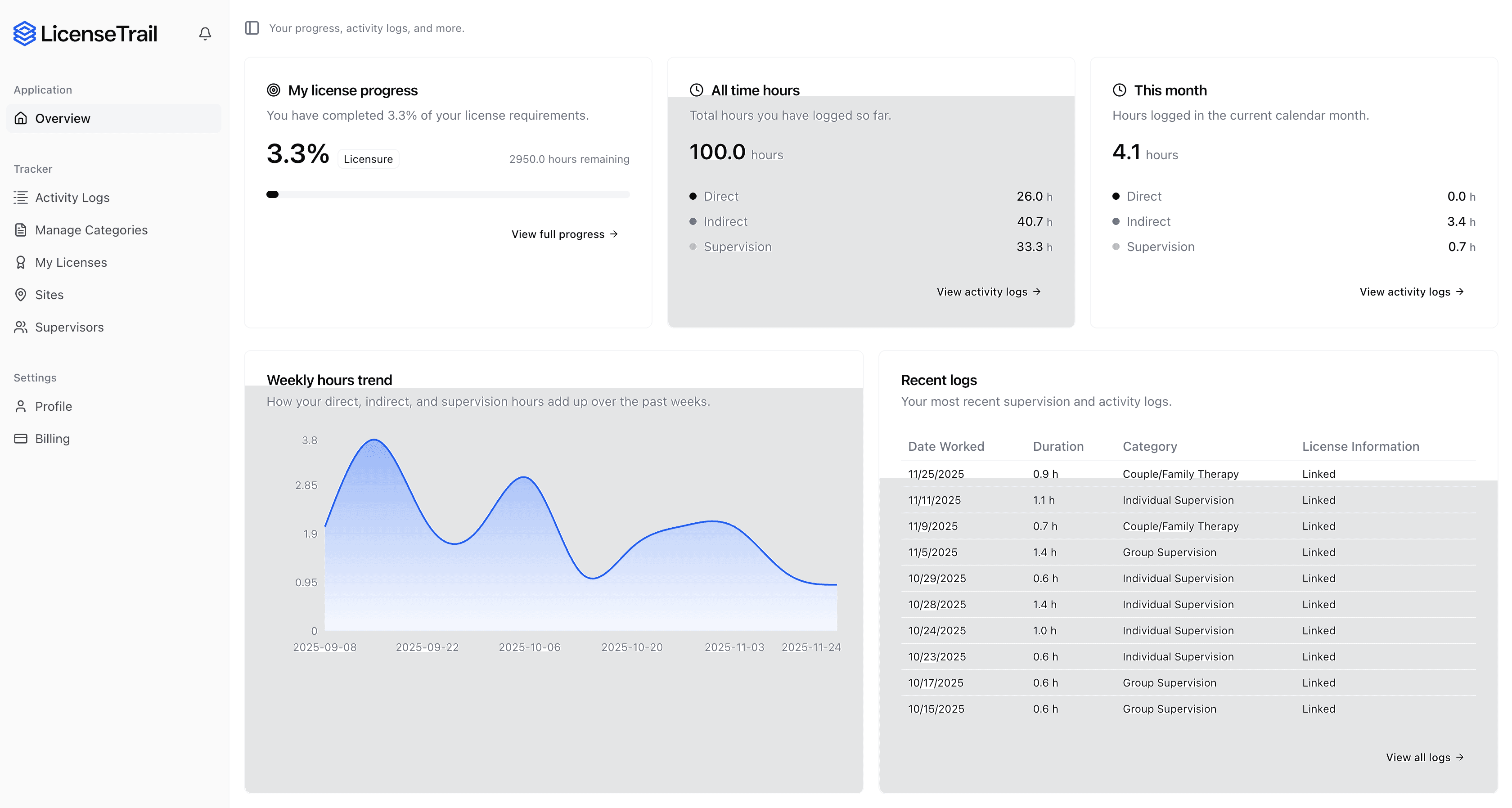
License Trail checks your direct, indirect, and supervision hours against North-dakota I/O Psychologist requirements continuously and flags mismatches before you submit.
 Start Tracking for Free
No credit card required · Free plan available
Related Licenses
Is your spreadsheet hiding North-dakota I/O Psychologist risks?
Stop guessing if your categories match North Dakota State Board of Psychologist Examiners requirements. License Trail checks your direct, indirect, and supervision hours continuously and flags mismatches before you submit.
Import or log
Bring your spreadsheet or start fresh
Upload your existing tracking spreadsheet and we'll map every hour into the right North Dakota State Board of Psychologist Examiners categories automatically.
Verify against North-dakota
Catch mismatches before the board does
License Trail checks your direct, indirect, and supervision hours against North-dakota I/O Psychologist requirements continuously.
Export board-ready
One-click clean reports
Generate professional, board-ready reports for supervision meetings and North Dakota State Board of Psychologist Examiners submissions in seconds.
No credit card required · Free plan available