
North-dakota LAMFT Requirements: Hours, Exams & Step-by-Step Guide
Stop guessing if your categories match North-dakota requirements. License Trail checks your direct, indirect, and supervision hours against LAMFT requirements continuously and flags mismatches before you submit.
No credit card required · Free plan available
Quick Requirements Overview
- Regulator: North Dakota Marriage & Family Therapy Licensure Board (NDMFTLB); governed by NDCC Ch. 43‑53 and NDAC Title 111
- Education: Master’s/doctoral in MFT or related degree deemed equivalent; “equivalent” includes 54 semester credits across specified content areas (incl. 9 credits practicum)
- Practicum (degree-based): 9 practicum credits or 500 hours/12 months supervised client contact; max 250 hours with individuals (remainder with couples/families); supervised by LMFT or AAMFT-approved supervisor
- Exam: Pass AMFTRB National MFT Exam (Board approval required to sit)
- Initial LAMFT issuance: Submit application + fee; meet moral character/discipline standards; file Supervisory Agreement (Form III); must practice under Board-qualified supervision
- LAMFT term/renewal: 1-year license, renewable up to 4 additional years (5-year max in associate status)
- Renewal CE (LAMFT): 15 CE hours annually, including 3 ethics
- Supervised experience while LAMFT (toward LMFT): Minimum 2 calendar years post-degree; commonly 3,000 total hours incl. 1,500 direct client contact and ≥200 supervision hours by an LMFT; ND jurisprudence exam required for LMFT upgrade
License Details
Procedures
North Dakota regulates marriage and family therapists through the North Dakota Marriage and Family Therapy Licensure Board (NDMFTLB) under Chapter 43‑53 of the North Dakota Century Code and Title 111 of the North Dakota Administrative Code. To become a Licensed Associate Marriage and Family Therapist (LAMFT), you must first qualify educationally and by exam, obtain the associate license, and then complete a substantial period of supervised clinical work on the way to full LMFT licensure.
Below is a step‑by‑step outline, emphasizing the specific hour requirements and the Board’s own wording where it is available.
1. Understand the two license levels in North Dakota
State law defines an “associate marriage and family therapist” as a person who:
has completed the educational requirements for a marriage and family license and has passed the licensing examination, but has not yet completed the supervised work experience requirement for licensure as a marriage and family therapist. (law.justia.com)
Key points:
- LAMFT is the transitional license you hold after your degree and national exam, while you complete supervised clinical experience.
- LMFT is the independent license you receive after completing supervised experience and passing both national and state exams.
By statute, an associate marriage and family therapist license lasts one year and may be renewed for up to four additional years (a maximum of five years in associate status). (law.justia.com)
2. Meet the educational and practicum requirements
2.1. Degree requirement
To be eligible for either LAMFT or LMFT, you must hold:
- A master’s or doctoral degree in marriage and family therapy, or
- A graduate degree in a related field with graduate‑level coursework equivalent to an MFT degree, as determined by the Board. (law.justia.com)
The Board’s rules (ND Admin Code 111‑02‑02‑02) specify that an “equivalent” degree must include at least 54 semester hours distributed across:
- Human development (9 credits)
- Systemic/relational assessment and mental health diagnosis and treatment (3)
- Marital and family studies (6)
- Marital and family therapy (12)
- Research (3)
- Professional studies (3)
- Diversity and psychopharmacology (9)
- Clinical practicum (9) (regulations.justia.com)
2.2. Graduate clinical practicum – specific hour requirements
The same rule requires a substantial practicum or its hourly equivalent:
- At least 9 semester hours of clinical practicum in marriage and family therapy, or at least 500 hours or 12 months of clinical client contact with individuals, couples, and families for assessment and intervention.
- Of the 500 hours, no more than 250 hours may be with individuals (the remainder must be with couples and families).
- This practicum experience must be supervised onsite or by the academic institution by a licensed marriage and family therapist or an AAMFT‑approved supervisor. (regulations.justia.com)
These practicum hours are part of your degree requirements, not post‑graduate supervised experience, but they are important because they are explicitly mandated by the Board’s rule and form part of what it means to have “completed the educational requirements” for associate licensure.
3. Pass the national MFT examination
North Dakota uses the AMFTRB National Examination in Marital and Family Therapy as its licensing exam. (ndmftlb.org)
According to the Board’s published licensing process:
- You must submit an application for associate licensure (LAMFT) and be approved by the Board in order to sit for the national exam. (ndmftlb.org)
- An applicant for LAMFT must “successfully pass the licensing examination” under Chapter 43‑53‑06 before being regarded as an associate. (law.justia.com)
In practice, programs often help you time the application so that Board approval and national exam scheduling align shortly before or after graduation.
4. Apply for the LAMFT license
Once you have:
- Completed the qualifying MFT (or equivalent) degree with the required coursework and practicum; and
- Passed the national MFT exam;
you may apply to the North Dakota Marriage and Family Therapy Licensure Board for Licensed Associate Marriage and Family Therapist status.
4.1. Statutory and Board requirements for issuing an LAMFT
Under 43‑53‑06 and the Board’s materials, you must provide evidence that you: (law.justia.com)
- Are of good moral character and have not engaged in conduct that would be grounds for discipline.
- Hold a qualifying master’s or doctoral degree (or equivalent) that meets the Board’s educational requirements.
- Have successfully passed the licensing examination (national AMFTRB exam).
- Agree to practice under the supervision of a Board‑qualified supervisor and to follow the same laws and rules as a fully licensed LMFT.
- Submit the Board’s initial license application (used for LMFT or LAMFT and for upgrading from LAMFT to LMFT) and pay the required fee. (ndmftlb.org)
- File a Supervisory Agreement (Form III) that identifies your Board‑approved supervisor(s) and describes the planned supervised practice. (ndmftlb.org)
4.2. Nature and duration of LAMFT license
By statute and Board description:
- LAMFTs must practice under the supervision of a board‑qualified supervisor and must obey the same laws and rules as LMFTs. (law.justia.com)
- The LAMFT license is issued for one year and may be renewed annually for up to four additional years (maximum of five years total associate status). (law.justia.com)
5. Work as an LAMFT and accumulate supervised experience hours
Although your question is about becoming a LAMFT, the hour requirements you referenced (e.g., 1,500 hours of direct experience) actually belong to the post‑graduate supervised experience required for LMFT licensure. You complete these hours while you are licensed as an LAMFT.
5.1. Statutory requirement: two calendar years of supervised work
North Dakota Century Code § 43‑53‑06(3)(b) requires that an LMFT applicant:
has successfully completed two calendar years of work experience in marriage and family therapy under qualified supervision following receipt of a qualifying degree. (codes.findlaw.com)
That two‑year minimum is in statute. The Board, through policy and rules, further defines that experience in terms of total hours, direct client contact hours, and supervision hours.
5.2. Board‑defined supervised experience hours (while an LAMFT)
According to the North Dakota Marriage and Family Therapy Licensure Board as summarized on the AAMFT North Dakota state‑resources page and corroborated by recent licensing summaries: (aamft.org)
- You must complete at least 3,000 hours of supervised clinical experience in marriage and family therapy after earning your qualifying degree.
- Of these 3,000 hours, at least 1,500 hours must be direct clinical contact with clients (face‑to‑face or approved telehealth) providing therapy.
- At least 200 hours must be supervision provided directly by a Licensed Marriage and Family Therapist (LMFT).
- Other credible summaries of the Board’s standards indicate a total of about 300 supervision hours, with at least 150 hours as individual supervision and the remainder possibly in approved group supervision, and allow up to 100 supervision hours and up to 500 client‑contact hours from a COAMFTE‑accredited graduate practicum to be credited toward these totals. (mft-license.com)
Putting this into a concrete breakdown (recognizing that minor details may change over time and must be confirmed with the Board):
- Total supervised clinical experience:
- 3,000 hours minimum of post‑graduate clinical work in marriage and family therapy.
- Direct client contact (“direct clinical contact”):
- At least 1,500 hours providing therapy to clients.
- Board‑oriented summaries specify that these direct hours should include substantial work with:
- Individuals,
- Couples, and
- Families with children.
- Supervision hours:
- At least 200 hours must be direct supervision by an LMFT. (aamft.org)
- Other Board‑based descriptions indicate around 300 total supervision hours, of which:
- At least 150 hours must be individual (one‑on‑one) supervision,
- The balance may be group supervision,
- Up to 100 hours of supervision and up to 500 client‑contact hours from an accredited graduate practicum can sometimes be counted toward these totals, depending on whether your program was COAMFTE‑accredited and how the Board evaluates your documentation. (mft-license.com)
You log these hours as an LAMFT and later document them on the Board’s Supervised Experience Verification (Form V) and related supervision forms when you apply to upgrade to LMFT. (ndmftlb.org)
Because these specific numeric hour breakdowns are implemented through Board policy and forms rather than spelled out verbatim in the statute, it is essential to check the latest Board instructions and forms when you are ready to plan or report your hours.
6. Continuing education while you are an LAMFT
North Dakota Administrative Code § 111‑02‑01‑06 sets continuing education (CE) requirements for license renewal:
- Licensed marriage and family therapists must complete 30 hours of CE every two years, including 6 hours in ethics.
- Licensed associates (LAMFTs) must complete 15 hours of continuing education every year, including 3 hours in ethics. (law.cornell.edu)
As an LAMFT, you attest to CE completion on each annual renewal application.
7. Final steps: state exam and upgrade from LAMFT to LMFT
After you have:
- Completed the 3,000 hours of supervised clinical experience (including 1,500 direct client hours and the required supervision hours), and
- Passed the national MFT exam,
you are eligible to:
- Apply to sit for the North Dakota state jurisprudence exam, which covers state statutes and administrative rules for MFT practice. (ndmftlb.org)
- Submit an “upgrade” application (the same initial licensure form, indicating an upgrade from LAMFT to LMFT), along with:
- Supervised experience verification (Form V and related supervision forms),
- Proof of passing scores, and
- Any additional documentation the Board requires. (ndmftlb.org)
Upon approval, the Board issues a Licensed Marriage and Family Therapist (LMFT) license, allowing independent practice.
Summary of hour‑based requirements on the path through LAMFT in North Dakota
-
Within your graduate program (to qualify educationally for LAMFT): (regulations.justia.com)
- At least 500 hours (or 12 months) of supervised clinical client contact in practicum.
- No more than 250 of those hours may be with individuals; the rest must be with couples and families.
- Supervised by a licensed marriage and family therapist or AAMFT‑approved supervisor.
-
Post‑graduate, while licensed as an LAMFT (to qualify for LMFT): (codes.findlaw.com)
- At least two calendar years of supervised work experience after your degree.
- At least 3,000 total hours of supervised clinical experience.
- At least 1,500 hours of direct clinical contact (therapy with clients).
- At least 200 hours of supervision by an LMFT; total supervision commonly structured at about 300 hours, with at least 150 hours of individual supervision.
- Some practicum hours and supervision hours from a COAMFTE‑accredited graduate program may be credited toward these totals, within Board‑defined limits.
-
While holding LAMFT:
- 15 hours of continuing education per year, including 3 ethics hours, for renewal. (law.cornell.edu)
Because North Dakota occasionally updates its rules and Board forms, anyone planning to pursue NDMFTLB licensure should always confirm the most current hour breakdowns, forms, and fee amounts directly with the Board before finalizing a supervision plan.
Track your LAMFT hours with confidence
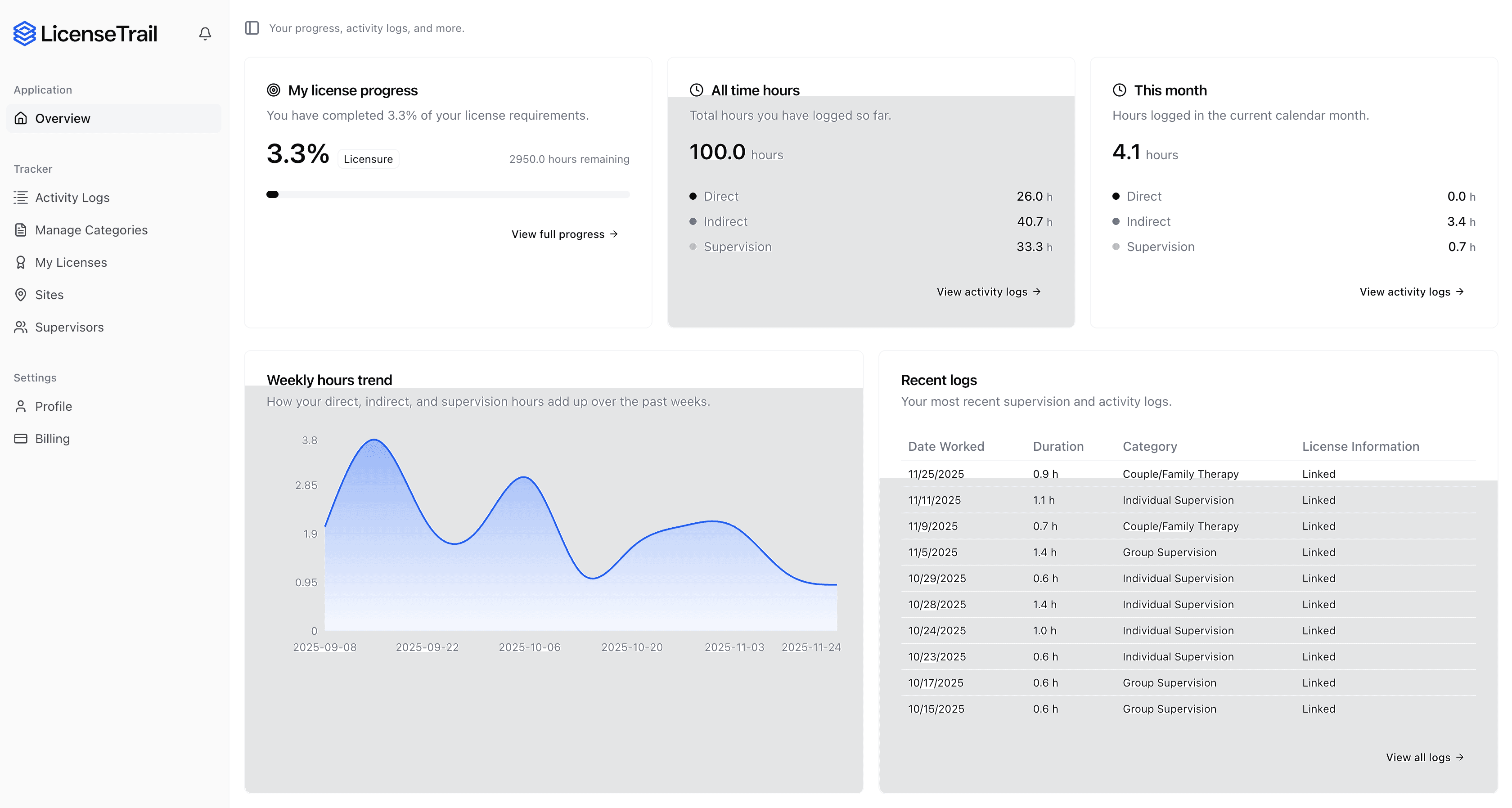
License Trail checks your direct, indirect, and supervision hours against North-dakota LAMFT requirements continuously and flags mismatches before you submit.
 Start Tracking for Free
No credit card required · Free plan available
Related Licenses
Is your spreadsheet hiding North-dakota LAMFT risks?
Stop guessing if your categories match North Dakota Marriage and Family Therapy Licensure Board requirements. License Trail checks your direct, indirect, and supervision hours continuously and flags mismatches before you submit.
Import or log
Bring your spreadsheet or start fresh
Upload your existing tracking spreadsheet and we'll map every hour into the right North Dakota Marriage and Family Therapy Licensure Board categories automatically.
Verify against North-dakota
Catch mismatches before the board does
License Trail checks your direct, indirect, and supervision hours against North-dakota LAMFT requirements continuously.
Export board-ready
One-click clean reports
Generate professional, board-ready reports for supervision meetings and North Dakota Marriage and Family Therapy Licensure Board submissions in seconds.
No credit card required · Free plan available