
North-dakota LBSW Requirements: Hours, Exams & Step-by-Step Guide
Stop guessing if your categories match North-dakota requirements. License Trail checks your direct, indirect, and supervision hours against LBSW requirements continuously and flags mismatches before you submit.
No credit card required · Free plan available
Quick Requirements Overview
- Degree: BSW from a Board‑approved social work program (typically CSWE‑accredited)
- Exam: Pass the ASWB Bachelor’s exam (official score sent to the Board)
- Application: Submit completed/signed Board application
- Transcript: Provide an official transcript sent directly from the school
- References: 3 written references (varies by work history; may include faculty/field supervisor/licensed social worker)
- Background checks: Statewide & nationwide criminal history + child abuse/neglect inquiry (applicant pays)
- Other eligibility: Age of majority, good moral character, agree to Board ethics code
- Hours: No post‑degree supervised experience hours required for LBSW (field hours are part of the BSW, not a separate licensure requirement)
License Details
Procedures
In North Dakota, the entry‑level social work license tied to a Bachelor of Social Work (BSW) is the Licensed Baccalaureate Social Worker (LBSW). State law calls this a “licensed baccalaureate social worker,” defined as an individual licensed “to practice baccalaureate social work,” a generalist scope that includes assessment, case management, counseling, advocacy, community organization, and related activities. (law.justia.com)
What follows is a step‑by‑step guide based on the North Dakota Century Code (NDCC) and North Dakota Administrative Code (NDAC), plus Board-derived summaries, with specific attention to any hour requirements.
1. Understand the LBSW scope and license structure
North Dakota’s social work licensure system has three levels:
- Licensed Baccalaureate Social Worker (LBSW) – bachelor’s level, generalist practice
- Licensed Master Social Worker (LMSW) – master’s level, advanced/generalist practice
- Licensed Clinical Social Worker (LCSW) – master’s/doctoral level, clinical practice; clinical supervision can lead to independent clinical status (often referred to as LICSW in secondary sources) (law.justia.com)
The statute describes “the practice of baccalaureate social work” as generalist practice that includes “assessment, planning, implementation, intervention, evaluation, research, social work case management, information and referral, counseling, supervision, consultation, education, advocacy, community organization, and the development, implementation, and administration of policies, programs, and activities.” (law.justia.com)
Only those licensed under this chapter may represent themselves to the public as a “licensed baccalaureate social worker,” “licensed master social worker,” or “licensed clinical social worker.” (law.justia.com)
2. Educational requirement
To become licensed at the baccalaureate level, the law requires:
“Baccalaureate social work must demonstrate having been awarded a baccalaureate degree in social work from a social work program approved by the board.” (law.justia.com)
In practice this means:
- A Bachelor of Social Work (BSW) from a CSWE‑accredited program, or an equivalent program the Board has approved. (publichealthonline.org)
There is no separate, board‑mandated post‑degree experience requirement for LBSW licensure beyond the normal field education hours that are already embedded in accredited BSW programs (typically at least 400 supervised field hours). Those field hours are a requirement of CSWE accreditation and the degree, not a separate North Dakota licensure hour tally. (publichealthonline.org)
3. Application and documentation requirements
The North Dakota Administrative Code section on “Application” lays out the core requirements for all initial licenses, including the baccalaureate level. Applications must include: (regulations.justia.com)
-
Completed, signed application form
- Submitted in the format prescribed by the Board of Social Work Examiners.
-
Official academic transcript
- An “official transcript showing proof of required degree submitted to the board’s office by the academic institution from which the degree was earned.” (regulations.justia.com)
-
Proof of passing the appropriate examination
- “Proof of successful completion of the appropriate examination submitted to the board’s office by the administrating body of the examination.” (regulations.justia.com)
- For LBSW, this is the ASWB Bachelors examination, as confirmed by multiple Board‑based summaries. (socialworklicensemap.com)
-
References
The rule requires “a minimum of three written references” documenting professional conduct and competence: (regulations.justia.com)- If you have never worked as a social worker:
- One reference from a social work faculty member
- One from a field placement supervisor
- One from a licensed social worker (regulations.justia.com)
- If you have social work work experience:
- Three references, including two from social workers at your proposed level or higher, and one from a work supervisor. (regulations.justia.com)
- The Board may waive or modify reference requirements “in appropriate circumstances.” (regulations.justia.com)
University and licensure guides written from Board materials echo this arrangement and describe the specific forms: a Faculty Advisor reference form, Field Supervisor reference form, and Social Worker reference form for LBSW applicants. (publichealthonline.org)
- If you have never worked as a social worker:
-
Background checks
The administrative rule and statute both require: (regulations.justia.com)- A statewide and nationwide criminal history record check, conducted under NDCC § 12‑60‑24.
- A child abuse and neglect background inquiry, with written consent allowing the Department of Health and Human Services (or designee) to release relevant reports to the Board.
All costs are the responsibility of the applicant.
-
Fees
The Board sets fees by rule; current Board‑derived summaries list, for initial licensure: (law.justia.com)- Application fee (historically $25)
- Fingerprint/background check fee
- License issuance fee (historically $75)
-
Good moral character and ethics attestation
The statute requires evidence that the applicant: (law.justia.com)- Has reached the age of majority
- “Has passed the examination approved by the board for the license sought”
- “Agrees to adhere to the code of social work ethics adopted by the board”
- “Is of good moral character,” with the Board considering adherence to professional values, principles, and ethical standards, along with any mandated reports.
4. Examination requirement (ASWB Bachelor’s exam)
For LBSW licensure, North Dakota requires passing the ASWB Bachelors examination: (socialworklicensemap.com)
- You submit your application and fee to the Board.
- Once the Board approves you to test, it notifies ASWB.
- You then register for and take the ASWB Bachelors exam at a testing center.
- ASWB sends the official score directly to the Board; the Board will not accept self‑reported scores. (publichealthonline.org)
Licensure is issued after the Board confirms that all requirements are satisfied: degree, exam, references, background checks, and fees. (regulations.justia.com)
5. Experience and supervision hours: what is and isn’t required
A. LBSW (bachelor’s level) – no post‑degree hour requirement
For the Licensed Baccalaureate Social Worker in North Dakota, there is no statutory or administrative requirement for a specified number of post‑degree practice hours (direct or supervised) to receive the license.
The controlling statute sets an explicit hours requirement only for clinical licensure and does not impose any such hours for “baccalaureate social work” applicants. It simply requires:
“Baccalaureate social work must demonstrate having been awarded a baccalaureate degree in social work from a social work program approved by the board.” (law.justia.com)
By contrast, for clinical licensure the same section requires:
“The successful completion, within a four‑year period, of three thousand hours of supervised post‑master’s clinical social work experience. The initial one thousand five hundred of the required hours must have been under the supervision of a licensed clinical social worker….” (law.justia.com)
This 3,000‑hour/1,500‑hour requirement applies only to clinical social work licensure, not to LBSW.
Multiple Board‑derived and national licensure references confirm that no additional field or supervised practice hours are specified for the LBSW in North Dakota beyond completion of the CSWE‑accredited BSW program and its built‑in field education: (socialworklicensemap.com)
- Education: BSW
- Supervised experience: “None specified” / “does not require clinical experience beyond the undergraduate degree”
- Exam: ASWB Bachelors
So, using your example framing: North Dakota does not require “1,500 hours of direct experience and 1,500 hours of supervised experience” (or any other specific hour count) for LBSW licensure. The only hour‑based requirement in the law is the 3,000 supervised hours for clinical social work, post‑master’s.
B. Educational field hours (embedded in the BSW)
Although not counted separately by the Board, CSWE‑accredited BSW programs must include a minimum of 400 hours of supervised field education. North Dakota‑oriented licensure guides note that BSW programs meeting CSWE standards in the state include at least this amount of field experience, and applicants commonly use their field placement supervisor as one of the required references. (publichealthonline.org)
This is sometimes where confusion arises: those 400+ hours are education/degree requirements, not additional licensure hours imposed by the state.
C. Clinical licensure (for comparison)
For clarity and contrast, the clinical license does have an explicit hour requirement in statute:
- “Three thousand hours of supervised post‑master’s clinical social work experience”
- Must be completed “within a four‑year period”
- “The initial one thousand five hundred” hours must be supervised by a licensed clinical social worker; remaining hours may be supervised by certain other qualified mental health professionals under specific hardship conditions approved by the Board. (law.justia.com)
Those numbers are often misattributed to earlier levels; they apply only when you seek clinical licensure.
6. After licensure: practice limits and renewal (briefly)
Practice limits
- A person may not “engage in social work practice in this state” unless licensed as a licensed baccalaureate social worker, licensed master social worker, or licensed clinical social worker. (law.justia.com)
- Only a licensed clinical social worker may engage in the private practice of social work in North Dakota. LBSWs cannot operate in independent private practice; they work within agencies or organizations and within the generalist scope defined for baccalaureate social work. (law.justia.com)
Renewal and continuing education
Current Board‑based summaries indicate that all social work licenses in North Dakota: (socialworklicensemap.com)
- Renew on a two‑year cycle (January 1 of even‑numbered years through December 31 of odd‑numbered years).
- Require 30 hours of approved continuing education per renewal period, including at least 2 hours in social work ethics.
- New licensees in the final portion of a cycle may have prorated CE requirements.
These renewal rules apply equally to LBSWs, LMSWs, and LCSWs, with some proration for first‑time licensees depending on when in the cycle they are first licensed.
Summary of hour requirements for an LBSW in North Dakota
Putting the pieces together:
- Post‑degree direct practice hours required by the Board for initial LBSW licensure:
- None. There is no requirement such as “1,500 hours direct + 1,500 hours supervised” for this level. (law.justia.com)
- Educational field hours:
- At least 400 hours of supervised field education as part of a CSWE‑accredited BSW program (degree/CSWE requirement, not a separate LBSW tally). (publichealthonline.org)
- Clinical licensure (for comparison only):
- 3,000 hours of supervised post‑master’s clinical social work experience, with at least 1,500 hours under a licensed clinical social worker, required only when seeking clinical licensure (LCSW/clinical status), not for LBSW. (law.justia.com)
The essential path to the LBSW in North Dakota is therefore: earn a CSWE‑accredited BSW, apply with the Board (including references and background checks), pass the ASWB Bachelors exam, and satisfy character and fee requirements—without any additional fixed number of supervised practice hours beyond your degree’s standard fieldwork.
Track your LBSW hours with confidence
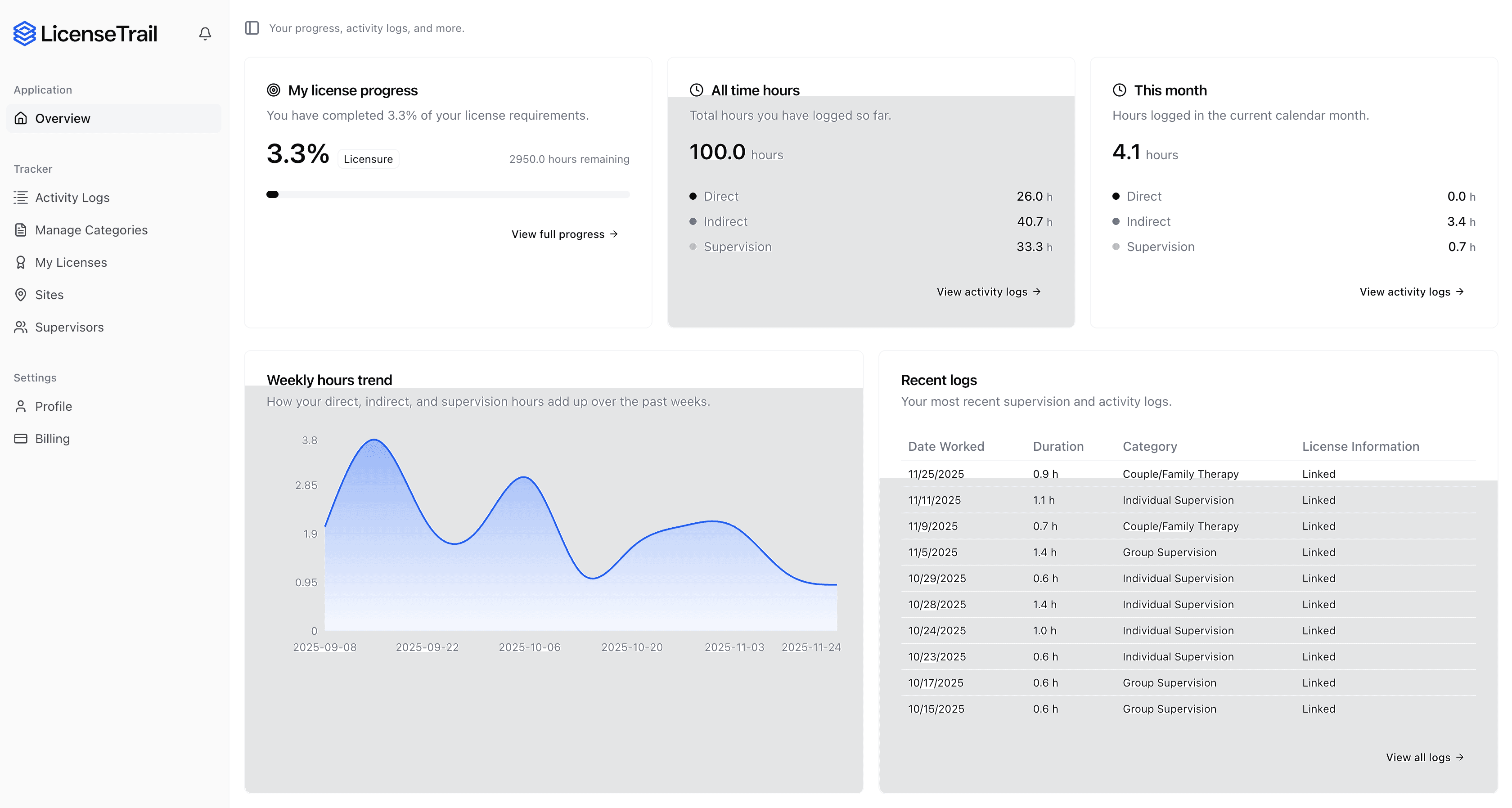
License Trail checks your direct, indirect, and supervision hours against North-dakota LBSW requirements continuously and flags mismatches before you submit.
 Start Tracking for Free
No credit card required · Free plan available
Related Licenses
Is your spreadsheet hiding North-dakota LBSW risks?
Stop guessing if your categories match North Dakota Board of Social Work Examiners requirements. License Trail checks your direct, indirect, and supervision hours continuously and flags mismatches before you submit.
Import or log
Bring your spreadsheet or start fresh
Upload your existing tracking spreadsheet and we'll map every hour into the right North Dakota Board of Social Work Examiners categories automatically.
Verify against North-dakota
Catch mismatches before the board does
License Trail checks your direct, indirect, and supervision hours against North-dakota LBSW requirements continuously.
Export board-ready
One-click clean reports
Generate professional, board-ready reports for supervision meetings and North Dakota Board of Social Work Examiners submissions in seconds.
No credit card required · Free plan available