
North-dakota LMSW Requirements: Hours, Exams & Step-by-Step Guide
Stop guessing if your categories match North-dakota requirements. License Trail checks your direct, indirect, and supervision hours against LMSW requirements continuously and flags mismatches before you submit.
No credit card required · Free plan available
Quick Requirements Overview
- MSW/DSW in social work from a board‑approved program (typically CSWE/CASWE) required.
- Pass the board‑approved exam for LMSW (ASWB Master’s).
- Submit completed application + fees to NDBSWE; transcript must be sent directly by the school.
- Provide 3 professional references (specific mix depends on work history; board may waive/modify).
- Complete state + nationwide criminal history record check (per board instructions).
- No post‑master’s supervised/practice hour requirement for initial LMSW (hours apply to LCSW only).
- Scope: may perform certain clinical functions only under LCSW supervision; no independent clinical private practice.
- Renewal: 30 CE contact hours/2‑year period (≥2 ethics; ≤10 independent learning; first cycle prorated).
License Details
Procedures
Becoming a Licensed Master Social Worker (LMSW) in North Dakota involves meeting statutory requirements in the North Dakota Century Code and procedural requirements in the North Dakota Administrative Code, all administered by the North Dakota Board of Social Work Examiners (NDBSWE). Importantly, North Dakota does not require any set number of post‑master’s practice hours (e.g., 1,500 “direct” hours) for the LMSW license; numeric practice‑hour requirements apply only to the clinical license.
Below is a structured explanation focused on what the law and board rules actually say, including how they use terms like “masters social work,” “supervised post‑master’s clinical social work experience,” and “continuing education contact hours.”
1. License name and role
North Dakota law recognizes three social work licenses:
- Licensed baccalaureate social worker
- Licensed master social worker
- Licensed clinical social worker (law.justia.com)
The licensed master social worker (LMSW) is the license tied to “masters social work” practice. By statute and rule, masters social work includes advanced, non‑clinical social work functions (assessment, treatment planning, case management, administration, etc.), and—under the supervision of a licensed clinical social worker (LCSW)—may also include practices that are otherwise reserved to clinical licensees (e.g., diagnosis and treatment of mental and behavioral disorders). (law.cornell.edu)
An LMSW may not independently engage in the private practice of clinical social work; independent clinical practice requires the clinical license and its associated supervised‑hours requirement.
2. Core legal requirements for LMSW licensure
North Dakota Century Code § 43‑41‑04 lays out general licensure standards for all social work licenses. To obtain any license, an applicant must submit an application and provide evidence that the applicant: (law.justia.com)
- Has attained the age of majority.
- Has passed “the examination approved by the board for the license sought.”
- Agrees to adhere to the board’s code of social work ethics.
- Is of good moral character, with the board explicitly directed to consider adherence to professional values and any reportable background information.
- Has paid all applicable fees set by rule.
For the specific type of license, the statute then adds education requirements:
- For masters social work (the LMSW level), an applicant must
“demonstrate having been awarded a doctorate or master’s degree in social work from a social work program approved by the board.” (law.justia.com)
In practice, this means a master’s or doctoral degree in social work from a CSWE‑accredited (or Canadian CASWE‑approved) program, with no additional coursework or post‑graduate training mandated for the LMSW itself. (waldenu.edu)
3. No post‑degree practice hours required for LMSW
The question of “how many hours” is crucial, and North Dakota is very clear in how it uses that term:
- The statute does not set any numeric practice‑hour requirement for licensure for the practice of masters social work (the LMSW).
- Numeric hour requirements appear only in the portion of the law dealing with clinical social work licensure.
Where the hours do appear in North Dakota law
In the same statute, § 43‑41‑04(3)(c)(2) states that an applicant for licensure for the practice of clinical social work must complete:
- “three thousand hours of supervised post‑master’s clinical social work experience”,
- completed “within a four‑year period,”
- with the initial 1,500 hours under the supervision of a licensed clinical social worker,
- and the remaining hours potentially under other board‑approved qualified mental health professionals if certain hardship conditions are met. (law.justia.com)
This 3,000‑hour supervised experience requirement applies only to the clinical license, not to the LMSW.
Separate professional licensure disclosures that summarize NDBSWE requirements are consistent with this: they list, for the Master Social Worker License, a CSWE‑accredited MSW, no postgraduate training, no postgraduate work experience requirement, and a relevant ASWB exam. (waldenu.edu)
So, to answer the kind of example you gave:
- North Dakota does not require “1,500 hours of direct experience and 1,500 hours of supervised experience” (or any similar breakdown) to become an LMSW.
- Instead, there is no codified post‑degree practice‑hour requirement at all for the Licensed Master Social Worker. Numeric hours in statute are reserved for the clinical license.
4. Application requirements and board procedures
The application process is governed by North Dakota Administrative Code 75.5‑02‑03‑01 (“Application”), which applies to initial licensure (including LMSW). It requires: (regulations.justia.com)
-
Completed, signed application form.
- Requests for application forms must be made with the board’s office, or you can apply through the board’s online system as directed.
-
Official transcript.
- An official transcript showing proof of the required degree must be submitted directly to the board’s office by the academic institution granting the degree.
-
Proof of successful completion of the appropriate examination.
- Proof must be submitted by the examination body (i.e., the Association of Social Work Boards for the Master’s exam approved by NDBSWE for LMSW candidates). (socialworklicensemap.com)
-
Supervised‑practice documentation (for clinical applicants only).
- The rule specifies that “for applicants for licensed clinical social worker” there must be a completed form verifying the MSW degree and “successfully completed supervised practice” plus a verification of social work employment form. This paragraph is explicitly limited to clinical applicants and does not apply to LMSW applicants. (regulations.justia.com)
-
Three written professional references.
The same rule requires at least three references documenting professional conduct and competence, with specific patterns:- New graduates / never worked as a social worker:
- One reference from a social work faculty member,
- One from a field placement supervisor, and
- One from a licensed social worker.
- Applicants who have worked as a social worker:
- Two references from social workers at the applicant’s proposed level of licensure or higher, and
- One from a work supervisor.
- The board may waive or modify reference requirements “in appropriate circumstances.” (regulations.justia.com)
- New graduates / never worked as a social worker:
-
Nationwide criminal history record check.
- The application must include completion of a statewide and nationwide criminal history record check conducted under N.D.C.C. § 12‑60‑24; the board is expressly authorized to require this of applicants and, in some cases, licensees. (law.justia.com)
In practice, secondary sources summarizing NDBSWE procedures add that LMSW applicants typically:
- Pay a $25 application fee,
- Pay a $75 license fee if not upgrading from a lower license,
- Pay the ASWB Master’s exam fee (currently around $230), and
- Complete required background‑check paperwork (fingerprints, child‑abuse registry check) as directed by the board. (socialworkerlicense.com)
5. Examination requirement: “examination approved by the board”
The Century Code frames the testing requirement generically:
- Applicants must have “passed the examination approved by the board for the license sought.” (law.justia.com)
In practice, for LMSW licensure this is the ASWB Master’s‑level examination, which is the exam level North Dakota uses for applicants to the master‑level license. (socialworklicensemap.com)
The process typically works as follows:
- The board reviews your application, references, and transcript.
- If you meet the requirements, the board authorizes you to take the ASWB Master’s exam.
- You register with ASWB, take and pass the exam, and ASWB sends your score directly to NDBSWE.
- Once the board has your passing score and background‑check results, it issues your LMSW license (assuming no disqualifying issues). (socialworkerlicense.com)
6. Scope of “masters social work” practice
Because supervision and clinical scope are often tied to license level, it helps to look at the board’s definition of masters social work in rule. The North Dakota Administrative Code defines “the practice of masters social work” as including, in addition to baccalaureate practice, the application of specialized knowledge and advanced practice skills in: assessment, treatment planning, implementation, intervention, evaluation, case management, information and referral, counseling, supervision, consultation, education, research, advocacy, community organization, and development and administration of policies and programs. (law.cornell.edu)
Crucially, the rule adds that under the supervision of a licensed clinical social worker, the practice of masters social work may include the practices reserved to licensed clinical social workers. (law.cornell.edu)
This is the legal foundation for LMSWs in North Dakota to perform certain clinical functions—but only under LCSW supervision until they meet the 3,000‑hour supervised‑clinical requirement and qualify for the clinical license.
7. Continuing education hours (after you are licensed)
Once you are licensed as an LMSW, North Dakota uses continuing education contact hours as its main “hours” requirement:
- 30 approved continuing education contact hours must be completed in each two‑year licensing period for all social work licensees. (elevatece.com)
- Of these:
- At least 2 hours must be in social work ethics.
- No more than 10 hours may be completed through independent learning (such as asynchronous online study with no live interaction).
- For newly licensed social workers, the requirement is prorated in the first cycle (e.g., 15 hours if licensed in the first half of the odd‑numbered year; no hours if licensed on or after July 1 of the odd‑numbered year). (msweducation.org)
These are continuing education hours, not supervised practice or employment hours. They do not function like “1,500 direct client hours” or similar requirements in some other states.
8. Step‑by‑step summary for becoming an LMSW in North Dakota
Putting the statutory and regulatory pieces together, the path looks like this:
-
Complete an approved MSW (or DSW) program.
- Must be a social work program “approved by the board,” which effectively means CSWE‑accredited (or Canadian CASWE‑approved). (law.justia.com)
-
Prepare and submit an application to the NDBSWE.
- Use the board’s application form.
- Arrange for your school to send an official transcript directly to the board.
- Obtain and submit the required three professional references as specified for new graduates or experienced social workers. (regulations.justia.com)
-
Complete required background checks.
- Follow the board’s instructions for fingerprinting and criminal‑history record checks under N.D.C.C. § 12‑60‑24. (law.justia.com)
-
Take and pass the ASWB Master’s‑level exam.
- The board must approve you to sit for the exam.
- ASWB sends your results directly to NDBSWE as proof that you have passed the examination approved for the LMSW license. (law.justia.com)
-
Pay licensing fees and receive your LMSW license.
- After all requirements are met (degree, exam, references, background check, fees), the Board issues the Licensed Master Social Worker license, authorizing you to practice masters social work in North Dakota (including some clinical activities under LCSW supervision). (law.justia.com)
-
Maintain your license with continuing education.
- Complete 30 hours of approved CE every two years, including at least 2 hours in ethics and no more than 10 hours of independent learning, with first‑cycle prorating as applicable. (elevatece.com)
Key point on “hours” for the LMSW in North Dakota
For the Licensed Master Social Worker in North Dakota:
- Post‑degree practice hours required for initial LMSW license:
- None specified in statute or rule.
- Supervised hours (3,000 total, first 1,500 under an LCSW):
- Required only if you later seek the licensed clinical social worker credential. (law.justia.com)
- Hour‑based obligations for LMSWs:
- Examination: no set number of prep hours; only that you pass the exam approved by the board.
- Continuing education: 30 continuing education contact hours every two‑year period after licensure.
That distinction—no hour requirement for initial LMSW licensure, but a substantial hour requirement for later clinical licensure—is the essential feature of North Dakota’s system as defined by the Board of Social Work Examiners and the state statutes and rules that govern it.
Track your LMSW hours with confidence
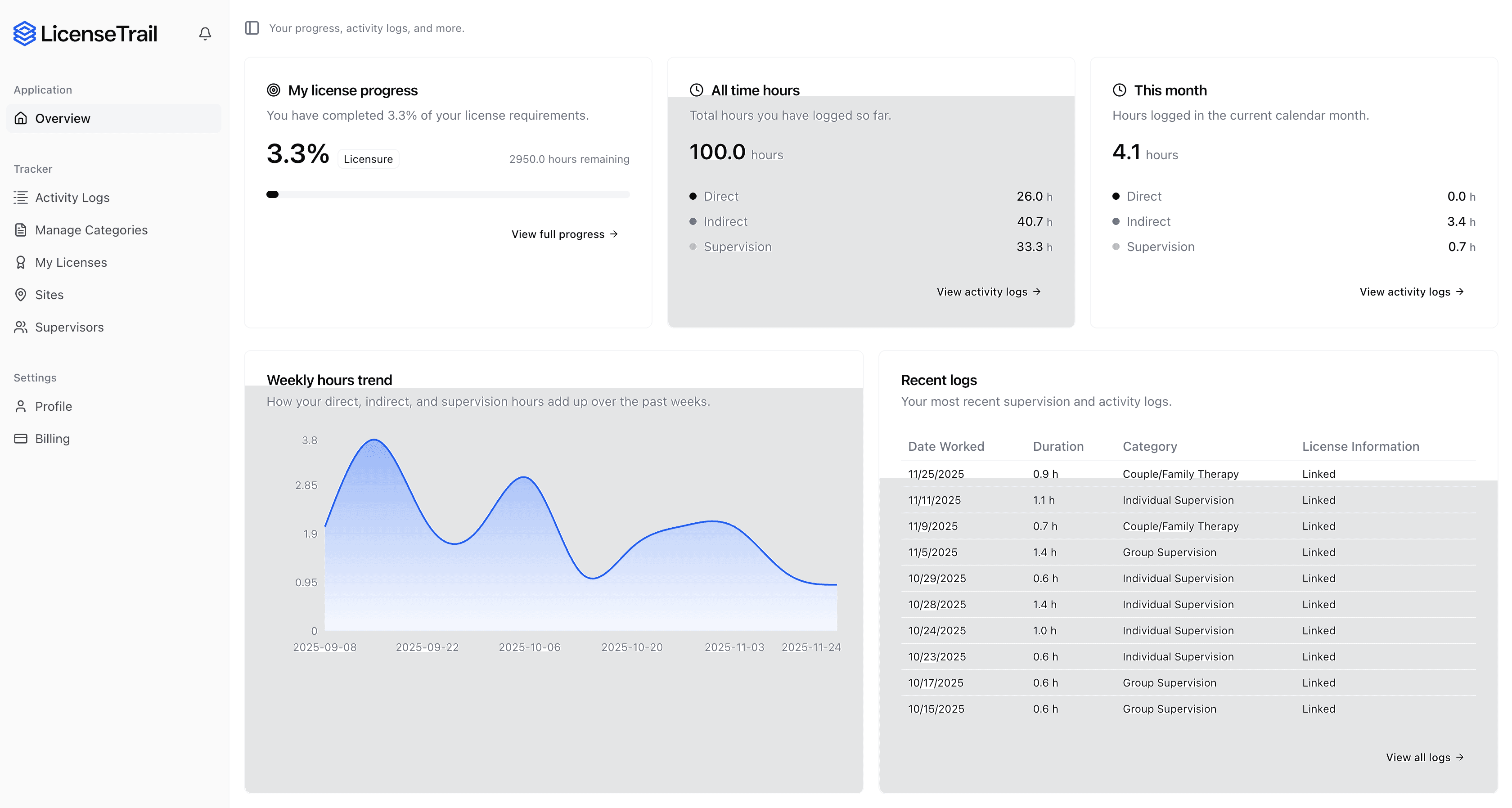
License Trail checks your direct, indirect, and supervision hours against North-dakota LMSW requirements continuously and flags mismatches before you submit.
 Start Tracking for Free
No credit card required · Free plan available
Related Licenses
Is your spreadsheet hiding North-dakota LMSW risks?
Stop guessing if your categories match North Dakota Board of Social Work Examiners requirements. License Trail checks your direct, indirect, and supervision hours continuously and flags mismatches before you submit.
Import or log
Bring your spreadsheet or start fresh
Upload your existing tracking spreadsheet and we'll map every hour into the right North Dakota Board of Social Work Examiners categories automatically.
Verify against North-dakota
Catch mismatches before the board does
License Trail checks your direct, indirect, and supervision hours against North-dakota LMSW requirements continuously.
Export board-ready
One-click clean reports
Generate professional, board-ready reports for supervision meetings and North Dakota Board of Social Work Examiners submissions in seconds.
No credit card required · Free plan available