
North-dakota LPCC Requirements: Hours, Exams & Step-by-Step Guide
Stop guessing if your categories match North-dakota requirements. License Trail checks your direct, indirect, and supervision hours against LPCC requirements continuously and flags mismatches before you submit.
No credit card required · Free plan available
Quick Requirements Overview
- Must already hold North Dakota LPC (LPCC is advanced/non–entry level)
- Master’s in counseling (accredited/board-approved) with 60 graduate semester credits
- Coursework within the 60 credits: ≥1 credit in diagnostic evaluation/psychopathology classification and ≥1 credit in clinical counseling skills
- Graduate training: 700 hours of supervised practicum/internship in counseling-relevant settings
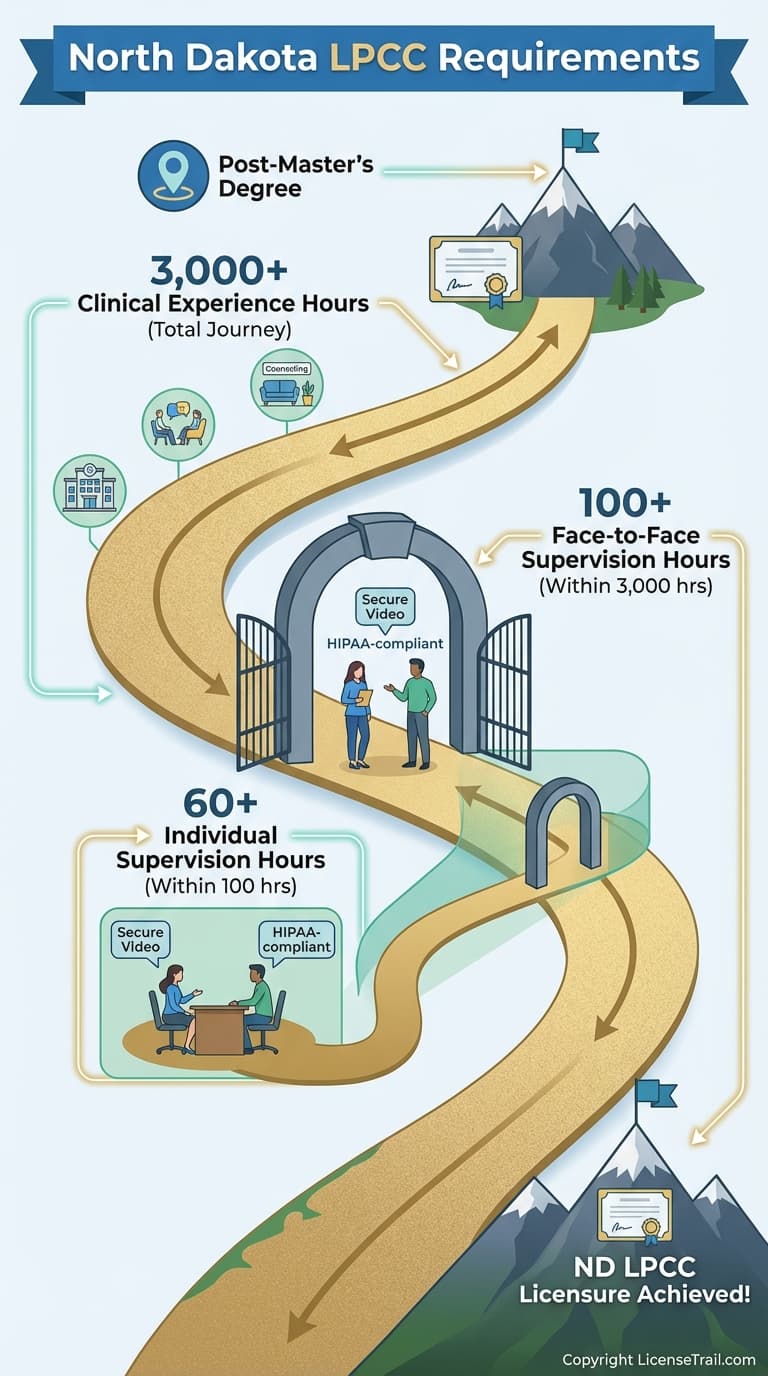
- Post-master’s: 3,000 hours of clinical experience in a clinical setting over ≥2 years
- Supervision within the 3,000 hours: 100 hours face-to-face, with ≥60 individual (up to 40 group); video allowed if secure/HIPAA-compliant; supervisor must be board-certified/authorized
- Submit 3 professional references (including one from post-master’s supervisor) + board supervisor evaluation attesting clinical competence
- Pass NBCC Clinical Mental Health Counseling Exam (NCMHCE)
License Details
Procedures
In North Dakota, the Licensed Professional Clinical Counselor (LPCC) is the advanced counseling license, allowing the full clinical scope of practice under the North Dakota Board of Counselor Examiners. The requirements are set out primarily in North Dakota Administrative Code (NDAC) 97‑02‑01.1‑01.
Below is a step‑by‑step breakdown, with the specific hour requirements and the state’s own terminology.
1. Start from LPC status
The LPCC is not an entry‑level license. The regulation begins by stating that an LPCC applicant must already be:
“a licensed professional counselor under North Dakota Century Code chapter 43‑47” (law.cornell.edu)
So the path is:
- Complete a qualifying counseling master’s degree.
- Obtain supervised experience and become a Licensed Professional Counselor (LPC).
- Then meet additional clinical requirements to become an LPCC.
The LPCC requirements described below are in addition to holding an LPC.
2. Educational requirements for LPCC
Graduate degree and total credits
An LPCC applicant must:
- Have at least a master’s degree from an accredited school or college in counseling that meets the board’s academic and training standards. (law.cornell.edu)
- Have 60 graduate semester hours in counseling. (law.cornell.edu)
Required clinical coursework
Within those 60 semester hours, NDAC requires at least one semester credit in each of two specific areas: (law.cornell.edu)
- “Current classification methods in the diagnostic evaluation of psychopathology”
- “Clinical counseling skills”
If your degree did not clearly include these, you may need additional graduate coursework to qualify.
3. Pre‑degree clinical training: 700 hours
The rule requires substantial practice-based training as part of your graduate program. It specifies: (law.cornell.edu)
- 700 hours of supervised practica and internships
- These must be “in settings relevant to the practice of counseling.”
- The 700 hours may be embedded within the 60 required graduate credits.
Functionally, this means your master’s program must include a practicum/internship sequence totaling at least 700 supervised clinical training hours.
Type of hours at this stage
The code does not subdivide the 700 hours into “direct” vs “indirect” services. It simply requires:
- Supervised practica and internships
- In counseling‑relevant settings
- Under appropriate supervision
Individual programs may further define how many of those hours must be direct client contact, but that detail comes from the school rather than the board rule.
4. Post‑master’s clinical experience: 3,000 hours
After the master’s degree, the LPCC rule requires: (law.cornell.edu)
“Two years (three thousand hours) of post‑master’s clinical experience in a clinical setting.”
This is the core LPCC experience requirement. Breaking it down:
-
Total post‑master’s hours:
- 3,000 hours of clinical experience
- Completed over at least two years
- In a clinical setting (e.g., mental health clinic, hospital, counseling center, etc.)
-
Nature of these hours:
- The rule calls them “clinical experience in a clinical setting” and “clinical counseling experience” in related sources. (law.cornell.edu)
- It does not specify an exact minimum of “direct client contact” hours vs “indirect” (documentation, case consultation, etc.) within the 3,000.
- The one explicit subdivision within these 3,000 hours is supervision (see next section).
You should plan for the 3,000 hours to consist primarily of direct clinical counseling services and closely related clinical activities, because the board expects “clinical” work consistent with the LPCC scope of practice.
5. Supervision requirements within the 3,000 hours
Within the 3,000 post‑master’s hours, NDAC requires a defined amount and type of supervision:
-
Total supervision:
- At least 100 hours of face‑to‑face supervision. (law.cornell.edu)
-
Individual vs group supervision:
- At least 60 of those 100 hours must be individual (one‑to‑one) supervision. (law.cornell.edu)
- Up to 40 hours may be group supervision, as long as it meets the board’s conditions.
-
Who can supervise you:
- Supervision must be provided by a certified supervisor under NDAC 97‑02‑01‑08 or a supervisor otherwise authorized in the statute. (law.cornell.edu)
- A certified supervisor must:
- Be an LPC or LPCC,
- Have five years of experience as a licensed counselor, and
- (for applications after July 1, 2016) have 30 hours of continuing education in supervision in the preceding five years. (regulations.justia.com)
-
What counts as “face‑to‑face” supervision:
- The rule states that “face to face includes electronic video communications that are secure and Health Insurance Portability and Accountability Act compliant on a secure server.” (law.cornell.edu)
Summary of post‑master’s hours for LPCC
From the board’s rule and consistent secondary sources:
- 3,000 hours post‑master’s clinical experience,
- Including 100 hours of face‑to‑face supervision, of which
- ≥ 60 hours must be individual supervision
- Up to 40 hours may be group supervision. (law.cornell.edu)
The remaining ~2,900 hours are general clinical counseling experience in a clinical setting; the code does not further divide these into “direct” vs “indirect” mandates.
6. Professional references and supervisor evaluation
To document your clinical competency, NDAC requires both references and a supervisor evaluation:
-
Three professional letters of reference (law.cornell.edu)
- One must be from your post‑master’s clinical supervisor.
- The other two must be from professionals familiar with your clinical experience.
-
Supervisor evaluation form (law.cornell.edu)
- You must submit a board‑approved form, completed by your clinical experience supervisor.
- The supervisor must attest that you have successfully demonstrated clinical counseling skills consistent with the LPCC scope of practice.
- The form and evaluation areas are set and approved by the board.
7. Examination requirement
NDAC specifies that an LPCC applicant must:
- Pass “the clinical mental health counseling examination as offered by the National Board for Certified Counselors.” (law.cornell.edu)
In practice, this is the NCMHCE (National Clinical Mental Health Counseling Examination).
This exam is in addition to the National Counselor Examination (NCE) that is typically used earlier in the LAPC/LPC process.
8. Putting the hours together (LPCC only)
If we focus strictly on what the North Dakota Board requires for the LPCC credential itself (beyond already being an LPC), the clinically relevant hour requirements are:
-
During the graduate program
- 700 hours of supervised practica and internships
- In counseling‑relevant settings
- Supervised by qualified practitioners
- May be taken within the 60 semester credits of the counseling degree. (law.cornell.edu)
- 700 hours of supervised practica and internships
-
After the master’s degree (post‑master’s)
- 3,000 hours of post‑master’s clinical experience in a clinical setting, over at least two years.
- Within those 3,000 hours:
- 100 hours must be face‑to‑face supervision, including
- ≥ 60 hours of individual supervision,
- Up to 40 hours of group supervision. (law.cornell.edu)
- 100 hours must be face‑to‑face supervision, including
The board’s regulation does not state, for example, “1,500 hours must be direct client contact and 1,500 hours may be indirect.” Instead, it uses the broader phrases “clinical experience” and “clinical counseling experience in a clinical setting”, and only carves out a minimum supervision component (100 hours) within the 3,000.
9. Additional practical points
Although not strictly “hours” requirements, two additional LPCC‑specific elements from board‑aligned sources are worth noting:
-
Videotaped clinical session:
The LPCC process in North Dakota includes submitting a videotaped clinical counseling session of at least 30 minutes for board review of your clinical skills. (counselor-education.com) -
Continuing education after licensure:
Once licensed as an LPCC, you must renew every two years and document continuing education, including a clinical practice component (often summarized as 30 CE hours plus 10 hours specifically in clinical professional development, per recent descriptions). (counselingschools.com)
10. Clarifying what the board does not spell out
Because your example mentioned something like “1,500 hours of direct experience and 1,500 hours of supervised experience,” it is important to emphasize:
- North Dakota’s LPCC rule does not split the 3,000 post‑master’s hours into separate minimums of “direct client contact” vs “indirect” work.
- It only clearly requires:
- That the 3,000 hours be clinical and in a clinical setting, and
- That 100 of those hours be structured face‑to‑face supervision (with at least 60 individual). (law.cornell.edu)
If you need to know exactly how your job duties will be counted (e.g., how much documentation time can be included), the safest approach is to clear your plan with a board‑certified supervisor and, if necessary, directly with the North Dakota Board of Counselor Examiners, referencing NDAC 97‑02‑01.1‑01.
Track your LPCC hours with confidence
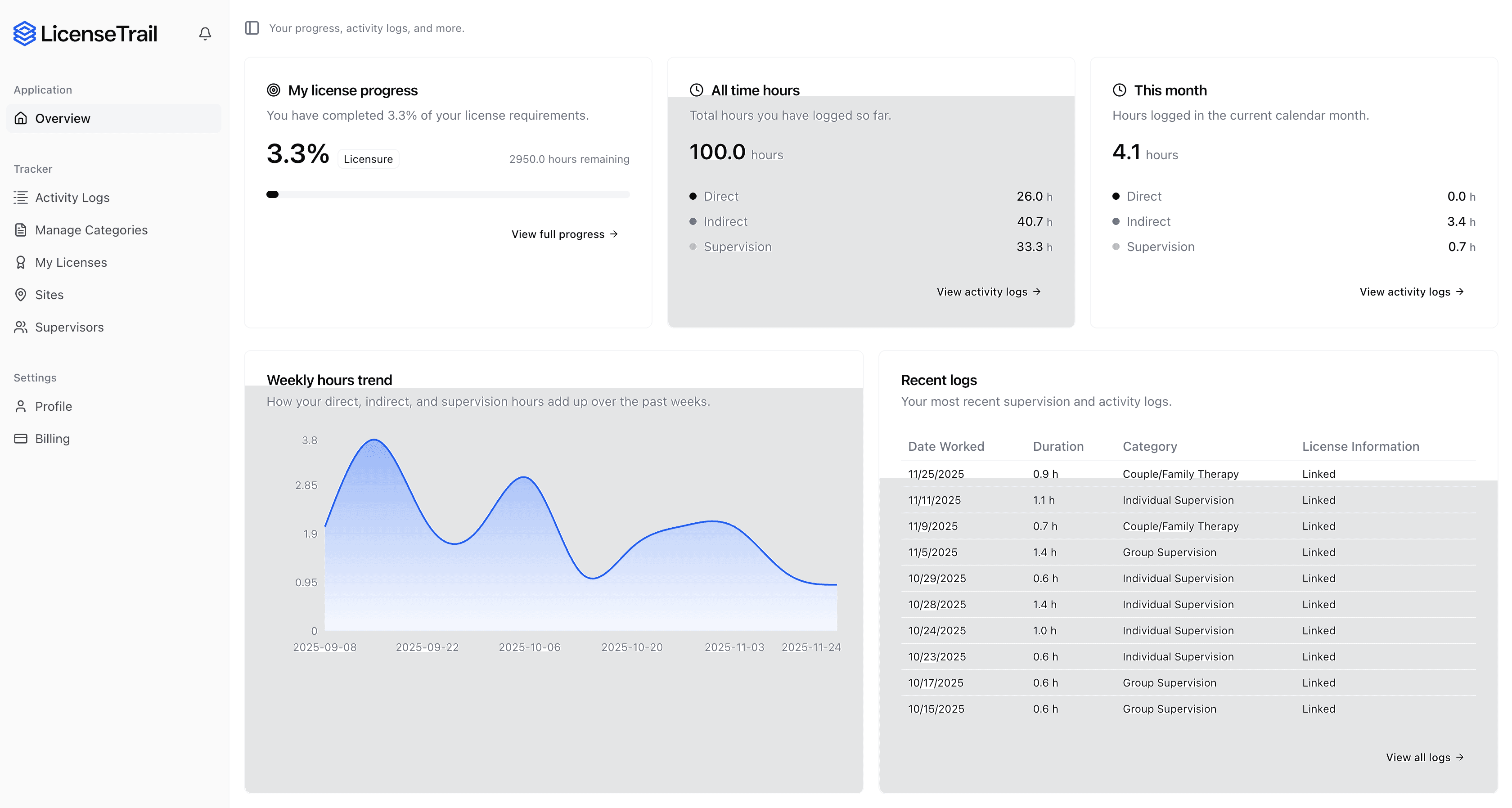
License Trail checks your direct, indirect, and supervision hours against North-dakota LPCC requirements continuously and flags mismatches before you submit.
 Start Tracking for Free
No credit card required · Free plan available
Related Licenses
Is your spreadsheet hiding North-dakota LPCC risks?
Stop guessing if your categories match North Dakota Board of Counselor Examiners requirements. License Trail checks your direct, indirect, and supervision hours continuously and flags mismatches before you submit.
Import or log
Bring your spreadsheet or start fresh
Upload your existing tracking spreadsheet and we'll map every hour into the right North Dakota Board of Counselor Examiners categories automatically.
Verify against North-dakota
Catch mismatches before the board does
License Trail checks your direct, indirect, and supervision hours against North-dakota LPCC requirements continuously.
Export board-ready
One-click clean reports
Generate professional, board-ready reports for supervision meetings and North Dakota Board of Counselor Examiners submissions in seconds.
No credit card required · Free plan available