
North-dakota LPC Requirements: Hours, Exams & Step-by-Step Guide
Stop guessing if your categories match North-dakota requirements. License Trail checks your direct, indirect, and supervision hours against LPC requirements continuously and flags mismatches before you submit.
No credit card required · Free plan available
Quick Requirements Overview
- Degree: Master’s in counseling/closely related from accredited school; 60 semester credits / 90 quarter credits (incl. ethics/orientation ≥3 semester / 5 quarter credits)
- Pre-degree clinical training: Practicum 100 hrs + Internship 600 hrs (total 700 hrs)
- Exam: Pass NCE (NBCC)
- Pathway: Obtain LAPC first, then upgrade to LPC
- Post-master’s experience: Minimum 2 years supervised counseling experience
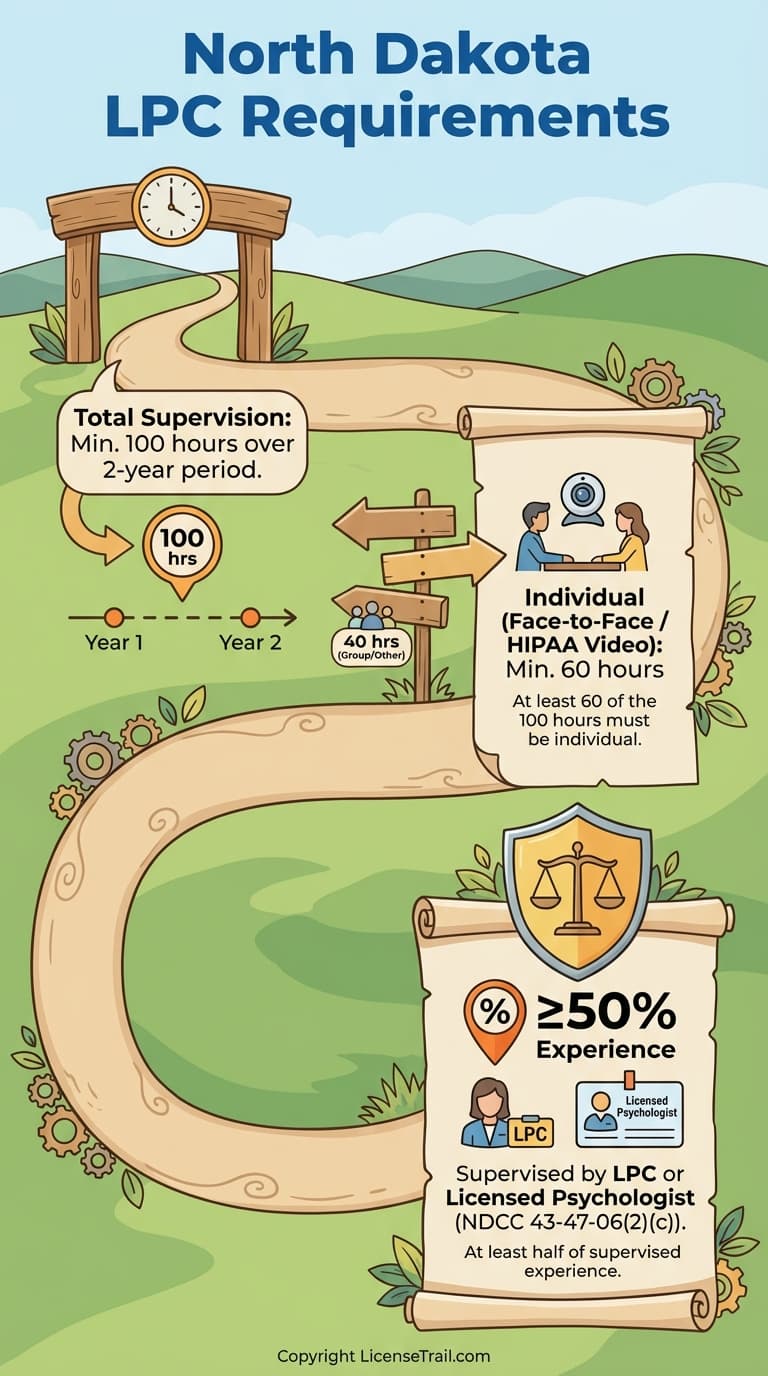
- Supervision hours (over 2 years): 100 total supervision hrs; ≥60 individual face-to-face (HIPAA-secure video allowed); remainder may be group/case conference; regular intervals; no supervised practice in a setting you own
- LPC application docs: transcript + 3 professional recommendations + supervised-experience certification + statement of intent + NCE proof; $150 fee
- Renewal/CE: Renew biennially; 30 CE hrs/2 years incl. ≥3 ethics (late fee $100)
License Details
Procedures
Licensure as a Licensed Professional Counselor (LPC) in North Dakota is governed by the North Dakota Board of Counselor Examiners under Chapter 43‑47 of the North Dakota Century Code and Title 97‑02 of the North Dakota Administrative Code. What follows walks through the exact pathway and the specific hour requirements as the Board defines them.
1. Overall structure of licensure in North Dakota
North Dakota uses a two‑step model:
- Licensed Associate Professional Counselor (LAPC) – your status while you complete your supervised post‑master’s experience.
- Licensed Professional Counselor (LPC) – the full professional license you obtain after meeting supervised‑experience and other requirements. (codes.findlaw.com)
A separate, higher license, Licensed Professional Clinical Counselor (LPCC), has its own additional clinical hour requirements (including a 3,000‑hour post‑master’s clinical requirement). Those LPCC numbers do not apply to basic LPC licensure. (law.cornell.edu)
2. Educational requirements for LPC (what your master’s must include)
The Board requires a counselor‑specific master’s that meets its “Academic programs” rule in N.D. Admin. Code 97‑02‑01‑02: (ndlegis.gov)
- A master’s degree in counseling (or a closely related counseling program) from an accredited school.
- At least 60 semester credits (or 90 quarter credits) “relating to counseling,” with coursework in:
- Counseling theories
- Counseling methods
- Group counseling
- Individual appraisal, assessment, or testing
- Counseling‑related research methods (must include statistics applied to counseling)
- Human growth and development
- Multicultural counseling
- Career and lifestyle development
- Professional orientation and ethics (at least 3 semester or 5 quarter credits; must include content on the counseling profession and the ACA Code of Ethics) (ndlegis.gov)
Required practicum and internship hours (pre‑degree clinical training)
Within those 60 credits, the Board requires:
- Counseling practicum: 100 hours of training in supervised practica “in settings relevant to the practice of counseling.”
- Counseling internship: 600 hours of training in supervised internship settings relevant to the practice of counseling. (ndlegis.gov)
Together, the master’s program must therefore include 700 hours of supervised practicum/internship experience, integrated into the graduate curriculum.
These are pre‑licensure clinical training hours, separate from the post‑master’s supervised experience you complete as an LAPC on your way to LPC.
3. Required examination
Both the LAPC and LPC levels require passing the National Counselor Examination (NCE) administered under the National Board for Certified Counselors (NBCC). The LPC rule requires “successful completion of the national counselor examination as distributed and administered under the auspices of the national board of certified counselors.” (ndlegis.gov)
In practice:
- You typically pass the NCE near the end of your master’s program or shortly afterward.
- Proof of passing the NCE is submitted with your LAPC application and later is referenced in your LPC file.
4. Step One: Licensed Associate Professional Counselor (LAPC)
You do not go straight to LPC after graduation. North Dakota expects you to practice under supervision as a LAPC first. The requirements to become an LAPC are set in N.D. Admin. Code 97‑02‑01‑03: (ndlegis.gov)
4.1. Minimum for LAPC application
To obtain the LAPC license, you must submit to the Board:
-
Proof of qualifying master’s degree
- A copy of your master’s degree from an accredited school or college that meets the academic standards of 97‑02‑01‑02 (the 60‑credit, practicum/internship‑based degree described above). (ndlegis.gov)
-
Three academic recommendations
- One from your practicum agency contact person.
- One from your master’s program advisor.
- One from an additional counselor educator. (ndlegis.gov)
-
A written plan for supervised experience
- Must include:
- Estimated client contact hours per week.
- How supervision will be provided (frequency, format, supervisor).
- The Board requires that “individual, face‑to‑face meetings… occur at regular intervals over the two‑year period.” (ndlegis.gov)
- Must include:
-
Proof of passing the NCE. (ndlegis.gov)
4.2. Supervision while you are an LAPC: specific hour requirements
During your time as an LAPC, you complete supervised practice according to your supervision plan. The Board sets explicit supervision‑hour requirements in 97‑02‑01‑03: (ndlegis.gov)
- Over a standard two‑year period of supervision, you must document:
- Total supervision hours:
- “A total of one hundred hours over the two‑year period of supervision through individual and group methods must be documented.” (20 words quoted) (ndlegis.gov)
- Individual vs. group supervision:
- At least 60 of those 100 hours must be individual, face‑to‑face supervision; the remainder may be in group formats such as case conferences.
- Frequency and format:
- Supervision must occur at regular intervals, in individual face‑to‑face meetings, with group supervision allowed in addition.
- Modality:
- “Face to face” explicitly includes secure, HIPAA‑compliant video communications.
- Practice ownership restriction:
- The supervised experience may not take place in a practice in which you hold an ownership interest.
- Total supervision hours:
The Board’s rules do not specify an exact number of client‑contact hours for the LAPC period in the administrative code itself, only that your plan must estimate client‑contact hours per week and that you must be under the required pattern of supervision. (ndlegis.gov)
Some secondary sources and supervisors commonly expect around 400 client‑contact hours per year during this two‑year LAPC period (≈800 hours total), but that number comes from guidance and practice patterns, not from the Board’s text of 97‑02‑01‑03. (careersinpsychology.org)
5. Step Two: Post‑master’s supervised experience for LPC
Once you are licensed as an LAPC and begin working under supervision, you are building the supervised experience that will qualify you for the LPC.
5.1. Required length and type of supervised experience
For LPC licensure, N.D. Admin. Code 97‑02‑01‑01 requires: (ndlegis.gov)
- “A minimum of two years of supervised experience” in counseling.
- This experience must be under:
- A Licensed Professional Counselor (LPC) or
- A Licensed Professional Clinical Counselor (LPCC) who is certified as a supervisor under 97‑02‑01‑08, or
- Another supervisor approved under the supervision provisions of N.D.C.C. 43‑47‑06(2)(c) (e.g., certain other licensed mental health professionals when LPC/LPCC supervisors are not available). (ndlegis.gov)
The Century Code adds that the two years of supervised experience must be arranged so that at least 50% of the supervised experience is under a licensed professional counselor or licensed psychologist, and the remainder may be under other board‑designated qualified professionals when hardship conditions exist. (law.justia.com)
5.2. Supervision hours for LPC (post‑master, same 100‑hour structure)
The LPC rule uses the same core supervision‑hour structure as the LAPC rule. For the two‑year supervised experience required for LPC, the Board again requires: (ndlegis.gov)
- Supervision that:
- Includes individual, face‑to‑face meetings at regular intervals over the two years.
- May also include group supervision, such as case conferences.
- A documented total of 100 hours of supervision over the two‑year period, using individual and group methods.
- At least 60 of the 100 hours must be individual, face‑to‑face supervision; the remaining hours may be in approved group formats.
- “Face to face” again explicitly includes secure, HIPAA‑compliant video sessions between supervisor and supervisee.
Important: Neither the Administrative Code nor the Century Code spells out a specific numeric requirement (e.g., “1,500 hours”) of direct client‑contact or total work hours for LPC. Instead, the law focuses on:
- The time frame (a minimum of two years),
- The pattern and amount of supervision (100 total hours, ≥60 individual face‑to‑face), and
- The qualifications of the supervisor and nature of the supervised setting. (ndlegis.gov)
Secondary sites sometimes describe the LPC path using approximated hour counts (e.g., 3,000 hours total or 1,500 face‑to‑face hours), but those figures reflect interpretations or are actually drawn from the LPCC rule, which explicitly requires 3,000 hours of post‑master’s clinical experience for the clinical license, not for the basic LPC. (law.cornell.edu)
6. Application to become a Licensed Professional Counselor (LPC)
After completing:
- The required master’s degree (with 60 credits and 700 hours of practicum/internship),
- The NCE, and
- At least two years of supervised experience that meet the Board’s supervision requirements,
you can apply to the Board for LPC licensure under N.D. Admin. Code 97‑02‑01‑01. (ndlegis.gov)
6.1. Documentation required for LPC
Your LPC application must provide, at minimum:
-
Graduate transcript
- A copy of your master’s degree transcript from an accredited school or college that meets 97‑02‑01‑02 (the Board’s academic‑program rule). (ndlegis.gov)
-
Three professional recommendations
- One from the counselor educator who directly supervised your counseling practicum or internship.
- One from an employer who supervised your work since receiving the master’s degree.
- One from the professional who provided direct supervision of your counseling experience (i.e., your clinical supervisor during your supervised practice). (ndlegis.gov)
-
Certification of supervised experience
- A formal statement (often a Board form) certifying you have:
- Completed a minimum of two years of supervised experience under appropriately qualified supervision.
- Received supervision in the pattern required (100 total hours over two years; at least 60 individual face‑to‑face; group supervision allowed for the rest).
- Practiced in settings where you do not hold an ownership interest. (ndlegis.gov)
- A formal statement (often a Board form) certifying you have:
-
Statement of professional intent
- The rules require a “statement of intent to practice, describing proposed use of the license, the intended client population, and the counseling procedures” you intend to use. (ndlegis.gov)
-
Proof of passing the NCE
- Evidence of “successful completion of the national counselor examination” administered under NBCC. (ndlegis.gov)
-
Fees
- Application fee for LPC: $150.
- If transcript review by NBCC is required (to verify whether your coursework meets 97‑02‑01‑02), you must also pay NBCC’s review fee. (ndlegis.gov)
Once the Board verifies that all statutory and rule‑based requirements are met (education, exam, supervised experience, recommendations, and intent statement) and that no grounds for denial exist under N.D.C.C. 43‑47‑07, it may grant the Licensed Professional Counselor license. (ndlegis.gov)
7. After licensure: renewal and continuing education
7.1. License renewal cycle
- LPC licenses expire every two years after being granted or last renewed. (ndlegis.gov)
- At least two months before expiration, the Board notifies you of renewal requirements at your last reported address.
- To renew, you must:
- Submit the Board’s renewal application form.
- Pay the renewal fee (currently $150 for LPC).
- Demonstrate completion of the required continuing education.
- Have no disqualifying disciplinary grounds. (ndlegis.gov)
If you submit the renewal less than 30 days before expiration, a $100 late fee applies; if you fail to renew within one year of expiration, you must re‑apply and meet full licensure requirements again. (ndlegis.gov)
7.2. Continuing professional education
The Board’s continuing‑education rule, N.D. Admin. Code 97‑02‑01‑06, sets the following for LPCs: (ndlegis.gov)
- 30 hours of continuing education every two years prior to license expiration.
- At least 3 of those hours must primarily focus on counselor ethics.
- A “continued professional education hour” is defined as 50 minutes.
- Qualifying activities include:
- Professional meetings and conferences.
- Workshops.
- Graduate courses in counseling or other mental health fields.
8. Summary of key hour‑based requirements from the Board’s own rules
Putting the Board’s own language and numbers together, the pathway to LPC in North Dakota centers on these specific, Board‑defined hours:
-
During the master’s program (pre‑degree)
- 100 hours counseling practicum.
- 600 hours counseling internship.
- Both must be in supervised settings “relevant to the practice of counseling.” (ndlegis.gov)
-
During LAPC / post‑master supervised practice (on the way to LPC)
- At least two years of supervised experience in counseling. (ndlegis.gov)
- Supervision pattern during those two years:
- 100 total hours of supervision documented.
- At least 60 hours must be individual, face‑to‑face supervision (which may be via secure, HIPAA‑compliant video).
- Remaining supervision hours may be in group or case‑conference formats.
- Supervision must occur at regular intervals.
- Supervised practice cannot be in a setting where you hold an ownership interest. (ndlegis.gov)
-
For LPC license maintenance
- 30 hours of continuing education every two years, with at least 3 hours in ethics. (ndlegis.gov)
Notably, for the basic LPC license, North Dakota’s statutes and administrative rules do not set a specific numerical requirement for total post‑master direct client‑contact hours (such as “1,500 hours of direct experience”). Instead, the law relies on:
- The two‑year supervised‑experience requirement,
- The 100/60 supervision‑hour structure, and
- The accredited, 60‑credit master’s program with 700 documented practicum/internship hours.
Track your LPC hours with confidence
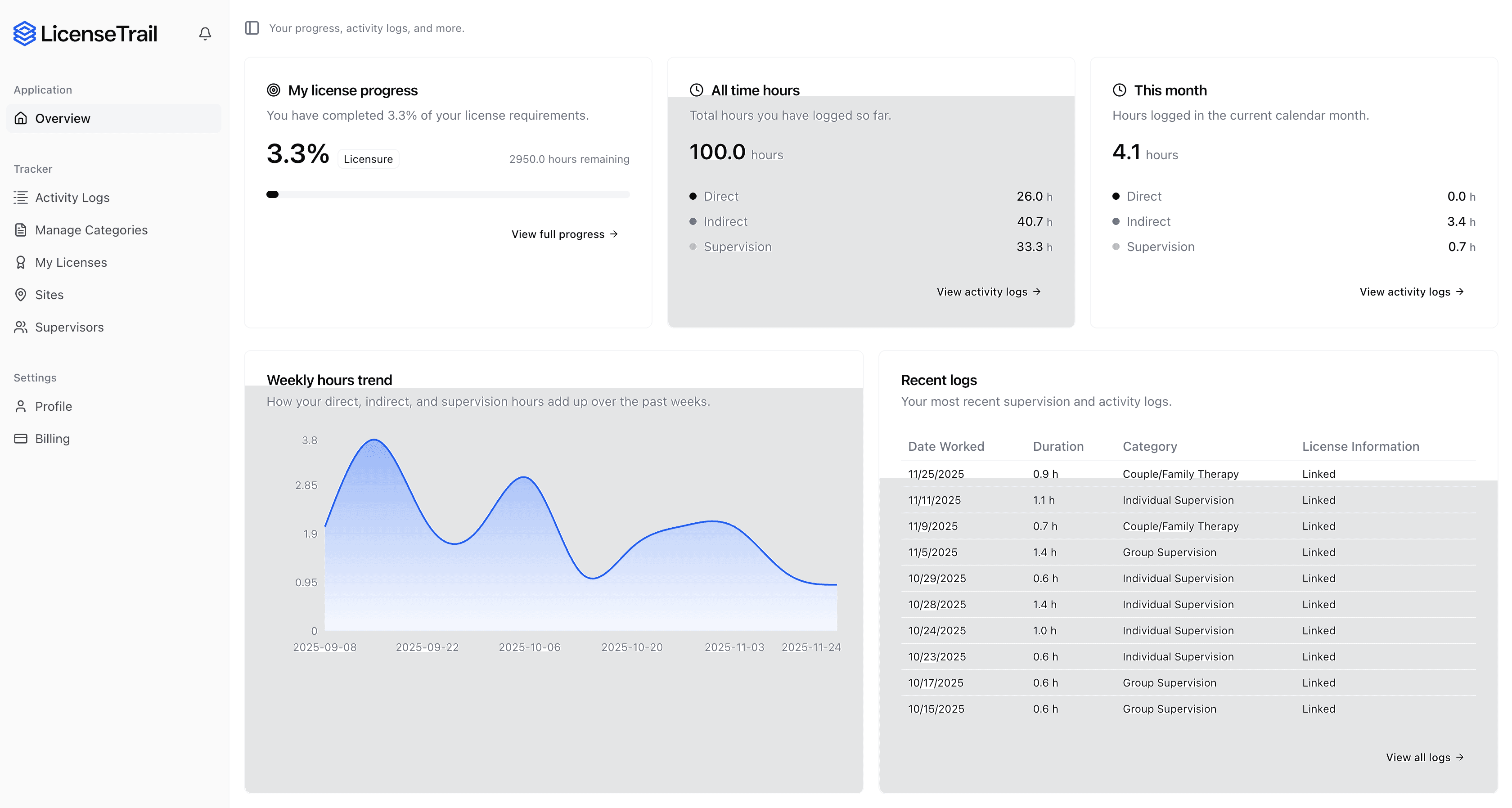
License Trail checks your direct, indirect, and supervision hours against North-dakota LPC requirements continuously and flags mismatches before you submit.
 Start Tracking for Free
No credit card required · Free plan available
Related Licenses
Is your spreadsheet hiding North-dakota LPC risks?
Stop guessing if your categories match North Dakota Board of Counselor Examiners requirements. License Trail checks your direct, indirect, and supervision hours continuously and flags mismatches before you submit.
Import or log
Bring your spreadsheet or start fresh
Upload your existing tracking spreadsheet and we'll map every hour into the right North Dakota Board of Counselor Examiners categories automatically.
Verify against North-dakota
Catch mismatches before the board does
License Trail checks your direct, indirect, and supervision hours against North-dakota LPC requirements continuously.
Export board-ready
One-click clean reports
Generate professional, board-ready reports for supervision meetings and North Dakota Board of Counselor Examiners submissions in seconds.
No credit card required · Free plan available