
North-dakota Limited License Certificate Requirements: Hours, Exams & Step-by-Step Guide
Stop guessing if your categories match North-dakota requirements. License Trail checks your direct, indirect, and supervision hours against Limited License Certificate requirements continuously and flags mismatches before you submit.
No credit card required · Free plan available
Quick Requirements Overview
- Limited practice authorization (not a “limited license”): for psychologists/I‑O psychologists licensed and in good standing in another jurisdiction; requires prior written Board approval.
- Time limit: may practice in ND no more than 30 full or partial days per calendar year under this authorization.
- Limited-practice application must include: license verification, description of services, when services will be provided, and $25 fee.
- Not a path for new grads / no new hour pathway: doesn’t create a separate licensure tier; relies on being already licensed elsewhere.
- Full ND psychologist licensure supervised experience: 3,000 hours total = 1,500-hour predoctoral internship + 1,500 additional hours (postdoc or qualifying additional predoctoral).
- Supervision minimums (internship and the additional 1,500 hours): ≥100 supervision hours, with ≥50 hours one-to-one; APA/CPA-accredited programs accepted.
- I‑O psychologist full licensure supervised experience: 3,000 hours, with ≥1,500 hours postdoctoral and an individualized, Board-approved supervision plan.
License Details
Procedures
North Dakota’s “limited license” for psychologists is technically a limited practice authorization, not a pathway for new graduates. It is a short‑term privilege for psychologists who are already licensed in another jurisdiction and want to practice briefly in North Dakota under the authority of the North Dakota State Board of Psychologist Examiners.
At the same time, the Board’s rules spell out detailed supervised‑experience hour requirements for anyone seeking full North Dakota licensure. Those supervised‑experience rules are what give you the “1,500 + 1,500 hours” structure you referenced.
Below is an organized explanation of both:
1. What North Dakota means by “Limited License / Limited Practice”
In Board rules, this is called “limited practice without a license.” Under North Dakota Administrative Code (N.D. Admin. Code) 66‑02‑01‑16, the Board allows certain out‑of‑state psychologists to practice in North Dakota without first obtaining a full ND license, provided they obtain prior written approval.
The rule states that:
- A psychologist or industrial‑organizational psychologist who is licensed in good standing in another jurisdiction may practice in North Dakota “for no more than thirty full or partial days per calendar year” if the Board has approved a prior written application. (law.cornell.edu)
- The application must include:
- Verification from the other jurisdiction’s licensing authority that the applicant is licensed and in good standing.
- A description of the nature of the services to be provided.
- An explanation of when the services are to be provided.
- A fee of $25. (law.cornell.edu)
This is what many secondary sources refer to as a “Limited Practice Certificate,” “limited practice letter,” or “limited license certificate.” The underlying legal term, however, is “limited practice without a license.”
Key points about this limited practice authority
- It is only for psychologists (or I‑O psychologists) already licensed elsewhere and in good standing. (law.cornell.edu)
- It does not create a separate clinical tier (e.g., no “limited license psychologist” category the way some states have).
- It does not specify new hour requirements of its own; instead, you must already meet whatever supervised‑experience requirements your home jurisdiction required for licensure.
- You are capped at 30 full or partial days of practice per calendar year in North Dakota under this mechanism. (law.cornell.edu)
If you want to practice more than 30 days per year or establish ongoing practice in North Dakota, you must meet the Board’s full licensure requirements (described next).
2. Supervised‑experience requirements for full psychologist licensure in North Dakota
Even though the limited practice authorization itself does not specify hours, the North Dakota State Board of Psychologist Examiners has very detailed supervised‑experience rules for full licensure. These are what you were likely thinking of with “1,500 + 1,500 hours.”
2.1 Statutory baseline: “two full years” of supervised experience
North Dakota Century Code § 43‑32‑20(1)(d) requires that an applicant for licensure as a psychologist:
“has completed at least two full years of supervised professional experience, one year of which must be an internship program, and one year of which may be postdoctoral. Both years of experience must comply with the board's rules.” (codes.findlaw.com)
The specific hour counts and structure of those two years are then spelled out in N.D. Admin. Code 66‑02‑01‑11.1.
2.2 Total hours and structure for a Psychologist license
Under N.D. Admin. Code 66‑02‑01‑11.1(1), applicants for licensure as a psychologist must complete:
- 1,500 hours of supervised predoctoral internship in the practice of psychology, plus
- An additional 1,500 hours of supervised experience, which can be either:
- 1,500 hours of postdoctoral supervised experience, or
- 1,500 hours of additional supervised predoctoral training that meets strict criteria. (law.cornell.edu)
In practical terms, the Board’s rules require 3,000 hours of supervised professional experience for a psychologist license, arranged as:
- 1,500 hours: Predoctoral internship
- 1,500 hours: Either postdoctoral or additional qualifying predoctoral supervised training (law.cornell.edu)
2.2.1 Predoctoral internship requirements (1,500 hours)
For the 1,500‑hour predoctoral internship, the Board requires: (law.cornell.edu)
- A minimum of 1,500 hours of supervised internship in the practice of psychology.
- At least 100 hours of supervision, of which at least 50 hours must be one‑to‑one supervision.
- An APA‑ or CPA‑accredited internship automatically satisfies this requirement.
- For non‑accredited internships, the applicant must provide detailed documentation of:
- The nature of the setting(s)
- The population(s) served
- The amount and type of supervision
- The skills in which the applicant demonstrated proficiency; supervisors must corroborate these competencies.
The rule conceptualizes the internship as a structured, intensive practice-of-psychology experience.
2.2.2 Option A: Postdoctoral experience (1,500 hours)
One way to meet the second 1,500 hours is through postdoctoral supervised experience. Under 66‑02‑01‑11.1(1)(a): (law.cornell.edu)
- You must complete 1,500 hours of supervised postdoctoral experience in the practice of psychology.
- There must be at least 100 hours of supervision, at least 50 hours of which must be one‑to‑one with a psychologist licensed in good standing.
- Completion of an APA‑ or CPA‑accredited postdoctoral program is automatically accepted as meeting this requirement.
- Non‑accredited postdoctoral experiences must be documented similarly to non‑accredited internships (setting, population, nature and amount of supervision, skills demonstrated, etc.), and supervisors must corroborate claimed competencies.
North Dakota Century Code § 43‑32‑20.1 adds that supervision must occur weekly and include at least 100 hours of direct supervision, with at least fifty of those hours with the primary supervisor, who must have at least three years of post‑licensure practice and documented competence in supervision. (codes.findlaw.com)
2.2.3 Option B: Additional supervised predoctoral training (1,500 hours)
Instead of postdoc hours, an applicant may use 1,500 hours of additional supervised predoctoral training if it meets a long list of conditions in 66‑02‑01‑11.1(1)(b). In summary, the additional 1,500‑hour predoctoral experience must: (law.cornell.edu)
- Include at least 100 hours of supervision, at least 50 one‑to‑one with a licensed psychologist in good standing.
- Be part of a doctoral program that meets the program requirements in § 43‑32‑20(1)(b).
- Be:
- Completed within six years of the doctoral degree, and
- Completed within ten years of first application for licensure.
- Occur after an introductory practicum of at least 600 hours in applied professional psychology or psychotherapy.
- Be documented as an “organized, sequential series of supervised experiences of increasing complexity” in a written plan.
- Occur outside the classroom and involve direct delivery of supervised psychological services in a clinic, agency, counseling center, graduate training clinic, or other approved setting.
- Consist of activities that fit North Dakota’s statutory definition of the “practice of psychology” in § 43‑32‑01. (codes.findlaw.com)
- Take place in placements:
- Approved in advance by the doctoral program’s director of training or designee.
- Where a licensed psychologist is directly responsible for the integrity and quality of the training and sets explicit training objectives.
- Have an identifiable primary supervisor who:
- Is a licensed psychologist,
- Has been licensed for at least three years, and
- Is responsible for the trainee’s clients or patients.
- Run for at least 30 weeks, with at least 15 hours per week on site.
- Provide:
- Weekly individual face‑to‑face supervision (in person or secure video), at no less than 1 hour per 15 hours on site and at least 1 hour per week, and
- At least 50% of the required supervision hours by the primary supervisor.
- Include at least one additional hour per week of structured learning activities (e.g., additional supervision, case conferences, seminars, co‑therapy, guided readings).
- Include regular, documented communication between the primary supervisor and the doctoral program’s director of training, with documentation available to the Board on request.
These provisions are why, in practice, people often summarize the requirement as “1,500 hours of internship plus 1,500 hours of additional supervised professional experience”—all structured around direct service, supervision, and related learning activities.
3. Supervised‑experience hours for Industrial–Organizational (I‑O) Psychologist licensure
The Board has a parallel structure for industrial–organizational psychologists, but the supervised practice is framed slightly differently.
Under N.D. Admin. Code 66‑02‑01‑11.1(2): (law.cornell.edu)
- Applicants for licensure as an industrial‑organizational psychologist must complete 3,000 hours of supervised experience in the practice of I‑O psychology.
- At least 1,500 of those hours must be completed after the doctoral degree is granted.
- Applicants must submit an individualized supervision plan, which is subject to Board approval.
- Supervisors must be licensed in their jurisdiction of practice, and the supervised experience must be consistent with the applicant’s intended area of practice.
Unlike clinical/counseling tracks, an I‑O psychologist is not required to complete a traditional predoctoral clinical internship; the 3,000 hours can be configured entirely as I‑O‑relevant supervised experience, with at least half of it postdoctoral.
4. How the limited practice authorization and supervised‑hour rules connect
Putting it together:
-
The limited practice authorization (“limited practice without a license”) is a temporary, short‑duration practice privilege for already‑licensed psychologists from other U.S. or Canadian jurisdictions. Its main constraints are:
- 30 full or partial days of practice per calendar year in North Dakota, and
- A simple application documenting good‑standing licensure elsewhere, nature and timing of services, and a $25 fee. (law.cornell.edu)
-
The supervised‑experience requirements (3,000 total hours for psychologists and I‑O psychologists) are what you must meet to obtain a full North Dakota license. Those hours are carefully structured as:
- Psychologist (clinical/counseling and similar practice)
- 1,500 hours predoctoral internship (with 100+ supervision hours, 50+ one‑to‑one).
- 1,500 hours additional supervised experience (either postdoctoral or additional qualifying predoctoral training), with similar supervision thresholds and detailed structural requirements. (law.cornell.edu)
- Industrial–Organizational Psychologist
- 3,000 hours of supervised I‑O experience, at least 1,500 hours postdoctoral, under an approved individualized supervision plan. (law.cornell.edu)
- Psychologist (clinical/counseling and similar practice)
If you are already licensed in another jurisdiction and want to obtain a Limited Practice Certificate / limited practice authorization in North Dakota, the Board will look at:
- Whether you are currently licensed and in good standing where you are already practicing; and
- Whether you have supplied the verification, service description, timing of service, and $25 fee required under N.D. Admin. Code 66‑02‑01‑16. (law.cornell.edu)
The specific supervised‑experience hour requirements you asked about—“1,500 plus 1,500 hours”—come from the Board’s rules for full licensure, not from the limited practice mechanism itself, but they define the experiential standard North Dakota uses when granting full psychologist licenses.
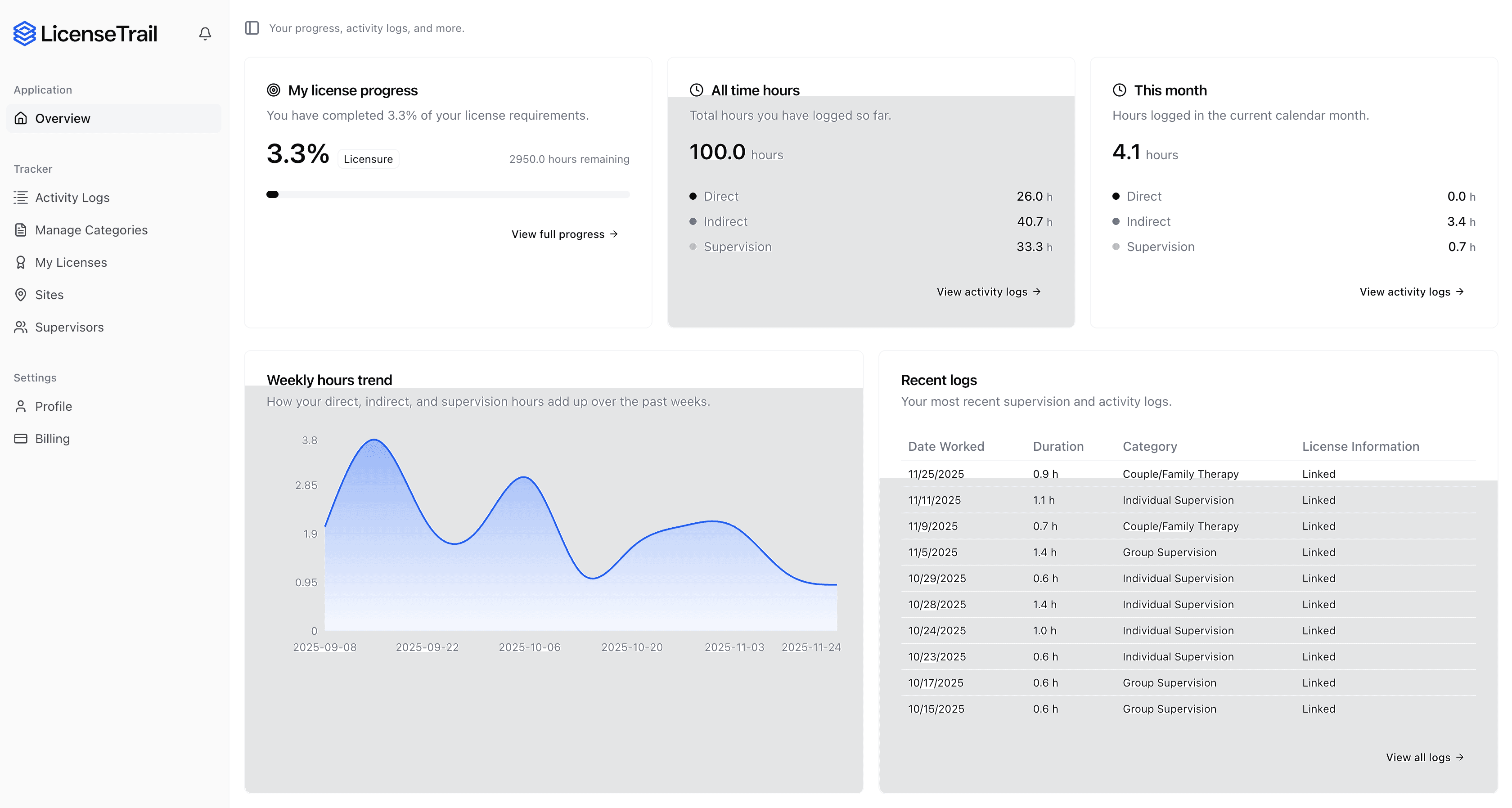
Track your Limited License Certificate hours with confidence
License Trail checks your direct, indirect, and supervision hours against North-dakota Limited License Certificate requirements continuously and flags mismatches before you submit.
 Start Tracking for Free
No credit card required · Free plan available
Related Licenses
Is your spreadsheet hiding North-dakota Limited License Certificate risks?
Stop guessing if your categories match North Dakota State Board of Psychologist Examiners requirements. License Trail checks your direct, indirect, and supervision hours continuously and flags mismatches before you submit.
Import or log
Bring your spreadsheet or start fresh
Upload your existing tracking spreadsheet and we'll map every hour into the right North Dakota State Board of Psychologist Examiners categories automatically.
Verify against North-dakota
Catch mismatches before the board does
License Trail checks your direct, indirect, and supervision hours against North-dakota Limited License Certificate requirements continuously.
Export board-ready
One-click clean reports
Generate professional, board-ready reports for supervision meetings and North Dakota State Board of Psychologist Examiners submissions in seconds.
No credit card required · Free plan available