
North-dakota Provisional License Requirements: Hours, Exams & Step-by-Step Guide
Stop guessing if your categories match North-dakota requirements. License Trail checks your direct, indirect, and supervision hours against Provisional License requirements continuously and flags mismatches before you submit.
No credit card required · Free plan available
Quick Requirements Overview
- Provisional licensure: for psychologists/I-O psychologists already licensed in another jurisdiction and in good standing; no disciplinary actions in past 5 years
- Must submit Application Initiation Form + required fee before beginning practice; Board issues a provisional licensure letter (no extra fee)
- Valid for 6 months from initial application; may be extended in up-to-6-month periods for good cause; ends immediately if full licensure is denied
- Full psychologist licensure supervised experience: 3,000 hours total = 1,500-hour predoctoral internship + 1,500 hours postdoc or 1,500 hours additional supervised predoctoral training (meeting ND criteria)
- Supervision minimums (each 1,500-hour segment): 100 supervision hours, including 50 hours one-to-one with a licensed psychologist in good standing
- I-O psychologist supervised experience: 3,000 hours, with ≥1,500 hours post-doctoral; requires an individualized Board-approved supervision plan
- Exams/verification for full licensure while provisional: typically national written exam (EPPP) + ND oral/professional responsibility exam as required by the Board
- Separate pathway: “psychology resident” status (for accruing supervised hours in ND) can last up to 3 years and requires supervisor form + application initiation + fee before practice
License Details
Procedures
Provisional licensure for psychologists in North Dakota sits at the intersection of two things:
- North Dakota’s full psychologist licensure requirements (including specific supervised‑experience hours), and
- A temporary, time‑limited “provisional license” that lets already‑licensed psychologists from other jurisdictions practice in North Dakota while their full application is processed.
Below is a focused guide on both pieces, with emphasis on the hour requirements and the board’s own terminology.
1. What a North Dakota provisional psychologist license is
Under North Dakota Administrative Code (NDAC) 66‑02‑01‑03, a provisional license is a short‑term license the Board may issue to an applicant who is:
- Already licensed as a psychologist (or industrial‑organizational psychologist) in another jurisdiction, and
- In good standing, with no disciplinary actions in the previous five years. (law.cornell.edu)
Once the Board receives a completed Application Initiation Form and the associated fee, it may grant a provisional license that is valid for six months from the date of initial application. On a showing of good cause, the Board can extend the provisional license in additional periods of up to six months. If the application for full licensure is denied, the provisional license ends on the date of the denial. (law.cornell.edu)
The board’s fee rule makes clear that:
- A completed Application Initiation Form and payment of the fee must be on file before you begin practice under provisional licensure.
- A “provisional licensure letter” is issued by the Board once the Application Initiation Form and fee are received; the letter itself carries no additional fee. (law.cornell.edu)
So, in practice, provisional licensure is a mechanism to let an out‑of‑state psychologist start practicing in North Dakota while the Board completes its standard licensure review.
2. Supervised‑experience hours required for North Dakota psychologist licensure
Although the provisional license itself does not create new hour requirements, eligibility to be fully licensed as a psychologist in North Dakota depends on specific supervised‑experience hours spelled out in NDAC 66‑02‑01‑11.1. (regulations.justia.com)
2.1. Total hours for a psychologist license (non‑I/O)
North Dakota regulations require a total of 3,000 hours of supervised professional experience in psychology, structured as:
-
1,500 hours of supervised predoctoral internship in the practice of psychology
- Must include at least 100 hours of supervision, of which at least 50 hours must be one‑to‑one.
- An internship accredited by the American Psychological Association (APA) or Canadian Psychological Association (CPA) automatically satisfies this requirement.
- Non‑accredited internships are acceptable only if detailed documentation (setting, population, type/amount of supervision, skills demonstrated) is submitted and corroborated by the supervisor(s). (regulations.justia.com)
-
An additional 1,500 hours, completed in one of two ways: (regulations.justia.com)
Option A – Postdoctoral experience
- 1,500 hours of supervised postdoctoral experience in the practice of psychology.
- Requires at least 100 hours of supervision, of which at least 50 hours must be one‑to‑one with a psychologist licensed in good standing.
- An APA‑ or CPA‑accredited postdoctoral program automatically meets this requirement; otherwise, detailed documentation similar to the internship requirement is needed and must be confirmed by supervisors. (regulations.justia.com)
Option B – Additional supervised predoctoral training experience
- 1,500 hours of additional supervised predoctoral training experience in the practice of psychology, with at least 100 hours of supervision, including at least 50 one‑to‑one hours with a psychologist licensed in good standing. (regulations.justia.com)
- This extra predoctoral training must meet a series of conditions, including that it: (regulations.justia.com)
- Is part of a qualifying doctoral program in psychology (as defined by state law).
- Is completed within 6 years after the doctoral degree is awarded and within 10 years of first applying for licensure.
- Occurs after an introductory practicum of at least 600 hours in applied professional psychology or psychotherapy.
- Follows an organized, sequential training plan of increasing complexity.
- Takes place outside the classroom and involves the trainee’s direct delivery of supervised psychological services in approved practice settings.
- Consists of activities that meet the statutory definition of the “practice of psychology” in North Dakota.
- Occurs in placements pre‑approved by the doctoral program’s training director (or designee), under a primary supervisor who:
- Is a licensed psychologist in the jurisdiction where training occurs,
- Has been licensed for at least three years, and
- Is directly responsible for the integrity and quality of the training experience.
- Runs for at least 30 weeks, with at least 15 hours per week onsite.
- Provides individual, face‑to‑face supervision (which can include secure video) at a minimum ratio of 1 hour per 15 onsite hours, and not less than 1 hour per week; at least half of this required supervision must be provided by the primary supervisor.
- Includes at least one additional hour per week of structured learning activities (e.g., additional supervision, case conferences, seminars, guided readings, or co‑therapy with a licensed psychologist).
- Involves regular documented contact between the primary supervisor and the graduate program’s training director regarding the trainee’s progress.
2.2. Hours for an industrial‑organizational (I/O) psychologist license
For industrial‑organizational psychologists, the same rule (66‑02‑01‑11.1) provides that: (regulations.justia.com)
- 3,000 hours of supervised experience in the practice of industrial‑organizational psychology are required.
- Of these, at least 1,500 hours must be completed after the doctoral degree is granted.
- The applicant must submit an individualized supervision plan for Board approval.
- Supervisors must be licensed in their jurisdiction, and the experience must align with the applicant’s intended I/O practice area.
These hour requirements are central to full licensure and are the standards against which the Board evaluates education/experience, whether you’re applying directly or coming from another jurisdiction.
3. How provisional licensure fits into that framework
The provisional license does not set its own hour minimums. Instead:
- It is available only to individuals already licensed as psychologists or I/O psychologists in another jurisdiction.
- It allows them to begin practicing in North Dakota while their full application is under review, assuming they meet good‑standing and disciplinary‑history criteria. (law.cornell.edu)
In other words, North Dakota’s hour requirements for psychologists (3,000 hours as described above) are mainly relevant when you originally qualified for licensure (either in North Dakota or another jurisdiction). When you apply for North Dakota provisional licensure, the Board relies heavily on your existing license, your degree, and proof that you have passed a national examination (typically the EPPP). (law.cornell.edu)
4. Eligibility criteria for a North Dakota provisional psychologist license
Based on NDAC 66‑02‑01‑03 and 66‑02‑01‑08, plus Board‑aligned summaries, eligibility for provisional licensure generally requires that you: (law.cornell.edu)
- Hold a current psychologist or I/O psychologist license in another jurisdiction, in good standing.
- Have no disciplinary actions in the previous five years (this is the explicit condition for being granted the provisional license).
- Initiate a North Dakota license application (via the Application Initiation Form) and pay the required application fee.
- Be pursuing licensure through one of the recognized “licensing from other jurisdictions / expedited licensing” pathways, which involve at least one of:
- Documented graduation from an accredited doctoral program at the appropriate level,
- Prior passage of a national examination required by North Dakota (e.g., EPPP),
- Documentation and current status of all professional licenses held, including any disciplinary history, and
- Professional endorsements from behavioral health professionals, or
- A Certificate of Professional Qualification in Psychology (CPQ), or
- Meeting requirements of any applicable interstate compact North Dakota has adopted. (law.cornell.edu)
Military spouses may qualify under a special North Dakota provision that waives fee requirements for both full licenses and provisional licenses if they meet certain experience and competency conditions. (onlinepsychologyprograms.org)
5. Step‑by‑step process to obtain a North Dakota provisional license
For a psychologist already licensed in another state or province, the process typically unfolds as follows:
Step 1 – Prepare your documentation
Be ready to provide (to the Board and/or through the ASPPB PLUS system): (law.cornell.edu)
- Proof of your current psychologist/I‑O psychologist license and its status (good standing, no recent discipline).
- Documentation of all professional licenses ever held and any related disciplinary records.
- Official transcript(s) showing a doctoral degree in psychology from an accredited program.
- EPPP scores or proof of passing another national exam required by North Dakota.
- Professional endorsements (if you are going through the “expedited licensing” route based on experience and references).
Step 2 – Submit the Application Initiation Form and fee
- File the Application Initiation Form with the North Dakota State Board of Psychologist Examiners and pay the application fee (currently listed as $450 in the fee schedule). (law.cornell.edu)
- This form and fee must be received and on file before you begin any practice under provisional licensure. (law.cornell.edu)
Step 3 – Receive the provisional licensure letter
Once the Board receives your completed Application Initiation Form and fee:
- The Board issues a “provisional licensure letter” at no additional charge. (law.cornell.edu)
- Under NDAC 66‑02‑01‑03, this grants a provisional license valid for six months from the date of initial application, provided you are in good standing and have had no disciplinary actions in the prior five years. (law.cornell.edu)
During this provisional period, you may practice psychology in North Dakota, but you must comply with all North Dakota laws and Board rules (including ethical standards and scope‑of‑practice limitations).
Step 4 – Complete the full online licensure application
While on provisional status, you are expected to complete your full licensure application:
- The Application Initiation Form triggers an invitation to complete the online PLUS application (Psychology Licensure Universal System) hosted by the Association of State and Provincial Psychology Boards (ASPPB).
- You will pay an additional fee directly to ASPPB for processing the online application. (law.cornell.edu)
- Original‑source verification of your degree, supervised experience, and exam scores occurs through this system.
Step 5 – Take required North Dakota examinations (if needed)
Depending on your status and the Board’s determination:
- You must have passed a national written exam (usually the EPPP). (law.cornell.edu)
- You will normally need to take and pass the North Dakota oral examination or, once it is fully implemented, the North Dakota professional responsibility examination as determined by the Board. (law.cornell.edu)
These exams may be completed while you are under provisional licensure, but you must follow Board scheduling and eligibility rules.
Step 6 – Board decision and end of provisional period
The Board reviews:
- Your education and training,
- Your total supervised experience hours (as required by NDAC 66‑02‑01‑11.1),
- Exam results, and
- Any disciplinary history from other jurisdictions. (regulations.justia.com)
Outcomes:
- If approved, you are granted a full North Dakota psychologist or I/O psychologist license and your provisional status ceases.
- If the application is denied, your provisional license expires on the date of denial. (law.cornell.edu)
- If processing is delayed and you show good cause, the Board may extend your provisional license in additional periods of up to six months. (law.cornell.edu)
6. Distinguishing provisional licensure from “psychology resident” status
For completeness, North Dakota regulations also recognize “psychology residents” (and I/O psychology residents) – individuals who are accruing post‑doctoral supervised experience or completing their supervised hours toward initial licensure in North Dakota: (law.cornell.edu)
- Before practicing as a psychology resident, a person must:
- Initiate an application for licensure,
- Pay the application fee, and
- Ensure that a supervisor files a completed supervisor form.
- The Board then issues a “psychology resident letter” once the supervisor form, Application Initiation Form, and fee are received (no additional charge). (law.cornell.edu)
- Resident status may last up to three years from the date residency is issued. (law.cornell.edu)
This route is used primarily by new graduates completing their 1,500 postdoc (or equivalent) hours inside North Dakota. The provisional license, by contrast, is explicitly for psychologists already licensed in another jurisdiction who are seeking to practice in North Dakota while their application for full licensure is processed.
7. Key hour numbers and terminology, in one place
-
Total supervised experience for ND psychologist licensure:
- 3,000 hours, broken down as:
- 1,500 hours supervised predoctoral internship, plus
- 1,500 hours supervised postdoctoral experience or
- 1,500 hours additional supervised predoctoral training experience meeting strict criteria. (regulations.justia.com)
- 3,000 hours, broken down as:
-
Minimum supervision within those hours:
- At least 100 supervision hours in each 1,500‑hour segment, with at least 50 hours one‑to‑one with a qualified licensed psychologist. (regulations.justia.com)
-
Industrial‑organizational psychologist hour requirements:
- 3,000 supervised hours in I/O psychology, with at least 1,500 hours post‑doctorate, under an individualized Board‑approved supervision plan. (regulations.justia.com)
-
Provisional license duration:
- Six months from date of initial application, with possible six‑month extensions for good cause; automatically ends on denial of licensure. (law.cornell.edu)
-
Trigger for provisional license:
- Submission of the Application Initiation Form and fee, by a psychologist/I‑O psychologist licensed in another jurisdiction in good standing with no discipline in the last five years. (law.cornell.edu)
Taken together, those are the core requirements and hour definitions you will be measured against when seeking provisional and then full psychologist licensure through the North Dakota State Board of Psychologist Examiners.
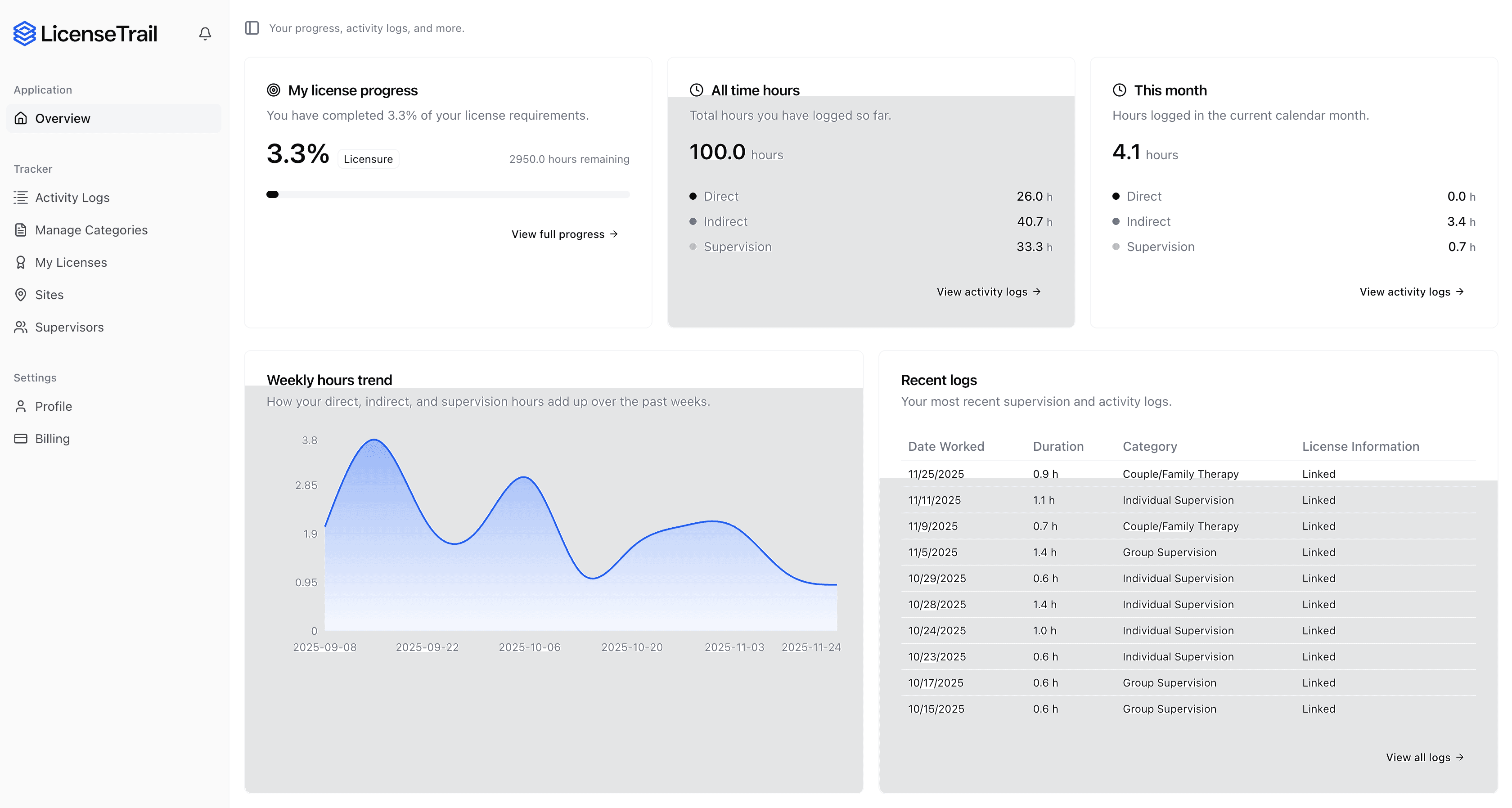
Track your Provisional License hours with confidence
License Trail checks your direct, indirect, and supervision hours against North-dakota Provisional License requirements continuously and flags mismatches before you submit.
 Start Tracking for Free
No credit card required · Free plan available
Related Licenses
Is your spreadsheet hiding North-dakota Provisional License risks?
Stop guessing if your categories match North Dakota State Board of Psychologist Examiners requirements. License Trail checks your direct, indirect, and supervision hours continuously and flags mismatches before you submit.
Import or log
Bring your spreadsheet or start fresh
Upload your existing tracking spreadsheet and we'll map every hour into the right North Dakota State Board of Psychologist Examiners categories automatically.
Verify against North-dakota
Catch mismatches before the board does
License Trail checks your direct, indirect, and supervision hours against North-dakota Provisional License requirements continuously.
Export board-ready
One-click clean reports
Generate professional, board-ready reports for supervision meetings and North Dakota State Board of Psychologist Examiners submissions in seconds.
No credit card required · Free plan available