
North-dakota Psychologist with Supervision Requirements: Hours, Exams & Step-by-Step Guide
Stop guessing if your categories match North-dakota requirements. License Trail checks your direct, indirect, and supervision hours against Psychologist with Supervision requirements continuously and flags mismatches before you submit.
No credit card required · Free plan available
Quick Requirements Overview
- Doctoral degree in psychology (or I‑O psychology) from a Board-acceptable program (regionally accredited)
- Register as a psychology resident before supervised practice; secure Board-filed supervisor; complete PSY|PRO PLUS requirements within 4 months
- Supervised professional experience: 3,000 hours total (all supervised)
- Predoctoral internship: 1,500 hours with ≥100 supervision hours (≥50 one-to-one); APA/CPA-accredited accepted or detailed documentation required
- Additional 1,500 hours via postdoc or structured additional predoctoral training; each requires ≥100 supervision hours (≥50 one-to-one)
- If using additional predoctoral training: after ≥600-hour practicum; ≥30 weeks, ≥15 onsite hrs/week; supervision ≥1 hr per 15 onsite hrs and ≥1 hr/week; plus ≥1 hr/week learning activities
- Exams: EPPP (scaled ≥500) + North Dakota professional responsibility (law/ethics) exam
- Ongoing CE: 40 hours/2 years incl. ≥3 ethics; supervision CE (≥3 hours) required when supervising (and commonly tied to “with supervision” designation)
License Details
Procedures
North Dakota licensure as a “Psychologist with Supervision” is built on the same statutory framework as full psychologist licensure. The label “with Supervision” is used by the North Dakota State Board of Psychologist Examiners and its CE partners as a credential category, but the underlying hour and supervision requirements come directly from the statute (North Dakota Century Code chapter 43‑32) and the North Dakota Administrative Code (Title 66).(codes.findlaw.com)
Below is a structured walk‑through of those requirements, with emphasis on how the Board itself describes the required hours.
1. How North Dakota defines the roles
The law distinguishes between fully licensed psychologists and pre‑license trainees (“residents”):(ndlegis.gov)
- “Psychologist” – an individual “licensed under this chapter in the practice of psychology.” (NDCC 43‑32‑01(7))
- “Psychology resident” – an individual “registered by the board and … actively engaged in supervised practice.” (NDCC 43‑32‑01(8))
The Administrative Code then adds “supervised professional experience” requirements that every applicant for psychologist licensure must meet (see section 66‑02‑01‑11.1, titled Supervised professional experience).(law.cornell.edu)
CE providers that work directly with the Board list two credentials under the Board’s jurisdiction:
- Psychologist with Supervision
- Psychologist
and treat both as North Dakota psychologist credentials for CE and renewal purposes.(addictioncounselorce.com)
The published statutes and rules do not separately define “psychologist with supervision”; they use the categories above (psychologist and psychology resident). The hour requirements below are therefore the controlling requirements for any psychologist license, including one labeled “with supervision.”
2. Educational foundation
The Board licenses only doctoral‑level psychologists (and industrial‑organizational psychologists). NDCC 43‑32‑08 directs the Board to define acceptable “programs of study … for the licensing of psychologists,” and NDAC 66‑02‑01 ties the supervised experience to a doctoral program that meets the requirements of NDCC 43‑32‑20.(ndlegis.gov)
In practice, this means:
- A doctoral degree in psychology (or industrial‑organizational psychology, if you pursue that track) from a regionally accredited institution and program acceptable to the Board.
- The doctoral program must include an organized predoctoral internship and/or supervised training consistent with the requirements summarized below.
3. Total supervised professional experience: 3,000 hours
North Dakota requires 3,000 hours of supervised professional experience for psychologist licensure.(law.cornell.edu)
The Board’s rule breaks this into:
- 1,500 hours of supervised predoctoral internship in the practice of psychology, plus
- 1,500 additional hours that must be either:
- supervised postdoctoral experience, or
- additional supervised predoctoral training, both under strict conditions.
Importantly, all 3,000 hours are “supervised”. North Dakota does not divide the requirement into “direct experience” versus “supervised experience” the way some states do; instead, it requires supervised professional experience with minimum amounts and ratios of supervision inside each 1,500‑hour block.
4. First 1,500 hours – Supervised predoctoral internship
NDAC 66‑02‑01‑11.1(1) states that applicants “must complete one thousand five hundred hours of supervised predoctoral internship in the practice of psychology.”(law.cornell.edu)
Key elements of this internship block:
- Hours required: 1,500 hours (this entire block is supervised internship).
- Supervision minimums:
- At least 100 hours of supervision, and
- At least 50 of those hours must be one‑to‑one (individual) supervision.(law.cornell.edu)
- Accredited internships: Completion of an APA‑ or CPA‑accredited psychology internship is automatically accepted as meeting this 1,500‑hour requirement.(law.cornell.edu)
- Non‑accredited internships: If the internship is not APA/CPA‑accredited, the applicant must document:
- the nature of the service setting(s);
- the nature of clients/consumers served;
- the “nature and amount of supervision”; and
- the specific skills in which the applicant demonstrated proficiency, on Board forms signed by the supervisor(s).(law.cornell.edu)
In other words, this first 1,500 hours is a formal, organized predoctoral internship under a licensed psychologist, with clearly documented supervision.
5. Second 1,500 hours – Two pathways
On top of the internship, NDAC 66‑02‑01‑11.1 requires “one or a combination of” the following for the second 1,500 hours:(law.cornell.edu)
Path A – 1,500 hours of supervised postdoctoral experience
- Hours required: 1,500 hours of supervised postdoctoral experience in the practice of psychology.
- Supervision minimums:
- At least 100 hours of supervision,
- At least 50 hours must be one‑to‑one with a psychologist licensed in good standing.(law.cornell.edu)
- Accredited APA/CPA postdoctoral programs are accepted as meeting this requirement. Otherwise, the same detailed documentation of setting, consumers, supervision, and skills is required, and supervisors must corroborate your claimed competencies.(law.cornell.edu)
Path B – 1,500 hours of additional supervised predoctoral training
Instead of (or in combination with) a postdoc, you may complete 1,500 hours of additional supervised predoctoral training in the practice of psychology. This is still pre‑license experience but is tightly defined. NDAC 66‑02‑01‑11.1(1)(b) and subparts (1)–(15) specify the conditions.(law.cornell.edu)
Core features:
- Supervision minimums: Again, at least 100 hours of supervision, with at least 50 hours one‑to‑one with a psychologist licensed in good standing.
- Timing and sequence:
- Must be part of your doctoral program that meets NDCC 43‑32‑20(1)(b).
- Must be completed within six years of the doctoral degree and within 10 years of first applying for licensure.
- Must occur after an introductory practicum of at least 600 hours of applied professional psychology or psychotherapy.(law.cornell.edu)
- Nature of the hours (this is ND’s closest analogue to “direct experience”):
- The experience must involve “direct delivery of supervised psychological services” in a practice, agency, institution, counseling center, training clinic, or similar setting approved by your doctoral program.(law.cornell.edu)
- Activities must fit the statutory definition of the practice of psychology in NDCC 43‑32‑01(6) (assessment, diagnosis, therapy, consultation, etc.).(ndlegis.gov)
- Weekly time and supervision ratios:
- The training plan must run for at least 30 weeks with a weekly onsite presence of at least 15 hours.
- It must provide, on average, weekly individual face‑to‑face supervision at a ratio of at least 1 hour of supervision per 15 hours onsite and at least 1 hour per week.(law.cornell.edu)
- At least 50% of this supervision must be by the primary supervisor; the rest can be individual or group supervision by another psychologist licensed for at least three years. Supplemental supervision (including by other mental health professionals or under “umbrella supervision”) may be added but cannot replace the required weekly individual supervision.(law.cornell.edu)
- Additional learning activities: On average, there must be at least one extra hour per week of learning activities (additional supervision, case conferences or grand rounds, didactic consultations, guided readings, seminars, or co‑therapy).(law.cornell.edu)
This second 1,500‑hour block is therefore structured, progressive, and heavily supervised, with an explicit emphasis on direct, supervised clinical service.
6. Putting the supervised hours together
For a traditional clinical psychology route, the supervised‑experience requirements to be licensed as a psychologist (including any license labeled “with Supervision”) look like this:
| Component | Total hours | Supervision required | Key features |
|---|---|---|---|
| Predoctoral internship | 1,500 | ≥100 hours supervision; ≥50 one‑to‑one | Formal internship in practice of psychology, typically APA/CPA accredited. |
| Additional experience | 1,500 | ≥100 hours supervision; ≥50 one‑to‑one | Either supervised postdoc or structured predoctoral training as defined in NDAC 66‑02‑01‑11.1(1)(b). |
| Total supervised professional experience | 3,000 | ≥200 hours supervision across both blocks (≥100 in each 1,500) | All hours are explicitly “supervised professional experience.”(law.cornell.edu) |
North Dakota does not say “1,500 hours direct experience and 1,500 hours supervised experience”; instead, it requires 3,000 hours of supervised professional experience, of which at least 1,500 is a supervised predoctoral internship, and the rest is either supervised postdoctoral practice or highly structured additional supervised predoctoral training.
7. Psychology resident status while you complete hours
Before you can practice in a supervised capacity toward licensure, you must register as a psychology resident. NDAC 66‑02‑01‑13 governs this status.(law.cornell.edu)
Steps to become a psychology resident
- Initiate an application for licensure
- Complete the Board’s Application Initiation Form and pay the application fee.(law.cornell.edu)
- Secure a supervisor
- A supervisor must file a completed supervisor form with the Board before you begin any practice related to the scope of psychology.(law.cornell.edu)
- Complete the online PLUS application
- The Board uses the PSY|PRO PLUS application system; you must complete all online requirements within four months of initiating the application.(law.cornell.edu)
While you are a resident
- You hold the title “psychology resident” and must use that title in reports, letters, business cards, and public presentations, and inform clients of your supervisor’s identity and contact information.(law.cornell.edu)
- Resident status is time‑limited: you may hold psychology resident status for up to three years from the date it’s issued.(law.cornell.edu)
- Your supervising psychologist:
- Must have been licensed in good standing for at least three years;
- Must have the training and competence to cover any services you provide; and
- Must meet the Board’s continuing education requirements, including credits in supervision.(law.cornell.edu)
The supervisor must later document the “number and nature of supervised hours of experience” to verify completion of your residency.(law.cornell.edu)
8. Examinations
To move from resident to licensed psychologist (including any “with Supervision” status), you must complete:
-
National written examination (EPPP)
- NDAC 66‑02‑01‑09.1 designates the Examination for Professional Practice in Psychology as the national written exam.
- Passing score: scaled score of 500 or, for older administrations, 70% correct.(law.cornell.edu)
-
North Dakota professional responsibility (law/ethics) examination
- Historically an oral exam administered by a committee; the rule allows the Board to convert this to a written exam.(law.cornell.edu)
- The exam covers North Dakota law regulating psychology and ethics/standards of practice.
NDAC 66‑02‑01‑13 explicitly allows residents to sit for the national written exam and, after passing it, the professional responsibility exam, while still in resident status, and describes Board review of both exam results and supervised practice hours before voting on licensure.(law.cornell.edu)
9. Licensure as a Psychologist / Psychologist with Supervision
Once you have:
- completed the doctoral degree requirements,
- documented the 3,000 hours of supervised professional experience in the required configuration, and
- passed both the EPPP and the North Dakota professional responsibility exam,
the Board reviews your file and votes on licensure. An applicant must be licensed if a majority of the Board approves the applicant for licensure.(law.cornell.edu)
The Board’s public rules call this license “psychologist.” CE providers and Board‑linked CE information, however, show two closely related credentials it regulates for continuing education:
- Psychologist with Supervision – must report 40 CE hours every two years, including 3 hours in ethics and 3 hours in supervision; up to 20 hours may be completed via distance learning.(addictioncounselorce.com)
- Psychologist – same 40‑hour CE cycle, with at least 3 hours in ethics; supervision CE is required if the psychologist actually supervises residents or applied behavior analysts.(regulations.justia.com)
Because the statutes and NDAC do not explicitly define “psychologist with supervision” as a separate license class, that label appears to function as a board‑administrative designation for psychologists whose license includes a supervision condition (for example, early‑career licensees or those under a specific Board order). The supervised‑experience hours to qualify for that license, however, are the same 3,000 hours outlined above.
Given that board practice can change and the Board’s main website is not fully accessible through automated tools, it is prudent to confirm with the Board office how they are currently using the “psychologist with supervision” label in 2025.
10. Hour requirements at a glance
For someone aiming to be licensed in North Dakota in a status the Board and its CE partners call Psychologist with Supervision, the Board‑defined hour requirements are:
-
Total supervised professional experience:
- 3,000 hours, all supervised, in the practice of psychology.(law.cornell.edu)
-
Mandatory structure of those 3,000 hours:
- 1,500 hours of supervised predoctoral internship in the practice of psychology, including:
- ≥100 hours of supervision, with ≥50 hours one‑to‑one.
- 1,500 hours of additional supervised experience, which must be either:
- supervised postdoctoral experience in the practice of psychology (again ≥100 supervision hours, ≥50 one‑to‑one), or
- structured supervised predoctoral training that:
- follows at least 600 hours of practicum,
- involves direct delivery of supervised psychological services,
- runs at least 30 weeks with ≥15 onsite hours/week,
- provides ≥1 hour of individual supervision per 15 onsite hours (and at least 1 hour/week), and
- includes ≥1 hour/week of additional learning activities.(law.cornell.edu)
- 1,500 hours of supervised predoctoral internship in the practice of psychology, including:
-
Resident phase: psychology resident status (up to 3 years) with an approved supervisor and Board‑filed supervision plan.(law.cornell.edu)
-
Exams:
- EPPP with scaled score ≥500, and
- North Dakota professional responsibility (law/ethics) exam.(law.cornell.edu)
-
Ongoing CE once licensed (including “with supervision”):
- 40 CE hours every 2 years,
- at least 3 hours in ethics/law/jurisprudence, and
- at least 3 supervision hours per cycle if you supervise residents or ABAs (and for the Psychologist with Supervision credential as presented by CE partners).(regulations.justia.com)
These are the Board’s operative requirements and terminology for supervised experience leading to psychologist licensure in North Dakota and for maintaining a psychologist license that carries a supervision condition.
Track your Psychologist with Supervision hours with confidence
License Trail checks your direct, indirect, and supervision hours against North-dakota Psychologist with Supervision requirements continuously and flags mismatches before you submit.
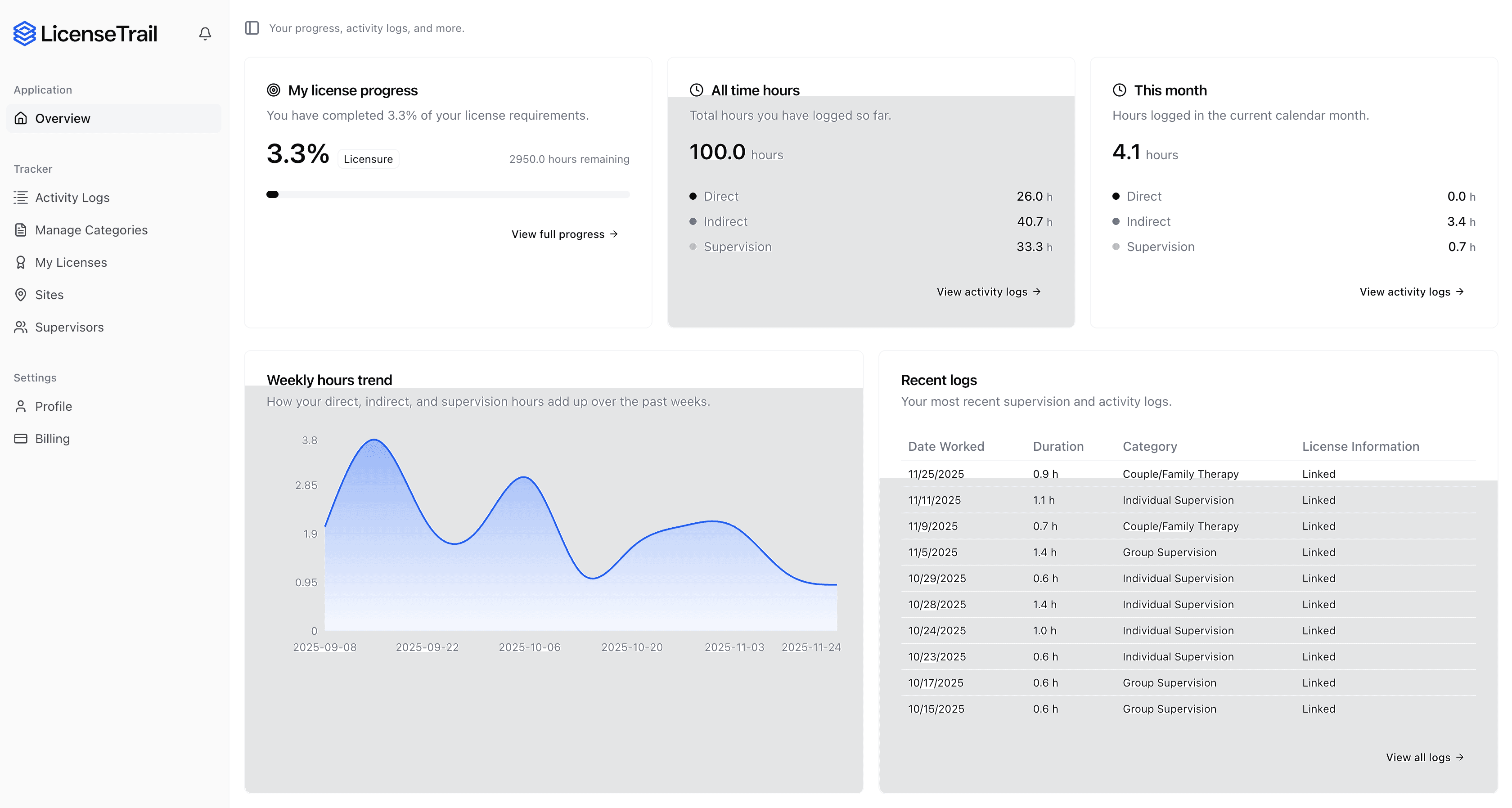 Start Tracking for Free
No credit card required · Free plan available
Related Licenses
Is your spreadsheet hiding North-dakota Psychologist with Supervision risks?
Stop guessing if your categories match North Dakota State Board of Psychologist Examiners requirements. License Trail checks your direct, indirect, and supervision hours continuously and flags mismatches before you submit.
Import or log
Bring your spreadsheet or start fresh
Upload your existing tracking spreadsheet and we'll map every hour into the right North Dakota State Board of Psychologist Examiners categories automatically.
Verify against North-dakota
Catch mismatches before the board does
License Trail checks your direct, indirect, and supervision hours against North-dakota Psychologist with Supervision requirements continuously.
Export board-ready
One-click clean reports
Generate professional, board-ready reports for supervision meetings and North Dakota State Board of Psychologist Examiners submissions in seconds.
No credit card required · Free plan available