
North-dakota RABA Requirements: Hours, Exams & Step-by-Step Guide
Stop guessing if your categories match North-dakota requirements. License Trail checks your direct, indirect, and supervision hours against RABA requirements continuously and flags mismatches before you submit.
No credit card required · Free plan available
Quick Requirements Overview
- Status/Board: Legacy credential under NDSBPE (psychology board) through 12/31/2019; no new RABA registrations via NDSBPE after that date
- Current ND pathway: Since 1/1/2020, ABA practice regulated under Chapter 43‑64 by the State Board of Integrative Health Care (LBA/LABA); prior NDSBPE registrants/licensees grandfathered
- Level/scope: Bachelor’s-level ABA provider; may not practice independently; must work under supervision of a licensed psychologist or licensed behavior analyst/qualified supervisor
- Education (RABA): Bachelor’s either ABAI-accredited/verified or BACB-recognized ABA coursework OR psychology/human services bachelor’s plus coursework: 3 credits Intro Psych, 6 credits learning theory/behavior intervention, 4 credits developmental psych/ASD topics
- Supervised experience (BACB-based): Meet one track: 1,500 hrs supervised independent fieldwork OR 1,000 hrs practicum OR 750 hrs intensive practicum (ABA activities in clinical/educational settings)
- Supervision admin: Supervising licensee must file a Supervisor form with the board before supervising a RABA
- Exams: Public summaries indicate no oral state board exam required for RABA (oral exam applied to ABA licensees)
- Fees/process (legacy): Application Initiation Form (fee schedule shows $450) then PLUS/PSY|PRO online application workflow
License Details
Procedures
North Dakota’s regulation of applied behavior analysis has changed significantly over the last few years. To understand what it meant (and largely still means, in practice) to become a Registered Applied Behavior Analyst (RABA) under the North Dakota State Board of Psychologist Examiners (NDSBPE), it helps to separate:
- The legacy RABA pathway under NDSBPE (what you asked about), and
- The current behavior analyst licensure system, which since 2020 is handled by a different board.
1. Regulatory backdrop: who licenses ABA in North Dakota now?
- Until December 31, 2019, applied behavior analysts (and registered ABAs) were regulated under the psychology law (Chapter 43‑32, Title 66 rules) by the NDSBPE. (appliedbehavioranalysisedu.org)
- Effective January 1, 2020, North Dakota created a separate chapter, Chapter 43‑64 (Behavior Analysts), administered by the State Board of Integrative Health Care. That chapter now requires a license to practice applied behavior analysis and defines the titles “licensed behavior analyst” and “licensed assistant behavior analyst.” (codes.findlaw.com)
- The new law includes a grandfather provision: if, on December 31, 2019, an individual held a license or registration issued by the State Board of Psychologist Examiners under Chapter 43‑32, that person “is deemed to have met the education, experience, and examination requirements for licensure” under the new behavior analyst chapter. (law.justia.com)
In practice, this means:
- You cannot newly become a RABA through NDSBPE today; existing RABAs were grandfathered into the new licensing framework.
- To practice ABA now, you must follow the Board of Integrative Health Care / Chapter 43‑64 pathway (typically built around BCBA/BCaBA certification). (law.cornell.edu)
However, the question you posed is specifically:
What were (and, for legacy purposes, still are) the hour and training requirements to become a Registered Applied Behavior Analyst (RABA) under the North Dakota State Board of Psychologist Examiners, including the board’s own wording where possible?
The rest of this guide reconstructs that legacy RABA pathway as clearly as the available sources allow.
2. What “Registered Applied Behavior Analyst (RABA)” meant under NDSBPE
Under NDSBPE, applied behavior analysis was incorporated into the psychology licensing framework:
- The Board’s own CE rule explicitly refers to “registered applied behavior analysts,” indicating that RABA was a recognized registration category under Title 66 rules. (regulations.justia.com)
- A RABA was a bachelor’s-level provider of ABA services, not allowed to practice independently, and required to work under the supervision of a licensed psychologist or a licensed applied behavior analyst. (appliedbehavioranalysisedu.org)
Broadly:
- Licensed Applied Behavior Analyst (LABA) = Master’s/doctoral-level, independently licensed ABA provider (under NDSBPE at the time).
- Registered Applied Behavior Analyst (RABA) = Bachelor-level practitioner providing ABA services only under supervision.
3. Education requirements for RABA (NDSBPE)
NDSBPE never wrote a detailed RABA education rule into Title 66. Instead, it used education standards tied to ABAI (Association for Behavior Analysis International) and BACB (Behavior Analyst Certification Board) guidance, as summarized by multiple professional education sources that track state board requirements.
Those summaries consistently describe the NDSBPE-approved RABA education requirements as follows: (appliedbehavioranalysisedu.org)
Option A – ABA‑focused bachelor’s degree
- A bachelor’s degree in a program that is:
- Accredited or verified by ABAI, or
- Recognized by the BACB (i.e., includes an approved course sequence that meets BACB standards for behavior-analytic coursework).
Option B – Psychology/human services bachelor’s with required ABA-related coursework
- A bachelor’s degree with a major in psychology or another human services field, and specific coursework that includes at least:
- 3 semester credits in Introduction to Psychology
- 6 semester credits in Learning Theory and Behavior Intervention
- 4 semester credits in Developmental Psychology and Autism Spectrum Disorder topics
These requirements reflect the board’s practice of basing RABA education on national ABA education standards while remaining under the psychology licensure chapter.
4. Experience and hour requirements: how many hours, and of what type?
Here is the core point:
- For RABAs and LABAs, North Dakota law required NDSBPE to set supervised practice requirements, but the Board did not create a separate, ABA‑specific hour rule in Title 66.
- Instead, the Board defaulted to BACB standards for supervised experience hours. (appliedbehavioranalysisedu.org)
4.1. The BACB‑based supervised experience paths NDSBPE used
Under the BACB standards in effect when NDSBPE was relying on them, an ABA candidate could meet the supervised experience requirement in one of three ways: (appliedbehavioranalysisedu.org)
- 1,500 hours of supervised independent fieldwork in applied behavior analysis
- 1,000 hours of practicum in applied behavior analysis (as part of a graduate or, for assistants, a structured university program)
- 750 hours of intensive practicum in applied behavior analysis
For each of these:
- The hours are all supervised hours in ABA practice, not split into “direct” vs “separately supervised” blocks.
- The experience takes place in clinical or educational settings, such as ABA clinics, schools, or agencies where ABA programs are designed and implemented.
- The supervisee is engaged in core ABA activities: conducting assessments, designing intervention plans, monitoring data, training technicians or caregivers, etc. (appliedbehavioranalysisedu.org)
- Supervision must be provided by a qualified BCBA‑level supervisor, and the supervisor:
- Attests that the required number of hours was completed, and
- Evaluates the candidate across domains like timeliness, professionalism, self‑analysis, and skills acquisition. (appliedbehavioranalysisedu.org)
In other words, the “1,500 / 1,000 / 750” numbers are all supervised ABA experience options. They are not a breakdown into “1,500 direct client-contact hours plus 1,500 separate supervision hours.”
Your example (“1,500 hours of direct experience and 1,500 hours of supervised experience”) is actually very close to how North Dakota handles psychologist licensure, not RABA:
- For psychologists, NDSBPE requires:
- 1,500 hours of supervised predoctoral internship “in the practice of psychology,” and
- An additional 1,500 hours of supervised experience, either postdoctoral or additional predoctoral training, for a total of 3,000 supervised hours before full licensure. (law.cornell.edu)
For RABA/ABA, by contrast, NDSBPE accepted one of the BACB supervised experience tracks above, rather than a fixed “3,000‑hour” psychologist-style requirement.
4.2. Were these BACB hours required for RABAs specifically?
The available summaries describe these supervised experience options in the context of ABA applicants generally (licensed ABAs), not as a separate, lighter track for RABAs. (appliedbehavioranalysisedu.org)
What can be said with confidence from the documentary record is:
- State law required the NDSBPE to impose supervised practice requirements for ABA applicants.
- In implementing that, the Board chose to use BACB’s supervised-fieldwork/practicum standards, rather than writing its own hours tables into Title 66.
- That same scheme was used for ABA licensure, and there is no indication in the available rules that RABAs had a fundamentally different, codified hour count.
So, if you wanted to become a RABA under NDSBPE during that period, the practical supervised-experience expectations matched the BACB pathways:
- Either 1,500 hours supervised independent fieldwork,
- Or 1,000 hours supervised practicum,
- Or 750 hours supervised intensive practicum,
all under a BCBA‑qualified supervisor.
5. Application process under NDSBPE (as it applied to ABA and RABA)
NDSBPE used a two‑step application across all of its regulated categories (psychologist, applied behavior analyst, and registered applied behavior analyst): (uvu.edu)
-
Application Initiation Form (Licensure/Registration)
- Completed and filed with the Board.
- Required information typically included:
- Education history
- Professional experience
- Any other licenses or certifications held
- Declarations related to ethics and conduct
- Fee: The Administrative Code schedule lists a $450 fee for the application initiation form. (law.cornell.edu)
- Filing this initiation form was a prerequisite to taking any required written examination.
-
PLUS Online Application (PSY|PRO platform)
- After initiation was accepted, applicants had to complete a PLUS (Psychology Licensure Universal System) online application. (uvu.edu)
- You were expected to:
- Start the PLUS application within a few months of the initiation form, and
- Complete the entire application process within a specified window (summaries describe 6 months from initial filing).
Because the same system was used for psychologists, licensed ABAs, and RABAs, not all sections of the online application applied to every category; you completed only those sections relevant to your credential.
6. Examinations under NDSBPE
For full ABA licensure, NDSBPE allowed applicants to meet the written exam requirement by passing either: (appliedbehavioranalysisedu.org)
- The EPPP (Examination for Professional Practice in Psychology), or
- The national behavior analyst examination (the BCBA exam developed by BACB).
Those details are clear for licensed ABAs. For RABAs, the publicly available descriptions do not spell out a separate, additional exam requirement beyond meeting the bachelor‑level education and supervised experience standards that are aligned with BCaBA‑level preparation. There is no explicit NDSBPE rule in Title 66 that, for example, requires RABAs to pass a particular national exam in addition to their supervised practice.
One other important distinction that the board’s guidance made:
- The oral state-board exam in professional responsibility and North Dakota law was required of ABA licensees,
- But RABA applicants were not required to sit for the oral board examination. (appliedbehavioranalysisedu.org)
7. Supervision and continuing education expectations
Even when ABAs were regulated under NDSBPE, the only individuals directly licensed by that board were psychologists and applied behavior analysts; RABAs were registered and had to practice under supervision.
Two pieces of board language show how seriously it treats supervision of RABAs:
-
Supervisor registration requirement
The NDSBPE fee schedule lists a “Supervisor form, submitted by any licensee supervising the practice of psychology residents or registered applied behavior analysis in North Dakota” as a required, no‑fee filing before supervision begins. (law.cornell.edu)- In practice: if you supervise a RABA (or psychology resident), you must register that supervision relationship with the Board before the supervisee practices in North Dakota.
-
Continuing education tied to supervision of RABAs
The continuing education rule requires:- At least 40 CE credits every two years for licensed psychologists, with
- A minimum of 3 credits in ethics/law/jurisprudence, and
- For psychologists who supervise residents or RABAs, an additional minimum of 3 credits in supervision. (regulations.justia.com)
This does not impose CE directly on the RABA, but it formally codifies expectations for supervisors who are responsible for RABAs’ clinical work.
8. How this compares to psychologist supervised‑experience requirements
Because your example mentioned “1,500 hours of direct experience and 1,500 hours of supervised experience,” it’s worth underscoring the difference:
-
Psychologists (full licensure, NDSBPE)
- Must complete:
- 1,500 hours of supervised predoctoral internship in psychology, and
- An additional 1,500 hours of supervised experience (postdoc or additional predoctoral training),
- For a total of 3,000 supervised hours, with specific supervision‑hour minimums and time frames. (law.cornell.edu)
- Must complete:
-
RABA / ABA under NDSBPE (legacy)
- Were expected to meet BACB‑style supervised ABA experience requirements, namely either 1,500 hours of supervised fieldwork, 1,000 hours practicum, or 750 hours intensive practicum, under qualified BCBA supervision. (appliedbehavioranalysisedu.org)
- These hours are already supervised practice hours, not a separate “direct vs supervised” split.
So, the 3,000‑hour, two‑year supervised model applies to psychologists; BACB fieldwork/practicum hour options apply to ABAs and, by all available practical descriptions, to RABAs as well.
9. What this means if you are planning a career path now
Because of the 2020 shift to Chapter 43‑64 and the Board of Integrative Health Care:
- You cannot now apply to NDSBPE for a new RABA registration. That pathway functionally closed as of the end of 2019, except for grandfathering. (law.justia.com)
- To practice ABA in North Dakota today, you must:
- Meet the education and supervised experience requirements set by the Board of Integrative Health Care, which are built around:
- An ABAI‑accredited / BACB‑approved degree, and
- Certification by BACB (BCBA for behavior analysts, BCaBA for assistant behavior analysts), including 1,500–2,000 supervised fieldwork hours depending on the current BACB pathway selected. (law.cornell.edu)
- Then apply for licensure as a licensed behavior analyst or licensed assistant behavior analyst under Chapter 43‑64.
- Meet the education and supervised experience requirements set by the Board of Integrative Health Care, which are built around:
For historical research or for understanding the legacy RABA category, though, the key points from the NDSBPE era are:
- Education: bachelor’s degree (ABAI/BACB verified, or psychology/human services with specified ABA‑related coursework).
- Experience: BACB‑style supervised practice (1,500 fieldwork or 1,000 practicum or 750 intensive practicum), under BCBA supervision.
- Regulatory posture: RABAs could not practice independently, required registered supervision, and were folded into NDSBPE’s broader psychologist ethics and CE framework.
Track your RABA hours with confidence
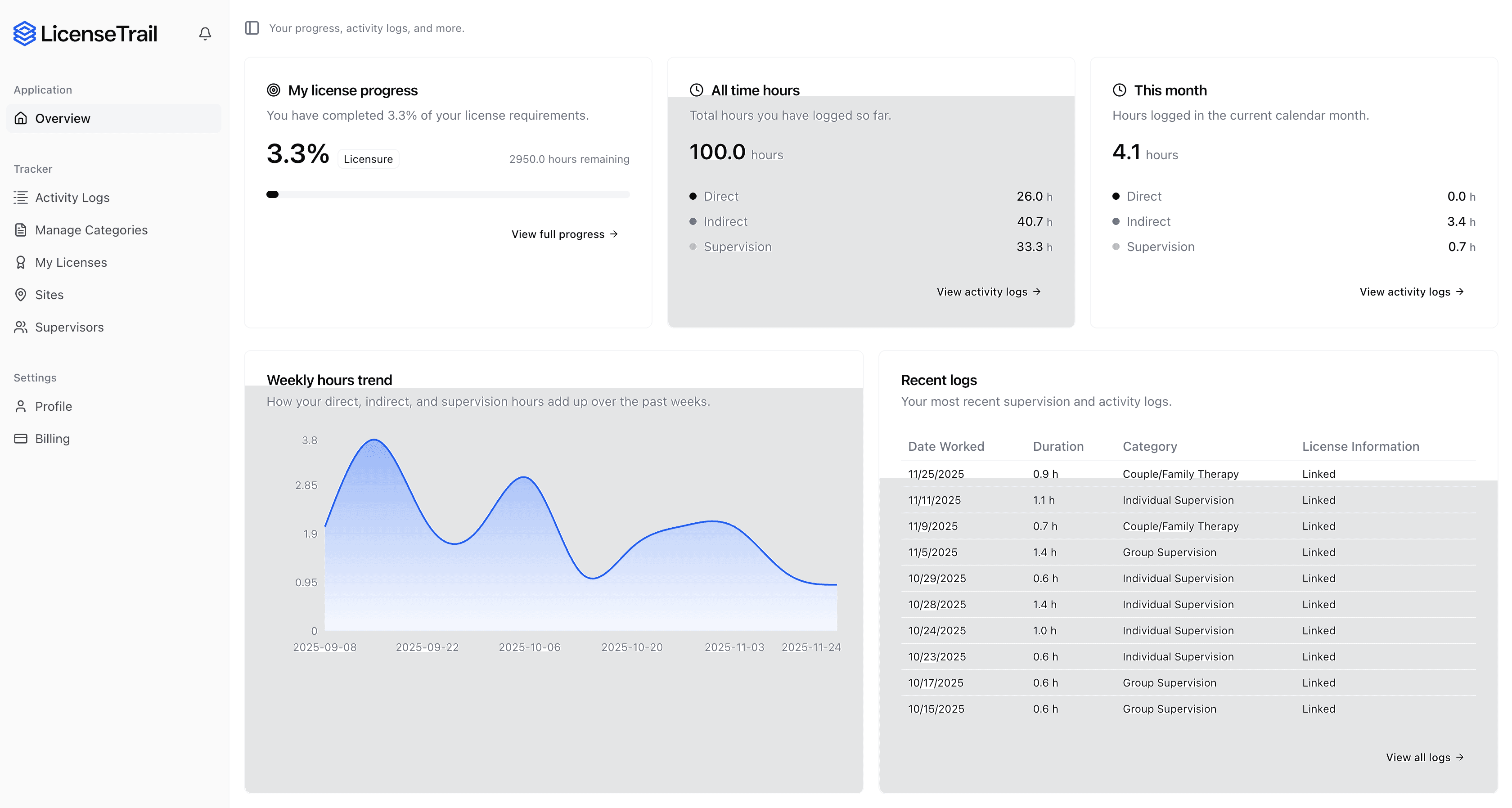
License Trail checks your direct, indirect, and supervision hours against North-dakota RABA requirements continuously and flags mismatches before you submit.
 Start Tracking for Free
No credit card required · Free plan available
Related Licenses
Is your spreadsheet hiding North-dakota RABA risks?
Stop guessing if your categories match North Dakota State Board of Psychologist Examiners requirements. License Trail checks your direct, indirect, and supervision hours continuously and flags mismatches before you submit.
Import or log
Bring your spreadsheet or start fresh
Upload your existing tracking spreadsheet and we'll map every hour into the right North Dakota State Board of Psychologist Examiners categories automatically.
Verify against North-dakota
Catch mismatches before the board does
License Trail checks your direct, indirect, and supervision hours against North-dakota RABA requirements continuously.
Export board-ready
One-click clean reports
Generate professional, board-ready reports for supervision meetings and North Dakota State Board of Psychologist Examiners submissions in seconds.
No credit card required · Free plan available