
Oklahoma LSWA Requirements: Hours, Exams & Step-by-Step Guide
Stop guessing if your categories match Oklahoma requirements. License Trail checks your direct, indirect, and supervision hours against LSWA requirements continuously and flags mismatches before you submit.
No credit card required · Free plan available
Quick Requirements Overview
- Degree: BSW from accredited/approved program or MSW/doctorate in social work from approved program
- Exam: Pass the ASWB Bachelors exam (LSWA level)
- Background check: Complete national criminal history check; pay costs; submit two classifiable fingerprint sets
- Application: Submit Board application/fees; official transcripts sent to Board; ASWB score report sent to Board; background check/fingerprints on file
- Experience hours: No post-degree supervised practice-hour requirement for initial LSWA licensure
- Practice limits: No independent social work practice; no private/independent clinical practice (LCSW only)
- Advancement note: LSWA (or LMSW) required to start Board-approved supervision toward LSW/LSW-ADM/LCSW (hours apply at that stage)
License Details
Procedures
Licensure requirements for the Licensed Social Work Associate (LSWA) in Oklahoma are built around education, examination, and background screening rather than post‑degree practice hours. The hours become critical later, when an LSWA moves up to LSW, LSW‑ADM, or LCSW.
Below is a concise, statute‑ and rule‑based guide.
1. What the LSWA License Is in Oklahoma
Oklahoma law defines a “licensed social work associate (LSWA)” as a person duly licensed to practice social work under the Social Worker’s Licensing Act. (law.justia.com)
The Board’s rules further describe the LSWA as a basic generalist practitioner applying social work theory and methods with individuals, couples, families, groups, organizations, and communities, including activities such as assessment, planning, intervention, evaluation, case management, information and referral, counseling, consultation, education, advocacy, community organization, and program/policy work. (regulations.justia.com)
However, LSWA is not an independent license. Oklahoma law explicitly excludes LSWAs (and LMSWs) from independent social work practice; independent practice is restricted to LSW, LSW‑ADM, and LCSW. (law.justia.com)
2. Core Eligibility Requirements for LSWA
2.1 Education
To be licensed as a Licensed Social Work Associate (LSWA), you must meet one of the following education standards under Oklahoma statute: (law.justia.com)
- Hold a baccalaureate degree in social work from an accredited institution or an approved social work program (as recognized in the statute); or
- Hold a master’s or doctoral degree in social work from a program accredited or approved under the Act.
There is no separate, board‑mandated post‑degree experience‑hour requirement written into the LSWA licensure section of the statute or the Board’s licensure rules. The supervised hour requirements attach when you pursue higher, post‑graduate licenses (LSW, LSW‑ADM, LCSW), not when you first obtain the LSWA.
2.2 Examination
Oklahoma requires LSWA applicants to pass the Association of Social Work Boards (ASWB) Bachelors‑level exam. This is the exam level the Board recognizes for LSWA candidacy. (socialworkdegree.net)
2.3 National Criminal History Background Check
Every applicant must: (law.justia.com)
- Submit to a national criminal history record check as defined in state law.
- Pay the costs of the criminal history check.
- Provide two classifiable sets of fingerprints to the Board, which are forwarded to the Oklahoma State Bureau of Investigation.
If the check reveals a disqualifying felony that “substantially relates” to social work practice and poses a reasonable threat to public safety, the Board may disapprove the application. (law.justia.com)
2.4 Application to the Oklahoma State Board of Licensed Social Workers
In practice, an LSWA application file will include at least: (law.justia.com)
- Completed application form and required fees (set by Board rule).
- Official social work transcripts sent directly from the school.
- Proof of passing the ASWB Bachelors exam (sent from ASWB).
- National criminal history check results and fingerprint documentation.
The Board must certify that you meet statutory qualifications before it authorizes issuance of the LSWA license. (law.justia.com)
3. Practice Scope and Limits as an LSWA
Under the Board’s “Titles of licenses” rule, LSWA practice is described as generalist social work including: (regulations.justia.com)
- Assessment, planning, intervention, and evaluation;
- Case management, information, and referral;
- Counseling, consultation, education, advocacy, and community organization;
- Development, implementation, and administration of policies, programs, and activities;
- Practice in private settings or under public, voluntary, or proprietary agencies that address family, economic, health, recreational, religious, penal, judicial, and educational concerns.
Key limits:
- LSWA cannot engage in independent social work practice; that is reserved for LSW, LSW‑ADM, and LCSW. (law.justia.com)
- LSWA cannot engage in private practice of clinical social work, which is restricted to LCSWs. (law.justia.com)
Oklahoma law also makes it unlawful to practice social work or use titles such as “licensed social work associate” or “LSWA” without appropriate licensure. (law.justia.com)
4. Hours Required for LSWA vs. Hours for Advanced Licensure
4.1 Hours Required to Obtain the LSWA License Itself
For LSWA initial licensure, Oklahoma statutes and Board rules:
- Do not specify any minimum number of post‑degree clinical or supervised practice hours as a condition to become an LSWA. (law.justia.com)
The supervised hours that many candidates associate with social work licensure instead apply to postgraduate licensure tracks (LSW, LSW‑ADM, LCSW). In other words:
- You earn your BSW (or higher social work degree) →
- Pass the ASWB Bachelors exam →
- Complete the background check and Board application →
- Receive your LSWA license.
No additional Board‑mandated, numbered experience hours—such as “1,500 direct + 1,500 supervised”—are required to become LSWA.
4.2 Supervised Hours Once You Use LSWA to Pursue Higher Licenses
Although LSWA itself has no extra hour requirement, Oklahoma law explicitly requires that anyone seeking postgraduate supervision for LSW, LSW‑ADM, or LCSW must first hold LSWA or LMSW licensure. (law.justia.com)
Once you are an LSWA and move into Board‑approved postgraduate supervision, the Board’s supervision rule sets detailed hour requirements. The key elements: (regulations.justia.com)
- Total supervised practice hours
- A supervisee must complete two years of full‑time (or equivalent part‑time) experience, defined as a total of 4,000 hours of postgraduate practice under the supervision of a licensed social worker with the same practice specialty.
- Direct client contact (for clinical track)
- Supervisees seeking clinical licensure (LCSW) must log at least 3,000 hours of direct client contact within that supervised experience. “Direct client contact” includes activities directly associated with providing treatment, and explicitly excludes administrative tasks, travel, and training.
- Educational supervision hours
- For supervisees working 20 or more hours per week, the Board requires an average of one continuous hour per week of face‑to‑face educational supervision for two years, for a minimum of 100 hours of supervision.
- The maximum gap between supervision sessions is two weeks; if you meet every two weeks, those meetings must last at least two hours.
- For supervisees working less than 20 hours per week, you must meet with your supervisor at least once every two weeks for one hour.
- Group vs. individual supervision
- Group supervision may not exceed half of the total supervisory time in any evaluation period.
- Group supervision must be led by a licensed social worker or Board‑approved supervisor with the appropriate specialty and is limited to no more than four supervisees at a time.
The Board also requires:
- A supervision agreement to be Board‑approved before hours begin accruing;
- Evaluation of Supervised Experience (EoSE) forms submitted every six months from the date of supervision approval;
- Supervised hours to be reported in quarter‑hour increments (e.g., 15 minutes = .25). (oklahoma.gov)
Note: The Social Worker’s Licensing Act still refers to “three thousand (3,000) hours of postgraduate experience” for LSW, LSW‑ADM, and LCSW. (law.justia.com)
The Board’s current supervision rule, however, requires 4,000 total hours of supervised practice (with 3,000 direct client hours for clinical). In practice, applicants are expected to meet the Board’s 4,000‑hour standard when progressing beyond LSWA.
5. Step‑by‑Step Path to LSWA in Oklahoma
-
Earn the required degree
- Complete a BSW from an accredited or Board‑approved social work program, or a MSW/DSW/PhD in social work from an approved program. (law.justia.com)
-
Prepare for and pass the ASWB Bachelors exam
- Register through ASWB for the Bachelors‑level exam and obtain a passing score. (socialworkdegree.net)
-
Complete the national criminal history check
- Arrange and pay for the national criminal history record check.
- Submit two fingerprint cards to the Board as required by statute. (law.justia.com)
-
Submit your LSWA application to the Board
- File the Board’s application form and fees.
- Have your school send official transcripts directly.
- Have ASWB send exam results to the Board.
- Ensure all background check documentation is received. (law.justia.com)
-
Receive LSWA licensure and practice under appropriate supervision/employment
- Once the Board certifies that you meet the statutory requirements, it authorizes issuance of your LSWA license. (law.justia.com)
- Practice within the LSWA scope described in Board rules and under organizational or supervisory structures consistent with state law (no independent practice). (regulations.justia.com)
-
If you plan to advance to LSW, LSW‑ADM, or LCSW
- While holding an LSWA (or LMSW), submit a Board‑approved supervision agreement.
- Then begin accruing 4,000 hours of supervised postgraduate practice, including the required direct client and educational supervision hours described above, with semi‑annual EoSE submissions. (regulations.justia.com)
In summary, Oklahoma’s LSWA license is an entry‑level social work credential based on education, exam, and background screening, with no separate, numeric practice‑hour requirement for initial licensure. The intensive hour requirements—4,000 total hours of supervised practice, including 3,000 direct client hours and at least 100 hours of face‑to‑face supervision—come into play only after you hold LSWA (or LMSW) and are moving toward independent or clinical licensure.
Track your LSWA hours with confidence
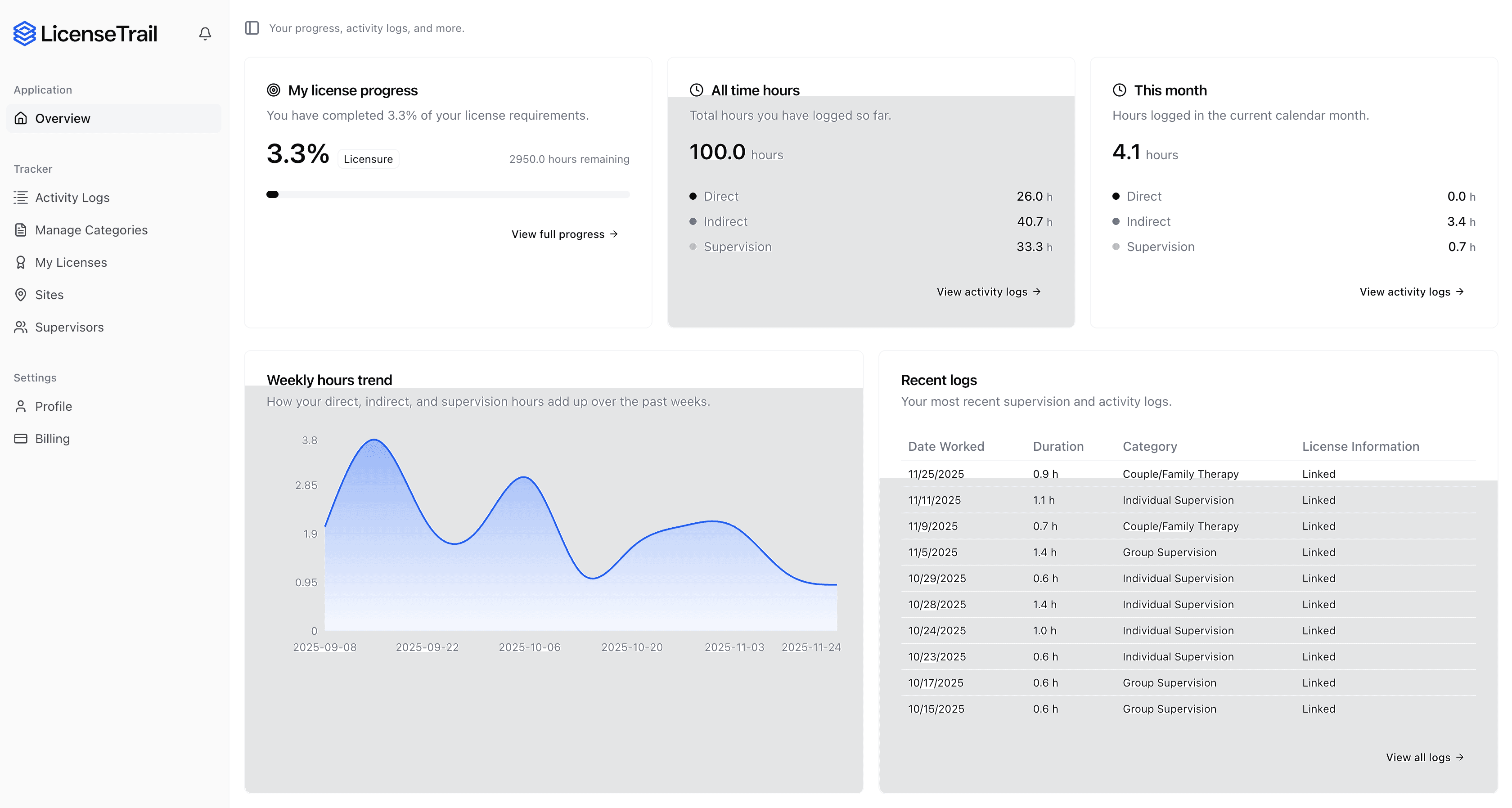
License Trail checks your direct, indirect, and supervision hours against Oklahoma LSWA requirements continuously and flags mismatches before you submit.
 Start Tracking for Free
No credit card required · Free plan available
Is your spreadsheet hiding Oklahoma LSWA risks?
Stop guessing if your categories match Oklahoma State Board of Licensed Social Workers requirements. License Trail checks your direct, indirect, and supervision hours continuously and flags mismatches before you submit.
Import or log
Bring your spreadsheet or start fresh
Upload your existing tracking spreadsheet and we'll map every hour into the right Oklahoma State Board of Licensed Social Workers categories automatically.
Verify against Oklahoma
Catch mismatches before the board does
License Trail checks your direct, indirect, and supervision hours against Oklahoma LSWA requirements continuously.
Export board-ready
One-click clean reports
Generate professional, board-ready reports for supervision meetings and Oklahoma State Board of Licensed Social Workers submissions in seconds.
No credit card required · Free plan available