
Oregon LMFT Requirements: Hours, Exams & Step-by-Step Guide
Stop guessing if your categories match Oregon requirements. License Trail checks your direct, indirect, and supervision hours against LMFT requirements continuously and flags mismatches before you submit.
No credit card required · Free plan available
Quick Requirements Overview
- Degree: Master’s/doctoral meeting OR LMFT standards (COAMFTE MFT, CACREP MCFC, or OR-equivalent); includes diagnosis coursework (2 sem / 3 qtr credits).
- Credits (if non‑COAMFTE/foreign): Program ≥2 academic years; 60 sem/90 qtr (degree on/after 10/1/2014) or 48 sem/72 qtr (before).
- Practicum/Internship (in‑program): 280 direct client contact hrs (on/after 10/1/2014) or 240 (before).
- Associate registration: Post‑degree OR hours generally must be under Registered Associate status with a Board‑approved supervision plan (and correct title use).
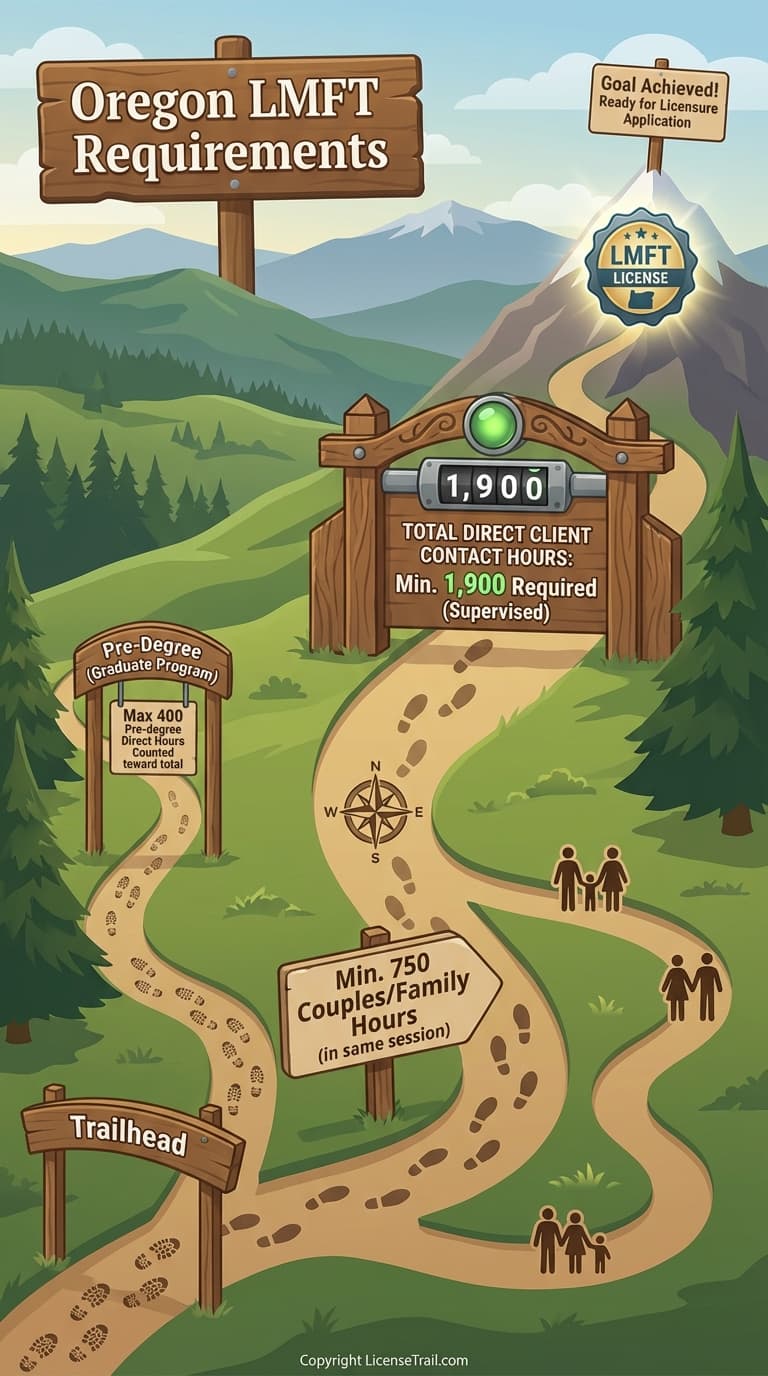
- Experience: 36 months supervised clinical experience and 1,900 supervised direct client contact hrs, incl. 750 hrs with couples/families in the same session.
- Pre‑degree credit: Up to 400 direct client contact hrs (and up to 1 year experience) from qualifying graduate clinical training may count toward the 1,900.
- Supervision (Registered Associates): Same month as client hours; 2+ meetings/month in different weeks (≥1 hr each); 2 hrs sup if ≤45 client hrs/mo or 3 hrs if ≥46; ≥50% individual; noncompliant months = 0 hrs credited.
- Exams: Pass AMFTRB MFT exam or CA BBS MFT Clinical exam (generally within 10 years) plus the Oregon Law & Rules exam.
License Details
Procedures
Becoming a Licensed Marriage and Family Therapist (LMFT) in Oregon involves meeting very specific education, experience, and examination standards set by the Oregon Board of Licensed Professional Counselors and Therapists (OBLPCT). The details below reflect Oregon statutes and administrative rules current through mid‑2025, as well as the Board’s own guidance as of late 2025. Always verify on the Board’s site before you apply, because rules can change.
1. Key Definitions the Oregon Board Uses
Understanding the Board’s terminology is essential before you start logging hours.
“Clinical experience”
For LMFTs, the Board defines clinical experience as professional practice in which you apply assessment, diagnosis, and treatment methods to individuals and families with mental health disorders. This is the broader umbrella under which your supervised hours occur. (oregon.gov)
“Direct client contact hours”
The Board defines direct client contact hours as:
- Only hours that are therapeutic, or assessment that leads into therapy,
- Provided directly to clients (individuals, couples, families, or groups),
- Delivered via face‑to‑face or voice‑to‑voice communication (including approved telehealth). (oregon.gov)
The Board explicitly says these do not count as direct client contact:
- Intake-only work if there is no ongoing therapeutic interaction,
- Case management, advocacy, administration, research,
- Teaching, training, or attending groups,
- Your supervision time. (oregon.gov)
When Oregon talks about hour requirements, they are talking about this specific type of “supervised direct client contact.”
2. Educational Requirements for LMFT Licensure
2.1 Graduate degree
You must hold a master’s or doctoral degree that meets LMFT standards in Oregon. The degree must be from one of the following: (oregon.gov)
- A marriage and family therapy program approved by COAMFTE, or
- A program fully accredited by CACREP in marriage, couple, and family counseling, or
- A program at a regionally accredited institution (or an approved foreign credential) that meets detailed LMFT coursework requirements in Oregon rules.
COAMFTE- and CACREP-accredited programs must also include formal coursework (at least 2 semester or 3 quarter credits) in the diagnosis of mental disorders. (oregon.gov)
2.2 Minimum program length and credits (for non‑COAMFTE/foreign programs)
For regionally accredited, non‑COAMFTE (and foreign) programs, Oregon requires: (oregon.gov)
- Degree at least 2 academic years in duration, and
- At least 60 semester credits / 90 quarter credits if granted on or after October 1, 2014; or
- At least 48 semester credits / 72 quarter credits if granted before that date.
2.3 Required practicum / internship hours (during the degree)
Your graduate program must include a supervised clinical practicum or internship with:
- If degree granted on or after October 1, 2014: at least 280 direct client contact hours.
- If degree granted before October 1, 2014: at least 240 direct client contact hours. (oregon.gov)
These are direct client contact hours as defined above (therapy and assessment-plus-therapy, face‑to‑face or voice‑to‑voice), not including administration, case management, or supervision.
3. Registered Associate Status (Pre‑License)
Oregon requires most people earning post‑degree hours in Oregon to register with the Board as a Registered Associate under an approved supervision plan. (oregon.gov)
Key points:
- You cannot use titles like “LMFT-A” or “LPC-Associate”; the Board directs you to use titles such as “Marriage and Family Therapist Associate” or “Registered Associate.” (oregon.gov)
- Any Oregon hours after June 30, 2002 count toward licensure only if earned under a Board‑approved associate registration plan (unless you qualify via a direct or reciprocity method). (oregon.gov)
4. Core Experience Requirement: Years and Hours
4.1 Overall time requirement
To become an LMFT, you must complete at least three years (36 months) of supervised clinical experience. (oregon.gov)
This 36‑month requirement is separate from the raw hour totals; you need both the time span and the hour counts.
4.2 Direct client contact hour requirement (the crucial numbers)
As of July 1, 2023 (and reflected in current rules and Board guidance), Oregon requires LMFT applicants to complete: (oregon.gov)
- At least 1,900 hours of supervised direct client contact in therapy,
- Of those 1,900 hours, at least 750 hours must be with couples and families in the same session.
These are not two separate pools of hours (e.g., “1,900 direct” plus additional supervised hours). Instead:
- The 1,900 hours are all supervised direct client contact hours.
- The 750 hours are a subset of those 1,900 hours, specifically where you are working with couples and families together.
In addition, all of this occurs within at least 36 months of supervised clinical experience.
4.3 Pre‑degree hours that can be applied
Oregon allows a limited number of pre‑degree hours from your graduate practicum/internship to count toward the 1,900: (oregon.gov)
- You may apply up to one year of full‑time supervised clinical experience and up to 400 hours of supervised direct client contact from the clinical portion of your qualifying graduate program.
Because your LMFT degree must already include at least 240 or 280 direct client contact hours, you can potentially credit up to 400 of those hours toward the 1,900-hour requirement, but not more.
5. What Counts (and Does Not Count) Toward the 1,900 Hours
5.1 Hours that do count
To be counted as direct client contact hours for LMFT licensure in Oregon, hours must: (oregon.gov)
- Be clinical in nature (assessment leading into therapy, and therapy itself),
- Involve you directly providing counseling or therapy to a client or clients (individuals, couples, families, or groups),
- Involve real‑time contact (in‑person or approved telehealth).
Examples that typically count:
- Individual psychotherapy sessions,
- Couple and family sessions (these are where you build the 750‑hour subset),
- Group therapy sessions,
- Initial assessments when followed by therapeutic work as part of the same treatment process.
5.2 Hours that do not count as direct client contact
The Board explicitly excludes the following from direct client contact hour totals: (oregon.gov)
- Intake-only sessions if there is no ongoing treatment,
- Case management and coordination,
- Program administration or paperwork,
- Research or advocacy activities,
- Teaching, training, or attending staff meetings or discussion groups,
- Your own supervision time.
These activities may be part of your broader “clinical experience” but they do not contribute to the 1,900 direct client contact hours.
6. Supervision Requirements and Structure
6.1 Who can supervise LMFT hours
For LMFT applicants using the direct or reciprocity methods, your supervised clinical experience must occur under a formal arrangement with a supervisor who: (oregon.gov)
- Is specifically trained in the systemic approach to couples and family therapy, and
- Holds a graduate‑level state‑issued license or registration as a marriage and family therapist, or an equivalent license (e.g., professional counselor, clinical psychologist, or clinical social worker) as determined by the Board.
For Registered Associates in Oregon, your associate registration plan must list approved supervisors who meet Board criteria.
6.2 Required monthly supervision pattern (for Registered Associates)
The Board provides specific supervision standards for Registered Associates: (oregon.gov)
- You must complete a minimum of 36 months and 1,900 direct client contact hours under supervision; for LMFT, 750 must be with couples and families.
- Supervision for those direct client contact hours must occur in the same calendar month as the client contact.
- Supervision meetings must:
- Occur at least twice per month,
- Occur in different weeks, and
- Last at least one hour each.
Ratio of supervision to client contact hours per month: (oregon.gov)
-
If you have 45 or fewer client contact hours in a month:
- You must receive at least 2 hours of supervision,
- Of which at least 1 hour must be individual (one‑on‑one).
-
If you have 46 or more client contact hours in a month:
- You must receive at least 3 hours of supervision,
- Of which at least 1.5 hours must be individual.
At least 50% of the minimum required supervision for post‑degree hours must be individual supervision (not group). (oregon.gov)
If in any month your supervision does not meet these minimums, none of the client contact hours for that month will be credited toward licensure. (oregon.gov)
7. Experience Pathways: Associate, Direct, and Reciprocity
Oregon recognizes three main methods of documenting your experience for LMFT licensure. The hour requirements for LMFT are the same (1,900 direct hours with 750 couples/families) but how you prove them differs. (oregon.gov)
-
Associate Registration Method
- For applicants gaining post‑degree hours in Oregon under a Board‑approved Registered Associate supervision plan.
- Must meet all supervision frequency and ratio requirements described above.
-
Direct Method
- For applicants who already have qualifying supervised experience (e.g., from another state or older Oregon experience) and can document at least 1,900 supervised direct client contact hours, including 750 with couples/families.
-
Reciprocity Method
- For applicants already licensed as LMFTs in another U.S. state.
- If you have been actively licensed for three or more years, the Board presumes you have met Oregon’s experience requirements and does not require further documentation of hours; otherwise, you must document that your prior supervised experience meets Oregon’s hour requirements. (regulations.justia.com)
8. Examination Requirements
Oregon requires two exams for LMFT licensure: a competency exam and an Oregon law and rules exam. (oregon.gov)
8.1 LMFT competency exam
You must pass one of the following:
- The Marital and Family Therapy Examination of the Association of Marital & Family Therapy Regulatory Boards (AMFTRB), or
- The California Board of Behavioral Sciences’ Marriage and Family Therapist Written Clinical Examination.
The exam must have been passed within 10 years prior to the date your application is received, unless you qualify for a specific reciprocity exception through continuing education. (oregon.gov)
8.2 Oregon law and rules exam
After your application is approved (and, for Registered Associates, after your experience requirement is met), you must also pass the Oregon Law and Rules Examination:
- Open-book, online, untimed (but must be completed in one sitting),
- Covers Oregon Revised Statutes (ORS) and Oregon Administrative Rules (OAR) relevant to counseling and MFT practice. (oregon.gov)
9. Practical Step‑by‑Step Summary
Putting all of this together, the Oregon LMFT pathway typically looks like this:
-
Complete a qualifying LMFT graduate program
- Meets COAMFTE/CACREP or Board‑approved equivalency,
- Contains required diagnosis coursework,
- Includes at least 240–280 direct client contact hours in practicum/internship.
-
Apply to the Oregon Board
- Submit an online application for LMFT via the Applicant Portal,
- If you will earn post‑degree hours in Oregon, apply for Registered Associate status with a supervision plan.
-
Accrue supervised clinical experience
- At least 36 months of supervised clinical experience, and
- At least 1,900 supervised direct client contact hours, including
- At least 750 hours with couples and families in the same session,
- With up to 400 direct hours from your graduate practicum/internship allowed to count toward the 1,900.
-
Meet monthly supervision requirements while a Registered Associate
- Supervision every month in which you see clients,
- At least two one‑hour meetings per month in different weeks,
- Supervision hours scaled to your client hours (2–3 hours per month minimum),
- At least half of required supervision as individual supervision.
-
Pass the exams
- Pass the AMFTRB MFT exam or the California MFT clinical exam, and
- Pass the Oregon Law and Rules Examination.
-
Request promotion to full LMFT licensure
- Once hours, time-in-practice, supervision, and exams are complete and documented to the Board’s satisfaction, you can be promoted from Registered Associate to Licensed Marriage and Family Therapist (LMFT) in Oregon.
This framework shows how Oregon’s requirements center on 1,900 hours of supervised direct client contact (with 750 hours focused on couples and families) within three years of supervised clinical experience, plus a qualifying LMFT degree and two required examinations.
Track your LMFT hours with confidence
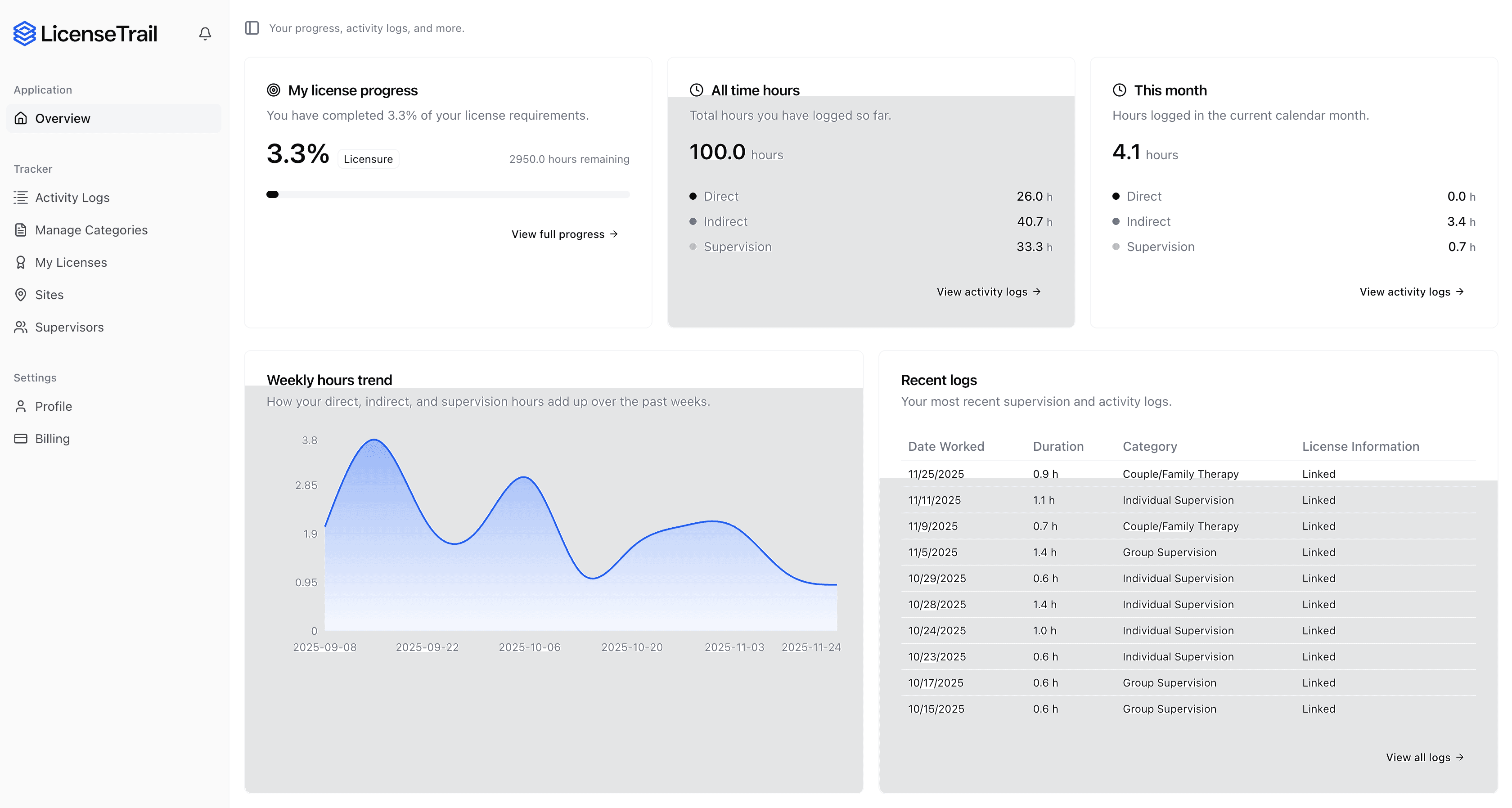
License Trail checks your direct, indirect, and supervision hours against Oregon LMFT requirements continuously and flags mismatches before you submit.
 Start Tracking for Free
No credit card required · Free plan available
Related Licenses
Is your spreadsheet hiding Oregon LMFT risks?
Stop guessing if your categories match Oregon Board of Licensed Professional Counselors and Therapists requirements. License Trail checks your direct, indirect, and supervision hours continuously and flags mismatches before you submit.
Import or log
Bring your spreadsheet or start fresh
Upload your existing tracking spreadsheet and we'll map every hour into the right Oregon Board of Licensed Professional Counselors and Therapists categories automatically.
Verify against Oregon
Catch mismatches before the board does
License Trail checks your direct, indirect, and supervision hours against Oregon LMFT requirements continuously.
Export board-ready
One-click clean reports
Generate professional, board-ready reports for supervision meetings and Oregon Board of Licensed Professional Counselors and Therapists submissions in seconds.
No credit card required · Free plan available