
Oregon LPC Requirements: Hours, Exams & Step-by-Step Guide
Stop guessing if your categories match Oregon requirements. License Trail checks your direct, indirect, and supervision hours against LPC requirements continuously and flags mismatches before you submit.
No credit card required · Free plan available
Quick Requirements Overview
- Qualifying graduate degree (master’s/doctorate) from CACREP/CORE program or regionally accredited (or Board‑approved foreign eval); CACREP/CORE must include 2 semester/3 quarter credits in diagnosis
- Supervised clinical counseling experience: 3 years (36 months) minimum
- Supervised direct client contact: 1,900 hours minimum (therapeutic or assessment+therapy; face‑to‑face or voice‑to‑voice)
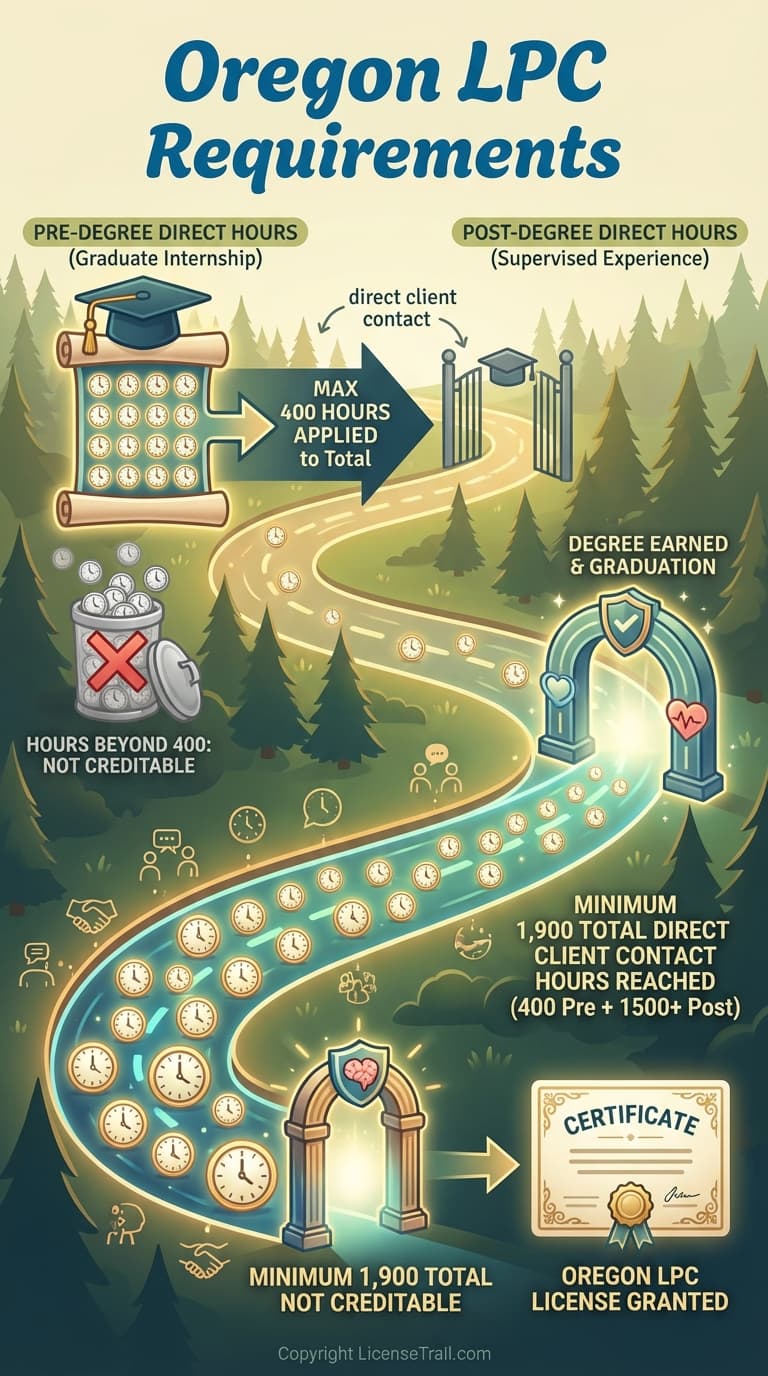
- Pre‑degree allowance: up to 400 of the 1,900 direct hours may be from supervised practicum/internship during the degree’s clinical portion
- Oregon post‑degree hours (after 6/30/2002) require Registered Associate plan/approval for hours to count
- Supervision (Associate): 2 meetings/month in different weeks, ≥1 hr each; 2 hrs/month if ≤45 direct hrs, 3 hrs/month if ≥46; ≥50% individual; must occur same calendar month or that month’s hours don’t count
- Exams: pass NCE or NCMHCE or CRC (within 10 years of application) and the Oregon law & rules exam
License Details
Procedures
Licensure as a Licensed Professional Counselor (LPC) in Oregon is governed by the Oregon Board of Licensed Professional Counselors and Therapists (OBLPCT). The Board ties licensure to three main elements:
- A qualifying graduate degree in counseling
- A specific amount and type of supervised clinical experience
- Passage of a national competency exam plus the Oregon law and rules exam
Below is a structured overview, with emphasis on the exact types of hours and how the Board defines them.
1. Educational requirements
Degree level and program type
To qualify educationally as an LPC applicant, you must hold a graduate degree (master’s or doctorate) from one of the following:(oregon.gov)
- A counseling program approved by CACREP or CORE; or
- A counseling or related program at an institution of higher learning accredited by a regional accrediting agency; or
- A foreign program evaluated by a credentialing body recognized by the Board (with extra programmatic requirements).
If the program is CACREP/CORE, it must include at least 2 semester credits or 3 quarter credits in diagnosis of mental disorders.(oregon.gov)
For regionally accredited non‑CACREP/CORE or foreign programs, the Board applies detailed programmatic requirements (course content areas, practicum/internship, etc.), which are spelled out in OAR Chapter 833, Division 30 and related guidance.(oregon.gov)
2. How Oregon defines clinical experience and direct client hours
Before looking at hour counts, it helps to understand the Board’s terminology.
On its “Experience” page, the Board states that:(oregon.gov)
- “Clinical experience” means the professional practice of applying counseling principles and methods to provide assessment, diagnosis, and treatment for individuals and families with mental health disorders (paraphrased).
- “Direct client contact hours” are those clinical experience hours that are therapeutic or involve a combination of assessment and subsequent therapeutic interactions (again, paraphrased).
- Qualifying clinical hours are counseling/therapy services provided directly with clients (individuals, couples, families, or groups) and must be face‑to‑face or voice‑to‑voice communication.
- The following do not count as clinical experience hours: intake-only work, case management, casual contact, research, advocacy, program administration, instruction, attending training or discussion groups, or supervision hours.
So, for Oregon LPC purposes, “direct client contact” is a subset of “clinical experience” and is limited to actual therapeutic or assessment‑plus‑therapy services delivered directly to clients.
3. Core experience requirement for an Oregon LPC
3.1 Overall supervised clinical experience (time requirement)
Oregon requires at least three years (36 months) of supervised clinical counseling experience for LPC licensure. This is stated in both the Board’s Experience page and in OAR 833‑030‑0021:(oregon.gov)
- Rule 833‑030‑0021(1) provides that an LPC applicant “must have completed at least three years, defined as 36 months, of supervised clinical counseling experience.”
This is a time requirement and is separate from (but must include) the specific hour requirements discussed next.
3.2 Direct client contact hours (numeric requirement)
The key numeric requirement is:
- At least 1,900 hours of supervised direct client contact
This appears in multiple places:
- The Board’s Experience page for LPCs: supervised clinical experience “must include at least 1,900 supervised direct client contact hours of counseling,” with up to 400 of those hours allowed pre‑degree (during the clinical portion of the qualifying graduate program).(oregon.gov)
- OAR 833‑050‑0071(1) similarly states that registered associates must complete at least three years (36 months) of supervised clinical experience that includes no less than 1,900 hours of supervised direct client contact to qualify for licensure.(secure.sos.state.or.us)
- For direct/reciprocity applicants, OAR 833‑030‑0021(3) provides that supervised clinical experience must include no less than 1,900 supervised direct client contact hours.(secure.sos.state.or.us)
Important:
Oregon does not split the requirement into separate, additional numeric quotas for “indirect” or non‑direct hours (such as treatment planning, documentation, etc.), the way some states do (e.g., 1,500 direct + 1,500 other). Instead, Oregon specifies:
- A minimum duration: 3 years / 36 months
- A minimum direct contact total: 1,900 supervised direct client contact hours
- All of it occurring under Board‑acceptable supervision within a Board‑approved structure
You will naturally accumulate many additional non‑direct, supervised clinical hours, but Oregon’s rule only sets a specific number for direct client contact (1,900).
3.3 Pre‑degree vs. post‑degree hours
The Board allows some pre‑degree (internship) hours to count, but only within limits:
- Up to 400 hours of the required 1,900 supervised direct client contact hours may be completed pre‑degree, during the clinical portion of the qualifying graduate program.(oregon.gov)
- These pre‑degree hours must be formal, supervised clinical experience as part of the graduate internship/practicum (not casual volunteer work).
The remainder of your 1,900 hours must be accrued post‑degree, under supervision that meets Board rules (often as a Registered Associate in Oregon).
4. Associate Registration method (typical in‑state path)
For most new graduates in Oregon, the usual path is via Associate Registration.
4.1 When this method is required
The rules state that the associate registration method is required if you want the Board to accept post‑degree supervised clinical experience completed in Oregon after June 30, 2002. You must obtain Board approval of an Associate Registration Plan before those hours will count.(secure.sos.state.or.us)
4.2 Required hours under Associate Registration
The Associate Registration page summarizes the LPC requirement as:(oregon.gov)
- A minimum of 3 years (36 months) of supervised clinical experience; and
- At least 1,900 hours of supervised direct client contact (with a note that this replaced an older 2,400‑hour requirement effective July 1, 2023).
These hours must satisfy the direct client contact and supervision rules in Division 50 (registered associates) and Division 130 (supervisor qualifications).(secure.sos.state.or.us)
You have five years from initial registration to complete the experience requirements for licensure or examination; failure to do so generally results in expiration of registration and closure of your file, unless the Board grants a limited extension for good cause.(secure.sos.state.or.us)
4.3 Supervision structure while you are a Registered Associate
Division 50 gives detailed supervision requirements for counting your direct client hours:
- Timing: Supervision of your direct client contact must occur within the same calendar month as the hours being supervised.(secure.sos.state.or.us)
- Frequency: You must have supervision meetings at least twice per month in different weeks, each meeting at least one hour long.(secure.sos.state.or.us)
- Amount per month:
- At least 2 hours of supervision in months when you complete 45 or fewer direct client contact hours.
- At least 3 hours of supervision in months when you complete 46 or more direct client contact hours.(secure.sos.state.or.us)
- Format: Supervision must be either in‑person in a professional setting or via live, synchronous, confidential electronic communication (e.g., secure video).(secure.sos.state.or.us)
- Individual vs. group: At least 50% of your monthly supervision hours must be one‑on‑one individual supervision. Group supervision is allowed but must:
- Include no more than six supervisees
- Have a single, non‑shifting supervisor leader
- Not double as staff meetings, training seminars, QA meetings, etc.(secure.sos.state.or.us)
- Credit for hours: If, in any month, you do not receive the minimum required supervision hours, none of your direct client contact hours for that month can be credited toward licensure.(secure.sos.state.or.us)
In addition, associates must document and report their hours by practice site under the approved plan, and supervisors must meet specific qualifications set out in Division 130 (graduate‑level state license, appropriate training/experience, not a relative, and so on).(secure.sos.state.or.us)
5. Direct Method and Reciprocity Method (alternative pathways)
Although most early‑career counselors use the Associate Registration method, Oregon recognizes two other application methods, each with the same ultimate hour requirement.
5.1 Direct Method
Under the Direct Method, you apply for licensure once you have already completed all required supervised experience. OAR 833‑030‑0021 describes this:(secure.sos.state.or.us)
- Your supervised clinical counseling experience must total at least three years (36 months).
- It must include at least 1,900 supervised direct client contact hours of counseling.
- These hours may be made up of any combination of:
- Post‑graduate supervised experience completed in Oregon before June 30, 2002;
- Post‑graduate supervised experience completed in another jurisdiction under that jurisdiction’s laws and rules;
- Experience completed while you were a registered associate with OBLPCT; and
- Up to one year of full‑time supervised clinical experience and 400 supervised direct client contact hours completed during the clinical portion of your qualifying graduate program.
The experience must be under a formal supervisory arrangement with a graduate‑level licensed counselor or equivalent (clinical psychologist, clinical social worker, LMFT, or similar) acceptable to the Board.(secure.sos.state.or.us)
5.2 Reciprocity Method
The Reciprocity Method is for applicants already licensed as professional counselors in another U.S. state. Experience requirements mirror the Direct Method, with a few adjustments:(oregon.gov)
- If you have been licensed less than three years, you must document supervised clinical experience that meets the same 1,900 supervised direct client contact hours standard.
- OAR 833‑030‑0021(4) allows up to two years of post‑license clinical experience to substitute for up to 200 hours of the 1,900 required direct client contact hours (credited at 100 hours per full year of post‑license practice).(secure.sos.state.or.us)
- If you have held an active qualifying license for three or more years in any U.S. state, the Board presumes you have met the experience requirements, and you generally do not have to submit detailed hour documentation.(secure.sos.state.or.us)
6. Examination requirements
Licensure as an LPC in Oregon also requires passing both:
- A national competency exam, and
- The Oregon law and rules exam.(oregon.gov)
6.1 Competency exam options for LPCs
According to the Board’s Exams page, LPC applicants must pass one of the following:(oregon.gov)
- National Counselor Examination (NCE)
- National Clinical Mental Health Counselor Examination (NCMHCE)
- Certified Rehabilitation Counselor Examination (CRC)
The exam must be passed within 10 years prior to applying for licensure. You apply through the Board (or in some cases, another jurisdiction) for exam authorization and have your scores sent directly to the Oregon Board.
6.2 Oregon law and rules exam
All LPC and LMFT applicants must pass the Oregon law and rules exam, which covers Oregon statutes and administrative rules governing counseling practice, ethics, and Board procedures. Passing this exam is mandatory even if you are applying by reciprocity.(oregon.gov)
7. Step‑by‑step: putting it all together
For a typical applicant educated and practicing in Oregon, the process to become a Licensed Professional Counselor looks like this:
-
Complete a qualifying graduate degree
- Master’s or doctorate in counseling (or closely related field) from a CACREP/CORE‑approved program, a regionally accredited program meeting OBLPCT’s programmatic requirements, or an approved foreign program.(oregon.gov)
-
Apply for Associate Registration (if accruing post‑degree hours in Oregon)
- Submit an online application and an Associate Registration Plan that specifies where and how you will accrue supervised clinical experience and who will supervise you.(secure.sos.state.or.us)
-
Accrue supervised clinical experience as a Registered Associate
- Over at least 36 months, accrue:
- 1,900 hours of supervised direct client contact (up to 400 of these may be pre‑degree internship hours if they meet criteria); and
- Additional supervised clinical work as part of your practice, meeting the Board’s definitions of “clinical experience” and “direct client contact.”(oregon.gov)
- Follow all supervision rules (2–3 hours/month, required mix of individual and group supervision, timely monthly supervision, appropriate documentation).(secure.sos.state.or.us)
- Over at least 36 months, accrue:
-
Pass the national competency exam
- NCE, NCMHCE, or CRC, with scores sent directly to OBLPCT.(oregon.gov)
-
Pass the Oregon law and rules exam
- After meeting educational and (for most applicants) experience requirements.
-
Apply for promotion to Licensed Professional Counselor
- Once the Board confirms you have met education, experience (3 years + 1,900 supervised direct hours under correct supervision), examination, and background check requirements, it issues the LPC license.(oregon.gov)
Key numbers and definitions at a glance (Oregon LPC, current rules)
- Minimum duration of supervised experience:
- 3 years (36 months) of supervised clinical counseling experience.
- Minimum direct client contact requirement:
- 1,900 supervised direct client contact hours of counseling.
- Pre‑degree hours allowed:
- Up to 400 of the 1,900 direct hours may be from supervised, degree‑program clinical internship/practicum.
- Definition focus:
- “Direct client contact” = therapeutic or assessment‑plus‑therapy services delivered directly to clients, face‑to‑face or via live voice/electronic communication, not including administration, training, or supervision time.(oregon.gov)
These figures and definitions are based on the Board’s Experience page and the current Oregon Administrative Rules (especially OAR 833‑030‑0021 and OAR 833‑050‑0071/0081), as amended through 2024 and in effect as of late 2025.
Track your LPC hours with confidence
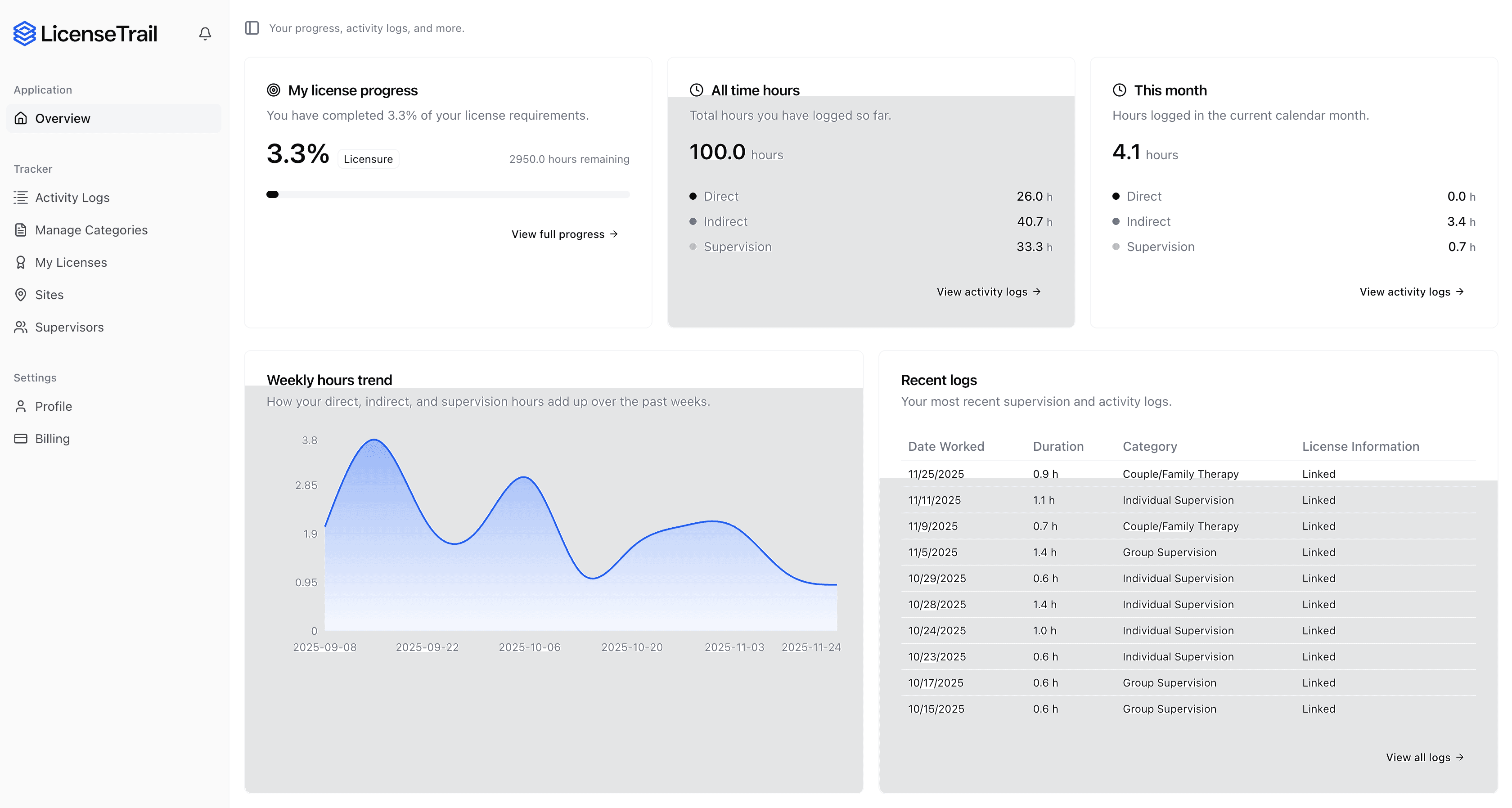
License Trail checks your direct, indirect, and supervision hours against Oregon LPC requirements continuously and flags mismatches before you submit.
 Start Tracking for Free
No credit card required · Free plan available
Related Licenses
Is your spreadsheet hiding Oregon LPC risks?
Stop guessing if your categories match Oregon Board of Licensed Professional Counselors and Therapists requirements. License Trail checks your direct, indirect, and supervision hours continuously and flags mismatches before you submit.
Import or log
Bring your spreadsheet or start fresh
Upload your existing tracking spreadsheet and we'll map every hour into the right Oregon Board of Licensed Professional Counselors and Therapists categories automatically.
Verify against Oregon
Catch mismatches before the board does
License Trail checks your direct, indirect, and supervision hours against Oregon LPC requirements continuously.
Export board-ready
One-click clean reports
Generate professional, board-ready reports for supervision meetings and Oregon Board of Licensed Professional Counselors and Therapists submissions in seconds.
No credit card required · Free plan available