
Rhode-island CMHCA Requirements: Hours, Exams & Step-by-Step Guide
Stop guessing if your categories match Rhode-island requirements. License Trail checks your direct, indirect, and supervision hours against CMHCA requirements continuously and flags mismatches before you submit.
No credit card required · Free plan available
Quick Requirements Overview
- Authority: RI Board of Mental Health Counselors & Marriage and Family Therapists (DOH); R.I. Gen. Laws §5‑63.2‑9; 216‑RICR‑40‑05‑11
- Character requirement: Must be of “good character”
- Education: Graduate degree specializing in counseling/therapy from a regionally accredited/recognized institution (CACREP accepted; equivalent pathways allowed)
- Credits: 60 semester credits / 90 quarter credits in counseling/therapy (completed before any post‑graduate supervised experience)
- Practicum: CACREP practicum or 12 semester / 18 quarter credits of supervised practicum
- Internship: 1 calendar year supervised internship at 20 hrs/week; minimum 600 hours
- No post‑degree hours for CMHCA: 2,000 direct client hours + 100 supervision hours apply only for upgrading to full CMHC
- Term: CMHCA expires 3 years from issuance; Board may grant 1‑year extension for good cause
License Details
Procedures
Rhode Island licenses entry‑level clinical counselors under the title Clinical Mental Health Counselor Associate (CMHCA). This credential is overseen by the Rhode Island Board of Mental Health Counselors and Marriage and Family Therapists, housed within the Department of Health, and is defined in both statute (R.I. Gen. Laws § 5‑63.2‑9) and the state regulations (216‑RICR‑40‑05‑11). (webserver.rilegislature.gov)
The CMHCA credential is an education‑based license. The only hours you must document at this stage are:
- Graduate credit hours in counseling/therapy, and
- Practicum and internship hours completed as part of your program.
Post‑degree supervised practice hours (like the 2,000 hours plus 100 hours of supervision required for full Clinical Mental Health Counselor licensure) are not required to obtain the CMHCA. Those come later when you upgrade to full licensure. (webserver.rilegislature.gov)
Below is a step‑by‑step guide that tracks the Board’s own language and structure.
1. Meet the baseline statutory criteria for a CMHCA
Rhode Island law on “Qualifications of licensed clinical mental health counselor associates and licensed clinical mental health counselors” sets the core requirements. For an associate, you must: (webserver.rilegislature.gov)
-
Be “of good character.”
- The statute explicitly lists good character as the first prerequisite.
-
Earn the required graduate degree in counseling/therapy.
- You must have a graduate degree specializing in counseling/therapy from a regionally accredited college or university (New England Association of Schools and Colleges or equivalent), recognized by an appropriate national or regional certifying authority. (webserver.rilegislature.gov)
-
Complete the required number of graduate credits.
- The law requires at least 60 semester hours or 90 quarter hours within your graduate counseling/therapy program. (webserver.rilegislature.gov)
-
Complete supervised practicum and internship as part of your training.
- Statute requires a minimum of 12 semester hours (or 18 quarter hours) of supervised practicum, and
- At least one full calendar year of supervised internship at 20 hours per week (or equivalent), with emphasis in mental health counseling, supervised by your program or an accredited postgraduate clinical training program recognized by the U.S. Department of Education (or equivalent education/experience accepted by the Board). (webserver.rilegislature.gov)
These statutory requirements are the foundation. The Board’s regulations then refine what types of degrees and practicum/internship arrangements will qualify.
2. Satisfy the Board’s degree and coursework pathway (216‑RICR‑40‑05‑11.3)
Under 216‑RICR‑40‑05‑11.3, section 11.3.2 (“Clinical Mental Health Counselor Associate”), the Board describes what counts as an acceptable degree and coursework pathway. (regulations.justia.com)
2.1 Acceptable degree types
To be licensed as a “clinical mental health counselor associate,” you must have completed one of the following: (regulations.justia.com)
-
A master’s or higher degree from a CACREP‑accredited counseling program, or from an equivalent accrediting agency approved by both the Board and the relevant national/regional certifying authority; or
-
A master’s degree, certificate of advanced graduate studies, or doctoral degree in mental health counseling from a recognized educational institution; or
-
A graduate degree in an allied field plus graduate‑level coursework equivalent to a master’s degree in mental health counseling,
- and that coursework must include the core curriculum components listed in § 11.5.1 of the regulations (e.g., counseling theory, assessment, ethics, etc.). (regulations.justia.com)
2.2 Required counseling/therapy credit hours
The regulations repeat and clarify the credit‑hour requirement:
- You must have 60 semester credits or 90 quarter credits in your graduate counseling/therapy program or post‑graduate program.
- Those 60 semester/90 quarter credits must be completed before you begin any post‑graduate experience and supervised case‑work hours (i.e., the hours that will later be used toward full Clinical Mental Health Counselor licensure). (regulations.justia.com)
So, in Board terms, the “hours” at the CMHCA stage are:
60 semester credit hours (or 90 quarter credit hours) in counseling/therapy at the graduate level, completed before you start post‑graduate supervised practice.
3. Practicum and internship hour requirements
The Board’s regulations give two ways to satisfy the practicum/internship requirement for the CMHCA. These are educational training hours, not post‑degree work hours.
3.1 Option A: CACREP practicum and internship
If you graduate from a CACREP‑accredited counseling program, you can satisfy the requirement simply by having completed the practicum and internship required by CACREP (the regulation calls this “requisite CACREP expectations for internship and practicum”). (regulations.justia.com)
3.2 Option B: Explicit credit‑hour and time minimums
If you are not using CACREP expectations as your pathway, the regulation spells out explicit, quantitative requirements: (regulations.justia.com)
-
Supervised practicum (in credit hours)
- At least 12 semester credit hours or 18 quarter credit hours of supervised practicum in counseling/therapy.
-
Supervised internship (in clock hours and time)
- A minimum of one (1) calendar year of supervised internship,
- Consisting of 20 hours per week, and
- “In no case less than 600 hours” of internship experience.
Putting this into the kind of breakdown you asked for:
-
Practicum requirement for CMHCA (educational stage)
- 12 semester credits (or 18 quarter credits) of supervised practicum in counseling/therapy.
-
Internship requirement for CMHCA (educational stage)
- At least 1 full year of supervised internship,
- 20 hours per week,
- No fewer than 600 total internship hours, as explicitly stated by the regulation. (regulations.justia.com)
These hours are all pre‑licensure, embedded in your graduate (or post‑graduate) training, and are part of what qualifies you for the associate license.
4. How these hours differ from full Clinical Mental Health Counselor licensure
Rhode Island’s model is different from the “1,500 direct / 1,500 supervised” example you mentioned. For full Clinical Mental Health Counselor licensure, the law instead requires: (webserver.rilegislature.gov)
- At least two (2) years of relevant post‑graduate experience, and
- At least 2,000 hours of direct client contact in clinical/counseling/therapy services with an emphasis in mental health counseling, after your qualifying degree, plus
- At least 100 hours of post‑degree supervised case‑work over that two‑year period, under an approved supervisor.
Those 2,000 direct client‑contact hours + 100 supervision hours are not part of the CMHCA requirements; they are what you complete after becoming an associate, on the road to full licensure. University and Board guidance explicitly state that the associate license does not require those post‑graduate hours or the national exam. (regulations.justia.com)
So, in Rhode Island terms:
- CMHCA = education, practicum and internship hours (600+ internship hours), but no post‑degree clinical hour requirement yet.
- Full CMHC license = 2,000 hours of post‑degree direct client contact + 100 hours of supervision, completed after graduation and typically after you hold the CMHCA.
5. Application process and Board review
The Board’s regulations and the statute outline a fairly standard application process for CMHCAs. (regulations.justia.com)
5.1 Documentation you must submit
While the Board’s application forms are provided by the Department of Health, the law and regulations require you to submit “written evidence on forms furnished by the Department” that you have followed an approved pathway for licensure. In practice, this means: (regulations.justia.com)
- Proof of graduate degree and program accreditation/approval (CACREP or equivalent pathway).
- Official transcripts showing:
- At least 60 semester / 90 quarter graduate credits in counseling/therapy.
- The 12 practicum credits (or CACREP practicum).
- The internship year (20 hours/week, minimum 600 hours) or documentation that you completed CACREP‑equivalent internship.
- Any practicum/internship verification forms required by the Board or your program.
- Attestations or other forms addressing good character, as required by the Department.
- A non‑refundable application fee, set in a separate Department of Health “Fee Structure” regulation. (regulations.justia.com)
5.2 Board approval
The statute also notes that a candidate is considered to have qualified for licensure (either as a CMHCA or full CMHC) only after an affirmative vote of at least four Board members, including two mental health counselors. (webserver.rilegislature.gov)
6. Length of the CMHCA license and progression to full licensure
The regulations specify the life span of an associate license and how it fits into the overall timeline. (regulations.justia.com)
- A Clinical Mental Health Counselor Associate license expires three (3) years from the date it is issued.
- For “good cause,” the Board may grant a one‑year extension of the associate license to complete all postgraduate requirements (i.e., the 2,000 hours of post‑degree experience and 100 hours of supervision needed for full licensure).
This structure reinforces how Rhode Island views the associate license:
- It is a transitional, time‑limited credential for graduates who have completed:
- The degree requirements,
- The 60 semester credits, and
- The practicum and internship (including at least 600 internship hours),
- And who are now working under supervision to accumulate the post‑graduate hours for full Clinical Mental Health Counselor licensure.
7. Hour requirements for CMHCA, summarized
Framed in the clear, numeric way you asked for, Rhode Island’s requirements to become a Clinical Mental Health Counselor Associate (CMHCA) are:
-
Graduate counseling/therapy coursework hours (educational credits)
- 60 semester hours or 90 quarter hours of graduate counseling/therapy coursework, completed in a qualifying program before post‑graduate supervised experience begins. (webserver.rilegislature.gov)
-
Supervised practicum (educational)
- Either CACREP‑standard practicum, or
- 12 semester credits or 18 quarter credits of supervised practicum in counseling/therapy. (webserver.rilegislature.gov)
-
Supervised internship (educational)
- At least one full calendar year of supervised internship,
- 20 hours per week,
- Total internship hours not less than 600. (regulations.justia.com)
-
No separate “1,500 direct / 1,500 supervised”‑style requirement at the associate level.
- Post‑degree requirements for full Clinical Mental Health Counselor license are:
- 2,000 hours of direct client contact over a minimum of 2 years, plus
- 100 hours of post‑degree supervised case work,
- and the Board‑approved national exam (NCMHCE or equivalent). (webserver.rilegislature.gov)
- Post‑degree requirements for full Clinical Mental Health Counselor license are:
Taken together, the CMHCA in Rhode Island is an education‑ and training‑based license: it certifies that you have completed the specific graduate credit hours, supervised practicum, and at least 600 hours of supervised internship in mental health counseling, and are now eligible to work under supervision while you accumulate the 2,000/100 post‑graduate hours and pass the exam for full Clinical Mental Health Counselor licensure.
Track your CMHCA hours with confidence
License Trail checks your direct, indirect, and supervision hours against Rhode-island CMHCA requirements continuously and flags mismatches before you submit.
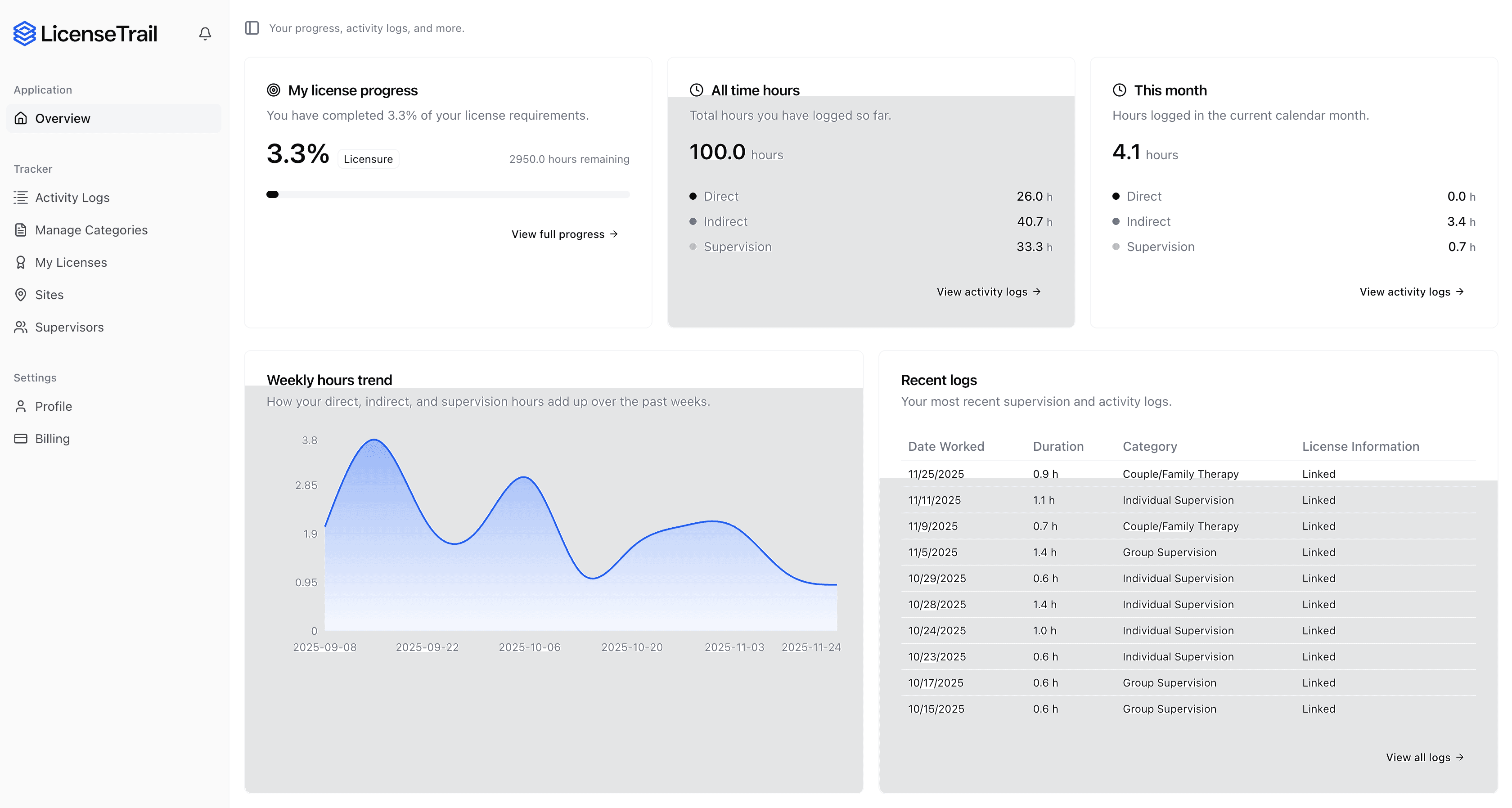 Start Tracking for Free
No credit card required · Free plan available
Is your spreadsheet hiding Rhode-island CMHCA risks?
Stop guessing if your categories match Rhode Island Board of Mental Health Counselors and Marriage and Family Therapists requirements. License Trail checks your direct, indirect, and supervision hours continuously and flags mismatches before you submit.
Import or log
Bring your spreadsheet or start fresh
Upload your existing tracking spreadsheet and we'll map every hour into the right Rhode Island Board of Mental Health Counselors and Marriage and Family Therapists categories automatically.
Verify against Rhode-island
Catch mismatches before the board does
License Trail checks your direct, indirect, and supervision hours against Rhode-island CMHCA requirements continuously.
Export board-ready
One-click clean reports
Generate professional, board-ready reports for supervision meetings and Rhode Island Board of Mental Health Counselors and Marriage and Family Therapists submissions in seconds.
No credit card required · Free plan available