
Rhode-island LMFTA Requirements: Hours, Exams & Step-by-Step Guide
Stop guessing if your categories match Rhode-island requirements. License Trail checks your direct, indirect, and supervision hours against LMFTA requirements continuously and flags mismatches before you submit.
No credit card required · Free plan available
Quick Requirements Overview
- License/Board: Rhode Island Marriage & Family Therapist Associate (LMFTA), regulated by RIDOH Board of Mental Health Counselors & MFTs
- Character: Must be of good character
- Degree: Master’s/CAGS/Doctorate in MFT (or allied graduate degree + MFT core-curriculum equivalent coursework) from a recognized institution
- Credits: 60 semester credits (or 90 quarter hours) in MFT (or equivalent) meeting RI MFT core curriculum
- Practicum: 12 semester credits (or 18 quarter hours) of supervised practicum
- Internship: 1 calendar year supervised internship at 20 hrs/week (or Board-approved equivalent), MFT emphasis
- Clinical hours (in program): 500 face-to-face direct client hours over 12 successive months; ≥250 hours must be with couples/families present; ≥100 hours supervision
- Associate term: LMFTA license expires in 3 years (possible 1-year extension for good cause)
License Details
Procedures
Rhode Island’s “marriage and family therapist associate” license (often written informally as LMFT‑A or LMFTA) is the pre‑independent level credential regulated by the Rhode Island Department of Health through the Board of Mental Health Counselors and Marriage and Family Therapists.
The associate license is based almost entirely on your graduate education and its supervised clinical training, not on a separate set of post‑degree hours. The post‑degree hours come later, when you move to full LMFT.
Below is a step‑by‑step breakdown of what the Board and regulations actually require, with the key hour counts and the Board’s own language.
1. Credential name and oversight
Rhode Island law and regulations use the formal title:
- “Marriage and family therapist associate” for the associate level, and
- “Marriage and family therapist” for full licensure. (law.cornell.edu)
Both are governed under R.I. Gen. Laws § 5‑63.2‑10 and 216‑RICR‑40‑05‑11 (Part 11 – Licensing Clinical Mental Health Counselors and Marriage and Family Therapists). (law.cornell.edu)
2. Baseline legal prerequisites for a Marriage and Family Therapist Associate
State law (R.I. Gen. Laws § 5‑63.2‑10(a)(1)) and the implementing regulation 216‑RICR‑40‑05‑11.3.5 lay out the core prerequisites: (law.cornell.edu)
-
Good character
- The statute requires that the applicant “is of good character.”
-
Qualifying graduate degree
You must have:
- A master’s degree, certificate of advanced graduate studies (CAGS), or doctoral degree in marriage and family therapy from a recognized educational institution,
or
- A graduate degree in an allied field (from a recognized educational institution) plus graduate‑level course work that is equivalent to a master’s degree in marriage and family therapy and that includes all components of the MFT Core Curriculum (see § 11.5.2). (law.cornell.edu)
-
Total MFT graduate credits
- You must have completed sixty (60) semester credit hours or ninety (90) quarter hours within your graduate or post‑graduate program specializing in marital and family therapy. (law.cornell.edu)
These credits must cover specific content areas spelled out in the MFT Core Curriculum (theoretical foundations, clinical knowledge, human development/family relations, ethics, research, elective, and supervised clinical practice). (law.cornell.edu)
3. Required practicum, internship, and supervised clinical practice hours
Rhode Island embeds the clinical hour requirements inside both the statute and the detailed “Core Curriculum” regulation. For an associate license, these are educational requirements.
3.1. Practicum and internship (credit‑based requirements)
Both the statute and regulations require the same practicum/internship structure:
- Minimum of twelve (12) semester hours or eighteen (18) quarter hours of supervised practicum, and (law.cornell.edu)
- A one (1) calendar year of supervised internship consisting of twenty (20) hours per week, or its equivalent, with an emphasis in marriage and family therapy. (law.cornell.edu)
Regulation 216‑RICR‑40‑05‑11.3.5 restates this as:
“Has completed a minimum of twelve (12) semester credit hours or eighteen (18) quarter hours of supervised practicum AND
has completed a one (1) calendar year of supervised internship consisting of twenty (20) hours per week deemed equivalent by the Board.” (law.cornell.edu)
These practicum and internship activities are where the direct client contact and supervision hours occur.
3.2. Supervised clinical practice: minimum 500 direct client hours
The detailed breakdown of required clinical hours comes from the MFT Core Curriculum in 216‑RICR‑40‑05‑11.5.2, which applies to all MFT degrees used for licensure in Rhode Island. It specifies:
- “Supervised Clinical Practice (five hundred (500) hours required for twelve (12) successive months)” – counted as 12 semester hours of credit. (law.cornell.edu)
Under Area VII (Supervised Clinical Practice), the regulation states:
-
Total direct client hours
- “Students are required to spend a minimum of five hundred (500) face‑to‑face hours with clients. Programs will document a student’s satisfactory completion of the five hundred (500) hour requirement before awarding a degree.” (law.cornell.edu)
These 500 hours are the educational direct client contact hours that the Board expects you to complete within your graduate MFT program before you can qualify as a marriage and family therapist associate.
-
Required supervision hours within that clinical practice
- “A minimum of one hundred (100) hours of supervision is required in the supervised clinical practicum.” (law.cornell.edu)
In other words, within your 500 hours of direct client work, you must receive at least 100 hours of clinical supervision (individual, dyadic, and/or group, as defined in the regulation).
-
Required couples/family hours
- “Although students may treat individual clients, at least two hundred fifty (250) hours (fifty percent (50%) of the five hundred (500) direct client contact hours) must be completed with couples or families physically present in the room.” (law.cornell.edu)
So the Board’s structure for pre‑licensure MFT training is:
- 500 total direct client contact hours,
- Of which at least 250 hours must be couples/family sessions, and
- At least 100 of those hours must be supervised clinical practice hours.
-
Required time frame
- “A minimum twelve (12) successive months of supervised clinical practice is required.” (law.cornell.edu)
This dovetails with the statutory requirement of a one‑calendar‑year supervised internship at 20 hours per week.
3.3. What counts as “direct client contact” in Rhode Island
The Board very explicitly defines “direct client contact” for MFT training:
-
Definition
- “Direct client contact is defined as face‑to‑face (therapist and client) therapeutic meetings.” (law.cornell.edu)
-
Activities that do not count as direct client contact
The regulation specifically excludes from direct client contact:
- Brief telephone contact
- Case planning
- Observation of therapy
- Record keeping
- Travel
- Administrative activities
- Consultation with community members or other professionals
- Supervision (law.cornell.edu)
-
Assessments
- “Assessments may be counted as direct client contact if they are face‑to‑face processes that are more than clerical in nature and focus.” (law.cornell.edu)
In practice, this means that the 500 hours must be true clinical, face‑to‑face therapy or assessment sessions with clients, not background or administrative tasks.
4. Summary of hour requirements specifically tied to the LMFTA level
Putting the legal and regulatory pieces together, the Rhode Island Board’s pre‑independent associate‑level requirements are:
-
Graduate MFT coursework
- 60 semester (or 90 quarter) credits in marriage and family therapy or equivalent, including the Board‑defined MFT Core Curriculum. (law.cornell.edu)
-
Educational practicum and internship
- At least 12 semester (or 18 quarter) credits of supervised practicum, and
- One calendar year of supervised internship, 20 hours per week (or Board‑approved equivalent). (law.cornell.edu)
-
Within that practicum/internship, supervised clinical practice hours
- Minimum 500 direct client contact hours, defined as face‑to‑face therapeutic meetings (not admin, planning, observation, or supervision).
- At least 250 of those hours must be with couples or families physically present in the room (50% of total).
- At least 100 hours of supervision during this supervised clinical practice.
- All of this must occur over at least 12 successive months. (law.cornell.edu)
These are the key hour‑based requirements that your degree program and supervised training must satisfy in order for the Board to issue you a marriage and family therapist associate license.
5. License duration and progression toward full LMFT
Two additional structural points from the regulations are relevant for planning:
-
Time‑limited associate license
- “Licenses for Clinical Mental Health Counselor Associates and Marriage and Family Therapist Associates shall expire three (3) years from the date of issuance. However, for good cause shown, a one (1) year extension of the Associate license may be granted to complete all postgraduate requirements, as approved by the Board in its discretion.” (law.cornell.edu)
-
Post‑degree hours for full LMFT (for context)
After holding the associate license and your qualifying degree, to become a fully licensed marriage and family therapist the Board requires:
- “A minimum of two (2) years of relevant postgraduate experience, including at least two thousand (2,000) hours of direct client contact offering clinical or counseling or therapy services with emphasis in marriage and family therapy,” and
- “A minimum of one hundred (100) hours of post‑degree supervised case work spread over two (2) years,” with supervision provided by an approved supervisor. (law.cornell.edu)
Those 2,000 hours and 100 supervision hours are post‑degree, post‑associate requirements for full LMFT, not for the associate license itself.
6. Practical checklist for LMFTA in Rhode Island
If you are mapping this to your own path, the Board‑aligned checklist looks like this:
-
Complete an MFT (or equivalent allied) graduate degree that:
- Is from a recognized, regionally accredited institution, and
- Provides at least 60 MFT‑specific semester credits that satisfy Rhode Island’s MFT Core Curriculum.
-
Within that program, ensure you complete:
- 12 semester credits of supervised practicum, plus
- A full calendar year of supervised internship at 20 hours/week (or equivalent).
-
Within your practicum/internship/clinical training:
- Accumulate at least 500 face‑to‑face direct client hours,
- Make sure at least 250 of those hours are with couples or families present, and
- Document at least 100 hours of clinical supervision, over at least 12 successive months.
-
Once those requirements are met and your degree is awarded, submit:
- The Department of Health’s marriage and family therapist associate licensure application,
- Documentation of your degree, coursework, practicum/internship, and supervised clinical practice, and
- The required fee, within the timelines set out by the Board (application at least 30 days before a Board meeting). (law.cornell.edu)
Meeting these educational and clinical hour benchmarks is what qualifies you for the Rhode Island marriage and family therapist associate license and positions you to accumulate the separate 2,000 post‑degree direct client hours + 100 post‑degree supervision hours required for eventual full LMFT licensure.
Track your LMFTA hours with confidence
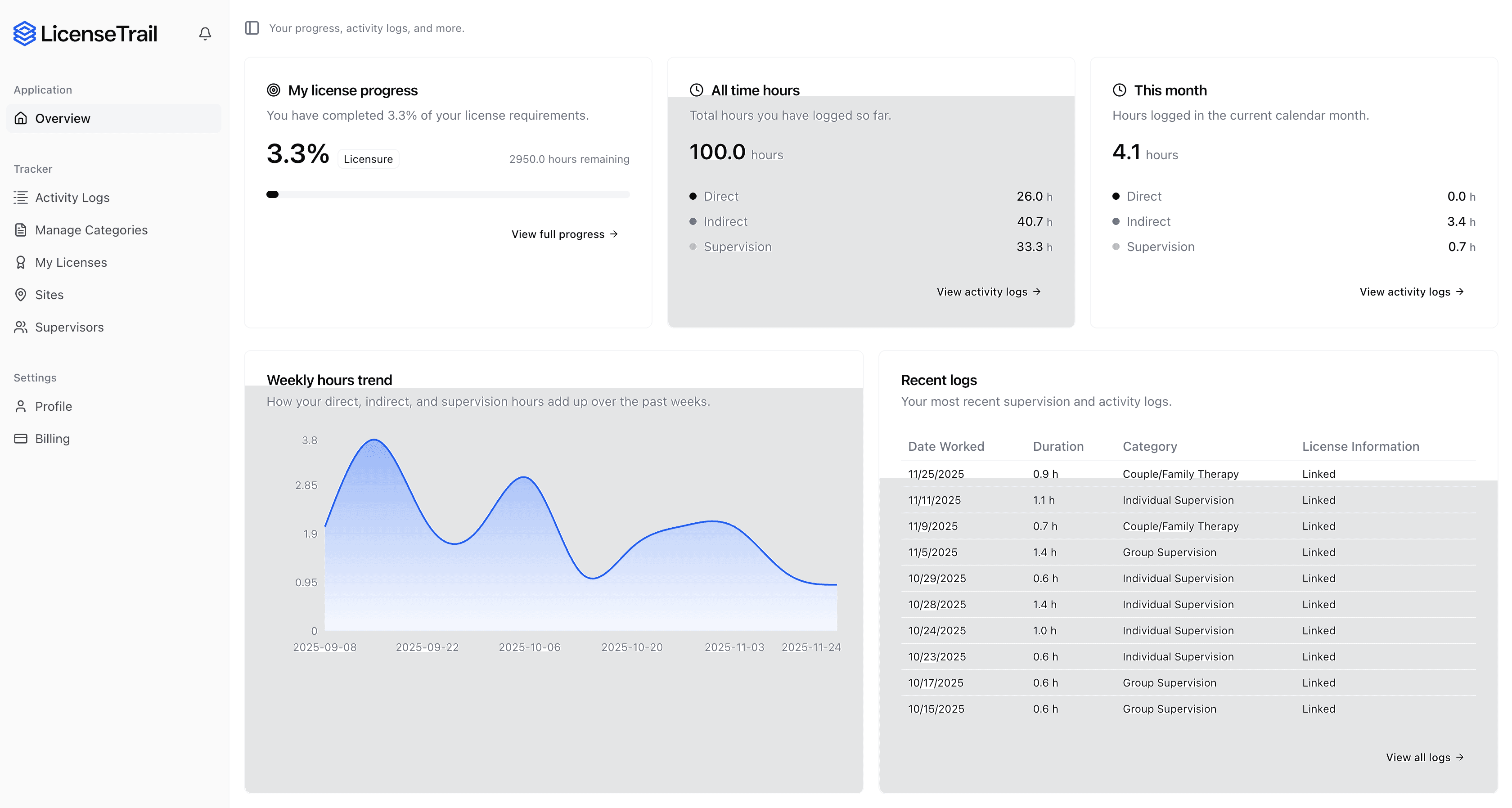
License Trail checks your direct, indirect, and supervision hours against Rhode-island LMFTA requirements continuously and flags mismatches before you submit.
 Start Tracking for Free
No credit card required · Free plan available
Is your spreadsheet hiding Rhode-island LMFTA risks?
Stop guessing if your categories match Rhode Island Board of Mental Health Counselors and Marriage and Family Therapists requirements. License Trail checks your direct, indirect, and supervision hours continuously and flags mismatches before you submit.
Import or log
Bring your spreadsheet or start fresh
Upload your existing tracking spreadsheet and we'll map every hour into the right Rhode Island Board of Mental Health Counselors and Marriage and Family Therapists categories automatically.
Verify against Rhode-island
Catch mismatches before the board does
License Trail checks your direct, indirect, and supervision hours against Rhode-island LMFTA requirements continuously.
Export board-ready
One-click clean reports
Generate professional, board-ready reports for supervision meetings and Rhode Island Board of Mental Health Counselors and Marriage and Family Therapists submissions in seconds.
No credit card required · Free plan available