
South-carolina LMSW Requirements: Hours, Exams & Step-by-Step Guide
Stop guessing if your categories match South-carolina requirements. License Trail checks your direct, indirect, and supervision hours against LMSW requirements continuously and flags mismatches before you submit.
No credit card required · Free plan available
Quick Requirements Overview
- Governed by SC Board of Social Work Examiners (Title 40, Ch. 63); “LMSW” title use requires licensure
- Eligibility: age 21+, good moral character, MSW/DSW from CSWE-accredited (or Board-approved equivalent) program
- Apply to Board + pay $45 nonrefundable application fee
- Submit/arrange: official transcript (degree conferred), ASWB score report (if taken), and out-of-state license verifications (if applicable) sent directly to Board; provide ID/SSN/name-change docs as required
- Exam: must pass ASWB Masters exam; final-semester MSW students may test with Dean letter, but license issued only after passing score + conferred-degree transcript
- Hours: no Board-mandated pre/postgraduate practice-hour totals required for LMSW licensure
- Practice limits: supervised practice only in organized settings (e.g., social/medical/governmental agencies); no private/independent practice or independent billing/reimbursement as LMSW
- Renewal: 40 CE hours each biennial cycle; starting 2025 renewals include ≥1 hour suicide assessment/treatment/management CE
License Details
Procedures
South Carolina’s LMSW (Licensed Masters Social Worker) license is governed by the South Carolina Board of Social Work Examiners under the Social Work Practice Act, Title 40, Chapter 63 of the South Carolina Code of Laws. Any person using the title “Licensed Masters Social Worker” or the initials “LMSW” must hold this license. (law.justia.com)
This article walks through what the state itself requires, with emphasis on whether any specific practice‑hour totals are required.
1. What the LMSW license allows – and where you can practice
Under the Practice Act, a Masters Social Worker is “a person licensed to engage in the practice of Masters Social Work.” The “practice of Masters Social Work” includes applying social work theory and methods for assessment, treatment planning, case management, counseling, advocacy, administration, and related functions. It may include clinical social work, but only under clinical supervision and only in organized settings such as social, medical, or governmental agencies. (law.justia.com)
The statute and board policy are explicit that:
- LMSWs may engage only in supervised practice in those agencies.
- LMSWs may not practice privately or independently and cannot provide clinical services in a private or independent practice setting or bill directly/receive third‑party reimbursement in that setting. (law.justia.com)
Independent or private practice is reserved for Licensed Independent Social Workers (LISW‑CP or LISW‑AP), which require additional supervised hours beyond the LMSW.
2. Statutory eligibility requirements for an LMSW
The Social Work Practice Act sets out the basic legal criteria in Section 40‑63‑230, “Licensure requirements; Masters Social Worker.” To be licensed as a Masters Social Worker in South Carolina, an applicant must: (law.justia.com)
- Submit a written application in the form prescribed by the Board.
- Be at least 21 years of age.
- Be of good moral character.
- Hold a master’s or doctorate degree in social work from a program that:
- is accredited by a nationally recognized accrediting body for social work programs (in practice, CSWE); or
- meets equivalent standards as approved by the Board.
- Pass an examination prescribed by the Board.
- Pay all applicable fees specified by the Board.
Note that Section 40‑63‑230 does not impose any pre‑ or post‑graduate practice‑hour requirement for LMSW licensure. (law.justia.com)
3. Board’s “Requirements for Masters Level Licensure” (LMSW)
The Board’s own one‑page “LMSW Requirements” document (revised 11/2015 and still posted as of 2025) fleshes out how you actually meet those statutory requirements. (llr.sc.gov)
According to that document, to be licensed as an LMSW you must:
3.1 Education
- Have a master’s or doctorate degree from a social work program accredited by the Council on Social Work Education (CSWE). The document directs applicants to CSWE’s website to verify accreditation. (llr.sc.gov)
3.2 Application and fee
-
Submit an LMSW application and pay a $45 non‑refundable application fee. (llr.sc.gov)
-
If you answer “Yes” to any character/discipline/legal questions on the application, the Board will review your file case‑by‑case and may require:
- a written explanation;
- copies of complaints, charges, or court documents;
- final orders or settlements;
- any other information requested;
- and you must agree to appear before the Board if requested. (llr.sc.gov)
3.3 Supporting documents sent directly to the Board
The Board requires the following to be sent directly to them from the issuing source: (llr.sc.gov)
- Official transcript showing the conferred social work degree.
- ASWB exam score report, if you have already taken and passed the exam.
- Verification of social work licenses from every other state/jurisdiction where you are currently or were previously licensed, if applicable (using either South Carolina’s verification form or the other state’s official verification).
You also must provide identity and eligibility documentation (e.g., government ID, Social Security card, and name‑change documentation if relevant) as described on the Board’s licensure‑requirements page. (llr.sc.gov)
4. Examination requirement: ASWB Masters exam
For an LMSW, the required examination is the Association of Social Work Boards (ASWB) Masters‑level exam.
The Board’s LMSW Requirements document states that the applicant: (llr.sc.gov)
- “must take and pass the masters level of the examination” that is administered by a testing service through ASWB; and
- will be approved by the Board to sit for the Masters exam after the Board receives the completed application, transcript, and any required verifications.
Once the Board approves you:
- You receive an approval letter, then
- You must contact ASWB (and, as of March 31, 2025, its test‑delivery vendor Pearson VUE) to register and schedule the exam. (llr.sc.gov)
4.1 Taking the exam in your final semester
The Board explicitly allows students in their final semester of an MSW program to sit for the Masters exam before the degree is officially conferred, if: (llr.sc.gov)
- they provide a letter from the Dean of their social work program verifying that they are in the final semester.
However, no license will be issued until the Board has both:
- a passing exam score, and
- an official transcript showing the degree and conferral date. (llr.sc.gov)
5. Practice restrictions and supervision for LMSWs
The Practice Act’s definition of “Practice of Masters Social Work” explains what LMSWs may do and under what conditions: (law.justia.com)
- Masters‑level practice includes assessment, treatment planning, counseling, case management, program administration, research, community organization, and related functions.
- It may include clinical social work, but only:
- under clinical supervision, and
- within recognized organized settings such as social, medical, or governmental agencies.
The statute then specifies that LMSWs may engage only in supervised practice in such agencies and may not practice privately or independently. (law.justia.com)
The Board’s FAQ reinforces this by stating, for example, that: (llr.sc.gov)
- LMSWs cannot practice in a private/independent practice setting or receive direct or third‑party payment for independent clinical services in South Carolina.
- LMSWs providing clinical services in an agency must be clinically supervised by a South Carolina‑licensed LISW‑CP, psychologist, psychiatrist, LPC, LMFT, or LAC employed by that agency.
This is about who must supervise you and where you can practice, not about accumulating a set number of hours for the LMSW license itself.
6. Hour requirements – what the Board actually requires
6.1 Pre‑ or post‑degree practice hours for the LMSW license
For initial LMSW licensure, South Carolina’s statute and Board documents do not require any specific number of practice hours beyond the practicum/internship hours already embedded in your CSWE‑accredited social work degree.
- Section 40‑63‑230 lists the LMSW licensure requirements and contains no requirement for a minimum number of supervised practice hours (such as 1,500 direct hours or 3,000 total hours). (law.justia.com)
- The Board’s “LMSW Requirements” sheet similarly lists education, application, fee, transcript, exam, and verifications, but does not impose any explicit hour requirement for the LMSW credential. (llr.sc.gov)
Some other states do require totals like “1,500 hours of direct experience and 1,500 hours of supervised experience” for certain licenses. South Carolina does not do this for the LMSW. Your practicum hours are governed by CSWE and your degree program, not by a separate Board‑mandated clock‑hour requirement for LMSW licensure.
6.2 Supervision requirement without a set hour count
The LMSW level is supervised‑practice only for clinical and advanced practice functions:
- You must work in a social, medical, or governmental agency.
- You must have appropriate licensed supervision for clinical or advanced practice work. (llr.sc.gov)
However, the law and Board guidance do not set a required number of supervised hours that must be completed simply to obtain or keep the LMSW license. Supervision at this level is primarily a quality‑of‑practice and scope‑of‑practice safeguard, not an hours‑tracking requirement.
6.3 When specific hour counts do appear: LISW (independent) licensure
Specific, numeric hour requirements do apply later if you use your LMSW as a stepping‑stone to independent practice licensure (LISW‑CP or LISW‑AP).
For example, to become a Licensed Independent Social Worker—Clinical Practice (LISW‑CP), the Practice Act requires you to: (law.justia.com)
- Complete 3,000 hours of social work practice under clinical supervision, after you are licensed as an LMSW, over at least 2 years and no more than 4 years.
- Within those 3,000 hours, complete a minimum of 100 hours of face‑to‑face direct clinical supervision, equitably distributed over the supervision period.
- Complete 45 academic contact hours each in psychopathology and psychodiagnostics, plus 15 academic contact hours or 20 CE contact hours in professional ethics during the supervision period (or the Board’s specialty ethics course).
Similar 3,000‑hour and supervision requirements exist for LISW‑AP (Advanced Practice). (law.justia.com)
These 3,000 hours + 100 supervision hours are not part of LMSW licensure; they are post‑LMSW requirements for the independent LISW credentials.
7. Continuing education hours after you are licensed
Once you hold an LMSW, maintaining the license requires ongoing continuing education (CE):
- The Board requires 40 hours of continuing education every two‑year renewal period for all licensed social workers. (llr.sc.gov)
- Licenses are renewed biennially; the current CE reporting period and deadlines are listed on the Board’s CE page.
- Beginning with the renewal cycle starting January 1, 2025, licensed social workers must include at least 1 hour of CE in suicide assessment, treatment, and management as part of the required 40 hours. (llr.sc.gov)
These CE hours are for license renewal, not initial licensure. They are the only hour totals that the Board associates directly with the LMSW credential itself.
8. Step‑by‑step path to a South Carolina LMSW
Putting the requirements together, the path typically looks like this:
-
Earn a qualifying degree
- Complete a CSWE‑accredited MSW (or DSW) program.
-
Confirm your program’s accreditation status
- Check the CSWE directory to make sure your program is recognized, as the Board relies on that standard. (llr.sc.gov)
-
Decide when to take the ASWB Masters exam
- Either in your final MSW semester (with a Dean’s letter) or after graduation, once your application has been approved. (llr.sc.gov)
-
Submit the LMSW application to the South Carolina Board
- Complete the application (online or paper).
- Pay the $45 non‑refundable application fee.
- Provide copies of your government ID, Social Security card, and any name‑change documents. (llr.sc.gov)
-
Arrange for third‑party documents to go directly to the Board
- Official transcript showing your social work degree and conferral date.
- ASWB exam score report, if already taken.
- License verifications from any other states where you have been licensed. (llr.sc.gov)
-
Respond to any character or legal history questions
- If you answer “Yes” to any application questions, submit required explanations and documents and be prepared for possible Board appearance. (llr.sc.gov)
-
Obtain Board approval and take the ASWB Masters exam
- Once approved, schedule and pass the ASWB Masters‑level exam through ASWB/Pearson VUE. (llr.sc.gov)
-
Receive your LMSW license
- After the Board has your completed application, passing exam score, and official transcript, it can issue the LMSW license. (llr.sc.gov)
-
Practice within LMSW scope under supervision
- Work in social, medical, or governmental agencies only, under appropriate supervision, and do not engage in private/independent practice as an LMSW. (law.justia.com)
-
Complete 40 hours of CE every two years
- Include at least 1 hour of suicide assessment/treatment CE starting with the 2025–2026 renewal cycle, to keep your license active. (addictioncounselorce.com)
Key point on hours
For the LMSW in South Carolina:
- Required pre‑licensure supervised or direct practice hours: 0 (none specified).
- Required post‑licensure supervised hours solely for maintaining LMSW: 0 (supervision is required for certain roles but not tracked as a numeric licensing requirement).
- Required hours if you later advance to LISW‑CP or LISW‑AP: 3,000 hours of supervised practice after LMSW, including at least 100 hours of direct supervision and specified coursework/CE in psychopathology, psychodiagnostics, and ethics. (law.justia.com)
The Board’s own documents and the Practice Act confirm that there is no South Carolina requirement such as “1,500 hours of direct experience and 1,500 hours of supervised experience” for LMSW licensure itself; those kinds of numeric hour requirements appear only at the independent (LISW) level.
Track your LMSW hours with confidence
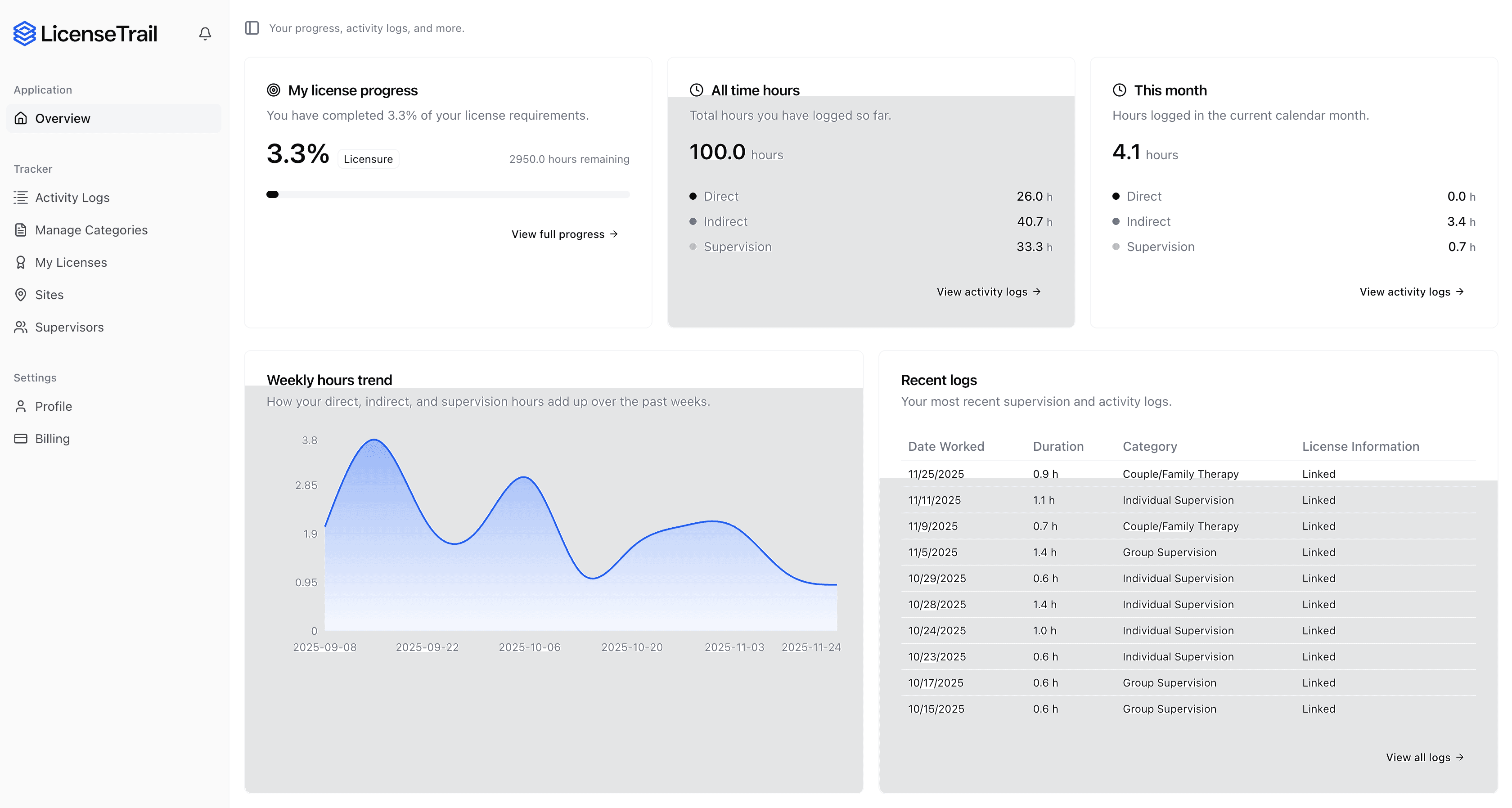
License Trail checks your direct, indirect, and supervision hours against South-carolina LMSW requirements continuously and flags mismatches before you submit.
 Start Tracking for Free
No credit card required · Free plan available
Related Licenses
Is your spreadsheet hiding South-carolina LMSW risks?
Stop guessing if your categories match South Carolina Board of Social Work Examiners requirements. License Trail checks your direct, indirect, and supervision hours continuously and flags mismatches before you submit.
Import or log
Bring your spreadsheet or start fresh
Upload your existing tracking spreadsheet and we'll map every hour into the right South Carolina Board of Social Work Examiners categories automatically.
Verify against South-carolina
Catch mismatches before the board does
License Trail checks your direct, indirect, and supervision hours against South-carolina LMSW requirements continuously.
Export board-ready
One-click clean reports
Generate professional, board-ready reports for supervision meetings and South Carolina Board of Social Work Examiners submissions in seconds.
No credit card required · Free plan available