
Tennessee Certified Psychological Assistant Requirements: Hours, Exams & Step-by-Step Guide
Stop guessing if your categories match Tennessee requirements. License Trail checks your direct, indirect, and supervision hours against Certified Psychological Assistant requirements continuously and flags mismatches before you submit.
No credit card required · Free plan available
Quick Requirements Overview
- Scope limited to psychological assessment/testing only; no psychotherapy or independent practice; must work under psychologist supervision (HSP required for health services)
- Apply to TN Board and register a supervisor of record (required to be certified)
- Graduate training: master’s degree in psychology (or equivalent accepted) in a formal, in‑residence program at a regionally accredited institution
- Coursework minimum: 33 graduate semester hours (excluding practicum) with required distribution (ethics 3; abnormal/psychopathology 3; ≥9 basic substantive across ≥3 areas; ≥9 applied incl. ≥3 cognitive/intellectual testing and ≥3 personality testing; remaining 9 elective/thesis); no double-counting
- Practicum: ≥3 graduate semester hours of on-site, formal supervised assessment practicum (in addition to 33 hours)
- Practicum hours: ≥300 clock hours total, with ≥25% (75 hours) in individual/group supervision; ≥1 hour/week individual face-to-face supervision during practicum
- Ongoing supervision after certification: direct and frequent on-site supervision (>1 hour/week); supervision limited to assessment activities
- Application documentation: photos, birth certificate, official transcripts, course worksheets/descriptions, practicum verification letters, 3 recommendation letters (incl. ≥1 HSP psychologist), background check and disclosures/license verifications as applicable
License Details
Procedures
Becoming a Certified Psychological Assistant in Tennessee
The Tennessee Board of Examiners in Psychology regulates Certified Psychological Assistants (CPAs) under Tennessee Code Annotated (T.C.A.) Title 63, Chapter 11, and Board Rules, Chapter 1180‑04. This credential is tightly focused on psychological assessment and testing under supervision; it does not authorize independent practice or psychotherapy. (regulations.justia.com)
Below is a step‑by‑step guide, with emphasis on the specific hour and course requirements the Board has written into rule.
1. Role and scope of a Certified Psychological Assistant
The Board defines the scope of practice for CPAs in Rule 1180‑04‑.01:
- The scope is restricted to “psychological assessment, psychological testing, and related activities,” because no education, training, supervised experience or practicum in psychotherapy or other intervention activities is prescribed for this credential. (regulations.justia.com)
- CPAs may not engage in psychotherapy or any other form of therapeutic intervention. (regulations.justia.com)
- CPAs may only render services for remuneration under:
- the direct employment and qualified supervision of a Psychologist, or
- the employment of a community mental health center or state governmental agency and the qualified supervision of a Psychologist with Health Service Provider (HSP) designation. (regulations.justia.com)
This framing matters because all education, practicum, and supervision requirements are oriented toward safe, competent assessment practice—not therapy.
2. Statutory baseline qualifications (T.C.A. § 63‑11‑207(b))
Under T.C.A. § 63‑11‑207(b), anyone seeking to practice as a Certified Psychological Assistant in Tennessee must: (law.justia.com)
- Apply to the Board on official forms, including registration of the supervisor of record (you cannot be certified without a designated supervisor).
- Provide satisfactory evidence that the candidate:
- Is of good moral character;
- Is a citizen of the United States;
- Is not considered by the Board to be engaged in unethical practice; and
- “Has had two (2) academic years of graduate training in psychology, including a master’s degree, from an accredited educational institution” recognized by the Board, or equivalent training and experience accepted at the Board’s discretion.
- That graduate training must include specialized training in psychological assessment, test construction and measurement, administration and interpretation of psychological testing, interviewing skills, and social history methods, and evidence of supervised practicum experience in those areas. (law.justia.com)
The statute does not itself specify a number of practicum hours; those appear in the Board’s rules (below).
3. Educational requirements and semester‑hour breakdown (Rule 1180‑04‑.02)
The Board’s rule on “QUALIFICATIONS FOR CERTIFICATION” (1180‑04‑.02) provides detailed academic requirements: (law.cornell.edu)
3.1 Program and institution
- Education must be completed “programmatically,” i.e., as a matriculated in‑residence student in a formal graduate training program in psychology whose stated purpose is to train Psychologists, Senior Psychological Examiners, Psychological Examiners, and/or Certified Psychological Assistants. (law.cornell.edu)
- The degree‑granting institution must be regionally accredited at the time of graduation. (law.cornell.edu)
3.2 Graduate credit hours (didactic)
The Board requires:
- At least one academic year of graduate training in psychology, including a master’s degree, based on a minimum of 33 graduate semester hours, exclusive of practicum/field experience hours. (law.cornell.edu)
- Alternatively, completion of 33 graduate semester hours in residence as a matriculated student in an approved doctoral program can meet the degree requirement. (law.cornell.edu)
Those 33 semester hours must be distributed as follows:
-
Required foundational courses (6 semester hours) (law.cornell.edu)
- 3 graduate semester hours in professional standards and ethics based on the APA Code of Ethics; and
- 3 graduate semester hours in Abnormal Psychology or Psychopathology.
-
Basic substantive psychology (at least 9 semester hours) (law.cornell.edu)
- Minimum of 9 graduate semester hours in basic substantive areas of psychology, with at least three substantive areas represented (e.g., experimental, developmental, social, personality theory, cognitive, learning, statistics, research design, history and systems, etc.).
-
Applied/assessment coursework (at least 9 semester hours) (law.cornell.edu)
- At least 9 semester hours related to the application of psychology, including:
- ≥3 graduate semester hours in cognitive/intellectual testing, and
- ≥3 graduate semester hours in formal personality testing.
- At least 9 semester hours related to the application of psychology, including:
-
Remaining credits (9 semester hours) (law.cornell.edu)
- The remaining 9 of the 33 hours may be substantive coursework, applied coursework, or thesis hours.
-
No double‑counting
- A single course **“shall count only one (1) time to meet only one (1) requirement.” (law.cornell.edu)
4. Practicum and experience hour requirements
This is where the Board specifies actual clock‑hour requirements.
4.1 Practicum credit
- Applicants must complete at least one on‑site, formal, supervised practicum in psychological assessment for a minimum of 3 graduate semester hours of credit.
- These practicum credits are in addition to the 33 didactic semester hours noted above. (law.cornell.edu)
4.2 Practicum as a supervised training experience
The Board defines the practicum as: (law.cornell.edu)
- A supervised training experience organized by a graduate academic psychology program,
- With the specific purpose of applied skill development appropriate to the student’s area(s) of preparation,
- Treated the same whether called a master’s practicum, doctoral practicum, or master’s‑level internship.
Before starting the practicum, the student must have completed at least 18 graduate semester hours of required coursework, including the 3‑credit ethics course, 3‑credit psychological assessment course, and 3‑credit abnormal psychology/psychopathology course. (law.cornell.edu)
4.3 Minimum practicum hours and supervision hours
Rule 1180‑04‑.02(7)(d) sets the only explicit pre‑certification experience‑hour minimum for CPAs:
- Total practicum hours:
- “Not less than three hundred (300) clock hours” of practicum training. (law.cornell.edu)
- Supervision within those hours:
- 25% of those 300 hours (i.e., 75 hours) must be spent in individual and group supervision. (law.cornell.edu)
In addition, the rule specifies: (law.cornell.edu)
- Practicum must be distinct from work experience and must occur in settings that provide a range of assessment and intervention activities conducted directly with clients seeking health services (though, for CPAs, the end credential is limited to assessment/testing).
- Practicum must be documented on the graduate transcript.
- The practicum must include substantial training and supervision in formal psychological assessment, including clinical diagnostic interviews and formal psychological testing.
4.4 Weekly supervision standard during practicum
- Adequate practicum supervision requires at least one hour per week of individual, face‑to‑face supervision by an on‑site supervisor. (law.cornell.edu)
- The remainder of the required supervision hours can be met through group supervision, case conferences, treatment team meetings, and supervisor review of notes/reports. (law.cornell.edu)
- An on‑site supervisor must be present whenever the student conducts assessment activities. The rule outlines three acceptable supervisory arrangements (preferably a Psychologist with HSP designation, or specific alternatives when no HSP Psychologist is on‑site). (law.cornell.edu)
4.5 Important clarification about “total hours”
For Certified Psychological Assistants, Tennessee does not require something like:
- “1,500 hours of direct experience” plus
- “1,500 hours of supervised experience,”
or any similar large, post‑degree numerical experience requirement.
Instead, the Board has:
- A defined minimum practicum of 300 clock hours, with 75 of those hours in individual and group supervision; and
- Ongoing supervision standards after certification (see next section), which are defined in frequency and intensity terms, not as a cumulative hour total. (law.cornell.edu)
5. Supervision requirements once certified
Once you are certified, you cannot practice independently; your work is governed by both the CPA scope‑of‑practice rule (1180‑04‑.01) and the general supervision standards for psychologists and their supervisees (1180‑02‑.01). (regulations.justia.com)
Key points:
-
Supervision relationship and notification to the Board
- A supervisor of record must be made known to the Board, using a Board‑supplied form signed by both supervisor and supervisee that lists the Certified Psychological Assistants for whom the Psychologist is the supervisor of record (or, for the CPA, the primary supervisor(s) if engaged in supervised activities). (regulations.justia.com)
-
Who may supervise
- Supervision must be by a licensed Psychologist qualified by experience and training to practice the supervised activities. (regulations.justia.com)
- For CPAs delivering health services, the supervising Psychologist must also hold HSP designation. (regulations.justia.com)
-
Standard of supervision intensity
- For CPAs, the Board states:
- “The standard for supervision of Certified Psychological Assistants is direct and frequent (more than one [1] hour a week) supervision to take place at the site of the service.” (law.cornell.edu)
- This is an ongoing standard, not a one‑time quota of total supervised hours.
- For CPAs, the Board states:
-
Limits on what can be supervised
- The supervising Psychologist must limit supervision of CPAs to psychological assessment activities, and should not supervise CPAs for psychotherapy or other forms of intervention, consistent with the CPA scope restriction. (regulations.justia.com)
6. Application procedures and required documentation
Rule 1180‑04‑.03 lays out the procedural steps. (law.cornell.edu)
6.1 Getting and filing the application
- Obtain an application packet from the Board’s administrative office or download it from the Tennessee Department of Health website.
- Complete the application truthfully and completely, and submit it with all required fees to the Board office.
- Applications are accepted throughout the year.
6.2 Identity and education documentation
You must submit:
- Two signed, passport‑type photographs taken within the previous 12 months.
- A certified copy or notarized photocopy of your birth certificate.
- Official transcripts of all graduate coursework, sent directly from the institution(s) to the Board, showing the highest degree earned and bearing the institutional seal. (law.cornell.edu)
6.3 Course and practicum documentation
- Completed worksheets evaluating your graduate courses, showing how course credits are allocated to:
- substantive psychology coursework; and
- coursework in psychological testing and measurement.
- Copies of graduate catalog course descriptions that were current when you enrolled, to support how you have classified courses. (law.cornell.edu)
- Documentation of practicum, including:
- Transcript notation of practica; and
- Letters from practicum supervisor(s) describing:
- types of clients seen;
- range of services provided;
- nature of the practicum/internship site; and
- overall evaluation of the quality of services you provided. (law.cornell.edu)
6.4 Character and professional references
To show “good moral character” and lack of unethical practice, you must submit: (law.cornell.edu)
- At least three (3) current letters of recommendation:
- All must explicitly recommend you for certification as a Certified Psychological Assistant;
- All must be original letters written specifically for the certification application, on the signatory’s letterhead, and mailed directly to the Board;
- They are valid for one year from receipt.
- Reference requirements:
- At least one letter must be from a Psychologist with HSP designation (or HSP‑equivalent Psychologist from another jurisdiction).
- Other letters may be from licensed Psychologists or licensed Senior Psychological Examiners.
- If you are in an APA‑approved or equivalent doctoral program in professional psychology and hold a master’s degree, a letter from the Director of Training of that program must also be provided. (law.cornell.edu)
6.5 Background and legal history
You must: (law.cornell.edu)
- Disclose circumstances of:
- any criminal convictions (other than minor traffic violations);
- denial or discipline of licensure/certification in any state;
- loss or restriction of licensure/certification;
- any civil suit judgments or settlements where you were a defendant (e.g., malpractice, breach of contract, etc.).
- Arrange for a criminal background check via the vendor specified in the Board’s application materials, sent directly to the Board.
If you have ever held any license or certificate to practice psychology in another state at any level, you must have that state’s regulatory agency send the equivalent of a Tennessee “Certificate of Fitness” (license verification) showing license status and whether it is or was in good standing. (law.cornell.edu)
7. Continuing education (post‑certification expectation)
For CPAs, continuing education (CE) is governed by the general Board CE rule. It states: (regulations.justia.com)
- Psychologists and Psychological Examiners have explicit numeric CE requirements (e.g., 40 hours every two years).
- Certified Psychological Assistants are handled differently:
- “Certified Psychological Assistants are required to pursue continuing education activities as directed by the supervising psychologist, as provided in Rule 1180‑04‑.01(4)(f).”
In other words, the Board has not set a fixed number of CE hours for CPAs in rule; instead, your supervising psychologist is responsible for directing appropriate CE activities for you.
8. Summary of key numerical requirements for Tennessee CPAs
To clarify the “hours” question in the way you requested:
- Graduate coursework:
- 33 graduate semester hours in psychology (excluding practicum), with specified distribution across ethics, abnormal/psychopathology, substantive areas, and applied/testing coursework. (law.cornell.edu)
- Practicum (pre‑certification experience):
- At least 300 clock hours of supervised practicum in psychological assessment, of which
- At least 75 hours (25%) must be individual and group supervision. (law.cornell.edu)
- Supervision during practicum:
- Minimum 1 hour per week of individual, face‑to‑face supervision, plus additional group/case‑conference supervision as needed. (law.cornell.edu)
- Supervision after certification:
- Ongoing “direct and frequent (more than one [1] hour a week) supervision to take place at the site of the service.” (law.cornell.edu)
There is no Tennessee Board requirement for Certified Psychological Assistants that mirrors a “1,500 hours of direct experience and 1,500 hours of supervised experience” model. The governing numerical requirements are the 33 graduate semester hours and the 300‑clock‑hour practicum with defined supervision, combined with ongoing, frequent supervision in practice.
Track your Certified Psychological Assistant hours with confidence
License Trail checks your direct, indirect, and supervision hours against Tennessee Certified Psychological Assistant requirements continuously and flags mismatches before you submit.
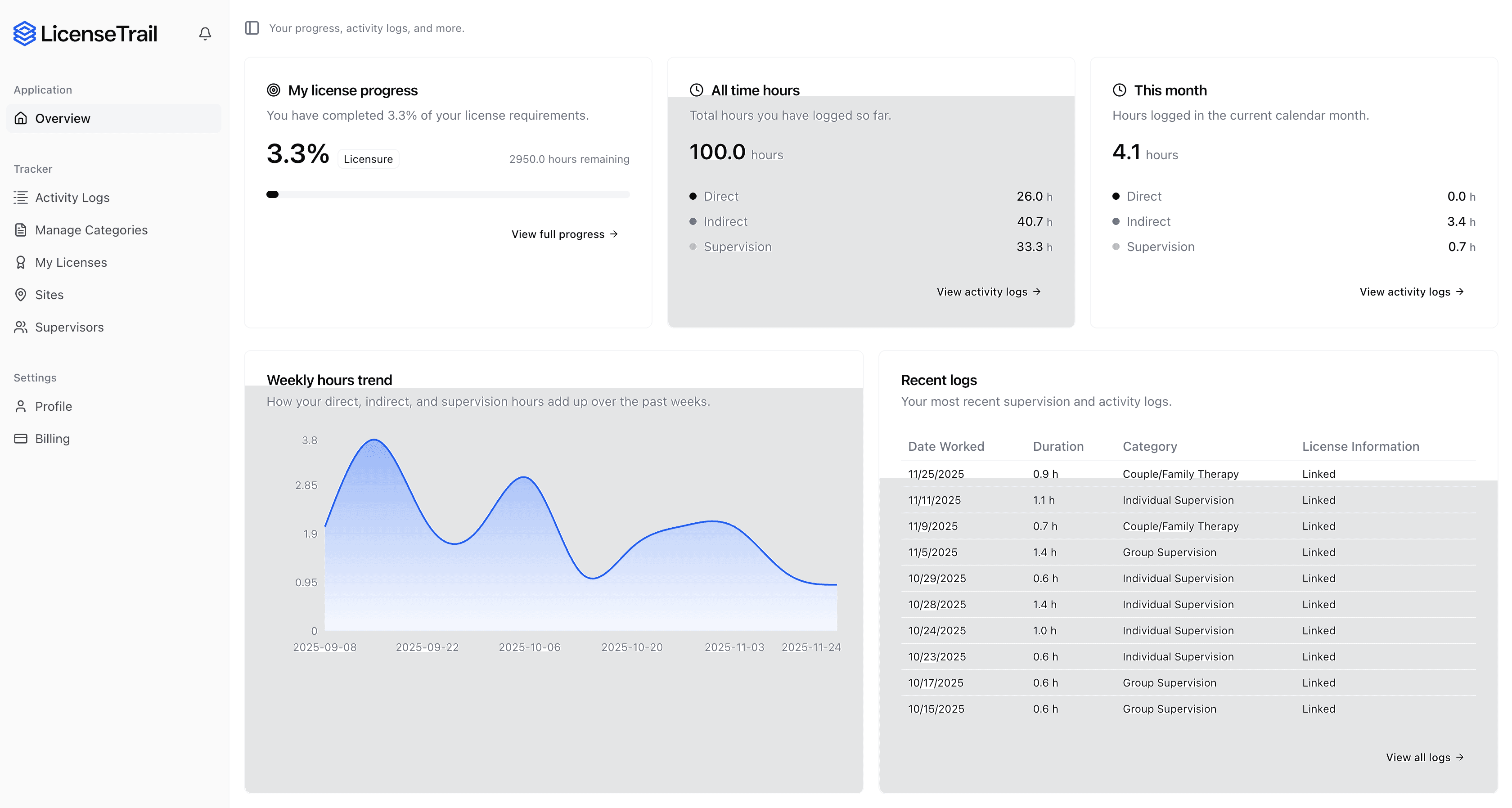 Start Tracking for Free
No credit card required · Free plan available
Related Licenses
Is your spreadsheet hiding Tennessee Certified Psychological Assistant risks?
Stop guessing if your categories match Tennessee Board of Examiners in Psychology requirements. License Trail checks your direct, indirect, and supervision hours continuously and flags mismatches before you submit.
Import or log
Bring your spreadsheet or start fresh
Upload your existing tracking spreadsheet and we'll map every hour into the right Tennessee Board of Examiners in Psychology categories automatically.
Verify against Tennessee
Catch mismatches before the board does
License Trail checks your direct, indirect, and supervision hours against Tennessee Certified Psychological Assistant requirements continuously.
Export board-ready
One-click clean reports
Generate professional, board-ready reports for supervision meetings and Tennessee Board of Examiners in Psychology submissions in seconds.
No credit card required · Free plan available