
Tennessee Certified Psychological Testing Technician Requirements: Hours, Exams & Step-by-Step Guide
Stop guessing if your categories match Tennessee requirements. License Trail checks your direct, indirect, and supervision hours against Certified Psychological Testing Technician requirements continuously and flags mismatches before you submit.
No credit card required · Free plan available
Quick Requirements Overview
- Credential: Certified Psychological Testing Technician (CPTT), regulated by TN Board of Examiners in Psychology; effective 1/1/2024
- Degree/enrollment: Bachelor’s or graduate degree or current enrollment in a qualifying graduate program (regionally accredited) in psychology or education w/ specialization (educational/counseling/school psychology)
- Baseline eligibility: Good moral character; U.S. citizen/legal resident; no unethical practice (per Board)
- Training hours (minimum 72 total): 20 hrs direct observation + 40 hrs administering/scoring in presence of licensed psychologist or senior psychological examiner + 12 hrs additional education
- 12-hr content minimums: 3+ hrs law/ethics and 3+ hrs multicultural competency (remainder skill-based training)
- Supervision (required to practice): All work under a Board-registered supervisor of record (licensed psychologist or senior psychological examiner)
- Employment/setting: Must be employed by/contracted with the same work setting as the supervising psychologist/senior psychological examiner
- Scope limits: May administer/score tests and observe/describe behavior; cannot select tests, interpret/write results, or provide feedback to clients
License Details
Procedures
Tennessee’s “Certified Psychological Testing Technician” (CPTT) is a distinct, entry‑level credential regulated by the Tennessee Board of Examiners in Psychology under Title 63, Chapter 11 of the Tennessee Code. The credential took effect January 1, 2024, and is defined primarily in Tenn. Code Ann. § 63‑11‑201, § 63‑11‑206, and § 63‑11‑207, plus the Board’s application policies. (codes.findlaw.com)
Unlike psychologist licensure, Tennessee does not require 1,500 hours of direct experience plus 1,500 hours of supervised experience for CPTTs. Instead, the law requires a minimum of 72 hours of very specific education and training tied to test administration and scoring, along with supervision and degree requirements.
1. How Tennessee defines a Certified Psychological Testing Technician
Level of practice
State law defines five levels of psychological practice; the fifth is “certified psychological testing technician.” (codes.findlaw.com)
Anyone practicing at that level must hold “a valid certificate to practice” as a CPTT under Chapter 11. (codes.findlaw.com)
What “practice as a certified psychological testing technician” means
Under § 63‑11‑207(c)(2), a CPTT is authorized to:
- Administer standardized psychological and neuropsychological tests
- Score those tests
- Observe and describe a client’s test behavior and test responses (law.justia.com)
A CPTT is specifically prohibited from:
- Selecting which psychological or neuropsychological tests (or test versions) to give
- Interpreting test results
- Writing test results
- Giving test feedback directly to clients (law.justia.com)
Separately, § 63‑11‑206 and § 63‑11‑204 clarify that anyone who claims to be a CPTT or who performs psychological services for pay at that level must be certified, must work only under supervision, and must not diagnose or treat problems outside the boundaries of psychological practice. (codes.findlaw.com)
2. Supervision and employment conditions (ongoing requirement)
The statutes build supervision into both eligibility and ongoing practice:
-
Supervision:
All services must be “provided under the supervision of a psychologist or senior psychological examiner who is registered with the board as a supervisor of record to provide such supervision for the certified psychological testing technician.” (law.justia.com) -
Same work setting:
The CPTT “must be employed by, or contracted with, the same work setting as the supervising psychologist or senior psychological examiner.” (law.justia.com) -
Scope of supervision requirement:
“Any and all work performed by a certified psychological testing technician is supervised by a psychologist or senior psychological examiner as determined by the board.” (codes.findlaw.com)
You cannot be certified—or practice—as a CPTT in Tennessee without a Board‑registered supervisor (or supervisors) of record.
3. Baseline eligibility requirements (non‑hour criteria)
Before hours are considered, § 63‑11‑207(c)(4) requires that every CPTT applicant present “satisfactory evidence” of the following: (law.justia.com)
- Good moral character
- Citizenship or legal residency in the United States
- No unethical practice as determined by the Board
- Degree or enrollment in the right field from a regionally accredited institution:
- Proof of completion of a bachelor’s or graduate degree, or
- Proof of current enrollment in a graduate degree program,
- From a regionally accredited university, college, or professional school
- In psychology, or education with a specialization in:
- Educational psychology
- Counseling psychology, or
- School psychology
Only after those baseline criteria are met does the Board look at the required 72 hours of education and training.
4. The 72‑hour education and training requirement (exact structure)
Tennessee law is very specific about the type and distribution of hours. The controlling phrase in § 63‑11‑207(c)(4)(D) is that the candidate’s training:
“must consist of a minimum of seventy‑two (72) hours of total education and training relating to psychological or neuropsychological test administration and scoring…”
Those 72 hours are broken down into three components:
A. 20 hours of direct observation
The statute requires:
- At least 20 hours of direct observation, broken down as: (law.justia.com)
- At least 10 hours directly observing a licensed psychologist or senior psychological examiner administering and scoring tests, and
- At least 10 hours directly observing either:
- A licensed psychologist,
- A senior psychological examiner, or
- A certified psychological testing technician who is already registered with the Board,
administering and scoring tests.
In other words, all 20 hours must be live observation of actual test administration and scoring, and the people you observe must hold the specified Tennessee credentials.
B. 40 hours administering and scoring tests in the presence of a supervisor
The law next requires:
- At least 40 hours of administering and scoring tests “in the presence of a licensed psychologist or senior psychological examiner.” (law.justia.com)
These 40 hours are hands‑on practice hours, not just shadowing:
- You, the trainee, are administering and scoring standardized psychological or neuropsychological tests.
- A licensed psychologist or senior psychological examiner is physically present while you do so.
The statute does not label these as “post‑degree supervised experience hours” the way a psychologist license does; they are training hours embedded in your pathway to the CPTT certificate, focused strictly on test administration and scoring.
C. 12 hours of additional education (with law/ethics and multicultural content)
Finally, you must complete:
- At least 12 hours of additional education on topics related to best practices for the functions defined in the CPTT’s scope (administering and scoring tests, and observing/describing test behavior and responses). (law.justia.com)
Those 12 hours must include both of the following minimums:
- At least 3 hours dedicated specifically to law and ethics
- At least 3 hours dedicated specifically to multicultural competency
The remaining hours (beyond those 6) must involve “growth, knowledge, and skill‑based training” that enhances your ability to provide testing services for people with medical, psychiatric, neurocognitive, and developmental conditions commonly assessed by psychologists and neuropsychologists. (law.justia.com)
Summary of required hours
Putting it all together:
- Total minimum: 72 hours of education and training, consisting of:
- 20 hours direct observation of testing and scoring (with specific credential requirements for who you may observe)
- 40 hours administering and scoring tests yourself, in the presence of a licensed psychologist or senior psychological examiner
- 12 hours additional education on best practices, including:
- 3+ hours: law and ethics
- 3+ hours: multicultural competency
- Remaining hours: advanced, skill‑building content related to common medical/psychiatric/neurocognitive/developmental conditions assessed in testing contexts
There is no separate requirement of 1,500 “direct” hours plus 1,500 “supervised” hours for CPTTs under Tennessee law; the only hour‑based requirements are those 72 training hours described above.
5. How you may obtain those 72 hours
§ 63‑11‑207(c)(5) specifies that the 72 hours can be assembled from several types of educational experiences, in any combination: (law.justia.com)
-
Individual or group instruction
- Participating in individual or group instruction by a licensed psychologist or senior psychological examiner.
-
Directed independent learning
- Engaging in independent learning (for example, structured readings, test manuals, structured exercises) that is directed by a licensed psychologist or senior psychological examiner.
-
Graduate‑level coursework
- Completing relevant graduate‑level courses at a regionally accredited university, college, or professional school.
-
Continuing education (CE) courses
- Taking CE courses offered by organizations that provide continuing education sponsorships (the statute contemplates Board‑recognized CE providers).
The law also makes clear that you are allowed to administer and score tests while you are accumulating these hours, as long as you are doing so as part of your supervised training:
The chapter does not prevent a person who is gaining the required education and training from administering and scoring psychological and neuropsychological tests. (law.justia.com)
6. Application to the Board (forms, supervisors, and documentation)
Required application forms
The Tennessee Department of Health’s Board of Examiners in Psychology posts a specific application for this credential:
- Online Application for Certified Psychological Testing Technician (PH‑4464)
- Paper Application for Certified Psychological Testing Technician (PH‑4464) (tn.gov)
Applications are submitted through the Board’s online or paper process.
Transcripts and proof of education
The Board’s applications page states that:
- You must submit an official transcript from the institution where you completed your education.
- The transcript must be sent directly from the educational institution to the Board’s office (by mail or directly by email to the Board’s address). (tn.gov)
If you are qualifying based on current enrollment in a graduate program (rather than a completed degree), you would need documentation that clearly demonstrates enrollment in a qualifying program in psychology or specialized education, consistent with § 63‑11‑207(c)(4)(D). (law.justia.com)
Registration of supervisor(s) of record
The statute requires that your application:
- Be submitted “upon such form and in such manner as is adopted and prescribed by the board,” including, but not limited to, proper registration with the board of the supervisor or supervisors of record for the CPTT. (law.justia.com)
In practice, this means:
- You and your supervising psychologist(s) or senior psychological examiner(s) must complete the appropriate supervisor‑of‑record registration sections of PH‑4464 (or related Board forms).
- You cannot be certified without at least one Board‑registered supervisor of record.
Character and legal status documentation
To satisfy the Board that you:
- Are of good moral character,
- Are a citizen or legal resident of the U.S., and
- Are not engaged in unethical practice,
you may be required to provide additional documentation, such as background checks, references, and disclosures of any disciplinary or criminal history, pursuant to the Board’s standard procedures and the general unlicensed‑practice provisions in § 63‑11‑206. (law.justia.com)
The detailed list of supporting documents is embedded in the PH‑4464 instructions and Board policies, but the legal baseline is those three statutory criteria.
7. How the CPTT pathway differs from psychologist licensure
For context—and to address your example of 1,500 hours of direct experience and 1,500 hours of supervised experience—Tennessee’s psychologist license requires thousands of supervised hours (e.g., 3,800 supervised hours in total for many applicants, split between internship and postdoctoral experience). (onlinepsychologyprograms.org)
By contrast:
- CPTT certification is not a license to independently practice psychology; it is a supervised, task‑focused credential.
- The law does not use a multi‑year “X thousand supervised hours” model for CPTTs.
- Instead, the law requires:
- A qualifying degree or enrollment,
- A minimum of 72 hours of structured education and training in test administration and scoring (with very tight definitions of “direct observation,” “in the presence of” a supervisor, and required law/ethics and multicultural hours), and
- Continuous supervision and same‑setting employment under a licensed psychologist or senior psychological examiner.
In other words, Tennessee’s CPTT credential is designed as a tightly supervised, training‑intensive role centered on standardized testing functions, rather than a broad, independently practicing license.
Track your Certified Psychological Testing Technician hours with confidence
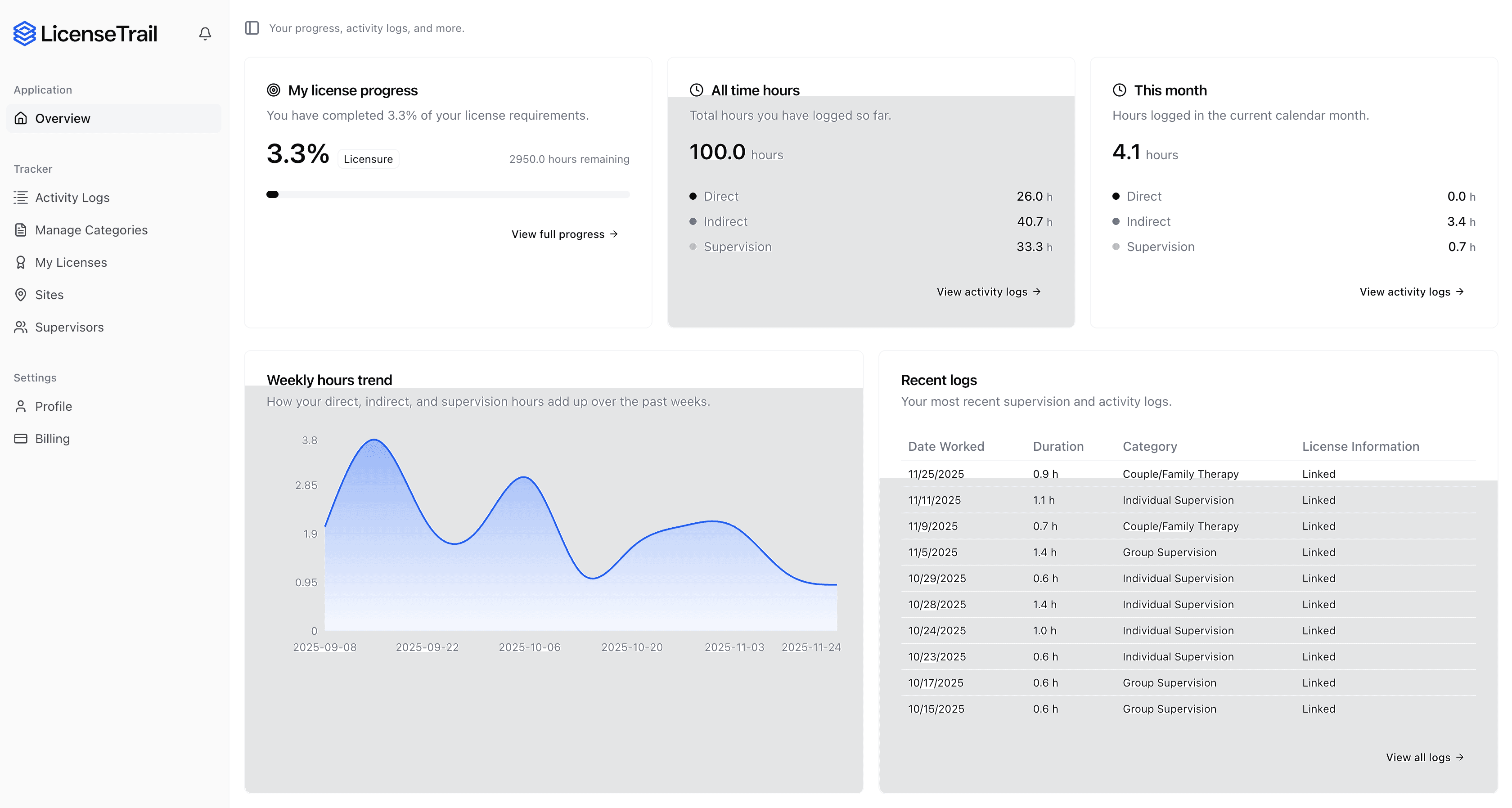
License Trail checks your direct, indirect, and supervision hours against Tennessee Certified Psychological Testing Technician requirements continuously and flags mismatches before you submit.
 Start Tracking for Free
No credit card required · Free plan available
Related Licenses
Is your spreadsheet hiding Tennessee Certified Psychological Testing Technician risks?
Stop guessing if your categories match Tennessee Board of Examiners in Psychology requirements. License Trail checks your direct, indirect, and supervision hours continuously and flags mismatches before you submit.
Import or log
Bring your spreadsheet or start fresh
Upload your existing tracking spreadsheet and we'll map every hour into the right Tennessee Board of Examiners in Psychology categories automatically.
Verify against Tennessee
Catch mismatches before the board does
License Trail checks your direct, indirect, and supervision hours against Tennessee Certified Psychological Testing Technician requirements continuously.
Export board-ready
One-click clean reports
Generate professional, board-ready reports for supervision meetings and Tennessee Board of Examiners in Psychology submissions in seconds.
No credit card required · Free plan available