
Tennessee LAPSW Requirements: Hours, Exams & Step-by-Step Guide
Stop guessing if your categories match Tennessee requirements. License Trail checks your direct, indirect, and supervision hours against LAPSW requirements continuously and flags mismatches before you submit.
No credit card required · Free plan available
Quick Requirements Overview
- MSW/DSW from a CSWE-accredited program; official transcript sent directly to the TN Board
- Hold an active LMSW (or temporary LMSW) before starting and throughout the LAPSW process; include copy with application
- Complete 3,000 hours of supervised nonclinical advanced practice experience (may include admin + direct client contact)
- Experience must be completed in 2–8 years (time window tied to date Board receives LAPSW application)
- Supervision: 100 supervisor contact hours in addition to the 3,000 hours; ~1 hour per 30 experience hours
- Supervision structure: ≥60 individual; ≤40 group (max 4 supervisees); ≤75% of individual via tele/video
- Supervisor must be LAPSW or LCSW meeting TN supervisor qualifications; logs/documentation maintained by both parties and submitted
- Apply (fees/photo/disclosures) + background check + pass ASWB Advanced Generalist exam (or reciprocity with TN requirements)
License Details
Procedures
Becoming a Licensed Advanced Practice Social Worker (LAPSW) in Tennessee involves a defined sequence of education, licensing, supervised practice, and examination, all governed by the Tennessee Board of Social Worker Licensure. The Board’s rules make very clear how many hours you must complete, what kind of work counts, and how supervision must be structured.
Below is a step‑by‑step guide built directly from the Board’s regulations.
1. Understand what the LAPSW license covers
Tennessee distinguishes between:
- Licensed Master’s Social Worker (LMSW) – entry‑level post‑MSW license.
- Licensed Advanced Practice Social Worker (LAPSW) – “advanced practice social worker” license for nonclinical advanced practice (administrative, policy, macro practice, and certain direct client work that is not clinical psychotherapy).(law.cornell.edu)
- Licensed Clinical Social Worker (LCSW) – clinical psychotherapy license.
LAPSWs provide nonclinical advanced practice social work independently, and may provide clinical services only under LCSW supervision.
2. Educational foundation
To qualify to apply for LAPSW, you must have:
- An MSW or doctoral degree in social work from a program that was accredited by the Council on Social Work Education (CSWE) at the time the degree was granted.(law.cornell.edu)
The Board requires the school to send an official transcript directly to the Board.
3. Obtain the LMSW (or temporary LMSW) first
Before you can begin counting advanced practice hours toward LAPSW, you must become:
- A Licensed Master’s Social Worker (LMSW), or
- A temporarily licensed master’s social worker, if applicable.(law.cornell.edu)
Key points:
- The LAPSW application must include a photocopy of your current LMSW or temporary LMSW license, and
- Your LMSW (or temporary LMSW) must remain in active status throughout the LAPSW application process and until the LAPSW is issued.(law.cornell.edu)
You also must complete a criminal background check sent directly from the approved vendor to the Board.(law.cornell.edu)
4. Get into a qualifying supervision arrangement
Your advanced practice experience must be supervised:
- You must practice “under the supervision of a licensed advanced practice social worker or licensed clinical social worker who has met the qualifications set forth in rule 1365‑01‑.08.”(law.cornell.edu)
Supervisors for LAPSW applicants must:
- Hold an active LAPSW or LCSW license.
- Meet Board experience requirements (for LCSW supervisors, at least 3 years of continuous LCSW licensure before starting supervision; similar experience expectations for LAPSW supervisors).(law.cornell.edu)
- Have completed required supervision‑specific continuing education, including hours on Tennessee licensing rules.(law.cornell.edu)
Tennessee also requires that supervision occur at reasonable intervals and continue until all required hours are completed and the license is granted.(law.cornell.edu)
Both supervisor and supervisee must keep detailed logs of experience and supervision; these logs must be submitted by both parties when you apply.(law.cornell.edu)
5. Accrue the required practice hours (experience requirements)
The Board’s rules are very specific about the experience required for LAPSW:
Within not less than two (2) years and not more than eight (8) years from the date the LAPSW application is received by the Board, you must show:(law.cornell.edu)
-
Licensure status during experience
- You must hold LMSW or temporary LMSW licensure before beginning the supervised experience for LAPSW, and maintain it throughout the period.(law.cornell.edu)
-
Total experience hours
- At least 3,000 hours of “nonclinical advanced practice experience”.(law.cornell.edu)
- The Board defines this as “nonclinical advanced practice experience, that may include administrative and direct client‑social worker contact.”(law.cornell.edu)
This is one block of 3,000 hours. Tennessee does not split this into separate “direct” vs. “supervised” hour totals like “1,500 + 1,500.” Instead, you must complete:
- 3,000 hours of qualifying nonclinical advanced practice experience, plus
- Supervision hours that are in addition to those 3,000 hours (detailed below).
-
Time frame
- All 3,000 hours must be completed in ≥ 2 years and ≤ 8 years from the date the Board receives your LAPSW application. Hours outside this window cannot be counted.(law.cornell.edu)
-
Nature of the work
Examples of activities that typically count as “nonclinical advanced practice experience” include:(law.cornell.edu)- Program administration and management
- Policy development and implementation
- Case management and nonclinical counseling (e.g., resource coordination, education, support)
- Community organizing, research, training, and other macro‑practice functions
Clinical psychotherapy and diagnosis toward LCSW would fall under the clinical track instead.
6. Supervision hour requirements (in addition to the 3,000 hours)
The supervision rules for LAPSW applicants are spelled out in Tenn. Comp. R. & Regs. 1365‑01‑.08(2)(b).(law.cornell.edu)
You must obtain:
- 100 hours of “supervisor contact hours”, in addition to the 3,000 hours of nonclinical advanced practice experience.
The Board’s exact structure:
-
Total supervision
- “The applicant must accumulate a total of one hundred (100) supervisor contact hours… The supervision hours are in addition to the three thousand required nonclinical advanced practice experience hours.”(law.cornell.edu)
-
Ratio and distribution
- Supervision must be spread throughout the experience period at approximately one (1) supervision hour to every thirty (30) nonclinical advanced practice experience hours.(law.cornell.edu)
Practically, if you worked 30 qualifying hours in a week, you’d aim for about 1 hour of supervision that week.
-
Individual vs. group supervision
- At least 60 of the 100 hours must be individual supervision (one supervisor with one supervisee).
- Up to 40 hours may be group supervision, and the group may include no more than four (4) supervisees at a time.(law.cornell.edu)
-
Modality (telehealth vs. in‑person)
- No more than 75% of individual supervision hours may be obtained via teleconferencing, visual multi‑media, or video conferencing technology.(law.cornell.edu)
-
Who can supervise
- Individual and group supervision must be provided by a licensed clinical or advanced practice social worker (LCSW or LAPSW).(law.cornell.edu)
- Supervision for LAPSW cannot be provided by other mental health or medical disciplines.(law.cornell.edu)
-
What does not count
- The Board expressly states that these supervision hours are in addition to:
- Any overall administrative supervision, and
- Any group seminar or group consultation that might occur.(law.cornell.edu)
- The Board expressly states that these supervision hours are in addition to:
In other words, supervision must be purposeful, documented professional supervision aimed at meeting the Board’s standards, not just day‑to‑day managerial oversight.
7. Documenting your experience and supervision
Throughout the 3,000 hours and 100 supervision hours:
- Both you and your supervisor must maintain records of:
- Dates and hours of advanced practice experience,
- Dates, length, and type of supervision (individual vs. group, modality),
- Content/focus of supervision.(law.cornell.edu)
At the time you apply for LAPSW, verification of supervision is:
- Submitted by both the supervisor and supervisee,
- Often using Board‑recommended supervision logs signed by both parties, which the Board states are sufficient documentation.(law.cornell.edu)
8. Application for LAPSW by examination
When you have completed the education, LMSW licensure, 3,000 hours of experience, and 100 hours of supervision, you apply for LAPSW “by examination.” For an Advanced Practice Social Worker, the Board requires you to submit:(law.cornell.edu)
-
Completed application on a form prescribed by the Board, including disclosures about:
- Criminal convictions (except traffic violations),
- Denial, loss, or discipline of any license,
- Civil judgments or adverse settlements.
-
Fees
- Payment of the application, license, and state regulatory fees.
-
Photo
- A passport‑style photograph taken within 12 months prior to application.
-
Criminal background check
- Background check results sent directly from the Board’s vendor.(law.cornell.edu)
-
Official transcript
- Sent directly from your school showing a master’s or doctorate in social work from a CSWE‑accredited institution.(law.cornell.edu)
-
Proof of exam
- Proof that you have successfully passed the Association of Social Work Boards (ASWB) Advanced Generalist licensing examination.(law.cornell.edu)
-
Proof of supervised practice
- Proof that you have practiced for no less than two (2) years as an LMSW or temporary LMSW under qualified supervision, within the required 2–8‑year window, including:
- Verification of 3,000 hours of nonclinical advanced practice experience, and
- Verification of 100 hours of supervision structured as described above.(law.cornell.edu)
- Proof that you have practiced for no less than two (2) years as an LMSW or temporary LMSW under qualified supervision, within the required 2–8‑year window, including:
Secondary sources and Board guidance also indicate that you will typically include:(publichealthonline.org)
- A copy of your current LMSW renewal card,
- Verification of supervision and supervision logs,
- A professional reference,
- Board‑specific forms such as a Mandatory Practitioner Profile Questionnaire and Declaration of Citizenship, as required at the time of application.
9. Pass the ASWB Advanced Generalist exam
The LAPSW license is linked to the ASWB Advanced Generalist examination:
- The Board must approve you to sit for the exam (generally after your application is reviewed).
- You then register with ASWB and pass the Advanced Generalist exam.(law.cornell.edu)
Once the Board receives your passing score from ASWB and confirms you have met all other requirements, it issues the LAPSW license.
10. If you are already licensed in another state (reciprocity)
Tennessee allows licensure by reciprocity for social workers who already hold comparable licenses elsewhere. To obtain LAPSW this way, you must submit:(law.cornell.edu)
- A completed reciprocity application,
- Fees and photograph,
- Criminal background check results,
- Letter of good standing and copies of your out‑of‑state license and renewal,
- Proof that you have not previously failed the examination required by the Tennessee Board,
- Proof you reside in or are employed in Tennessee.
If you don’t meet Tennessee’s criteria for reciprocity, you must apply by examination, but you may still use out‑of‑state supervised hours if they meet Tennessee’s supervision and hour requirements.(law.cornell.edu)
11. Hour requirements at a glance (Tennessee LAPSW)
For the Tennessee Licensed Advanced Practice Social Worker (LAPSW), the Board’s requirements can be summarized as:
-
Experience
- 3,000 hours of “nonclinical advanced practice experience” (may include administrative and direct client‑social worker contact).
- Completed over at least 2 years and no more than 8 years from the date the LAPSW application is received by the Board.(law.cornell.edu)
-
Supervision
- 100 hours of supervision (“supervisor contact hours”), in addition to the 3,000 experience hours.
- Supervision distributed at approximately 1 hour for every 30 hours of nonclinical advanced practice experience.
- At least 60 hours individual, up to 40 hours group (group of ≤4 supervisees).
- No more than 75% of individual supervision may be via tele/video technologies.
- Supervision must be provided by a licensed clinical or advanced practice social worker (LCSW or LAPSW), not by other disciplines.(law.cornell.edu)
Tennessee does not divide the total into “1,500 hours of direct experience and 1,500 hours of supervised experience.” Instead, the Board’s exact structure is:
- 3,000 hours of qualifying nonclinical advanced practice experience,
- Plus 100 hours of qualifying supervision that is separate from and additional to those 3,000 hours.
Track your LAPSW hours with confidence
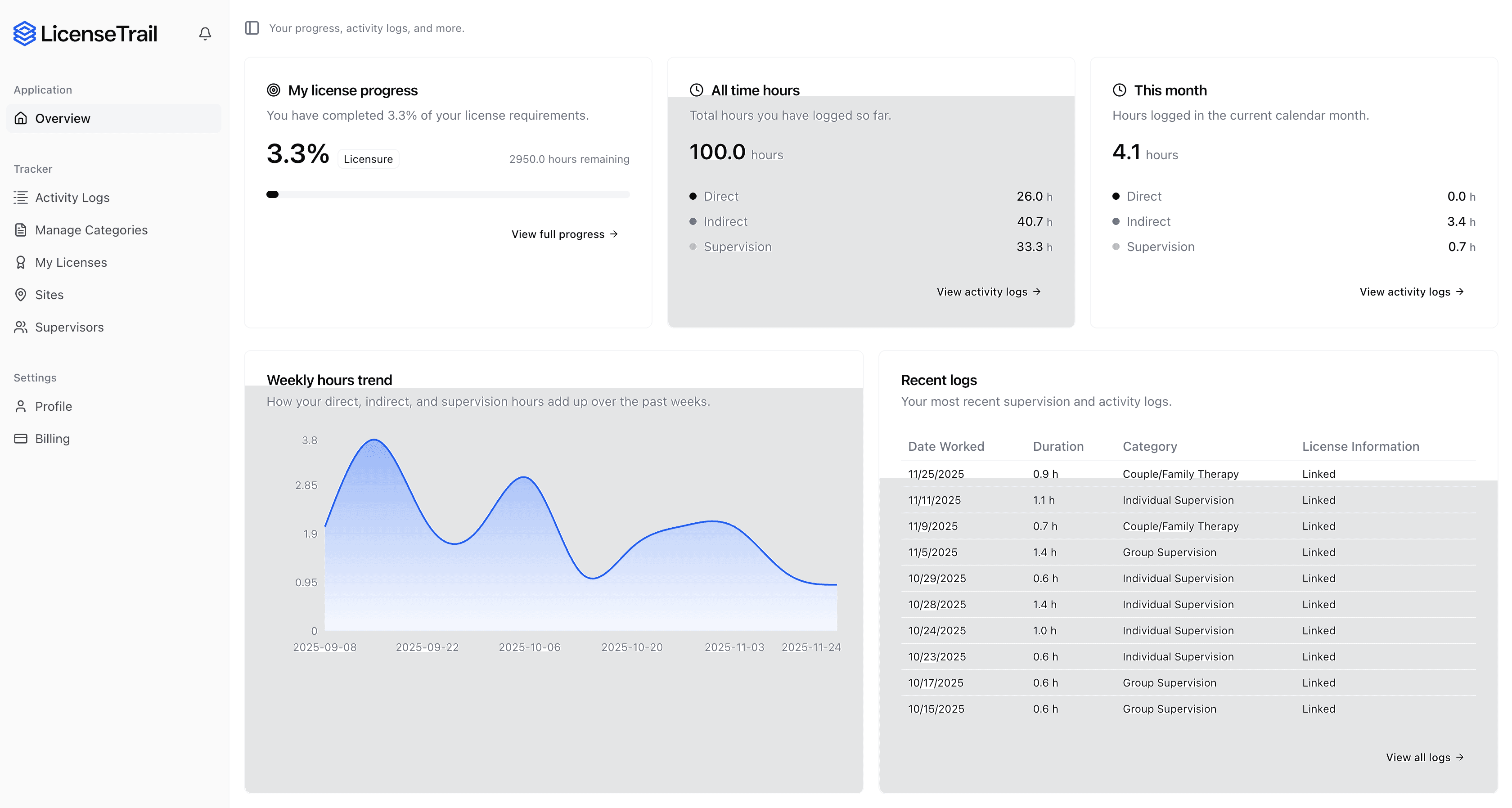
License Trail checks your direct, indirect, and supervision hours against Tennessee LAPSW requirements continuously and flags mismatches before you submit.
 Start Tracking for Free
No credit card required · Free plan available
Related Licenses
Is your spreadsheet hiding Tennessee LAPSW risks?
Stop guessing if your categories match Tennessee Board of Social Worker Licensure requirements. License Trail checks your direct, indirect, and supervision hours continuously and flags mismatches before you submit.
Import or log
Bring your spreadsheet or start fresh
Upload your existing tracking spreadsheet and we'll map every hour into the right Tennessee Board of Social Worker Licensure categories automatically.
Verify against Tennessee
Catch mismatches before the board does
License Trail checks your direct, indirect, and supervision hours against Tennessee LAPSW requirements continuously.
Export board-ready
One-click clean reports
Generate professional, board-ready reports for supervision meetings and Tennessee Board of Social Worker Licensure submissions in seconds.
No credit card required · Free plan available