
Tennessee LBSW Requirements: Hours, Exams & Step-by-Step Guide
Stop guessing if your categories match Tennessee requirements. License Trail checks your direct, indirect, and supervision hours against LBSW requirements continuously and flags mismatches before you submit.
No credit card required · Free plan available
Quick Requirements Overview
- Regulator: TN Board of Social Worker Licensure (Title 63, Ch. 23; Rule 1365-01)
- Education: BSW from a CSWE-accredited/approved program (at time degree granted)
- Exam: Pass ASWB Bachelor’s exam
- Application: Board form + fees; required disclosures (criminal history, license discipline, civil judgments/settlements)
- Documentation: Official transcript sent directly; passport-style photo (within 12 months); background check via Board vendor
- Experience hours: No Board-required post-degree practice/supervision hours for initial LBSW
- Practice limits: Nonclinical generalist practice only; no diagnosis/psychotherapy; no private practice/direct payment/3rd-party reimbursement—must work for an agency/organization
- Continuing education: 18 hours every 2 years (6 ethics + 1 hour TN laws/rules); suicide prevention 2 hours at least every 4 years
License Details
Procedures
In Tennessee, the Licensed Baccalaureate Social Worker (LBSW) is the entry‑level social work license regulated by the Tennessee Board of Social Worker Licensure under Title 63, Chapter 23 of the Tennessee Code and Chapter 1365‑01 of the Tennessee Rules and Regulations. (law.justia.com)
A key point up front: Tennessee does not require any specified number of post‑degree practice hours (e.g., “1,500 direct hours + 1,500 supervised hours”) to obtain the initial LBSW license. All numeric “experience hour” requirements in the Board’s rules apply only to advanced (LAPSW) and clinical (LCSW) licenses, not to the LBSW. (law.cornell.edu)
What follows is a structured guide based directly on the statute and Board rules.
1. Legal definition and scope of the LBSW
Tennessee law defines “the practice of baccalaureate social work” as basic generalist practice that includes functions such as interviewing, assessment, planning, intervention, evaluation, case management, mediation, supportive counseling, direct nonclinical practice, information and referral, advocacy, community organization, and the development and administration of programs and policies. (law.justia.com)
The same statute makes several explicit limitations for LBSWs:
- Baccalaureate social workers are not qualified to diagnose or treat mental illness nor provide psychotherapy services. (law.justia.com)
- An LBSW “shall not provide services to clients in exchange for direct payment or third‑party reimbursement” and must work in or for an agency or organization, not in private or independent practice. (law.justia.com)
- LBSWs may not hold themselves out as LMSWs, LAPSWs, or LCSWs, and may not prescribe medication or interpret psychological tests. (law.justia.com)
These limitations are important because they explain why Tennessee does not tie the LBSW to a post‑licensure hour requirement in the way it does for advanced and clinical licenses.
2. Core eligibility requirements for LBSW licensure
Under Tenn. Code Ann. §63‑23‑102(b)(1) and Rule 1365‑01‑.04(1), to obtain an LBSW license you must provide evidence satisfactory to the Board that you have: (codes.findlaw.com)
- Submitted a written application on a form prescribed by the Board.
- Paid all applicable fees specified by the Board.
- Attained the age of majority (legally an adult).
- Graduated and received a baccalaureate degree in social work from a program approved/accredited by the Council on Social Work Education (CSWE) at the time the degree was granted.
- Successfully passed the Association of Social Work Boards (ASWB) Bachelor’s licensing exam.
The Board’s licensure rule adds some procedural details for the LBSW “by examination”: (law.cornell.edu)
- A completed application disclosing:
- Criminal convictions (other than traffic violations)
- Denial, loss, restriction, or discipline of any professional license
- Civil judgments or adverse civil settlements involving the applicant
- Payment of the application, license, and state regulatory fees
- A passport‑style photograph taken within 12 months prior to application submission
- Criminal background check results sent directly to the Board’s office by the designated vendor
- An official transcript sent directly from the institution showing a bachelor’s degree in social work from a CSWE‑accredited program
- Proof of passing the ASWB Bachelor’s examination
There is no mention in the statute or Rule 1365‑01‑.04(1) of any required number of clinical, direct practice, or supervised hours for LBSW licensure. (law.cornell.edu)
3. Step‑by‑step path to LBSW licensure in Tennessee
Step 1: Complete a CSWE‑accredited BSW program
The Board requires that you “graduated and received a baccalaureate degree in social work from a council on social work education approved program,” and the Board’s rule further clarifies that the institution must be accredited by CSWE at the time the degree was granted. (codes.findlaw.com)
- Field/practicum hours: CSWE‑accredited BSW programs include field education hours as part of their accreditation standards, but the Tennessee Board does not set a separate, numerical practicum‑hour requirement in its statute or rules for LBSW licensure. Those hours are controlled by your school and CSWE, not by the Board.
Step 2: Apply to the Tennessee Board “by examination”
Under Rule 1365‑01‑.04(1): (law.cornell.edu)
- Submit the Board application form for LBSW (Baccalaureate Social Worker by examination).
- Disclose the required background items (criminal history, license discipline, civil judgments/settlements).
- Pay required application, license, and state regulatory fees.
- Arrange for:
- Passport‑style photo (within the last 12 months)
- Criminal background check via the Board’s specified vendor
- Official transcript sent directly from your CSWE‑accredited BSW program
Step 3: Take and pass the ASWB Bachelor’s exam
- The statute requires you to have “successfully passed the association of social work board’s bachelor’s licensing exam.” (codes.findlaw.com)
- The Board’s rule requires proof that you have passed the ASWB Bachelor’s exam before it will issue the license. (law.cornell.edu)
Step 4: License issuance and title protection
Once the Board has all required documents, fees, and a passing exam score, it may issue the Licensed Baccalaureate Social Worker (L.B.S.W.) license.
Tennessee law then restricts use of the title:
- “No person shall… represent that the person is a licensed baccalaureate social worker unless the person possesses a valid license issued pursuant to subsection (b).” (codes.findlaw.com)
Representing yourself as an LBSW without a valid license is a Class A misdemeanor under §63‑23‑102(d). (codes.findlaw.com)
4. Clarifying “hours” for LBSW: what is and isn’t required
A. Pre‑licensure practice or supervision hours
For LBSW applicants, there is no specified number of practice, direct service, or supervised hours set by the Tennessee Board for initial licensure.
- The only quantitative practice/supervision hours in Rule 1365‑01‑.04 are for:
- Licensed Advanced Practice Social Worker (LAPSW): at least 3,000 hours of nonclinical advanced practice experience and at least 100 hours of supervision, with supervision distributed at a ratio of approximately 1 hour of supervision per 30 practice hours. (law.cornell.edu)
- Licensed Clinical Social Worker (LCSW): at least 3,000 hours of clinical experience and at least 100 hours of supervision, also at roughly 1 supervision hour per 30 clinical hours. (law.cornell.edu)
Those 3,000‑hour/100‑hour requirements sometimes cause confusion, but they belong only to the LAPSW and LCSW sections of the rule; they are not part of the LBSW requirements in subsection (1).
B. Educational (field) hours
- Your BSW program will require practicum/field hours to meet CSWE standards, but the Board’s LBSW provisions do not name a number (e.g., 400, 900 hours) for licensure.
- For licensure, the Board simply requires that the degree is from a CSWE‑accredited program and that you pass the ASWB Bachelor’s exam. (codes.findlaw.com)
5. Temporary LBSW licensure (if your school’s accreditation is pending)
Tennessee law and rules allow for temporary licensure for baccalaureate social workers whose school has applied for, but not yet received, CSWE accreditation: (codes.findlaw.com)
- Statute: the Board “shall establish regulations for the issuance of temporary licenses to baccalaureate social workers who hold a baccalaureate degree in social work” from a school that has applied for CSWE accreditation. (codes.findlaw.com)
- Rule 1365‑01‑.04(6) lays out what you must submit for a temporary LBSW:
- Application (with the same disclosures as above)
- Official transcript showing a bachelor’s degree in social work
- Proof the institution had applied for CSWE accreditation at the time the degree was granted
- Application, temporary license, and state regulatory fees
- Proof of passing the ASWB Bachelor’s exam
- Passport‑style photograph
- Criminal background check
A temporary LBSW license expires if you do not apply for full LBSW licensure within 60 days after your institution actually receives CSWE accreditation, or if the school’s CSWE application is denied or withdrawn. (law.cornell.edu)
Again, even for the temporary LBSW, no practice‑hour requirement is stated; the focus is on degree status, exam, and accreditation timing.
6. Required continuing education hours for an LBSW
Once licensed, Tennessee does impose specific continuing education (CE) hours on LBSWs.
A. Basic CE structure and “clock hour” definition
Rule 1365‑01‑.09 defines: (regulations.vlex.com)
- Social work continuing education as education aimed at enhancing social work knowledge and service delivery skills in planning, administration, education, research, and direct service.
- Social work ethics continuing education as education focused on professional ethics and the statutes and rules governing social work in Tennessee.
- Clock hour: “A clock hour represents actual time in continuing education activity.”
All social workers licensed by the Board must complete the required CE in the two calendar years preceding the year of renewal. (regulations.vlex.com)
B. LBSW‑specific CE hour requirements
The Board’s official CE page and Rule 1365‑01‑.09 specify for Licensed Baccalaureate Social Workers: (tn.gov)
- Eighteen (18) clock hours every two (2) calendar years.
- Of those 18 hours:
- Six (6) hours must be in social work ethics.
- One (1) hour must be specific to Tennessee Code Annotated §§63‑23‑101 et seq. and the Rules and Regulations of the Tennessee Board of Social Worker Licensure.
In addition, Rule 1365‑01‑.09 and the Board’s CE guidance require: (tn.gov)
- Suicide prevention training:
- All active LBSWs must complete a minimum of two (2) hours of Board‑approved suicide‑prevention training at least once every four (4) years.
- New licensees are exempt from this requirement for two years after initial licensure if they can document a qualifying 2‑hour academic training program completed within two years before their application.
For new LBSW licensees, successfully passing the exam may substitute for half of the required CE hours in the first renewal period if you applied in the same calendar year you took the exam. (regulations.justia.com)
7. How LBSW requirements differ from “hour‑heavy” licenses
To avoid mixing requirements between levels:
-
LBSW (bachelor’s level):
- No Board‑mandated post‑degree practice or supervision hours for initial licensure.
- Only numerical requirements are CE clock hours (18 per two‑year cycle, with specified ethics and law content) and suicide‑prevention CE (2 hours every four years). (tn.gov)
-
LAPSW and LCSW (master’s level):
- Must first hold a Licensed Master Social Worker (LMSW) or temporary LMSW.
- Must complete at least 3,000 hours of relevant practice (advanced practice for LAPSW; clinical for LCSW) plus at least 100 hours of supervision, with supervision spread roughly at a 1:30 supervision‑to‑practice‑hour ratio, over at least two and no more than eight years. (law.cornell.edu)
Those 3,000/100‑hour requirements have no application to someone seeking only the LBSW license.
Summary
For Tennessee’s LBSW license, the Board’s law and rules focus on:
- Education: BSW from a CSWE‑accredited program.
- Examination: Passing the ASWB Bachelor’s exam.
- Application package: Disclosures, fees, background check, photo, and official transcript.
- Post‑licensure CE hours: 18 clock hours every two years, including 6 ethics hours, 1 hour on Tennessee laws/rules, and periodic suicide‑prevention training.
They do not require a specified number of direct client hours or supervised hours (such as 1,500 + 1,500) for initial LBSW licensure; all such quantitative “experience hours” in the Board’s rules are reserved for advanced and clinical licenses. (law.cornell.edu)
Track your LBSW hours with confidence
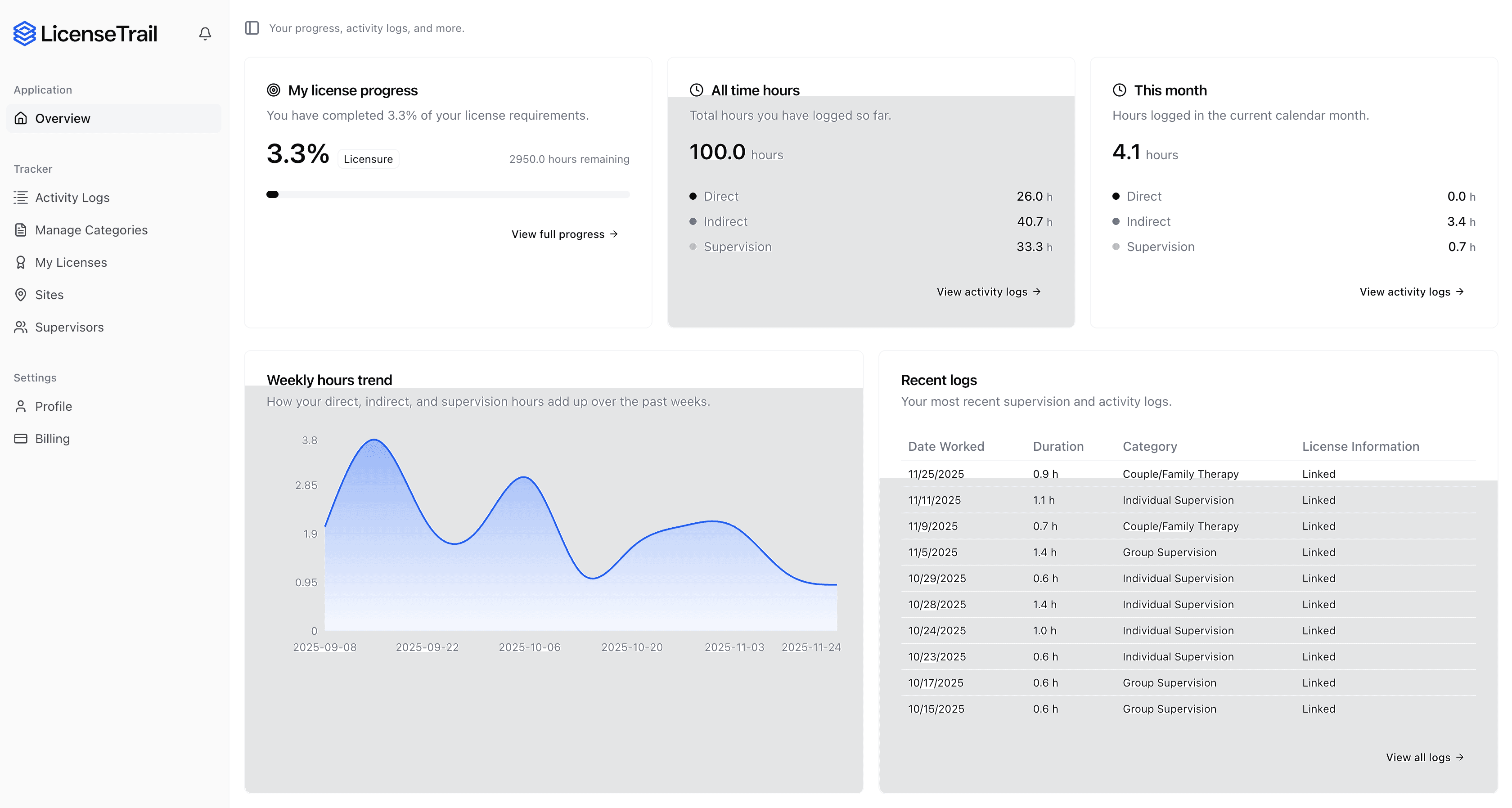
License Trail checks your direct, indirect, and supervision hours against Tennessee LBSW requirements continuously and flags mismatches before you submit.
 Start Tracking for Free
No credit card required · Free plan available
Related Licenses
Is your spreadsheet hiding Tennessee LBSW risks?
Stop guessing if your categories match Tennessee Board of Social Worker Licensure requirements. License Trail checks your direct, indirect, and supervision hours continuously and flags mismatches before you submit.
Import or log
Bring your spreadsheet or start fresh
Upload your existing tracking spreadsheet and we'll map every hour into the right Tennessee Board of Social Worker Licensure categories automatically.
Verify against Tennessee
Catch mismatches before the board does
License Trail checks your direct, indirect, and supervision hours against Tennessee LBSW requirements continuously.
Export board-ready
One-click clean reports
Generate professional, board-ready reports for supervision meetings and Tennessee Board of Social Worker Licensure submissions in seconds.
No credit card required · Free plan available