
Tennessee LMSW Requirements: Hours, Exams & Step-by-Step Guide
Stop guessing if your categories match Tennessee requirements. License Trail checks your direct, indirect, and supervision hours against LMSW requirements continuously and flags mismatches before you submit.
No credit card required · Free plan available
Quick Requirements Overview
- Education: MSW/DSW in social work from a CSWE-accredited program; official transcript sent directly to the Board
- Exam: Pass ASWB Master’s licensing exam (Board approval letter required to sit)
- Initial LMSW hours: No post-degree supervised/practice hour requirement for LMSW licensure in TN
- Application items: Board application + required disclosures (criminal/discipline/civil matters), fees, passport-style photo (≤12 months)
- Background check: Criminal background check results sent directly to the Board from approved vendor
- How to apply: Submit via TN Dept. of Health LARS (Master Social Worker application)
- Renewal CE: 24 CE hours every 2 years (incl. 6 ethics + 1 hour TN laws/rules) + 2-hour suicide prevention at least every 4 years
- If advancing later: LAPSW/LCSW require 3,000 hours experience + 100 supervision hours (≈1:30), completed within 2–8 years post-application period
License Details
Procedures
Becoming a Licensed Master’s Social Worker (LMSW) in Tennessee is primarily an education‑and‑exam process. Unlike some states, Tennessee’s Board of Social Worker Licensure does not require a set number of post‑degree supervised practice hours to obtain the LMSW itself; hourly requirements apply only later if you move up to Licensed Advanced Practice Social Worker (LAPSW) or Licensed Clinical Social Worker (LCSW).
Below is a structured guide based directly on the Board’s rules and official materials.
1. License category and scope
Tennessee recognizes four social work licenses:
- Licensed Baccalaureate Social Worker (LBSW)
- Licensed Master’s Social Worker (LMSW)
- Licensed Advanced Practice Social Worker (LAPSW)
- Licensed Clinical Social Worker (LCSW) (law.cornell.edu)
The rules state that anyone with a valid master’s social worker license may use the title and/or acronym “Licensed Master’s Social Worker (L.M.S.W.)” as defined in Tennessee Code Annotated (T.C.A.) § 63‑23‑103. (law.cornell.edu)
The LMSW is the entry‑level post‑master license and is also the platform from which you later accrue “hours of experience” for LAPSW or LCSW.
2. Core eligibility for LMSW (by examination)
The Board’s “Licensure Requirements” rule sets out what you must submit as an applicant for a master’s social worker by examination. (law.cornell.edu)
2.1 Education
You must have:
- An official transcript showing a master’s or doctorate degree in social work from a program that “must be accredited by the Council on Social Work Education at the time the degree was granted.”
The transcript must be “submitted directly from the institution to the Board office.” (law.cornell.edu)
2.2 ASWB Master’s exam
You must provide:
- “Proof the applicant has successfully passed the Association of Social Work Board’s master’s licensing examination.” (law.cornell.edu)
The Board will send you an approval letter to sit for the ASWB exam; that letter explains how to register and schedule your test. (tn.gov)
2.3 Background disclosures and documents
The LMSW application must include: (law.cornell.edu)
- A completed application on the Board’s form, including disclosure of:
- Criminal conviction(s), except traffic violations
- Any denial, loss, restriction, or discipline of other licenses
- Civil suit judgment or adverse civil settlement involving you
- Payment of application, license, and state regulatory fees
- A passport‑style photograph taken within 12 months of the application
- Results of a criminal background check sent directly to the Board from the state’s approved vendor
- The official transcript described above
- Proof of passing the ASWB Master’s exam
You submit this via the Tennessee Department of Health’s online Licensure and Regulatory System (LARS) after selecting the Master Social Worker application option on the Board’s “Applications” page. (tn.gov)
3. What “hours” are – and are not – required for the LMSW
3.1 No post‑degree practice hours required to get the LMSW
For the LMSW license by examination, the Board’s rule lists the items above and does not require any specified number of post‑MSW “direct client” or “supervised” hours. The only quantitative requirements in that LMSW subsection concern:
- having the accredited degree, and
- passing the ASWB Master’s exam. (law.cornell.edu)
In other words:
- Tennessee does not say anything like “1,500 hours direct experience and 1,500 hours supervised experience” to become an LMSW.
- The “hours of experience” language in Tennessee rules is explicitly defined as hours “necessary for the advancement of an L.M.S.W. to a higher level of licensure as either an L.A.P.S.W. or an L.C.S.W.” (law.cornell.edu)
Your field placement hours inside your CSWE‑accredited MSW program are governed by CSWE and your school, not by specific Tennessee hour counts for the LMSW license.
3.2 Continuing education hours once you are licensed
Once you hold an LMSW, you must complete continuing education (CE) to renew. The Board states: (tn.gov)
- An LMSW must complete twenty‑four (24) clock hours every two (2) calendar years.
- Of those 24 hours:
- Six (6) hours must be in social work ethics.
- One (1) hour must be specific to Tennessee Code Annotated §§ 63‑23‑101, et seq., and the Rules and Regulations of the Tennessee Board of Social Worker Licensure.
- New LMSW licensees who apply in the calendar year they took the exam may have the licensing exam count as preparatory education for one‑half (½) of the required hours for their first renewal cycle.
Additionally, all licensees (including LMSWs) must complete a minimum two (2) hour Board‑approved training in suicide prevention at least once every four (4) years under the “Kenneth and Madge Tullis, MD, Suicide Prevention Training Act.” (tn.gov)
Those CE “clock hours” are renewal requirements, not prerequisites for initial licensure.
4. Key definitions of “experience,” “clinical experience,” and “hours of experience”
These definitions matter for understanding the hours you will need later if you pursue LAPSW or LCSW.
The Board defines in rule 1365‑01‑.01: (law.cornell.edu)
-
Nonclinical Advanced Practice Experience
Experience under supervision of an LCSW or LAPSW in areas such as education, research, advocacy, community organization, consultation, public policy, case management, counseling and administrative work. It is:- “Designated as the actual time spent in direct services to clients, client systems and/or organizations,” and
- “Not defined as solely face‑to‑face contact” with individuals, couples, families, or groups.
-
Clinical Experience
The application of social work theory and methods to “restore or enhance social, psychosocial or biopsychosocial functioning” of individuals, couples, families, or groups, including:- assessment, diagnosis and/or treatment of mental, emotional, and behavioral disorders;
- individual, marital, family, and group therapy; crisis assessment; treatment planning; and related interventions.
Clinical experience is “designated as the actual time spent providing direct services to clients.”
-
Hours of Experience
Defined as “the number of actual hours of supervised experience necessary for the advancement of an L.M.S.W. to a higher level of licensure as either an L.A.P.S.W. or an L.C.S.W.”
These definitions confirm that experience hours are about moving beyond the LMSW, not about getting it.
5. Experience and supervision hours for advanced licenses (after LMSW)
While your question is specifically about LMSW, the Board’s rules are very specific about hour requirements once you hold an LMSW and want to upgrade. These may be important to your planning.
5.1 Hours to become a Licensed Advanced Practice Social Worker (LAPSW)
The LAPSW requirements assume you already hold an LMSW (or temporary LMSW). The Board requires: (law.cornell.edu)
-
Supervised practice period
- You must have “practiced for no less than two (2) years after the date of application as a licensed master’s social worker or temporarily licensed master’s social worker” under the supervision of an LAPSW or LCSW who meets Board supervisor qualifications.
-
Experience hours (nonclinical advanced practice)
Within a period no less than two (2) years and no greater than eight (8) years from the date your LAPSW application is received, you must document:- “At least three thousand (3000) hours of nonclinical advanced practice experience, that may include administrative and direct client‑social worker contact.”
- “At least one hundred (100) hours of supervision in addition to the three thousand (3000) hours of experience. These hours must be spread throughout the three thousand (3000) advanced practice experience contact hours at a ratio of approximately one (1) hour of supervision to every thirty (30) advanced practice experience contact hours.”
This is where Tennessee provides the explicit hour counts—but again, only for advancement beyond LMSW.
5.2 Hours to become a Licensed Clinical Social Worker (LCSW)
Similarly, the LCSW requirements apply after you have an LMSW. The Board requires: (law.cornell.edu)
-
Supervised practice period
- Proof that you “have practiced for not less than two (2) years after the date of application as a licensed master’s social worker or temporarily licensed master’s social worker” under the supervision of a qualified LCSW.
-
Experience hours (clinical)
Within a 2–8 year period from application, you must document:- “At least three thousand (3000) hours of clinical experience; and
- At least one hundred (100) hours of supervision in addition to the three thousand (3000) hours of experience,” also at a ratio of approximately 1 hour of supervision for every 30 clinical experience hours.
These 3,000 hours + 100 hours supervision are the Board’s controlling numbers for clinical licensure—there is no similar numeric breakdown attached to initial LMSW licensure.
6. Temporary LMSW license and hours
There is a separate “temporary” license category for baccalaureate and master’s social workers when their schools have applied for, but not yet received, CSWE accreditation. For a temporary licensed master’s social worker, the Board requires: (law.cornell.edu)
- Application, fees, photo, background check
- Transcript showing a master’s degree in social work
- Proof that the program had applied for CSWE accreditation at the time of graduation
- Proof of passing the ASWB master’s licensing exam
Crucially, the rule adds:
“The temporary licensed master’s social worker license is required prior to beginning the supervised experience needed for licensure as a licensed clinical social worker or licensed advanced practice social worker.” (law.cornell.edu)
So even when you are accruing the 3,000 hours for LAPSW or LCSW, Tennessee insists you be in LMSW (or temporary LMSW) status first; but, again, none of that supervised experience is required simply to obtain the LMSW.
7. Renewal and ongoing obligations for LMSWs
Once licensed as an LMSW, you must:
- Renew your license on the schedule set by the Board (licenses are renewed through the online system; the Board emphasizes that the licensee is responsible for timely renewal and for keeping contact information current). (tn.gov)
- Complete the continuing education requirements described above:
- 24 clock hours every two calendar years
- 6 ethics hours and 1 hour specific to Tennessee statutes and Board rules
- 2‑hour suicide prevention training at least once every four years (tn.gov)
Failure to meet CE requirements can lead to disciplinary action, which may be reported publicly in the Department’s licensure verification system. (tn.gov)
Summary focused on your “hours” question
-
To become an LMSW in Tennessee:
- You need a CSWE‑accredited MSW or DSW, a criminal background check, and a passing score on the ASWB Master’s exam, plus the standard application materials (fees, photo, background, and disciplinary disclosures, official transcripts).
- The Board’s LMSW licensure rule does not require any specific number of post‑degree direct‑practice or supervised hours to obtain the LMSW license. (law.cornell.edu)
-
The only quantitative “hours” tied directly to LMSWs are:
- Continuing education for renewal: 24 clock hours every two years (with required sub‑categories) and 2 hours of suicide‑prevention training every four years. (tn.gov)
- Post‑LMSW advancement hours:
- LAPSW: at least 3,000 hours of nonclinical advanced practice experience plus 100 hours of supervision at about a 1:30 ratio. (law.cornell.edu)
- LCSW: at least 3,000 hours of clinical experience plus 100 hours of supervision at about a 1:30 ratio. (law.cornell.edu)
So if you are mapping out your pathway: expect no supervised‑hours requirement for initial LMSW licensure in Tennessee, but plan for substantial, clearly defined supervised experience hours if you later choose to become an LAPSW or LCSW.
Track your LMSW hours with confidence
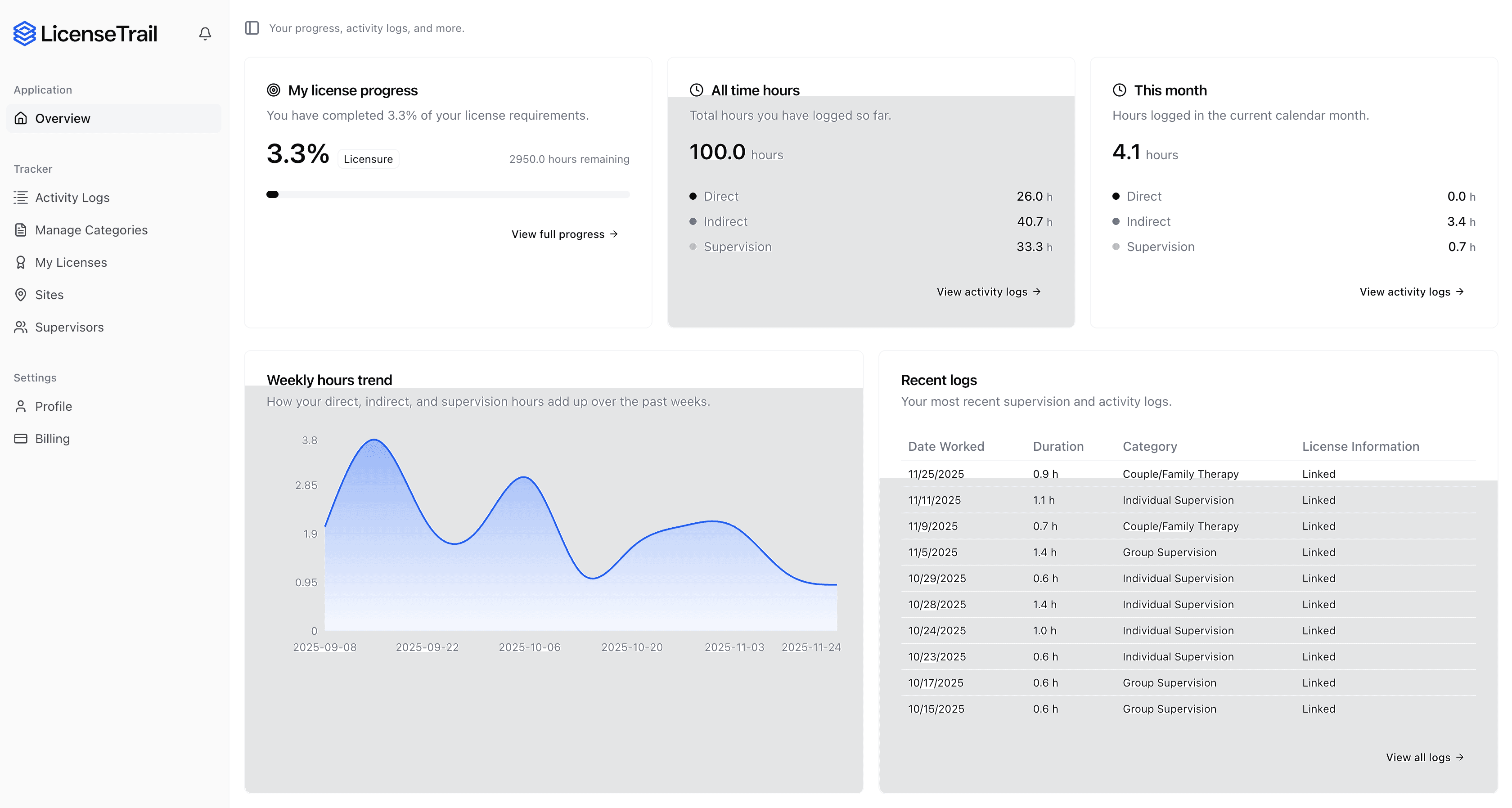
License Trail checks your direct, indirect, and supervision hours against Tennessee LMSW requirements continuously and flags mismatches before you submit.
 Start Tracking for Free
No credit card required · Free plan available
Related Licenses
Is your spreadsheet hiding Tennessee LMSW risks?
Stop guessing if your categories match Tennessee Board of Social Worker Licensure requirements. License Trail checks your direct, indirect, and supervision hours continuously and flags mismatches before you submit.
Import or log
Bring your spreadsheet or start fresh
Upload your existing tracking spreadsheet and we'll map every hour into the right Tennessee Board of Social Worker Licensure categories automatically.
Verify against Tennessee
Catch mismatches before the board does
License Trail checks your direct, indirect, and supervision hours against Tennessee LMSW requirements continuously.
Export board-ready
One-click clean reports
Generate professional, board-ready reports for supervision meetings and Tennessee Board of Social Worker Licensure submissions in seconds.
No credit card required · Free plan available