
Tennessee Senior Psychological Examiner Requirements: Hours, Exams & Step-by-Step Guide
Stop guessing if your categories match Tennessee requirements. License Trail checks your direct, indirect, and supervision hours against Senior Psychological Examiner requirements continuously and flags mismatches before you submit.
No credit card required · Free plan available
Quick Requirements Overview
- Must already hold an active TN Psychological Examiner license and be providing health-related clinical services (no direct-entry to Senior)
- Pathway A (licensed before 7/1/1991): upgrade to Senior by written/online request (no additional years/CE specified)
- Pathway B (licensed on/after 7/1/1991): requires 5 years applied experience from temporary permit/original licensure date
- Experience must be health-related clinical services as a Psychological Examiner under supervision for the 5 years; documented on Board form (notarized) listing supervisor(s)
- No fixed minimum clinical hour count specified; requirement is years + supervised clinical practice
- Must complete 200 hours post-licensure CE for upgrade
- CE distribution: 45 Type I + 45 Type I or II + 110 any Type I/II/III
- Submit application + fees + CE documentation + experience/supervision attestation; Board reviews and approves upgrade (Authority: T.C.A. §63-11-202; Rules 1180-03-.02/.03)
License Details
Procedures
In Tennessee, the Senior Psychological Examiner license is an advanced credential for master’s‐level clinicians who start as Psychological Examiners and then meet additional experience and continuing education requirements. The license and its upgrade criteria are created by statute in Tennessee Code Annotated (T.C.A.) § 63‑11‑202 and implemented through the Board’s rules in Chapters 1180‑01 and 1180‑03 of the Tennessee Compilation of Rules and Regulations. (law.justia.com)
Below is a structured overview of how the upgrade works and the exact types of hours the Board requires.
1. Preconditions: You must already be a Psychological Examiner
Tennessee does not license someone directly as a Senior Psychological Examiner from graduate school. You must first:
- Be duly licensed in Tennessee as a Psychological Examiner, and
- Be actively “rendering health‑related clinical activities or services” as a Psychological Examiner. (law.justia.com)
Only then can you qualify for upgrade to Senior Psychological Examiner under T.C.A. § 63‑11‑202(c) and Board Rule 1180‑03‑.02 (“Qualifications for Upgrade”). (law.justia.com)
2. Two pathways to Senior Psychological Examiner
Pathway A – Grandfathered Psychological Examiners (licensed before July 1, 1991)
By statute, psychological examiners who:
- Were “duly licensed prior to July 1, 1991”, and
- Are “rendering health‑related clinical activities or services,”
“shall be senior psychological examiners” once they request that status from the Board in writing or via online application. (law.justia.com)
In other words, for this older cohort the law does not require a specified number of years or a specified number of hours beyond their existing licensure; they upgrade by request.
Pathway B – Psychological Examiners licensed on or after July 1, 1991
For psychological examiners licensed on or after July 1, 1991, the statute and Board rules impose specific experience and continuing education requirements:
T.C.A. § 63‑11‑202(c) states that these examiners will qualify for Senior Psychological Examiner licensure upon completion of:
- At least five (5) years of applied experience from the date their temporary permit was first issued, and
- Two hundred (200) hours of post‑licensure continuing education units, distributed by category according to the Board’s continuing education rules. (law.justia.com)
The Board’s implementing rules in 1180‑03‑.02 and 1180‑03‑.03 use essentially the same language and add detail on supervision and documentation. (law.cornell.edu)
3. Experience requirement: “five years of applied experience”
For post‑1991 psychological examiners, the experience requirement is framed in years and in the type of work done, not in a numerical total of clinical hours.
3.1. How the law defines the experience
The statute provides that you must complete:
“at least five (5) years of applied experience from the date their temporary permit was first issued by the board”
in conjunction with your work as a psychological examiner providing health‑related clinical services. (law.justia.com)
The Board’s rule 1180‑03‑.02 mirrors this, requiring:
- “five (5) years of applied experience from the date of original licensure or from the date of issuance of a temporary permit.” (law.cornell.edu)
3.2. Supervision requirement tied to those five years
The Board’s procedures rule, 1180‑03‑.03, specifies that the five years of experience must be:
- “health‑related clinical activities or services as a Psychological Examiner for five (5) years under supervision,” and
- Documented on a Board‑provided form that is notarized and lists your supervisor(s). (law.cornell.edu)
In practical terms:
- The experience is clinical: It must be health‑service work (e.g., assessment, psychotherapy, counseling, behavior analysis, etc.) that falls within the psychological examiner scope of practice under T.C.A. § 63‑11‑202. (law.justia.com)
- The experience is supervised: During those five years, when you are providing the types of clinical services that require supervision for psychological examiners, that supervision must be by a psychologist with Health Service Provider (HSP) designation or a senior psychological examiner, consistent with the supervision rules in 1180‑03‑.01. (regulations.justia.com)
3.3. What is not specified: No fixed “clinical hour” tally
The Tennessee Board does not break this requirement into a set number of direct versus supervised hours (for example, “1,500 direct hours and 1,500 supervised hours”).
Instead, the governing language is:
- “five (5) years of applied experience”, and
- “rendering health‑related clinical activities or services … for five (5) years under supervision.” (law.justia.com)
There is no rule or statute that converts those five years into a specified minimum number of clock hours like 2,000 or 3,000; the unit the Board uses is time in practice (years) plus the supervisory/clinical nature of that work, not a fixed hour count.
4. Continuing education requirement: 200 post‑licensure hours
The second major requirement for the post‑1991 group is continuing education, and this is where you see a specific number of hours and categories.
4.1. Core CE requirement
For upgrade, the Board’s rule 1180‑03‑.02(2)(b) requires:
- “two hundred (200) hours of post‑licensure continuing education”
- Completed after you are licensed as a psychological examiner,
- Meeting the standards of Rule 1180‑1‑.08 (the general continuing education rule for the Board). (law.cornell.edu)
T.C.A. § 63‑11‑202(c) uses nearly identical language, referring to “two hundred (200) hours of post‑licensure continuing education units”. (law.justia.com)
4.2. Distribution by CE “Type”
The Board divides CE into three categories: Type I, Type II, and Type III. Rule 1180‑03‑.02(2)(b) specifies that your 200 hours for the upgrade must be distributed as follows: (law.cornell.edu)
- 45 hours must be Type I
- 45 hours must be either Type I or Type II
- 110 hours may be any combination of Type I, Type II, or Type III
In other words:
- You need a minimum of 45 hours in the Board’s most formal CE category (Type I).
- Another 45 hours can be either formal (Type I) or somewhat less formal but still structured CE (Type II).
- The remaining 110 hours can come from any of the Board‑recognized categories I, II, or III (including self‑directed, if handled within the rules).
Although Rule 1180‑1‑.08 (which defines the three Types in detail) is hosted on a state site that is difficult to access directly, the Board and training materials consistently describe Type I as more formal, structured programs from recognized sponsors, with Types II and III allowing for broader and more self‑directed professional learning. (slideserve.com)
4.3. Relationship to routine license‑renewal CE
Separately from the upgrade, the Board requires 40 hours of CE every two years for continuing licensure, with its own Type I/II/III distribution and a jurisprudence/ethics component. (slideserve.com)
Those routine renewal hours can also count toward your total 200‑hour requirement, so long as they meet the Type and documentation requirements above. The upgrade is essentially asking you to accumulate a larger lifetime total of qualifying CE after licensure as a psychological examiner.
5. Application procedure for upgrade
For psychological examiners licensed after June 30, 1991, the procedural steps to become a Senior Psychological Examiner are laid out in Board Rule 1180‑03‑.03 (“Procedures for Upgrade”): (law.cornell.edu)
-
Obtain the Senior Psychological Examiner application
- Request it from the Board’s administrative office, or
- Download it from the Tennessee Department of Health website (Board of Examiners in Psychology applications page).
-
Complete the application form
- Provide identifying information and licensure history as requested.
-
Complete and notarize the Board’s experience attestation form
- This is a Board‑provided document, included as part of the application, where you must:
- Attest that you have been “rendering health‑related clinical activities or services as a Psychological Examiner for five (5) years under supervision”; and
- List the names of your supervisors for that period. (law.cornell.edu)
- This is a Board‑provided document, included as part of the application, where you must:
-
Document your 200 hours of post‑licensure CE
- Provide certificates, transcripts, or other documentation showing:
- A total of 200 hours of qualifying post‑licensure continuing education; and
- The breakdown meeting the 45 / 45 / 110 hour distribution across Type I, II, and III activities required by 1180‑03‑.02(2)(b). (law.cornell.edu)
- Provide certificates, transcripts, or other documentation showing:
-
Submit the application and fees
- Mail or upload the completed, notarized forms and CE documentation to the Board’s office at 665 Mainstream Drive, Nashville, TN 37243, or as otherwise specified on the current application instructions. (tn.gov)
-
Board review and licensure decision
- The Board or its designee reviews your experience, supervision attestations, and CE documentation.
- If approved, your license is reissued as a Senior Psychological Examiner.
For those licensed as Psychological Examiners prior to July 1, 1991, Rule 1180‑03‑.03 and T.C.A. § 63‑11‑202(c) indicate that the process is simpler—essentially, submitting a written or online request for Senior status—provided you were already “rendering health‑related clinical activities or services.” (law.justia.com)
6. Scope of practice difference once upgraded
While your question focuses on requirements rather than practice, it is worth noting the practical effect of the upgrade:
- A Psychological Examiner must conduct a range of health‑related clinical activities (overall personality appraisal, diagnosis of mental disorders, psychotherapy, behavior analysis, personality readjustment techniques) under qualified supervision. (law.justia.com)
- A Senior Psychological Examiner is classified as a Health Service Provider and may provide these same services without supervision, within the limits of the Senior Psychological Examiner scope described in T.C.A. § 63‑11‑202 and Rule 1180‑03‑.01. (law.justia.com)
7. Quick summary of “hours” and board terminology
For the Tennessee Senior Psychological Examiner license (post‑1991 cohort):
-
Experience requirement
- Timeframe: “at least five (5) years of applied experience”
- Nature of work: “health‑related clinical activities or services” as a Psychological Examiner
- Supervision: those five years must be “under supervision” by a qualified psychologist (HSP) or senior psychological examiner, documented on a Board form.
- Important: The Board does not specify this as a certain number of direct contact hours vs. supervised hours (e.g., 1,500/1,500). It is defined in years of supervised applied clinical experience, not in a precise hour count. (law.justia.com)
-
Continuing education requirement
- Total: 200 hours of post‑licensure continuing education (sometimes referred to as “continuing education units”)
- Distribution by type:
- 45 hours must be Type I
- 45 hours must be Type I or Type II
- 110 hours may be any combination of Type I, II, or III
- Governing rules: T.C.A. § 63‑11‑202(c); Tenn. Comp. R. & Regs. 1180‑03‑.02 and 1180‑1‑.08. (law.cornell.edu)
Taken together, Tennessee’s Senior Psychological Examiner license is based on five years of supervised applied clinical work plus a defined body of continuing education (200 hours), rather than on a numeric breakdown of “direct service hours” vs. “supervision hours” commonly seen in some other states or professions.
Track your Senior Psychological Examiner hours with confidence
License Trail checks your direct, indirect, and supervision hours against Tennessee Senior Psychological Examiner requirements continuously and flags mismatches before you submit.
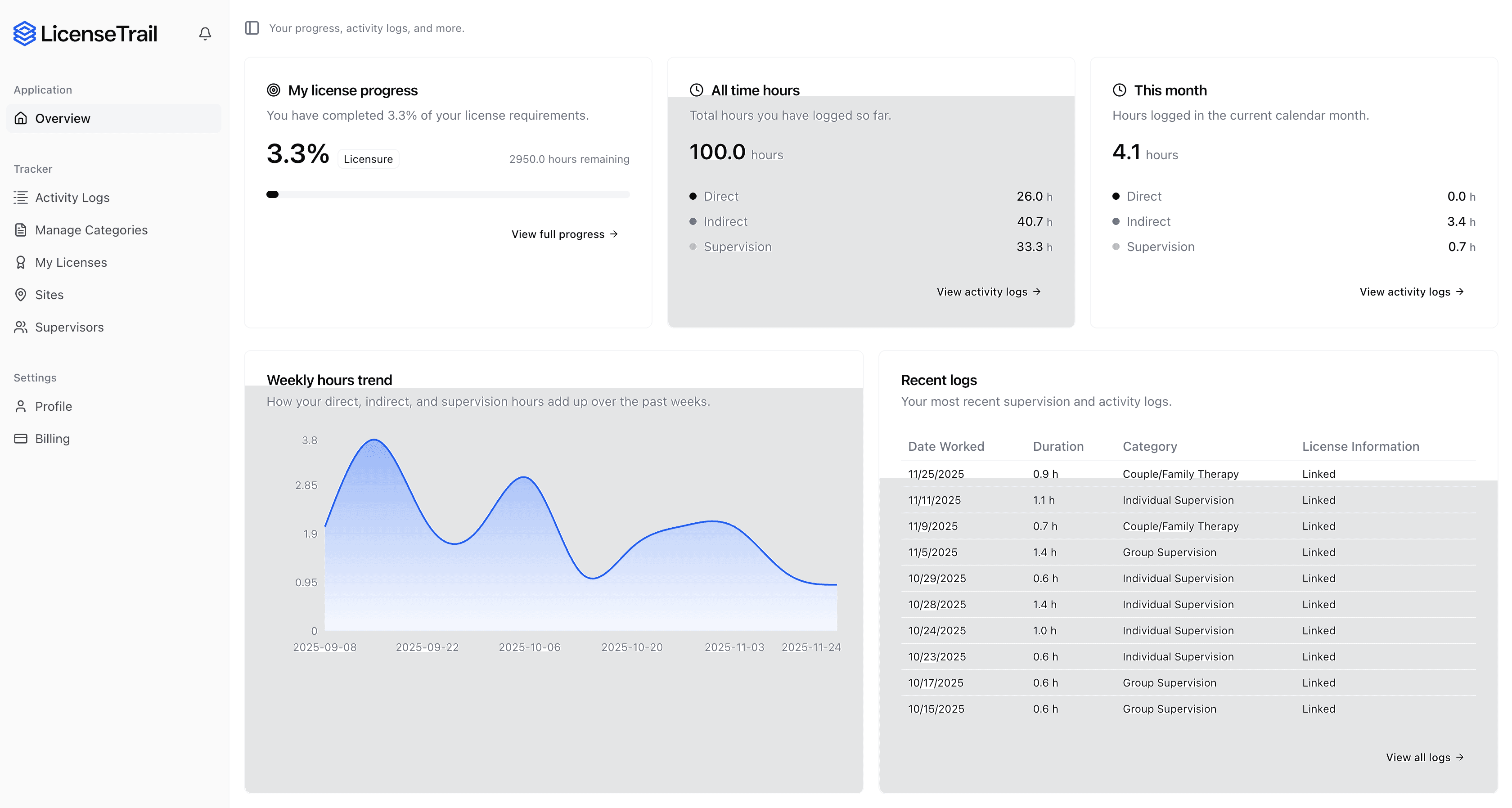 Start Tracking for Free
No credit card required · Free plan available
Related Licenses
Is your spreadsheet hiding Tennessee Senior Psychological Examiner risks?
Stop guessing if your categories match Tennessee Board of Examiners in Psychology requirements. License Trail checks your direct, indirect, and supervision hours continuously and flags mismatches before you submit.
Import or log
Bring your spreadsheet or start fresh
Upload your existing tracking spreadsheet and we'll map every hour into the right Tennessee Board of Examiners in Psychology categories automatically.
Verify against Tennessee
Catch mismatches before the board does
License Trail checks your direct, indirect, and supervision hours against Tennessee Senior Psychological Examiner requirements continuously.
Export board-ready
One-click clean reports
Generate professional, board-ready reports for supervision meetings and Tennessee Board of Examiners in Psychology submissions in seconds.
No credit card required · Free plan available