
Tennessee Special Volunteer License (Psychology) Requirements: Hours, Exams & Step-by-Step Guide
Stop guessing if your categories match Tennessee requirements. License Trail checks your direct, indirect, and supervision hours against Special Volunteer License (Psychology) requirements continuously and flags mismatches before you submit.
No credit card required · Free plan available
Quick Requirements Overview
- License type: Tennessee Special Volunteer License (Psychology) — no fee for issuance or renewal
- Eligibility: Must be currently/previously licensed as a psychologist in TN or another state and never disciplined by any psychology board
- Practice setting limit: May practice only at the specific approved nonprofit “free health clinic” site listed in the application (site‑restricted)
- Compensation limit: No fees/compensation/remuneration of any kind; clinic cannot bill patients or third‑party payers (incl. Medicaid/Medicare/insurance)
- Application essentials: Submit special volunteer application; all prior/current licensing states must send “certificate of fitness” showing no discipline/encumbrances
- If never TN‑licensed: Must also meet specified TN licensure procedure items (e.g., photos, official transcripts, recommendations, disclosures) and consumer profile requirements
- Hours/training: No separate volunteer-hour minimums; relies on existing psychologist licensure standards (HSP training commonly 1,900‑hr internship + 1,900‑hr postdoc where applicable)
- Ongoing requirements: Subject to standard renewal/discipline rules and CE: 40 hours/2 years (incl. real‑time, APA‑sponsor minimums, and required topic hours)
License Details
Procedures
Tennessee’s Special Volunteer License for psychologists is a limited, no‑fee license that lets already‑licensed psychologists provide unpaid services only in qualifying free health clinics. It does not create a separate training track; instead, it sits on top of the Board’s existing psychologist licensure standards.
Below is a step‑by‑step guide grounded in the Tennessee Code and the Board of Examiners in Psychology’s rules, with emphasis on required hours and official terminology.
1. Legal framework
Four sets of authorities define the Special Volunteer License for psychology:
- Tennessee Code Annotated (T.C.A.) 63‑1‑201 to 63‑1‑203 – general “medical practitioner” and “special volunteer license” provisions for free health clinics. (unicourt.github.io)
- T.C.A. 63‑11‑225 – special volunteer license for psychologists (fees and renewal; cross‑references the general provisions). (law.justia.com)
- Board of Examiners in Psychology Rule 1180‑02‑.07 – Free Health Clinic and Volunteer Practice Requirements – implements the Special Volunteer License for psychologists. (law.cornell.edu)
- General psychologist licensure rules, in particular:
- 1180‑02‑.02 – Qualifications for Licensure (education and supervised‑experience hours). (law.cornell.edu)
- 1180‑02‑.03 – Procedures for Licensure. (law.cornell.edu)
- 1180‑01‑.08 – Continuing Education. (law.cornell.edu)
2. What “Special Volunteer License” means in Tennessee
Under T.C.A. 63‑1‑201(3), a “special volunteer license” is a license granted to a medical practitioner:
- whose sole practice under that license is providing professional services without remuneration,
- in a “free health clinic” at a specified site or setting, and
- who has previously been licensed in Tennessee or another state and has never been the subject of disciplinary action. (unicourt.github.io)
A “free health clinic” must be a nonprofit private entity that does not receive payment for its services and does not impose any charges on individuals receiving care. (unicourt.github.io)
These general definitions apply to psychologists as “medical practitioners” because psychologists licensed under Chapter 11 are explicitly included in the definition. (unicourt.github.io)
3. Who is eligible as a psychologist
Rule 1180‑02‑.07(1)(a) specifies that the Board may issue a Special Volunteer License to:
- “Any psychologist licensed to practice psychology in this state or any other state”
- who “has not been disciplined by any psychology licensure board.” (law.cornell.edu)
In practice, this means:
- You must already hold (or have held) a psychology license in at least one U.S. jurisdiction (Tennessee or another state).
- You must have no history of disciplinary action on any psychology license.
- You must intend to practice only in a qualifying free health clinic, without compensation.
There is no separate clinical‑hour minimum written specifically for the special volunteer license itself. The Board relies on the training and supervised‑experience hours you already completed for your underlying psychologist license (described in Section 4).
4. Underlying psychology licensure – required training hours
To understand the “hours” behind the Special Volunteer License, you have to look at the Board’s general qualifications for licensure, especially for psychologists who provide health services (Health Service Provider, or HSP, designation).
4.1 Educational requirement
Rule 1180‑02‑.02(1) requires a qualifying doctoral degree in psychology from a program recognized by:
- the ASPPB/CNRHSPP Designated Doctoral Programs in Psychology listing, or
- APA’s Committee on Accreditation (for professional psychology programs in clinical, counseling, school, or combined areas). (law.cornell.edu)
4.2 Predoctoral internship – 1,900 hours
For psychologists who intend to provide health services (i.e., seek HSP designation), a qualifying predoctoral internship is mandatory. The internship must: (law.cornell.edu)
- Last at least one full calendar year (or two continuous years if half‑time).
- Occur after completion of all doctoral requirements except the dissertation.
- Be part of an organized, integrated training program in a setting where health services are normally provided.
- Provide “no less than nineteen hundred (1900) hours in psychology” at that site (this is Board language).
- Be supervised at the site by at least two licensed psychologists with HSP designation (or equivalent).
A qualified internship is further described as a structured, continuous training experience designed to provide roughly 1,900 hours of predoctoral training under qualified supervision in professional psychology. (law.cornell.edu)
4.3 Postdoctoral supervised experience – 1,900 hours
For HSP designation, Tennessee separately requires a postdoctoral supervised experience year, beyond the internship:
- The postdoc year must include a minimum of 1,900 hours of supervised experience.
- At least 1,900 hours must be under the direct supervision of a psychologist with HSP designation.
- Supervision must include at least one hour per week of individual supervision, focused on the applicant’s direct provision of health services in psychology (administrative meetings do not count).
- Supervisors must be licensed psychologists with HSP designation, and their qualifications must be appropriate to the services being supervised. (law.cornell.edu)
Rule 1180‑02‑.02(d)(1) and (d)(3) lay out these criteria and allow several pathways to fulfilling them (e.g., provisional license in Tennessee, APPIC/APA‑listed postdoc fellowships, waiver for certain pre‑1982 licensees). (law.cornell.edu)
Important:
These 1,900‑hour internship and 1,900‑hour postdoctoral supervised‑experience requirements are part of general psychologist licensure with HSP designation, not an extra requirement added by the Special Volunteer License. If you already hold a Tennessee psychologist license with HSP designation, you will have completed these hours (or obtained an allowed waiver).
5. Application process for the Special Volunteer License (Psychology)
5.1 Obtain the correct application
The Tennessee Department of Health’s psychology board website lists an “Application for Special Volunteer License (PH‑3839)” under the Applications section. (tn.gov)
You may complete this via the online system or by paper, following the Board’s posted instructions.
5.2 Submit the Special Volunteer License application
Under Rule 1180‑02‑.07(1)(a)1, you must: (law.cornell.edu)
- Request a Special Volunteer License application from the Board’s administrative office (or use the online portal).
- Complete it fully and submit it with any required documentation to the Board’s administrative office.
5.3 Have all licensing boards send “certificate of fitness” verifications
Rule 1180‑02‑.07(1)(a)2 requires that: (law.cornell.edu)
- Every state licensing authority where you hold or have ever held a psychology license must send to the Tennessee Board the equivalent of a “certificate of fitness” (as described in T.C.A. 63‑1‑118).
- Each certificate must show that your license has never been subject to disciplinary action and is free and clear of all encumbrances.
This implements the statutory requirement that a special volunteer license may be issued only to a practitioner who has never been disciplined. (unicourt.github.io)
5.4 Additional steps if you have never been licensed in Tennessee
Rule 1180‑02‑.07(1)(a)3 imposes extra requirements for psychologists who have not previously held a Tennessee license: (regulations.justia.com)
-
You must comply with paragraphs (4), (6), (7), and (8) of Rule 1180‑02‑.03 (Procedures for Licensure). In practice, this includes:
- Providing two passport‑type photos (para. 4).
- Arranging for official transcripts of all graduate coursework to be sent directly from your institution, showing your highest degree and bearing the official seal (para. 6).
- Submitting three letters of recommendation attesting to your moral character, education, training, and performance (para. 7). Two of these must be from licensed psychologists, and for HSP designation at least one must be from an internship director or supervisor with specific information about clients, services, and the training site.
- Disclosing any criminal convictions, prior denials of licensure, loss or restriction of any license, and any civil malpractice or related judgments/settlements (para. 8).
-
You must also comply with the Health Care Consumer‑Right‑To‑Know Act (T.C.A. 63‑51‑101 et seq.), which typically means completing a public practitioner profile for the Department of Health. (regulations.justia.com)
5.5 Document the free health clinic where you will volunteer
Rule 1180‑02‑.07(1)(a)4 requires that you: (law.cornell.edu)
- Submit the specific location (site or setting) of the free health clinic where you plan to practice; and
- Provide proof that the clinic is private and not‑for‑profit, consistent with the statutory definition of a “free health clinic” (nonprofit private entity, no payments or charges to patients). (unicourt.github.io)
The license is tied to that specific clinic site; you cannot use it at other locations.
5.6 Fees
By statute, no fee may be charged for the application or issuance of a special volunteer license. (unicourt.github.io)
Rule 1180‑02‑.07(b) also states that a psychologist holding a Special Volunteer License does not pay any fee for issuance or for required biennial renewal (the license is renewed on the same birth‑date cycle as other health‑related boards, but with fees waived). (law.cornell.edu)
6. Practice limitations under the Special Volunteer License
Once the Special Volunteer License is granted, Rule 1180‑02‑.07 imposes strict limits: (law.cornell.edu)
-
Practice limited to the specified free health clinic
- You may not practice psychology anywhere other than the free health clinic site or setting identified in your application.
-
No fees, compensation, or remuneration
- You may not charge any fee or receive compensation or remuneration of any kind from any person or third‑party payer.
- This includes insurance companies, health plans, and state or federal benefit programs such as Medicare or Medicaid.
-
The clinic itself may not bill
- You may not practice for any free health clinic that imposes any charge on individuals or submits charges to any third‑party payer for services.
- This mirrors T.C.A. 63‑1‑203, which prohibits compensation for services under the free‑clinic volunteer authority, though clinics may accept donations or gifts. (unicourt.github.io)
-
Same renewal, CE, and discipline rules as full licenses (except fees)
- Special Volunteer Licenses are subject to:
- All rules on renewal, retirement, reinstatement, and reactivation in 1180‑01‑.05 and 1180‑01‑.07, except fee requirements. (law.cornell.edu)
- The continuing education rules in 1180‑01‑.08 (see Section 7). (law.cornell.edu)
- The same disciplinary standards and procedures as any other psychology license issued by the Board. (law.cornell.edu)
- Special Volunteer Licenses are subject to:
7. Continuing education hours required
The only “hours” explicitly attached to the Special Volunteer License itself are continuing education (CE) hours, because Rule 1180‑02‑.07(d)(2) incorporates the general CE rule 1180‑01‑.08. (law.cornell.edu)
For Psychologists (and Senior Psychological Examiners and Psychological Examiners):
-
40 hours of CE every two years.
- CE must be accumulated in the two calendar years (January 1–December 31) preceding the renewal year.
- At least 20 of the 40 hours must involve an opportunity for real‑time interaction during the event (e.g., live in‑person or synchronous online activities).
- At least 9 of the 40 hours must be from an APA‑approved sponsor. (law.cornell.edu)
-
Content‑specific requirements
- At least 3 hours must pertain to cultural diversity, explicitly designated in the course title, objectives, or description.
- Another 3 hours must cover a combination of:
- Tennessee Code Annotated Title 63, Chapter 11,
- The Board’s rules (Chapters 1180‑01 through 1180‑04), and
- Professional ethics for psychologists. (law.cornell.edu)
-
Voluntary healthcare service credit
- Psychologists may count 1 CE hour for each 1 hour of voluntary healthcare services, up to 4 CE hours per year, when those services meet the conditions of T.C.A. 63‑6‑712 (e.g., volunteering through approved programs or clinics). Evidence must include a letter from the sponsoring organization documenting dates and hours. (regulations.justia.com)
Special Volunteer License holders are not excused from CE; they must meet these hour and content requirements just like other licensees, but they do so without paying renewal fees.
8. Is there a minimum number of volunteer practice hours?
The question often arises whether Tennessee requires, for example, 1,500 hours of direct volunteer practice and 1,500 hours of supervised volunteer practice specifically for the Special Volunteer License.
Under the current statutes and rules:
- There is no minimum or maximum number of volunteer clinical hours per year specified for the Special Volunteer License in psychology.
- The quantified hour requirements relate to:
- Training and licensure as a psychologist with HSP designation (1,900‑hour internship + 1,900‑hour postdoc supervised experience), which you must have met (or lawfully waived) to qualify as a health‑services psychologist. (law.cornell.edu)
- Continuing education (40 hours of CE every two years, with the specific breakdown above). (law.cornell.edu)
So, unlike some states that specify, for example, “X hours of direct service” versus “Y hours of supervision” for special volunteer or limited licenses, Tennessee’s Special Volunteer License for psychologists does not add its own separate hour quotas. It assumes you already meet Tennessee‑level professional standards for practice (or are licensed in another state with a clean record) and then constrains where and how you can practice (free clinics only, no payment).
9. Alternative volunteer pathway: Volunteer Health Care Services Act
Rule 1180‑02‑.07(2) also implements the Volunteer Health Care Services Act (T.C.A. 63‑6‑701 et seq.): (law.cornell.edu)
- Psychologists licensed in Tennessee or any other U.S. jurisdiction whose license is not suspended or revoked may practice temporarily in Tennessee only under the auspices of an organization that has complied with that Act and the Department of Health’s volunteer‑services rule (1200‑10‑01‑.12).
- Certain individuals who are lawfully practicing under other states’ licensure exemptions may also provide services under this Act, so long as they do not “regularly practice” in Tennessee and meet the Act’s conditions.
This route is distinct from, but related to, the Special Volunteer License and may be used for short‑term or event‑based volunteer work.
Summary of key hour requirements tied to a Special Volunteer License (Psychology) in Tennessee
-
Training hours (for psychologist licensure with HSP designation):
- 1,900 hours predoctoral internship in a health‑services setting;
- 1,900 hours postdoctoral supervised experience under an HSP psychologist. (law.cornell.edu)
-
Continuing education hours (ongoing, including for special volunteers):
- 40 CE hours every 2 years for psychologists, including:
- ≥ 20 hours with real‑time interaction,
- ≥ 9 hours from APA‑approved sponsors,
- 3 hours on cultural diversity,
- 3 hours on Tennessee law, rules, and professional ethics. (law.cornell.edu)
- 40 CE hours every 2 years for psychologists, including:
-
No additional volunteer‑practice hour minimums are imposed specifically for the Special Volunteer License; instead, the license limits setting and remuneration, not volume of service.
All of these requirements remain in effect as of regulations current through June 26, 2025. For an actual application, it is prudent to confirm with the Board’s administrative office and review the latest posted forms and rules, as Tennessee is actively updating some psychology rules in 2025.
Track your Special Volunteer License (Psychology) hours with confidence
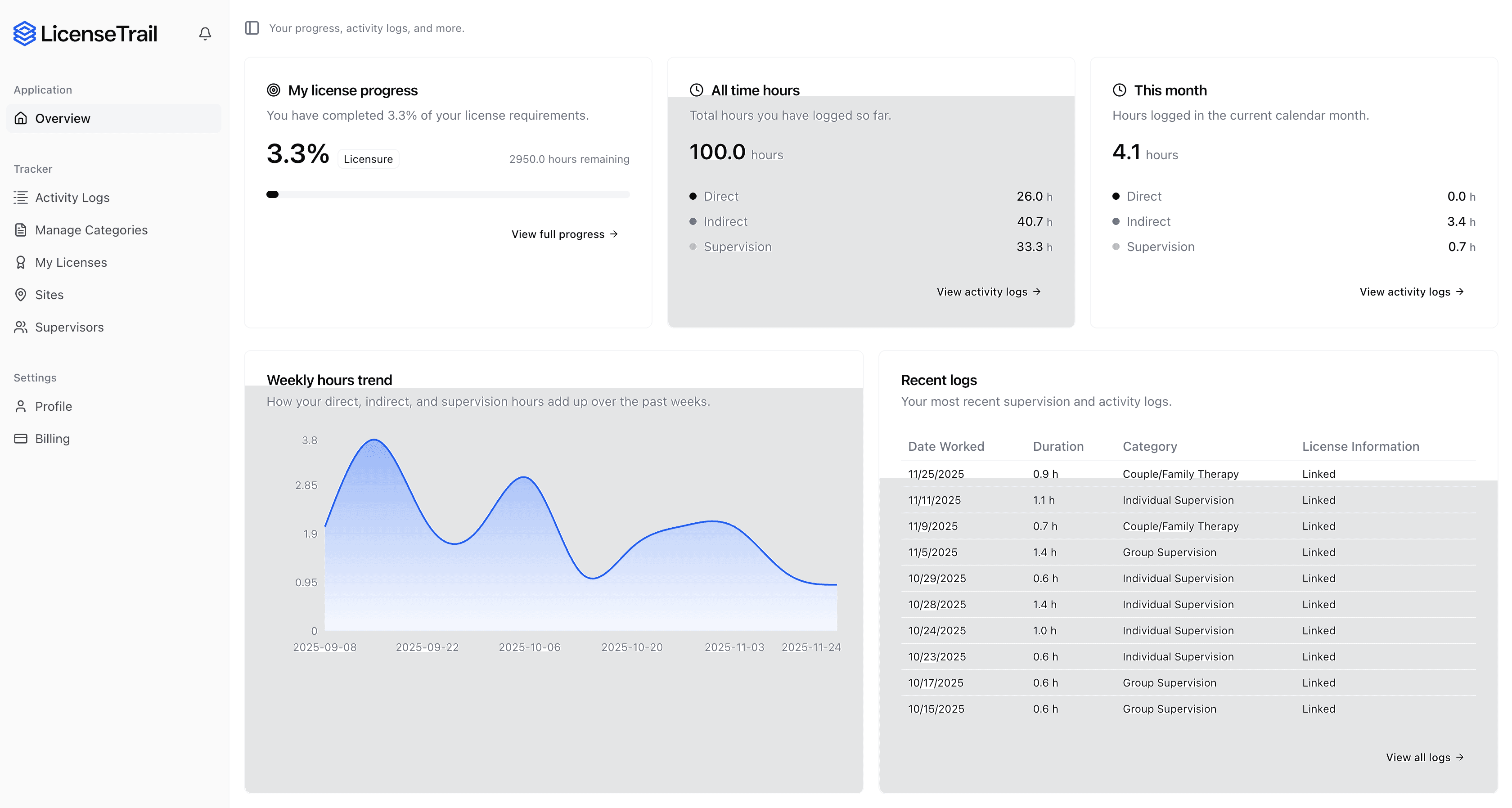
License Trail checks your direct, indirect, and supervision hours against Tennessee Special Volunteer License (Psychology) requirements continuously and flags mismatches before you submit.
 Start Tracking for Free
No credit card required · Free plan available
Related Licenses
Is your spreadsheet hiding Tennessee Special Volunteer License (Psychology) risks?
Stop guessing if your categories match Tennessee Board of Examiners in Psychology requirements. License Trail checks your direct, indirect, and supervision hours continuously and flags mismatches before you submit.
Import or log
Bring your spreadsheet or start fresh
Upload your existing tracking spreadsheet and we'll map every hour into the right Tennessee Board of Examiners in Psychology categories automatically.
Verify against Tennessee
Catch mismatches before the board does
License Trail checks your direct, indirect, and supervision hours against Tennessee Special Volunteer License (Psychology) requirements continuously.
Export board-ready
One-click clean reports
Generate professional, board-ready reports for supervision meetings and Tennessee Board of Examiners in Psychology submissions in seconds.
No credit card required · Free plan available