
Texas LBSW-IPR Requirements: Hours, Exams & Step-by-Step Guide
Stop guessing if your categories match Texas requirements. License Trail checks your direct, indirect, and supervision hours against LBSW-IPR requirements continuously and flags mismatches before you submit.
No credit card required · Free plan available
Quick Requirements Overview
- Not a separate license: LBSW‑IPR is a non‑clinical Independent Practice Recognition added to an active regular (non‑temporary) LBSW
- Scope: Allows independent, non‑clinical baccalaureate social work (incl. direct/third‑party billing); no psychotherapy/diagnosis (clinical work reserved to LCSW)
- Base LBSW requirements: CSWE BSW, pass ASWB Bachelor, pass TX jurisprudence (within 6 months of application), fingerprints + NPDB self‑query, apply/fees + transcript/verification
- Supervisor required: Council‑approved LBSW‑IPR‑S, LMSW‑IPR‑S, LMSW‑AP‑S, or LCSW‑S
- Written plan & records: Signed Non‑clinical Supervision Plan; supervisor maintains file (plan, locations, logs) and later submits Non‑clinical Verification
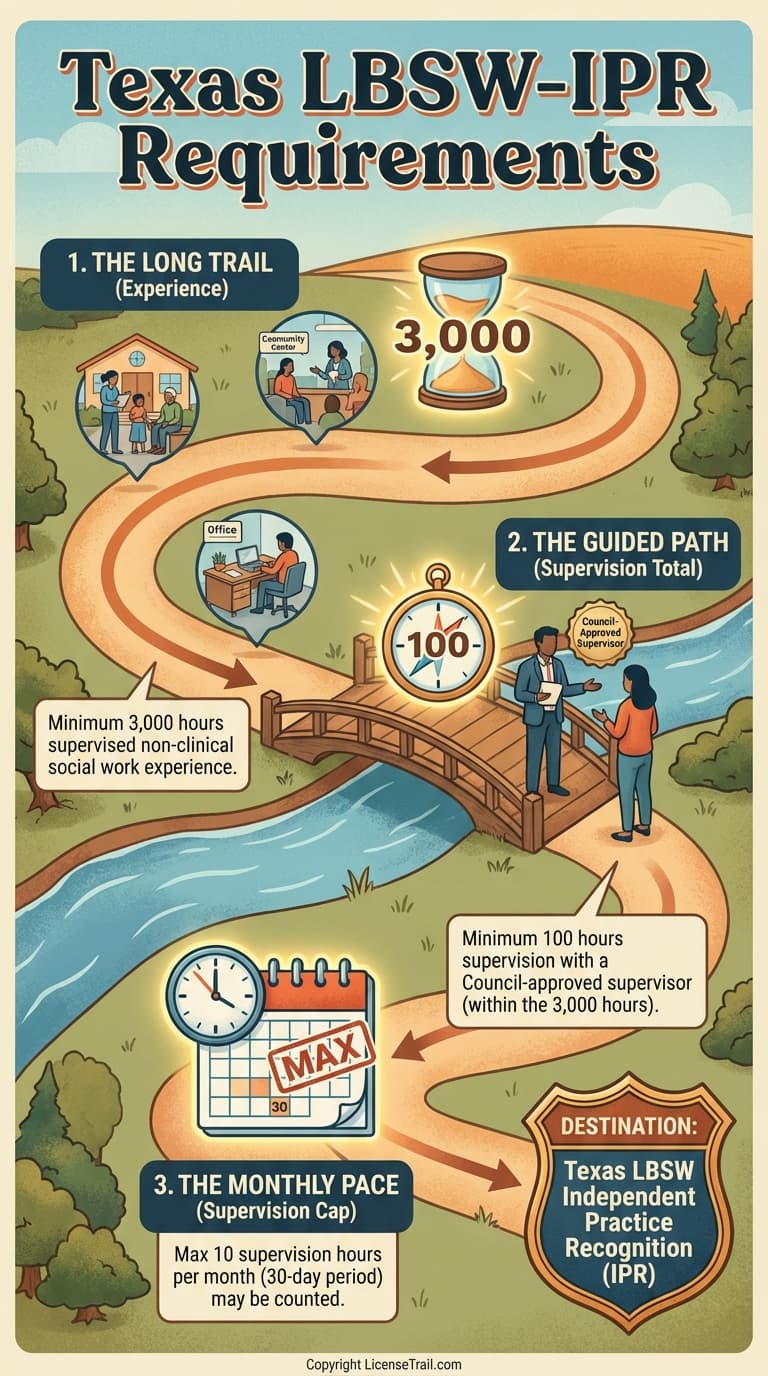
- Experience minimum: 3,000 hours supervised non‑clinical social work experience over ≥ 24 full months
- Supervision minimum/rules: 100 hours over the same ≥ 24 months; supervision proportional to work; max 10 hours/month countable; individual or group (2–6); in‑person or secure electronic
- IPR application: Submit IPR application/fees plus supervisor verification; may practice independently only after IPR is granted (or under an active IPR supervision plan per rules)
License Details
Procedures
In Texas, “LBSW‑IPR” is not a separate license but a specialty recognition added to a regular Licensed Baccalaureate Social Worker (LBSW) license. It allows a baccalaureate social worker to practice non‑clinically in independent settings (including billing directly) instead of only through an agency. (sos.texas.gov)
The path has two stages:
- Obtain the LBSW license.
- Complete non‑clinical supervised experience and apply for Independent Practice Recognition (IPR).
Below is a step‑by‑step outline of what Texas currently requires.
1. Understand what LBSW‑IPR allows (scope of practice)
Texas rule 22 TAC §781.302 describes “Practice of Independent Non‑Clinical Baccalaureate Social Work.” An LBSW with IPR:
- “May provide any non‑clinical baccalaureate social work services in either an employment or an independent practice setting.”
- May work under contract, bill clients directly, and bill third parties.
- Must restrict independent practice to non‑clinical social work services (no psychotherapy or diagnosis). (sos.texas.gov)
Clinical social work (diagnosis/treatment of mental, emotional, or behavioral disorders using DSM/ICD, psychotherapy, etc.) is reserved to LCSWs. (sos.texas.gov)
2. Step One – Qualify for the base LBSW license
Before you can even start counting hours toward IPR, you must hold a regular (non‑temporary) LBSW license. A temporary license holder is not allowed to begin supervision for independent practice. (bhec.texas.gov)
The current “How to Become an LBSW” guidance and 22 TAC §781.401 require you to: (bhec.texas.gov)
-
Earn a qualifying degree
- Baccalaureate degree in social work from a program accredited by, or in candidacy with, the Council on Social Work Education (CSWE). (bhec.texas.gov)
-
Pass the national ASWB Bachelor’s Examination
- Texas allows you to sit while still in a qualifying BSW program, but to be licensed you must have passed the exam. (bhec.texas.gov)
-
Complete the Texas Social Workers Jurisprudence Exam
- Must be completed no more than six months before the date the online license application is received. (bhec.texas.gov)
-
Clear background and data‑bank checks
- Fingerprint‑based criminal background check.
- Certified self‑query from the National Practitioner Data Bank (NPDB). (bhec.texas.gov)
-
Submit the online application and fees, including:
- Official CSWE‑accredited transcript sent directly to BHEC.
- Verification of any social work licenses held in other jurisdictions, if applicable. (bhec.texas.gov)
Once your regular LBSW license is issued, you may then move on to supervised experience for IPR.
3. Step Two – Set up non‑clinical supervision for Independent Practice Recognition
3.1. You must be supervised by an appropriately licensed, Council‑approved supervisor
Under 22 TAC §781.403 and §781.404, supervision for LBSW‑IPR must be provided by a Council‑approved supervisor who holds one of these licenses/specialties: (bhec.texas.gov)
- LBSW with non‑clinical Independent Practice Recognition (LBSW‑IPR) and supervisor status (LBSW‑IPR‑S), or
- LMSW with non‑clinical Independent Practice Recognition (LMSW‑IPR‑S), or
- LMSW‑AP (Advanced Practitioner) with supervisor status, or
- LCSW with supervisor status (LCSW‑S).
The FAQ repeats this in practical terms: an LBSW working toward LBSW‑IPR can be supervised by an LBSW‑IPR‑S, LMSW‑IPR‑S, LMSW‑AP‑S, or LCSW‑S. (bhec.texas.gov)
3.2. A formal non‑clinical supervision plan is required
22 TAC §781.402(d) requires that to accrue supervised experience toward IPR, the LBSW must: (bhec.texas.gov)
- Complete a Non‑clinical Supervision Plan for IPR on a Council‑prescribed form (or equivalent), signed by both supervisee and supervisor.
- Ensure the supervisor keeps a supervision file containing:
- The plan,
- A list of practice locations, and
- A log of supervised experience and supervision hours.
- Have the supervisor submit a Non‑clinical Verification Form for IPR when you apply for IPR. (bhec.texas.gov)
4. Step Three – Required experience hours for LBSW‑IPR
The same supervision rule (22 TAC §781.402) governs both LCSW clinical supervision and non‑clinical Independent Practice Recognition (IPR). For either LCSW licensure or IPR, the minimum supervised experience requirements are identical. (bhec.texas.gov)
4.1. Total supervised experience hours
For LBSW‑IPR, Texas requires:
- At least 3,000 hours of supervised professional social work experience,
- Accrued under an approved supervisor,
- Over a period of not less than 24 full months. (bhec.texas.gov)
This is stated in §781.402(9)(E), which says that supervision toward licensure or specialty recognition must extend over a full 3,000 hours and at least 24 full months for LCSW or Independent Practice Recognition.
Important:
There is no split such as 1,500 “direct” and 1,500 “indirect” hours for social work IPR. That 1,500/1,500 model appears in counselor and marriage & family therapy rules, not in the social work IPR rule. (bhec.texas.gov)
All 3,000 hours for LBSW‑IPR are non‑clinical social work practice hours performed within the baccalaureate scope of practice.
4.2. Minimum supervision hours
Within those 3,000 hours of supervised experience, you must also complete:
- At least 100 hours of supervision,
- Provided by your Council‑approved supervisor,
- Spanning the same minimum 24 full months.
The rule explains that even if someone completes the 3,000 supervised experience hours and 100 supervision hours before 24 months have elapsed, supervision that meets minimum requirements must still extend to at least 24 months from the start date. (bhec.texas.gov)
The Social Worker FAQs reinforce this with a practical example: working 30+ hours per week with one hour of supervision per week for 24 months yields about 104 supervision hours (1 hour × 52 weeks × 2 years). (bhec.texas.gov)
4.3. Frequency and format of supervision
Key parameters in §781.402(9) and the FAQs: (bhec.texas.gov)
- Proportionate to hours worked
- Supervision “shall occur in proportion to the number of actual hours worked for the 3,000 hours of supervised experience.”
- Cap per month
- You may count no more than 10 hours of supervision in any one month (30‑day period) toward the minimum.
- Individual or group
- Supervision may be one‑on‑one, group, or a combination.
- Group supervision must have 2–6 members.
- Location/medium
- May occur in the same geographic location or via secure audio/video/electronic means, as long as confidentiality and other laws (e.g., HIPAA, Texas Health and Safety Code ch. 611) are met.
- Record‑keeping
- Supervisor and supervisee share responsibility for documenting supervision and practice locations, consistent with the written plan. (bhec.texas.gov)
5. Step Four – What kinds of hours “count” for LBSW‑IPR?
Texas does not publish an itemized hour‑by‑hour list for IPR the way it does for some other professions, but your 3,000 hours must:
-
Fall within the scope of “Baccalaureate Social Work” practice (22 TAC §781.302(a)), such as:
- Interviewing, assessment, planning, intervention, and evaluation,
- Case management and resource coordination,
- Supportive counseling (non‑clinical), crisis intervention within agency protocols,
- Information and referral, advocacy, community organization, and policy/program implementation and administration. (sos.texas.gov)
-
Remain non‑clinical, consistent with the independent‑practice definition:
- You may not independently provide psychotherapy, diagnose mental disorders, or use DSM/ICD diagnostic authority as part of IPR hours; those are functions of “clinical social work,” which is tied to the LCSW. (sos.texas.gov)
-
Be supervised under an approved non‑clinical supervision plan that documents:
- Settings and roles,
- Population served,
- How activities align with non‑clinical baccalaureate practice. (bhec.texas.gov)
In practice, if you remain within typical BSW‑level roles—case management, resource linkage, non‑clinical counseling/education, service coordination, advocacy, and program work—those hours are normally acceptable, provided your supervisor signs off that they meet rule requirements.
6. Step Five – Applying for Independent Practice Recognition (LBSW‑IPR)
Once you have:
- A current LBSW license in good standing;
- Completed 3,000 hours of supervised non‑clinical social work practice over at least 24 full months;
- Logged at least 100 hours of supervision under a Council‑approved supervisor; and
- Maintained appropriate supervision documentation,
you may submit an application for non‑clinical Independent Practice Recognition.
6.1. Application components
Based on §781.402(d) and §781.403 plus BHEC’s “Applying for a Social Work License” and Forms pages, you should expect to submit: (bhec.texas.gov)
- Online application for IPR (via BHEC’s licensing system), including required fees.
- Non‑clinical Verification Form for IPR, completed and signed by your Council‑approved supervisor(s), verifying:
- Total supervised practice hours (must be ≥ 3,000),
- Total supervision hours (must be ≥ 100),
- Start and end dates of the supervision period (must cover ≥ 24 full months),
- Confirmation that supervision followed an approved plan and met rule requirements.
- Any additional documentation BHEC requests (for example, clarification if you changed supervisors or practice locations).
Under §781.403(g), an LBSW may practice independently only after holding the Independent Practice Recognition or while under a supervision plan for independent practice with an active Council‑approved supervisor. (bhec.texas.gov)
Once BHEC determines you have satisfied 22 TAC §§781.401, 781.402, and 781.403, your license record is updated to show LBSW‑IPR, and you are listed among independent practitioners. (bhec.texas.gov)
7. Condensed checklist: requirements for LBSW‑IPR in Texas
Phase 1 – LBSW licensure
- CSWE‑accredited BSW degree.
- Pass ASWB Bachelor exam.
- Complete Texas Social Work Jurisprudence Exam (within 6 months of application).
- NPDB self‑query, fingerprint background check.
- Submit online LBSW application, fees, and official transcript; arrange any out‑of‑state license verifications.
- Receive regular (non‑temporary) LBSW license. (bhec.texas.gov)
Phase 2 – Non‑clinical supervision toward Independent Practice Recognition
- Secure a Council‑approved supervisor with one of: LBSW‑IPR‑S, LMSW‑IPR‑S, LMSW‑AP‑S, or LCSW‑S. (bhec.texas.gov)
- File a Non‑clinical Supervision Plan for IPR (or equivalent) signed by you and your supervisor.
- Accrue 3,000 hours of supervised non‑clinical social work experience in roles within LBSW scope.
- Receive at least 100 hours of supervision tied to those 3,000 hours.
- Ensure the experience and supervision span at least 24 full months.
- Observe supervision rules:
- Supervision proportional to hours worked,
- Max 10 supervision hours counted per month,
- Individual or small‑group supervision (2–6 members), in‑person or via secure technology. (bhec.texas.gov)
Phase 3 – Apply for and obtain LBSW‑IPR
- Supervisor completes and submits Non‑clinical Verification Form for IPR documenting your hours and dates. (bhec.texas.gov)
- You file the IPR application and pay required fees.
- Upon approval, BHEC grants Independent Practice Recognition (non‑clinical) and your credential becomes LBSW‑IPR, allowing non‑clinical independent practice and direct billing consistent with §781.302(b). (sos.texas.gov)
This summarizes the current, rule‑based requirements in Texas as of late 2025 for becoming an LBSW with non‑clinical Independent Practice Recognition (LBSW‑IPR). Always check the BHEC website and the latest version of 22 TAC Chapter 781 before acting, in case rules or forms change.
Track your LBSW-IPR hours with confidence
License Trail checks your direct, indirect, and supervision hours against Texas LBSW-IPR requirements continuously and flags mismatches before you submit.
 Start Tracking for Free
No credit card required · Free plan available
Is your spreadsheet hiding Texas LBSW-IPR risks?
Stop guessing if your categories match Texas State Board of Social Worker Examiners requirements. License Trail checks your direct, indirect, and supervision hours continuously and flags mismatches before you submit.
Import or log
Bring your spreadsheet or start fresh
Upload your existing tracking spreadsheet and we'll map every hour into the right Texas State Board of Social Worker Examiners categories automatically.
Verify against Texas
Catch mismatches before the board does
License Trail checks your direct, indirect, and supervision hours against Texas LBSW-IPR requirements continuously.
Export board-ready
One-click clean reports
Generate professional, board-ready reports for supervision meetings and Texas State Board of Social Worker Examiners submissions in seconds.
No credit card required · Free plan available