
Texas LCSW Requirements: Hours, Exams & Step-by-Step Guide
Stop guessing if your categories match Texas requirements. License Trail checks your direct, indirect, and supervision hours against LCSW requirements continuously and flags mismatches before you submit.
No credit card required · Free plan available
Quick Requirements Overview
- Education: MSW (CSWE-accredited/candidate) or acceptable doctoral SW degree; transcript shows social work field placement
- Prereq license: Hold Texas LMSW while completing LCSW-supervised clinical experience
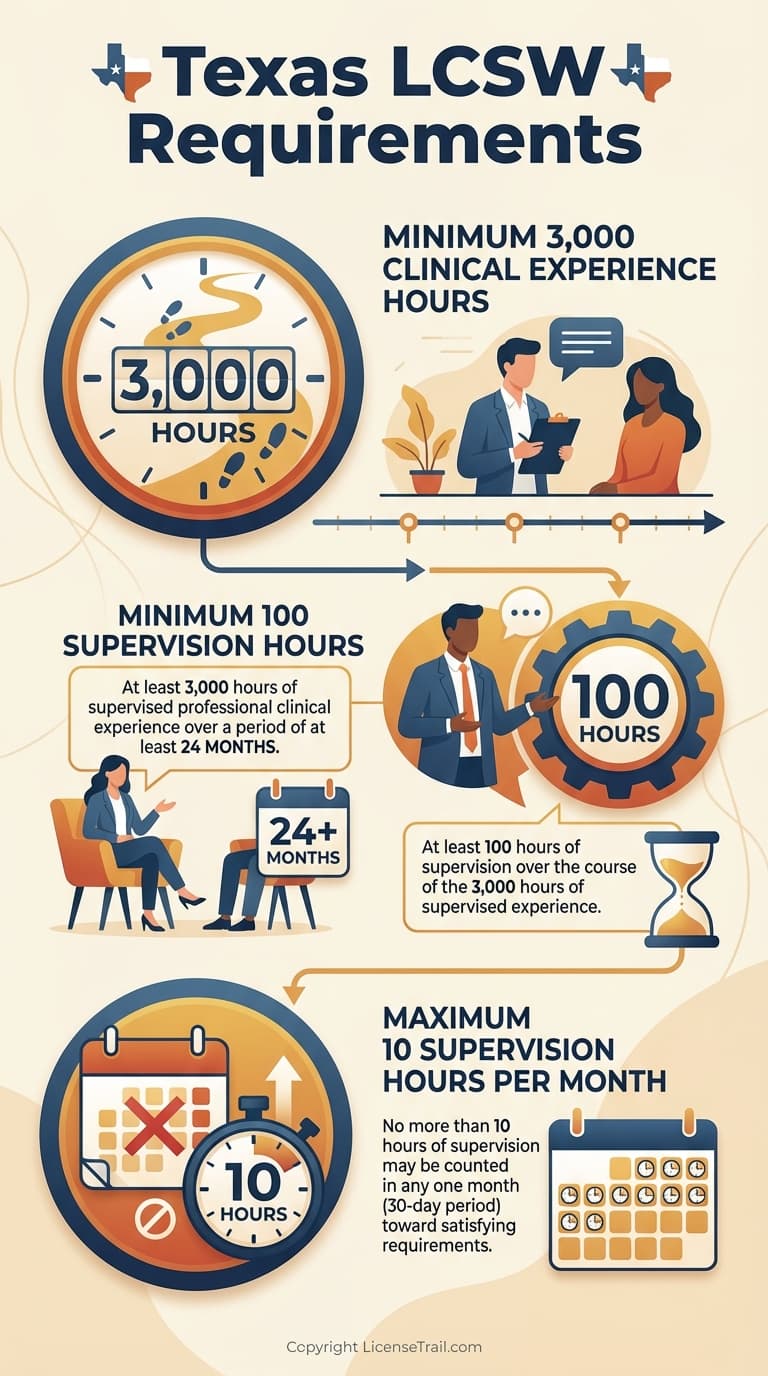
- Clinical experience: 3,000 hours of supervised professional clinical experience over ≥24 months (must be clinical practice; if mixed/non-clinical setting, still ≥4 hrs/week clinical SW)
- Supervision: 100 hours total, with a Council-approved LCSW supervisor; each hour ≥60 min; ≤10 supervision hours/month may count
- Supervision plan + documentation: Signed Clinical Supervision Plan at start; supervisor maintains logs/file; submit CSV verification form(s) + plan with application
- Exams: Pass ASWB Clinical exam; complete TX Social Work Jurisprudence Exam within 6 months before BHEC receives application
- Admin checks: Fingerprint background check, NPDB self-query, and verification of any other-state licenses
- Out-of-state/endorsement note: If holding a substantially equivalent out-of-state clinical license in good standing for ≥1 year immediately prior, TX deems the experience requirement met (still must complete TX-specific items above)
License Details
Procedures
Becoming a Licensed Clinical Social Worker (LCSW) in Texas involves a tightly defined combination of education, supervised clinical experience, specific supervision hours, and several administrative requirements set by the Texas State Board of Social Worker Examiners under the Texas Behavioral Health Executive Council (BHEC). The summary below reflects the current Texas Administrative Code provisions (updated through June 27, 2025) and BHEC’s own guidance as of November 23, 2025.(regulations.justia.com)
1. Regulatory framework and what an LCSW is allowed to do
Texas regulates social workers under:
- The Texas State Board of Social Worker Examiners (the “Board”)
- The Texas Behavioral Health Executive Council (BHEC), which administers licensing and applications(bhec.texas.gov)
An LCSW is a master‑level social worker authorized to provide clinical social work, which the rules define as a specialty of master social work focused on applying theory and advanced clinical skills to assess, diagnose, and treat mental, emotional, and behavioral disorders, including serious mental illness. Clinical methods may include individual, couple, family, and group psychotherapy, using DSM and ICD diagnostic systems, among others.(law.cornell.edu)
Only an LCSW (or an LMSW under appropriate clinical supervision) may practice clinical social work in Texas.
2. Baseline eligibility for LCSW
To qualify for LCSW licensure, Texas requires the following foundational criteria:(regulations.justia.com)
-
Graduate degree in social work
- A master’s degree in social work (MSW) from a CSWE‑accredited program (or a CSWE‑candidate program), or
- A doctoral degree in social work from an accredited institution acceptable to the Council.
- The transcript must show successful completion of a field placement in social work.
-
LMSW as the stepping stone
- In practice, BHEC structures the LCSW process for holders of an LMSW seeking an LCSW, and the required supervised clinical hours are completed while licensed as an LMSW.(bhec.texas.gov)
-
Jurisprudence exam
- All license applicants must complete the Council’s Texas Social Work Jurisprudence Examination. For LCSW reclassification, the jurisprudence completion date cannot be more than six months before BHEC receives the online LCSW application.(regulations.justia.com)
3. Core supervised clinical experience requirements (the 3,000 hours)
3.1 The main hour requirement
Texas does not split the requirement into categories such as “1,500 direct + 1,500 other hours.” Instead, the Board requires a single block of clinical practice hours plus a separate supervision requirement:
- “3000 hours of supervised professional clinical experience over a period of at least 24 months”.(regulations.justia.com)
Key points:
- The 3,000 hours are clinical practice hours, not a mix of unrelated duties.
- The experience must span at least 24 months (no shorter path, even if you accumulate hours quickly).
- Hours obtained in non‑clinical settings may count only if you provide at least 4 hours per week of “clinical social work” as defined in §781.102.(regulations.justia.com)
3.2 What “clinical social work” means for your hours
“Clinical social work” in Texas rules includes:(law.cornell.edu)
- Using advanced clinical skills to assess, diagnose, and treat mental, emotional, and behavioral disorders and addictions
- Providing psychotherapy (individual, couple, family, group)
- Working with DSM/ICD diagnostic systems
In practical terms, hours that generally count toward the 3,000 include:
- Direct psychotherapy and counseling sessions
- Diagnostic assessments and treatment planning
- Crisis intervention related to mental health or substance use
- Clinical documentation directly tied to assessment/treatment
- Case consultations and staffing that are primarily clinical in nature
Hours that are mainly administrative, purely case management without a clinical component, or macro/policy work typically do not qualify unless they are clearly part of clinical social work for at least 4 hours per week as required.
4. Supervision requirements (the 100 hours) and how they are structured
Separate from the 3,000 practice hours, Texas requires a defined amount and type of supervision.
4.1 Amount and timing of supervision
The Texas Administrative Code specifies:(regulations.justia.com)
- A minimum of 100 hours of supervision
- Supervision occurs “over the course of the 3000 hours of supervised experience”
- Supervision must be with a Council‑approved supervisor
- A “supervision hour” is a minimum of 60 minutes
The supervision rules further clarify:
- Supervision must occur in proportion to the number of hours worked toward the 3,000 hours.
- You may count no more than 10 hours of supervision in any one month toward the 100‑hour minimum.(regulations.justia.com)
So, functionally, you must:
- Accrue 3,000 clock hours of clinical work, and
- During that same period, complete at least 100 clock hours of supervision (1:1, group, or a mix), spaced out reasonably across your clinical experience.
4.2 Format of supervision
For supervision “towards licensure or specialty recognition,” including LCSW:(regulations.justia.com)
- Supervision can be:
- Individual (one supervisor, one supervisee)
- Group (2–6 supervisees), or
- A combination of individual and group
- Sessions may be in-person or via secure electronic means (e.g., HIPAA‑compliant video) if confidentiality is maintained and methods are detailed in the supervision plan.
- All supervision formats must be oriented toward professional growth, using clear, accurate, case‑based communication while protecting client confidentiality.
4.3 Qualifications of the supervisor
A Council‑approved supervisor must:(txrules.elaws.us)
- Be actively licensed in good standing (for LCSW supervision, the supervisor must be an LCSW)
- Have at least two years of practice at their level of licensure before becoming a supervisor
- Complete a 40‑hour supervisor training program that meets specific content criteria (models of supervision, supervisory relationship, methods/techniques, ethics, legal issues, and administrative tasks)
For clinical supervision of an LMSW under an LCSW supervision plan toward the LCSW, the rules explicitly state that this supervision must be delivered by a Licensed Clinical Social Worker who is a Council‑approved supervisor.(txrules.elaws.us)
5. Supervision plan, documentation, and verification
Texas is particular about how you document the 3,000 + 100 hours.
5.1 Before or at the start of supervised clinical practice
To accrue supervised experience toward LCSW:(regulations.justia.com)
- As an LMSW, you must complete a Clinical Supervision Plan for LCSW (Council-prescribed form or equivalent), signed by both you and your Council‑approved LCSW supervisor.
- The supervisor must maintain a supervision file that includes:
- The supervision plan
- A list of all locations where you provide supervised clinical services
- A log of clinical experience and supervision you earn
Although older rules once required pre‑approval before you could begin accruing hours, current practice (reflected in BHEC guidance) is that the plan is created at the start and submitted with the application when you reclassify to LCSW.(txrules.elaws.us)
5.2 During and after supervision
- The supervisor keeps ongoing documentation (supervision notes, logs of hours and topics).
- When you complete the requirements and apply to “re‑categorize” to LCSW, each LCSW‑Supervisor must complete a Clinical Supervision Verification Form for LCSW (CSV) and send it to BHEC.(bhec.texas.gov)
- You must also submit a copy of the original Clinical Supervision Plan along with your application.
If supervision was completed outside Texas, verification must come from the non‑Texas licensing authority or, if that’s not possible, via Texas’s CSV form plus proof of the supervisor’s credentials, per BHEC instructions.(bhec.texas.gov)
6. Examinations and non‑hour administrative requirements
Beyond education and experience, Texas requires several additional steps to issue an LCSW license.
6.1 ASWB Clinical Examination
For LCSW licensure, you must pass the Clinical examination administered nationally by the Association of Social Work Boards (ASWB).(regulations.justia.com)
- Texas partners with ASWB so that ASWB handles pre‑exam eligibility.
- Current LMSWs under supervision may register for the exam up to six months before completing the supervision requirements, though the exam is designed for those with about two years of experience.(bhec.texas.gov)
6.2 Texas Social Work Jurisprudence Exam
- The Jurisprudence Exam is an online, open‑book style exam covering Texas laws and rules governing social work.
- The completion date on the jurisprudence certificate must be no earlier than six months before BHEC receives your online LCSW application.(bhec.texas.gov)
6.3 Background and data checks
BHEC requires:(bhec.texas.gov)
- A fingerprint‑based background check (instructions issued after you submit the online application)
- A certified self‑query report from the National Practitioner Data Bank (NPDB)
- Verification of any social work license you hold or have held in another jurisdiction
All of these must be completed and received as part of your LCSW application package.
7. Step‑by‑step path from MSW to LCSW in Texas
Putting everything together, the typical sequence looks like this:
-
Earn your MSW (or DSW) from a CSWE‑accredited program
- Ensure your transcript reflects a social work field placement.(regulations.justia.com)
-
Obtain your LMSW
- Apply to BHEC/TSBSWE.
- Complete the Texas Jurisprudence Exam and the ASWB Master’s exam for the LMSW license.(regulations.justia.com)
-
Secure a qualifying clinical position
- Work in a role where you can perform clinical social work (assessment, diagnosis, treatment of mental health/substance use issues, psychotherapy, etc.).(law.cornell.edu)
-
Choose a Council‑approved LCSW supervisor
- Verify the supervisor’s LCSW status and Council‑approved supervisor designation.
- Confirm they have completed the 40‑hour supervisor training and are in good standing.(txrules.elaws.us)
-
Complete a Clinical Supervision Plan for LCSW
- For each practice location, sign a supervision plan with your supervisor.
- Ensure the plan specifies:
- Clinical duties and settings
- Format and frequency of supervision
- How confidentiality and HIPAA requirements are met(regulations.justia.com)
-
Accrue your 3,000 hours of supervised clinical experience
- Work at least 24 months in clinical social work.
- Ensure your role provides ongoing clinical functions (assessment, diagnosis, psychotherapy, treatment planning, etc.).
- If working in a mixed/“non‑clinical” environment, make sure you do at least 4 hours per week of clinical social work so your hours qualify.(regulations.justia.com)
-
Complete at least 100 hours of clinical supervision
- Spread these over the 3,000 hours of experience.
- Use a mix of individual and group supervision as appropriate, but:
- Count only sessions at least 60 minutes long
- Do not count more than 10 supervision hours in any one month(regulations.justia.com)
-
Track and verify everything
- Keep detailed logs of:
- Total clinical hours
- Supervision dates, durations, and modalities
- Practice settings and job descriptions
- Your supervisor should maintain parallel records and will complete the Clinical Supervision Verification Form (CSV) at the end.(bhec.texas.gov)
- Keep detailed logs of:
-
Pass the ASWB Clinical Exam
- Register via ASWB per Texas instructions.
- Ensure your passing score is sent or transferred to Texas.(bhec.texas.gov)
-
Complete the remaining administrative requirements
- Take the Texas Social Work Jurisprudence Exam within six months of applying.
- Obtain and submit your NPDB self‑query.
- Complete the fingerprint background check once you receive instructions.
- Arrange for license verifications from any other jurisdiction where you are or were licensed.(bhec.texas.gov)
-
Apply online to reclassify from LMSW to LCSW
- Submit:
- Online application and fees
- CSV forms from each supervisor
- Copies of supervision plans
- Jurisprudence certificate, NPDB report, and any out‑of‑state verifications
- Once approved, your LMSW license is re‑categorized as an LCSW; your renewal cycle remains the same.(bhec.texas.gov)
- Submit:
8. Endorsement and out‑of‑state experience (brief note)
If you already hold a substantially equivalent clinical license in another jurisdiction and have held it in good standing for at least one year immediately before applying in Texas, the Texas rules state that you are deemed to have met the experience requirement for LCSW (i.e., the 3,000 hours and supervision).(regulations.justia.com)
You would still need to meet Texas‑specific requirements, including the jurisprudence exam, background checks, and other documentation.
9. Clarifying the “type of hours” question
Using your example:
- Texas does not divide the requirement into 1,500 hours of direct experience + 1,500 hours of supervised experience.
- Instead, it requires:
- 3,000 hours of supervised professional clinical experience (clinical work hours), and
- At least 100 hours of supervision delivered by a Council‑approved LCSW supervisor, occurring across those 3,000 hours, with no more than 10 supervision hours counted in any month.(regulations.justia.com)
The statute and BHEC guidance are specific on these points and do not impose any additional numeric split (e.g., minimum face‑to‑face client contact versus indirect clinical activities) beyond the overarching definition of clinical social work and the 4‑hour‑per‑week requirement when in non‑clinical settings.
Track your LCSW hours with confidence
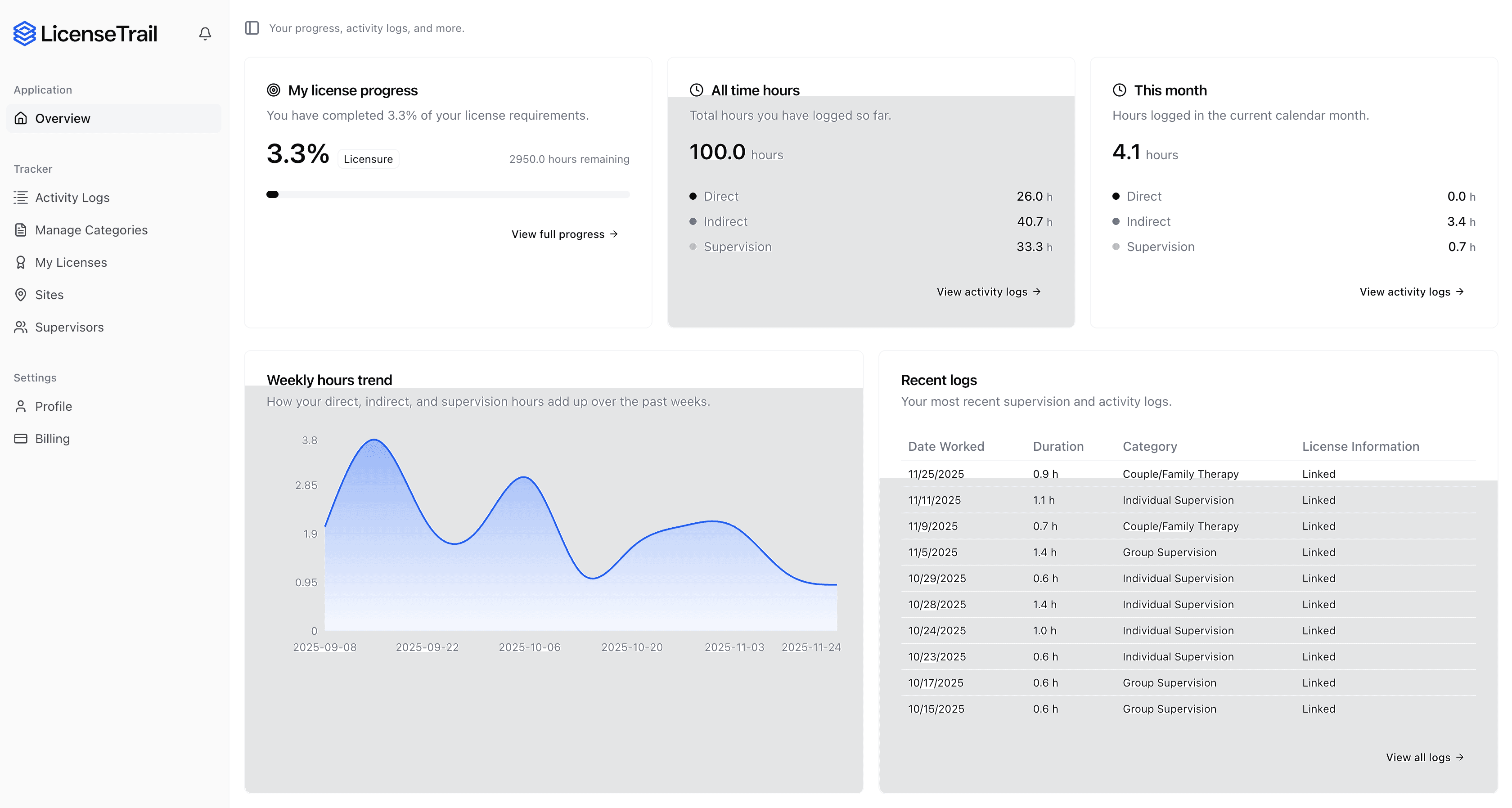
License Trail checks your direct, indirect, and supervision hours against Texas LCSW requirements continuously and flags mismatches before you submit.
 Start Tracking for Free
No credit card required · Free plan available
Is your spreadsheet hiding Texas LCSW risks?
Stop guessing if your categories match Texas State Board of Social Worker Examiners requirements. License Trail checks your direct, indirect, and supervision hours continuously and flags mismatches before you submit.
Import or log
Bring your spreadsheet or start fresh
Upload your existing tracking spreadsheet and we'll map every hour into the right Texas State Board of Social Worker Examiners categories automatically.
Verify against Texas
Catch mismatches before the board does
License Trail checks your direct, indirect, and supervision hours against Texas LCSW requirements continuously.
Export board-ready
One-click clean reports
Generate professional, board-ready reports for supervision meetings and Texas State Board of Social Worker Examiners submissions in seconds.
No credit card required · Free plan available