
Texas LMFT Associate Requirements: Hours, Exams & Step-by-Step Guide
Stop guessing if your categories match Texas requirements. License Trail checks your direct, indirect, and supervision hours against LMFT Associate requirements continuously and flags mismatches before you submit.
No credit card required · Free plan available
Quick Requirements Overview
- Hold a qualifying master’s/doctorate in MFT or a substantially equivalent related field (regionally accredited/council-approved)
- Complete graduate internship/practicum: 150 direct client hours, incl. 75 with couples/families
- Pass AMFTRB national MFT exam (or California MFT exam) before/with LMFT Associate application
- Apply for LMFT Associate with required materials incl. Supervisory Agreement Form (LMFT‑Supervisor lined up) and education verification/equivalency if needed
- Post‑grad experience for full LMFT: minimum 2 years + 3,000 hours supervised clinical practice
- Within 3,000 hours: ≥1,500 direct clinical service hours; ≥500 must be with couples/families; ≤750 direct hours may be telehealth/technology-assisted
- Supervision: 200 hours by LMFT‑S (at least 100 individual); when providing services, ≥1 hour supervision per week (unless good cause)
- Possible credit (if degree program began before 9/1/2025): excess internship hours toward 3,000 (COAMFTE: up to 500; non-COAMFTE: up to 400) and up to 100 internship supervision hours toward the 200 supervision requirement
License Details
Procedures
In Texas, “Licensed Marriage and Family Therapist Associate” (LMFT Associate) is the temporary, post‑graduate license you hold while completing supervised clinical experience toward full LMFT licensure. The requirements are defined in statute (Texas Occupations Code, Chapter 502) and in the Texas Administrative Code (Title 22, Part 35), overseen by the Texas Behavioral Health Executive Council and the Texas State Board of Examiners of Marriage and Family Therapists.
Below is a structured guide based directly on the current Texas Administrative Code and recent adopted rules as of mid‑2025.
1. Terminology Texas Uses
The board uses very specific language:
- The appropriate council‑approved titles are “Licensed Marriage and Family Therapist Associate” or “LMFT Associate.” Other terms such as “LMFT‑A” are not council‑approved. (txrules.elaws.us)
- “LMFT Associate” is the title for a person who has completed the graduate degree and passed the exam but is still completing supervised clinical experience toward the full LMFT license.
2. Big‑Picture Path: From Graduate to Full LMFT
At a high level, Texas expects you to:
- Complete a qualifying graduate degree and internship/practicum.
- Meet academic content and internship hour requirements.
- Pass the national (or California) MFT licensure exam.
- Apply for and receive the LMFT Associate license.
- Under the LMFT Associate license, complete:
- At least two years of supervised work experience, including
- 3,000 hours of supervised clinical practice, with detailed sub‑requirements, and
- 200 hours of supervision by an LMFT‑Supervisor (LMFT‑S).
- Then apply for upgrade to full LMFT licensure.
The sections below focus especially on the LMFT Associate and the supervised experience requirements, with the exact types and breakdown of hours.
3. Academic and Internship Requirements for an LMFT Associate
3.1. Degree requirements
To qualify for LMFT Associate, you must meet the education requirements in §801.113 and §801.114 of the Texas Administrative Code: (txrules.elaws.us)
- A master’s or doctorate degree in:
- Marriage and family therapy, or
- A related mental health field with coursework and training that the council finds “substantially equivalent” to a graduate degree in MFT, from a regionally accredited institution or one otherwise approved by the council.
3.2. Graduate internship/practicum
For the graduate internship that is part of the degree program, Texas requires a minimum level of clinical exposure (summarizing from §801.114):
- The marriage and family therapy graduate internship must include at least:
- 150 hours of direct client contact, and
- Of those 150 hours, at least 75 hours must be direct client contact with couples and families. (txrules.elaws.us)
These internship hours are pre‑licensure and are separate from the post‑graduate 3,000 hours of supervised clinical practice you must complete as an LMFT Associate (though, as explained below, some “excess” internship hours can be applied toward the 3,000).
4. Applying for the LMFT Associate License
The application for LMFT Associate is governed by §801.75 – Application for Licensed Marriage and Family Therapist Associate (LMFT Associate). (txrules.elaws.us)
4.1. Basic qualifications
- Qualifications:
An applicant for LMFT Associate “must meet the qualifications required by §502.252(b) of the Act.” (txrules.elaws.us)
(This statute covers basic eligibility such as degree completion and good moral character.)
4.2. Application packet contents
According to §801.75(b), an LMFT Associate applicant must submit: (txrules.elaws.us)
- General application materials required under the council’s general rules:
- All requirements in 22 TAC §§882.1 and 882.2 (Application Process and General Application File Requirements).
- A Supervisory Agreement Form.
- You must already have an LMFT‑Supervisor (LMFT‑S) lined up and documented when you apply.
- Proof of a passing score on a licensure examination.
- The “licensure examination” is defined (in §801.2) as the national licensure examination administered by AMFTRB or the State of California MFT licensure examination. (txrules.elaws.us)
4.3. Academic verification
- Under §801.75(c), you must meet the education requirements in §801.112 (General Academic Requirements). Staff may require you to submit a council‑approved educational equivalency form if your degree is in a related field or from a less typical program. (txrules.elaws.us)
5. Post‑Graduate Supervised Experience as an LMFT Associate
The most detailed requirements are in §801.142 – Supervised Clinical Experience Requirements and Conditions, as updated through June 27, 2025 (and in corresponding adopted rules). (txrules.elaws.us)
5.1. Required time frame
- Texas requires that the LMFT Associate complete “a minimum of two years of work experience in marriage and family therapy.” (regulations.justia.com)
This is a time‑based requirement in addition to the hour‑based requirements.
5.2. Total supervised clinical experience hours
The rule states that this work experience:
- “includes a minimum of 3,000 hours of supervised clinical practice.” (txrules.elaws.us)
In other words:
- 3,000 hours of supervised clinical practice is the total post‑graduate experience required for full LMFT licensure, obtained while you are an LMFT Associate.
5.3. Required breakdown of the 3,000 hours
Under the current §801.142 (as adopted and reflected in state and legal summaries), the 3,000 hours must be composed as follows: (txrules.elaws.us)
-
Direct clinical services – 1,500 hours minimum
The board requires “at least 1,500 hours providing direct clinical services.” (regulations.justia.com)
Within those 1,500 direct service hours:
- No more than 750 hours may be provided via technology‑assisted services (e.g., telehealth), as approved by the supervisor. (regulations.justia.com)
- At least 500 hours must be providing direct clinical services to couples or families (i.e., relational hours). (regulations.justia.com)
Some older, non‑official summaries may still list 750 relational hours, but the current codified rule specifies “at least 500 hours” of direct services to couples or families.
-
Supervision – 200 hours total
There are actually two closely related formulations in the rules:
- The older text of §801.142 had the 200 supervision hours written as part of the 3,000‑hour formula in paragraph (1)(B). (txrules.elaws.us)
- The currently adopted language (as reflected in later rule revisions and legal compilations) separates it out and states:
“An LMFT Associate must obtain a minimum of 200 hours of supervision by an LMFT‑S during the required 3,000 hours, and at least 100 of these hours must be individual supervision.” (sos.texas.gov)
Practically, this means:
- You must receive at least 200 hours of supervision (provided by a board‑approved LMFT‑Supervisor, i.e., LMFT‑S) over the course of earning your 3,000 practice hours.
- Of those, at least 100 hours must be individual supervision (one‑on‑one).
- The remaining supervision hours may be group supervision, as long as they comply with council rules.
Regarding format of supervision:
- The rules specify that supervision may be “provided in person or by live video or, if the supervisor determines that in‑person or live video supervision is not accessible, by telephone.” (sos.texas.gov)
-
Related experience – remainder of the 3,000 hours
After counting the 1,500 direct clinical hours, the rest of the 3,000‑hour total can be made up of “related experiences.” The rule says:
- “The remaining required hours, not covered by paragraph (1) [i.e., the direct services], may come from related experiences, including workshops, public relations, writing case notes, consulting with referral sources, etc.” (txrules.elaws.us)
In other words, you will have:
- 1,500 hours minimum of direct clinical services (with sub‑requirements above).
- Up to 1,500 hours of additional related professional activities in marriage and family therapy (indirect services, documentation, administration related to clinical work, consultation, etc.), as supervised and approved.
5.4. Weekly supervision requirement
The rules also impose a minimum ongoing supervision schedule:
- “An LMFT Associate, when providing services, must receive a minimum of one hour of supervision every week, except for good cause shown.” (txrules.elaws.us)
This means:
- Any week in which you see clients as an LMFT Associate, you are expected to receive at least one hour of supervision (individual or group), unless there is a documented, acceptable reason (“good cause”) for deviation.
5.5. Settings where an LMFT Associate may practice
Under §801.142:
- “An LMFT Associate may practice marriage and family therapy in any setting under supervision, such as a private practice, public or private agencies, hospitals, etc.” (txrules.elaws.us)
The key is that you must remain under supervision by an LMFT‑S; you cannot practice independently.
5.6. Supervisory agreements and number of supervisors
The rules specify supervisory reporting:
- “Within 30 days of initiating supervision with any LMFT supervisor, an LMFT Associate must submit to the council a Supervisory Agreement Form.” (sos.texas.gov)
Earlier versions stated that this must be submitted “for each council‑approved supervisor,” and the rules historically limited associates to no more than two supervisors at a time unless the council approved otherwise. (txrules.elaws.us)
Recent amendments keep the 30‑day filing requirement and clarify the timing (“within 30 days of initiating supervision with any LMFT supervisor”).
5.7. Use of excess graduate internship hours toward the 3,000
Texas allows some “excess” graduate internship hours to be applied toward the 3,000 post‑graduate supervised hours, but with narrow caps and a program‑start‑date cutoff.
According to §801.142(4), for an LMFT applicant who began the graduate degree program used for their license application before September 1, 2025, staff may count certain internship hours that exceed the minimum required under §801.114(b)(8): (regulations.justia.com)
- If your graduate program is COAMFTE‑accredited:
- Up to 500 excess graduate internship hours may be counted toward the 3,000.
- Of those, no more than 250 hours may be direct clinical services to couples or families.
- If your program is not COAMFTE‑accredited:
- Up to 400 excess graduate internship hours may be counted toward the 3,000.
- Of those, no more than 200 hours may be direct clinical services to couples or families.
In addition, the rule provides:
- An LMFT Associate may apply up to 100 graduate internship supervision hours toward the required 200 hours of supervision. (sos.texas.gov)
This can significantly reduce the post‑graduate supervision you must complete if you had substantial supervision during an intensive graduate internship.
6. Summary of Required Hours in Texas (Verbatim‑Style, but Condensed)
Putting the core numbers together from the Texas Administrative Code and adopted rules:
-
Total supervised clinical experience:
- “a minimum of 3,000 hours of supervised clinical practice” accumulated over **“a minimum of two years of work experience in marriage and family therapy.” (regulations.justia.com)
-
Direct clinical services:
- At least 1,500 hours providing direct clinical services.
- Within those 1,500 hours:
- No more than 750 hours via technology‑assisted services (telehealth, etc.), as approved by the supervisor. (regulations.justia.com)
- At least 500 hours must be providing direct clinical services to couples or families. (regulations.justia.com)
-
Supervision hours:
- A minimum of 200 hours of supervision by an LMFT‑S during the 3,000 hours.
- Of these, at least 100 hours must be individual supervision. (sos.texas.gov)
- “An LMFT Associate, when providing services, must receive a minimum of one hour of supervision every week, except for good cause shown.” (sos.texas.gov)
-
Remaining hours:
- The balance of the 3,000 hours (after counting direct clinical hours) may come from “related experiences, including workshops, public relations, writing case notes, consulting with referral sources, etc.” (txrules.elaws.us)
This is the core “verbiage” and numerical breakdown used by the Texas State Board of Examiners of Marriage and Family Therapists and codified in the Texas Administrative Code for the LMFT Associate pathway and the post‑graduate supervised experience required for full LMFT licensure.
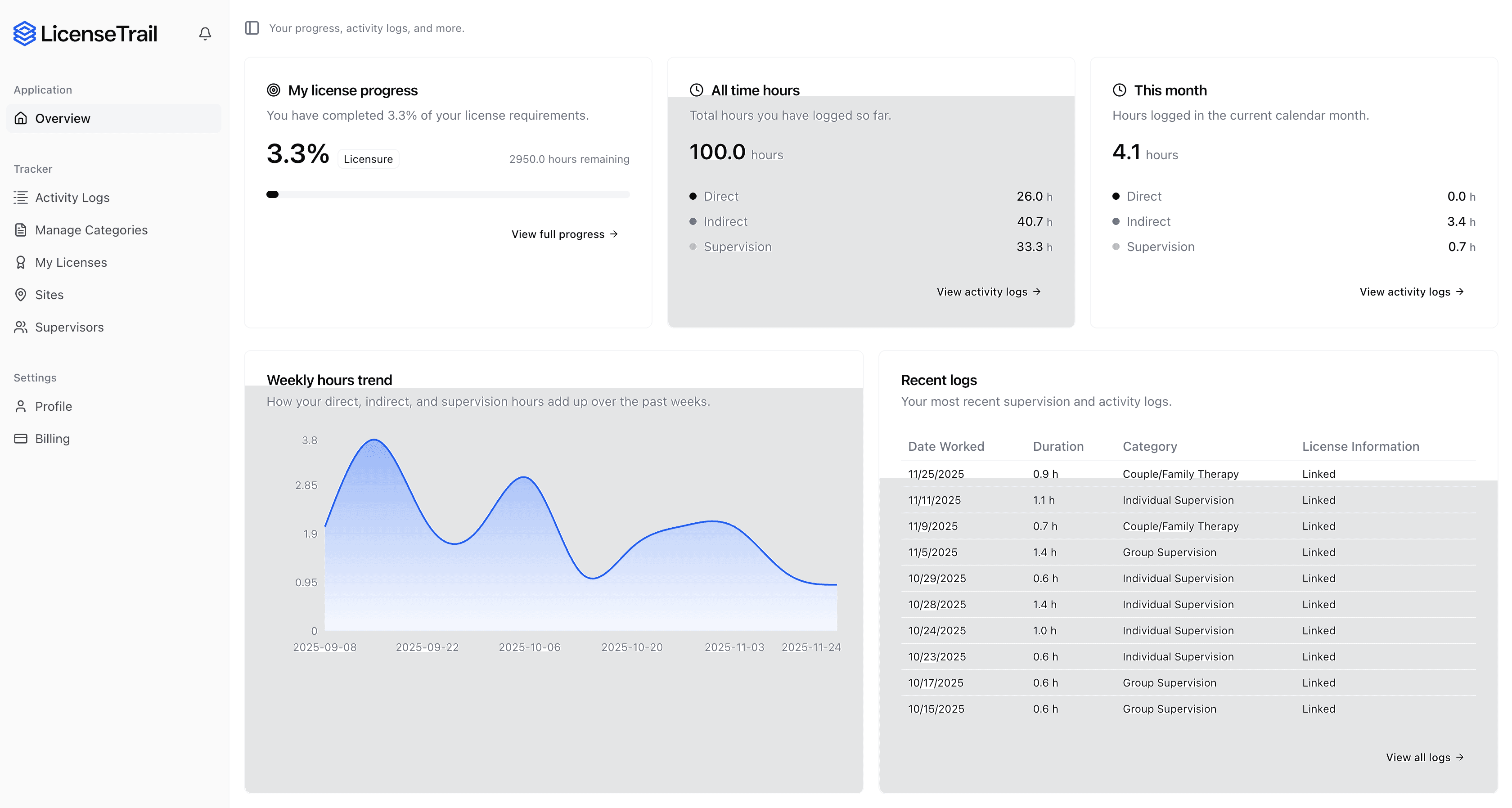
Track your LMFT Associate hours with confidence
License Trail checks your direct, indirect, and supervision hours against Texas LMFT Associate requirements continuously and flags mismatches before you submit.
 Start Tracking for Free
No credit card required · Free plan available
Related Licenses
Is your spreadsheet hiding Texas LMFT Associate risks?
Stop guessing if your categories match Texas State Board of Examiners of Marriage and Family Therapists requirements. License Trail checks your direct, indirect, and supervision hours continuously and flags mismatches before you submit.
Import or log
Bring your spreadsheet or start fresh
Upload your existing tracking spreadsheet and we'll map every hour into the right Texas State Board of Examiners of Marriage and Family Therapists categories automatically.
Verify against Texas
Catch mismatches before the board does
License Trail checks your direct, indirect, and supervision hours against Texas LMFT Associate requirements continuously.
Export board-ready
One-click clean reports
Generate professional, board-ready reports for supervision meetings and Texas State Board of Examiners of Marriage and Family Therapists submissions in seconds.
No credit card required · Free plan available